
Judge, 1938-02 · page 6 of 52
Judge — February 1938 — page 6: what you’re looking at
What you’re looking at
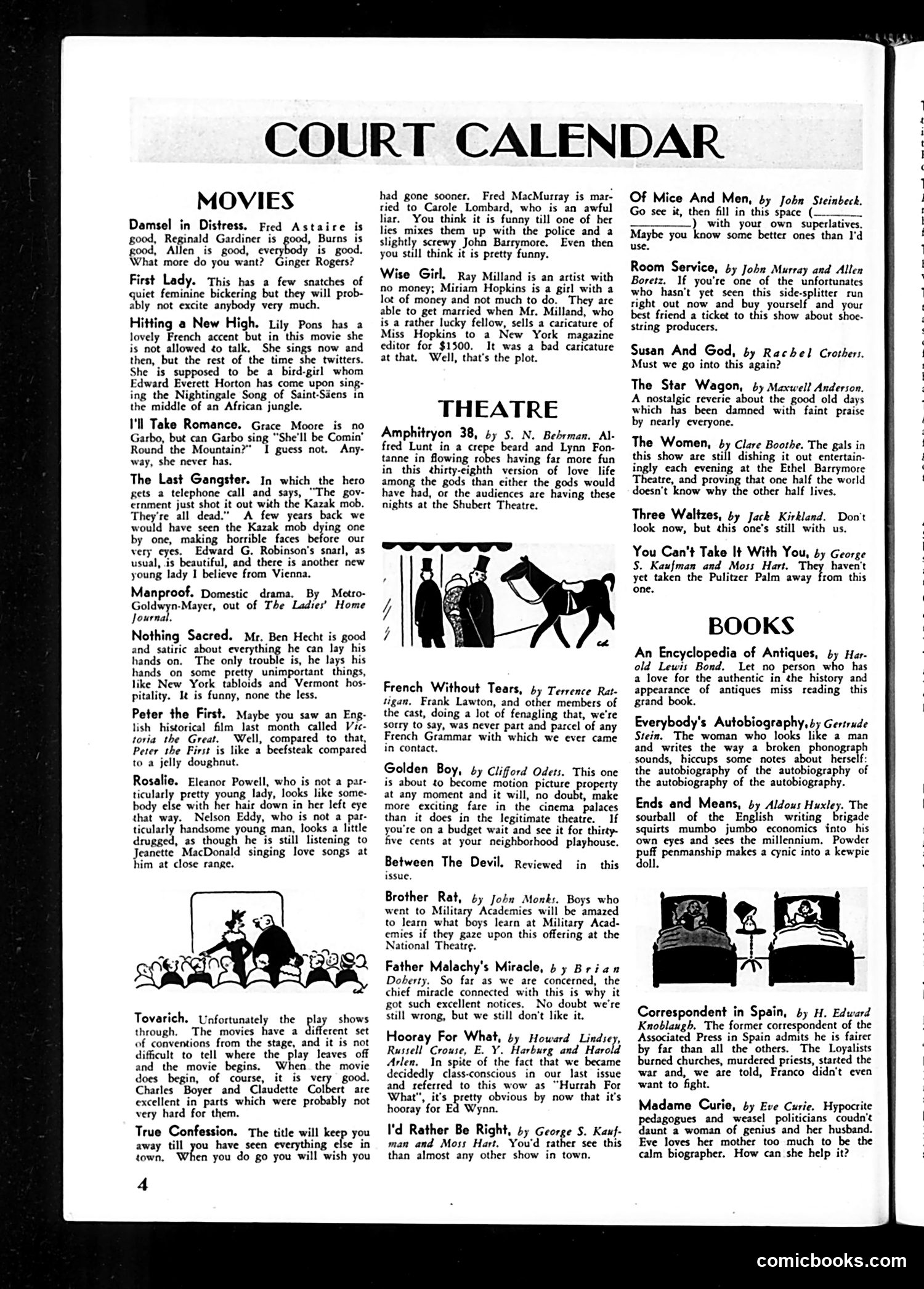
# Court Calendar Page Analysis This page from Judge magazine contains entertainment reviews (movies, theatre, books) rather than political cartoons. The only illustration is a small, stylized crowd scene at the bottom left—appears to show simplified audience silhouettes, likely generic theatrical imagery rather than political satire. The reviews themselves offer period social commentary. For example, "Ninotchka" is described as featuring a Soviet character in "bowing robes," reflecting Cold War-era attitudes toward communism. References to "Military Academies" and mentions of Spain suggest 1930s-40s historical context. This is primarily a consumer-focused entertainment guide page, not a vehicle for political satire. Any social commentary emerges incidentally through the film and theatre descriptions rather than through deliberate cartoon satire.
📄 Transcribed text from this page (OCR, searchable)
Machine-transcribed from the original scan — historical spelling and the odd misread are preserved.
COURT CALENDAR MOVIES Damsel in Distress. Fred Astaire is good, Reginald Gardiner is good, Burns is good, Allen is good, everybody is good. ‘What more do you want? Ginger Rogers? First Lady. This has a few snatches of quiet feminine bickering but they will prob- ably not excite anybody very much. Hitting a New High. Lily Pons has a lovely French accent but in this movie she is not allowed ¢o talk. She sings now and then, but the rest of the time she twitters. She is supposed to be a bird-girl whom Edward Everett Horton has come upon sing- ing the Nightingale Song of Saint-Siens in the middle of an African jungle. I'll Take Romance. Grace Moore is no Garbo, but can Garbo sing “She'll be Comin’ Round the Mountain?” 1 guess not. Any- way, she never has, The Last Gangster. In which the hero gets a telephone call and says, “The gov- ernment just shot it out with the Kazak mob. They're all dead.” A few years back we would have seen the Kazak mob dying one by one, making horrible faces before our very eyes. Edward G. Robinson's snarl, as usual, is beautiful, and there is another new young lady I believe from Vienna. Manproof. Domestic drama. By Metro- Goldwyn-Mayer, out of The Ladies’ Home Journal. Nothing Sacred. Mr. Ben Hecht is good and satiric about everything he can lay his hands on, The only trouble is, he lays his hands on some pretty unimportant things, like New York tabloids and Vermont hos- pitality. Ie is funny, none the less. Peter the First. Maybe you saw an Eng- lish historical film last month called Vic- toria the Great. Well, compared to that, Peter the First is like a beefsteak compared to a jelly doughnut. Rosalie. Eleanor Powell, who is not a par- ticularly pretty young lady, looks like some- body clset with her hair down in her left eye that way. Nelson Eddy, who is not a par- ticularly handsome young man, looks a little drugged, as though he is still listening to Jeanette MacDonald singing love songs at him at close range. Tovarich. Unfortunately the play shows through. The movies have a different set of conventions from the stage, and it is not difficult to tell where the play leaves off and the movie begins. When the movie does begin, of course, it is very good. Charles Boyer and Claudette Colbert are excellent in parts which were probably not very hard for them. True Confession. The title will keep you away till you have seen everything else in town. When you do go you will wish you 4 had gone sooner. Fred MacMurray is mar- ried to Carole Lombard, who is an awful liar. You think it is funny till one of her lies mixes them up with the police and a slightly screwy John Barrymore. Even then you still think it is pretty funny. Wise Girl. Ray Milland is an artist with no money; Miriam Hopkins is a girl with a lot of money and not much to do. They are able to get married when Mr. Milland, who is a rather lucky fellow, sells a caricature of Miss Hopkins to a New York magazine editor for $1500. It was a bad caricature at that. Well, that's the plot. THEATRE Amphitryon 38, by 5. N. Bebrman. Al- fred Lunt in a crepe beard and Lynn Fon- tanne in flowing robes having far more fun in this ¢hirty-eighth version of love life among the gods than either the gods would have had, or the audiences are having these nights at the Shubert Theatre. it, Be French Without Tears, by Terrence Rat- tigan. Frank Lawton, and other members of the cast, doing a lot of fenagling that, we're sorry to say, was never part and parcel of any French Grammar with which we ever came in contact. Golden Boy, by Clifford Odets. This one is about to become motion picture property at any moment and it will, no doubt, make more exciting fare in the cinema palaces than it does in the legitimate theatre. If you're on a budget wait and see it for thirty- five cents at your neighborhood playhouse. Between The Devil. Reviewed in this issue. Brother Rat, by John Monks. Boys who went to Military Academies will be amazed to learn what boys learn at Military Acad- emies if they gaze upon this offering at the National Theatre. Father Malachy's Miracle, 4» Brian Doberty, So far as we are concerned, the chief miracle connected with this is why it got such excellent notices. No doubt we're still wrong, but we still don’t like it. Hooray For What, ty Howard Lindsey, Russell Crouse, E. Y. Harburg and Harold Arlen. In spite of the fact that we became decidedly class-conscious in our last issue and referred to this wow as “Hurrah For What", it’s pretty obvious by now that it's hooray for Ed Wynn. I'd Rather Be Right, by George S. Kauf- man and Moss Hart. You'd rather see this than almost any other show in town. Of Mice And Men, by Jobn Steinbeck. Go see it, then fill in this space ( Maybe you use, with your own superlatives. w some better ones than I'd Room Service, by John Murray and Allen Boretz. If you're one of the unfortunates who hasn't yet seen this side-splitter run right out now and buy yourself and your best friend a ticket to this show about shoe- string producers, Susan And God, by Rachel Crothers. Must we go into this again? The Star Wagon, by Maxwell Anderson. A nostalgic reverie about the good old days which has been damned with faint praise by nearly everyone. The Women, by Clare Boothe. The gals in this show are still dishing it out entertain- ingly each evening at the Ethel Barrymore Theatre, and proving that one half the world doesn't know why the other half lives. Three Waltzes, by Jack Kirkland. Don't look now, but this one’s still with us, You Can't Take It With You, by George S. Kaufman and Moss Hart. aber haven't yet taken the Pulitzer Palm away from this one. BOOKS An Encyclopedia of Antiques, 4; Har- old Lewis Bond. Let no person who has a love for the authentic in the history and appearance of antiques miss reading this grand Everybody's Autobiography, sy Gertrude Stein. The woman who looks like a man and writes the way a broken Phonograph sounds, hiccups some notes about herself: the autobiography of the autobiography of the autobiography of the autobiography. Ends and Means, by Aldous Huxley. The sourball of the English writing brigade squirts mumbo jumbo economics into his own eyes and sees the millennium, Powder putt penmanship makes a cynic into a kewpie H. Correspondent in Spain, by H. Edward Knoblaugh. The former correspondent of the Associated Press in Spain admits he is fairer by far than all the others. The Loyalists burned churches, murdered priests, started the war and, we are told, Franco didn't even want to fight. Madame Curie, by Eve Curie. Hypocrite pedagogues and weasel politicians coudn't daunt a woman of genius and her husband. Eve loves her mother too much to be the calm biographer. How can she help it? comicbooks.com