
Judge, 1938-02 · page 28 of 52
Judge — February 1938 — page 28: what you’re looking at
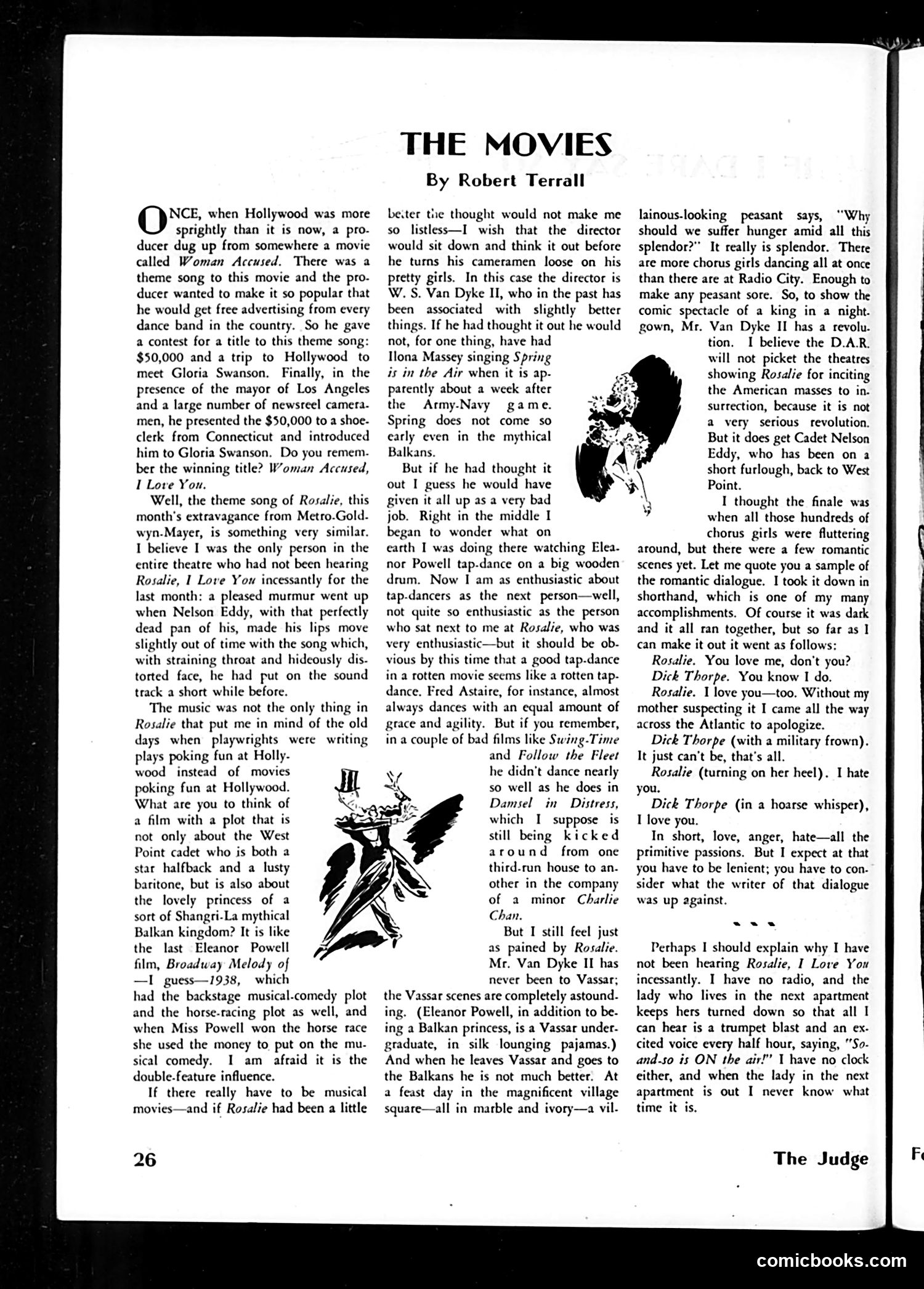
A restored page from Judge, 1938-02. Page through the whole issue in the reader above.
📄 Transcribed text from this page (OCR, searchable)
Machine-transcribed from the original scan — historical spelling and the odd misread are preserved.
NCE, when Hollywood was more sprightly than it is now, a pro- ducer dug up from somewhere a movie called Woman Accused. There was a theme song to this movie and the pro- ducer wanted to make it so popular that he would get free advertising from every dance band in the country. So he gave a contest for a title to this theme song: $50,000 and a trip to Hollywood to meet Gloria Swanson. Finally, in the presence of the mayor of Los Angeles and a large number of newsreel camera- men, he presented the $50,000 to a shoe- clerk from Connecticut and introduced him to Gloria Swanson. Do you remem. ber the winning title? Woman Accused, I Lore You. Well, the theme song of Rosalie, this month's extravagance from Metro.Gold- wyn-Mayer, is something very similar. I believe I was the only person in the entire theatre who had not been hearing Rosalie, | Love You incessantly for the last month: a pleased murmur went up when Nelson Eddy, with that perfectly dead pan of his, made his lips move slightly out of time with the song which, with straining throat and hideously dis- torted face, he had put on the sound track a short while before. The music was not the only thing in Rosalie that put me in mind of the old days when playwrights were writing plays poking fun at Holly- wood instead of movies poking fun at Hollywood. What are you to think of a film with a plot that is not only about the West Point cadet who is both a star halfback and a lusty baritone, but is also about the lovely princess of a sort of Shangri-La mythical Balkan kingdom? It is like the last Eleanor Powell film, Broadway Melody of —I guess—1938, which had the backstage musical.comedy plot and the horse-racing plot as well, and when Miss Powell won the horse race she used the money to put on the mu- sical comedy. I am afraid it is the double-feature influence. If there really have to be musical movies—and if Rosalie had been a little 26 THE MOVIES By Robert Terrall be.ter the thought would not make me so listless—I wish that the director would sit down and think it out before he turns his cameramen loose on his pretty girls. In this case the director is W. S. Van Dyke II, who in the past has been associated with slightly better things. If he had thought it out he would not, for one thing, have had Ilona Massey singing Spring is in the Air when it is ap- parently about a week after the Army-Navy game. Spring does not come so early even in the mythical Balkans. But if he had thought it out I guess he would have given it all up as a very bad job. Right in the middle I began to wonder what on earth I was doing there watching Elea- nor Powell tap-dance on a big wooden drum. Now I am as enthusiastic about tap-dancers as the next person—well, not quite so enthusiastic as the person who sat next to me at Rosalie, who was very enthusiastic—but it should be ob- vious by this time that a good tap.dance in a rotten movie seems like a rotten tap- dance. Fred Astaire, for instance, almost always dances with an equal amount of grace and agility. But if you remember, in a couple of bad films like Swing-Time and Follow the Fleet he didn’t dance nearly so well as he does in Damsel in Distress, which I suppose is still being kicked around from one third-run house to an. other in the company of a minor Charlie Chan. But I still feel just as pained by Rosalie. Mr. Van Dyke II has never been to Vassar; the Vassar scenes are completely astound- ing. (Eleanor Powell, in addition to be- ing a Balkan princess, is a Vassar under- graduate, in silk lounging pajamas.) And when he leaves Vassar and goes to the Balkans he is not much better. At a feast day in the magnificent village square—all in marble and ivory—a vil- lainous-looking peasant says, “Why should we suffer hunger amid all this splendor?” It really is splendor. There are more chorus girls dancing all at once than there are at Radio City. Enough to make any peasant sore. So, to show the comic spectacle of a king in a night. gown, Mr. Van Dyke II has a revolu. tion. I believe the D.A.R. will not picket the theatres showing Rosalie for inciting the American masses to in. surrection, because it is not a very serious revolution. But it does get Cadet Nelson Eddy, who has been on a short furlough, back to West Point. I thought the finale was when all those hundreds of chorus girls were fluttering around, but there were a few romantic scenes yet. Let me quote you a sample of the romantic dialogue. I took it down in shorthand, which is one of my many accomplishments. Of course it was dark and it all ran together, but so far as I can make it out it went as follows: Rosalie. You love me, don’t you? Dick Thorpe. You know I do. Rosalie. 1 love you—too. Without my mother suspecting it I came all the way across the Atlantic to apologize. Dick Thorpe (with a military frown). It just can’t be, that’s all. Rosalie (turning on her heel). I hate you. Dick Thorpe (in a hoarse whisper), I love you. In short, love, anger, hate—all the primitive passions. But I expect at that you have to be lenient; you have to con- sider what the writer of that dialogue was up against. see Perhaps I should explain why I have not been hearing Rosalie, I Love You incessantly. I have no radio, and the lady who lives in the next apartment keeps hers turned down so that all I can hear is a trumpet blast and an ex- cited voice every half hour, saying, "So- and-so is ON the air!” 1 have no clock either, and when the lady in the next apartment is out I never know what time it is. The Judge comicbooks.com Fe