
Judge, 1938-02 · page 19 of 52
Judge — February 1938 — page 19: what you’re looking at
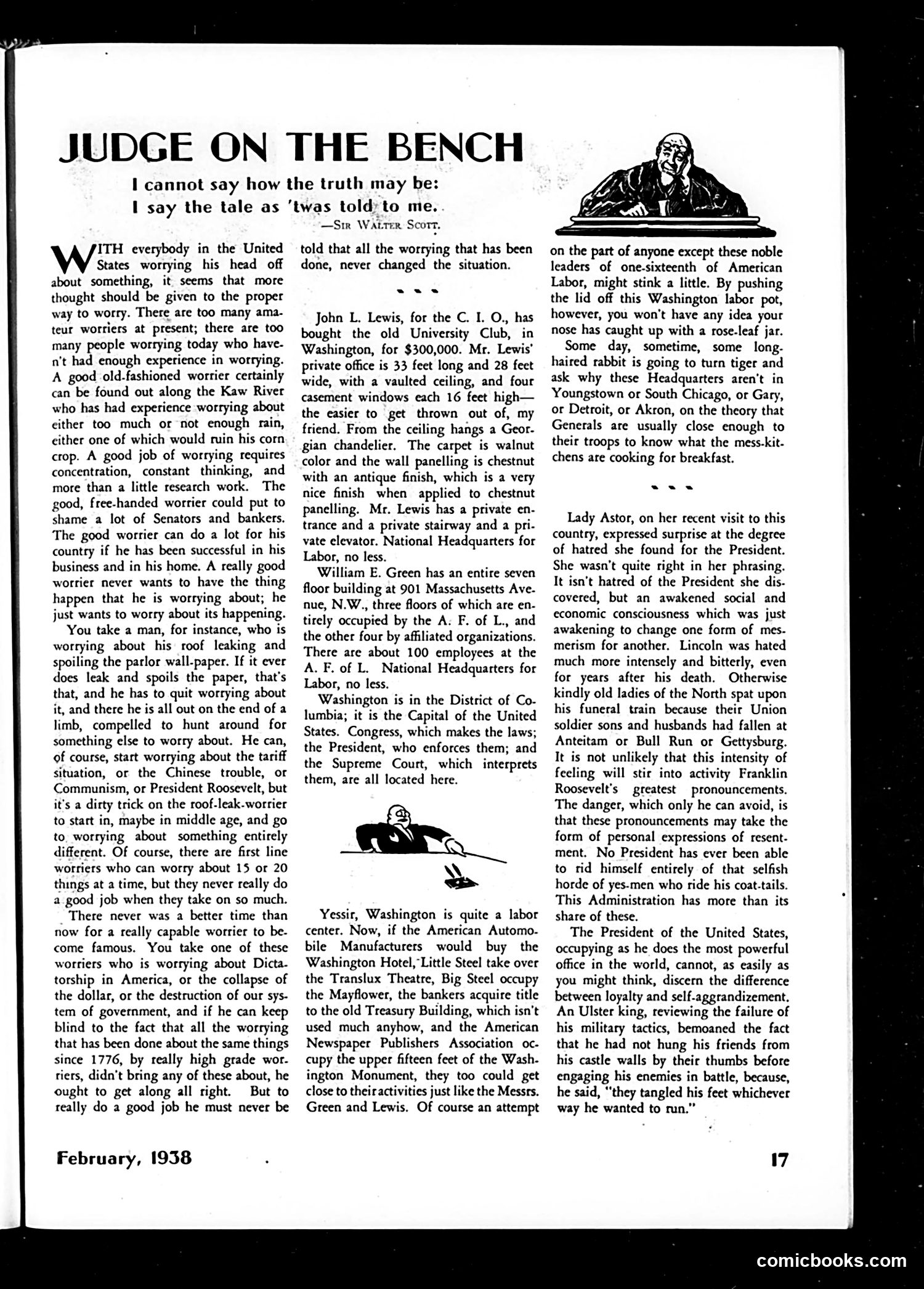
A restored page from Judge, 1938-02. Page through the whole issue in the reader above.
📄 Transcribed text from this page (OCR, searchable)
Machine-transcribed from the original scan — historical spelling and the odd misread are preserved.
JUDGE ON THE BENCH I cannot say how the truth may be: I say the tale as ITH everybody in the United States worrying his head off about something, it seems that more thought should be given to the proper way to worry. There are too many ama- teur worriers at present; there are too many people worrying today who have- n't had enough experience in worrying. A good old-fashioned worrier certainly can be found out along the Kaw River who has had experience worrying about either too much or not enough rain, either one of which would ruin his corn crop. A good job of worrying requires concentration, constant thinking, and more than a little research work. The good, free-handed worrier could put to shame a lot of Senators and bankers. The good worrier can do a lot for his country if he has been successful in his business and in his home. A really good worrier never wants to have the thing happen that he is worrying about; he just wants to worry about its happening. You take a man, for instance, who is worrying about his roof leaking and spoiling the parlor wall-paper. If it ever does leak and spoils the paper, that's that, and he has to quit worrying about it, and there he is all out on the end of a limb, compelled to hunt around for something else to worry about. He can, of course, start worrying about the tariff situation, or the Chinese trouble, or Communism, or President Roosevelt, but it's a dirty trick on the roof-leak-worrier to start in, maybe in middle age, and go to. worrying about something entirely different. Of course, there are first line worriers who can worry about 15 or 20 things at a time, but they never really do a_good job when they take on so much. There never was a better time than now for a really capable worrier to be- come famous. You take one of these worriers who is worrying about Dicta- torship in America, or the collapse of the dollar, or the destruction of our sys- tem of government, and if he can keep blind to the fact that all the worrying that has been done about the same things since 1776, by really high grade wor- riers, didn’t bring any of these about, he ought to get along all right. But to really do a good job he must never be February, 1938 ‘twas toldyto me. —Sir Watter Scorr. told that all the worrying that has been done, never changed the situation. see John L. Lewis, for the C. I. O., has bought the old University Club, in Washington, for $300,000. Mr. Lewis’ private office is 33 feet long and 28 feet wide, with a vaulted ceiling, and four casement windows each 16 feet high— the easier to get thrown out of, my friend. From the ceiling hangs a Geor- gian chandelier. The carpet is walnut color and the wall panelling is chestnut with an antique finish, which is a very nice finish when applied to chestnut panelling. Mr. Lewis has a private en- trance and a private stairway and a pri- vate elevator. National Headquarters for Labor, no less. William E. Green has an entire seven floor building at 901 Massachusetts Ave- nue, N.W., three floors of which are en- tirely occupied by the A; F. of L., and the other four by affiliated organizations. There are about 100 employees at the A. F. of L. National Headquarters for Labor, no less. Washington is in the District of Co- lumbia; it is the Capital of the United States. Congress, which makes the laws; the President, who enforces them; and the Supreme Court, which interprets them, are all located here. > Yessir, Washington is quite a labor center. Now, if the American Automo- bile Manufacturers would buy the Washington Hotel, Little Steel take over the Translux Theatre, Big Steel occupy the Mayflower, the bankers acquire title to the old Treasury Building, which isn’t used much anyhow, and the American Newspaper Publishers Association oc- cupy the upper fifteen feet of the Wash. ington Monument, they too could get close to theiractivities just like the Messrs. Green and Lewis. Of course an attempt on the part of anyone except these noble leaders of one-sixteenth of American Labor, might stink a little. By pushing the lid off this Washington labor pot, however, you won't have any idea your nose has caught up with a rose-leaf jar. Some day, sometime, some long- haired rabbit is going to turn tiger and ask why these Headquarters aren't in Youngstown or South Chicago, or Gary, or Detroit, or Akron, on the theory that Generals are usually close enough to their troops to know what the mess-kit- chens are cooking for breakfast. Lady Astor, on her recent visit to this country, expressed surprise at the degree of hatred she found for the President. She wasn’t quite right in her phrasing. It isn't hatred of the President she dis- covered, but an awakened social and economic consciousness which was just awakening to change one form of mes- merism for another. Lincoln was hated much more intensely and bitterly, even for years after his death. Otherwise kindly old ladies of the North spat upon his funeral train because their Union soldier sons and husbands had fallen at Anteitam or Bull Run or Gettysburg. It is not unlikely that this intensity of feeling will stir into activity Franklin Roosevelt's greatest pronouncements. The danger, which only he can avoid, is that these pronouncements may take the form of personal expressions of resent- ment. No President has ever been able to rid himself entirely of that selfish horde of yes-men who ride his coat.-tails. This Administration has more than its share of these. The President of the United States, occupying as he does the most powerful office in the world, cannot, as easily as you might think, discern the difference between loyalty and self-aggrandizement. An Ulster king, reviewing the failure of his military tactics, bemoaned the fact that he had not hung his friends from his castle walls by their thumbs before engaging his enemies in battle, because, he said, “they tangled his feet whichever way he wanted to mn.” 17 comicbooks.com