A complete issue · 39 pages · 1937
Judge — December 1937
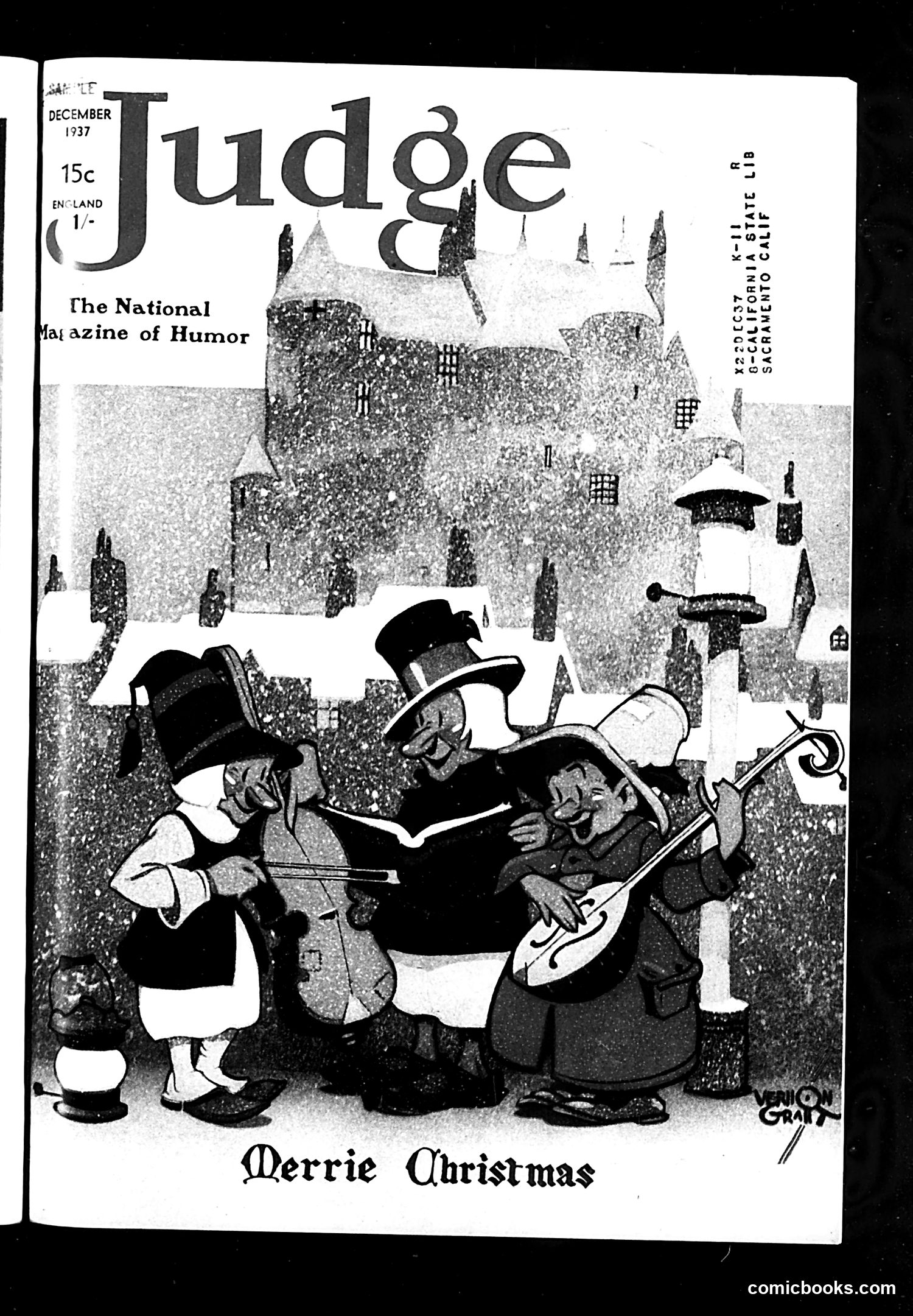
# Judge Magazine Cover, December 1937 This is a Christmas-themed cover from Judge, "The National Magazine of Humor." The illustration shows four carolers in winter dress performing music outside a Gothic castle in a snowy landscape. Three figures play instruments (violin, cello, and what appears to be a lute or similar stringed instrument) while a fourth listens or participates. The "Merrie Christmas" caption and festive caroling scene suggest straightforward holiday humor rather than political satire. The exaggerated medieval/fairy-tale castle setting and the caricatured carolers' expressions appear designed for gentle, seasonal amusement—typical of Judge's satirical but family-friendly content from this era. No specific political figures or events are clearly referenced on this cover.
# Content Analysis This page is **not a cartoon or satire**—it's a straightforward advertisement for W.M. H. Rankin Company's advertising and public relations services. The article argues that effective advertising must appeal to human nature and individuality. Rankin advocates for "contagious belief"—sincere, personality-driven marketing that builds consumer confidence. He emphasizes that good advertising should reflect the human character behind a product, and that the United States needs advertising rooted in genuine belief rather than "competitive spirit which results in undermining public confidence." The piece reads as earnest business philosophy about post-industrial American marketing strategy, with no satirical intent or political commentary. It's essentially a professional manifesto for mid-20th century advertising practice.
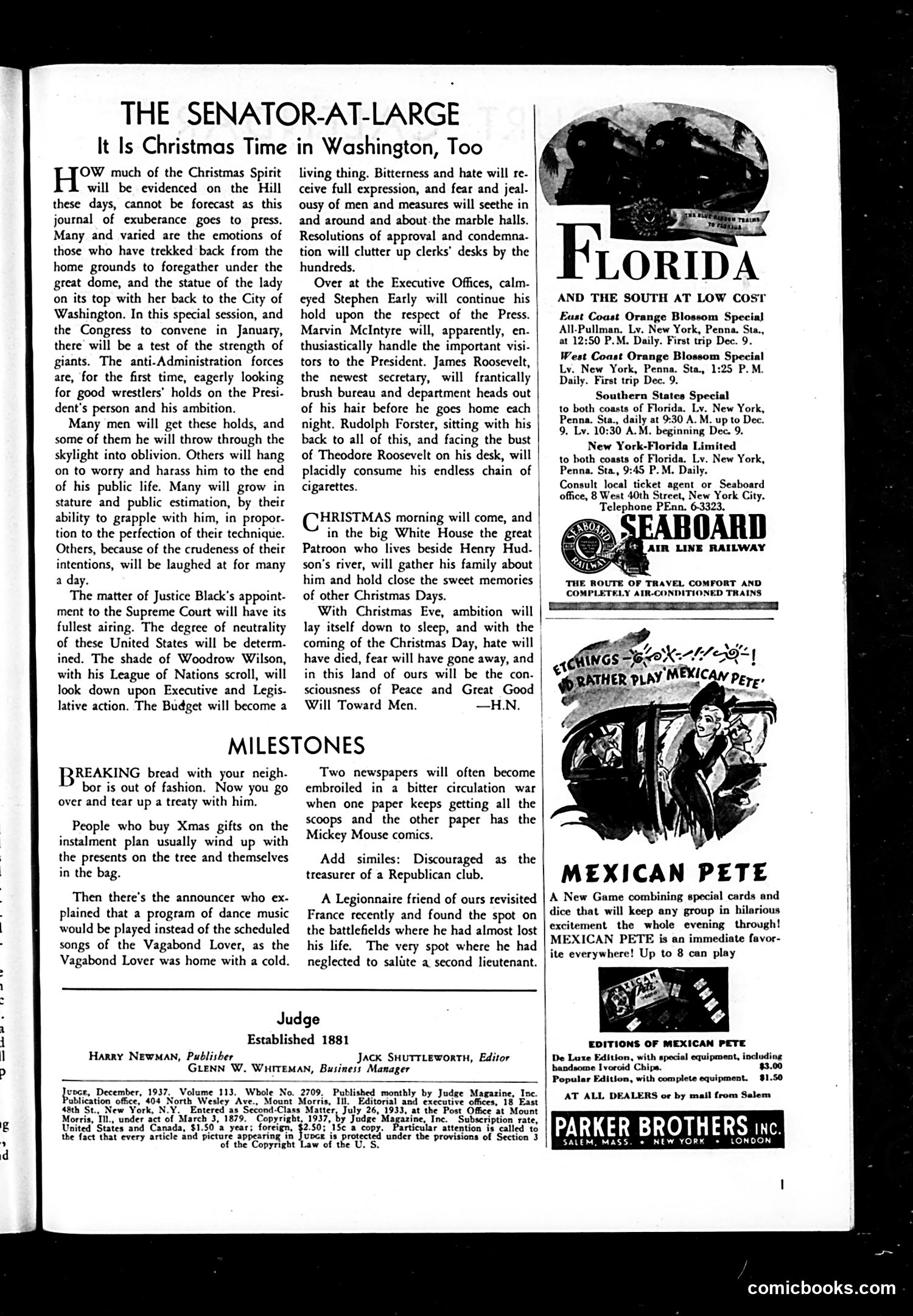
# Analysis of Judge Magazine Page This page is primarily **editorial and advertising content** rather than political cartoons. The main article, "The Senator-at-Large: It Is Christmas Time in Washington, Too," discusses Christmas spirit in Washington D.C. during what appears to be a Congressional session, mentioning the appointment of Justice Black to the Supreme Court and commentary on various government officials. The only substantive cartoon is **"Mexican Pete,"** advertised as a new game combining special cards and dice. It depicts a stereotypical Mexican character and appears to be a commercial advertisement rather than political satire. The rest of the page contains travel advertisements (Seaboard railroad, Florida tourism) and publishing information. Without a visible date, the specific political context remains unclear.
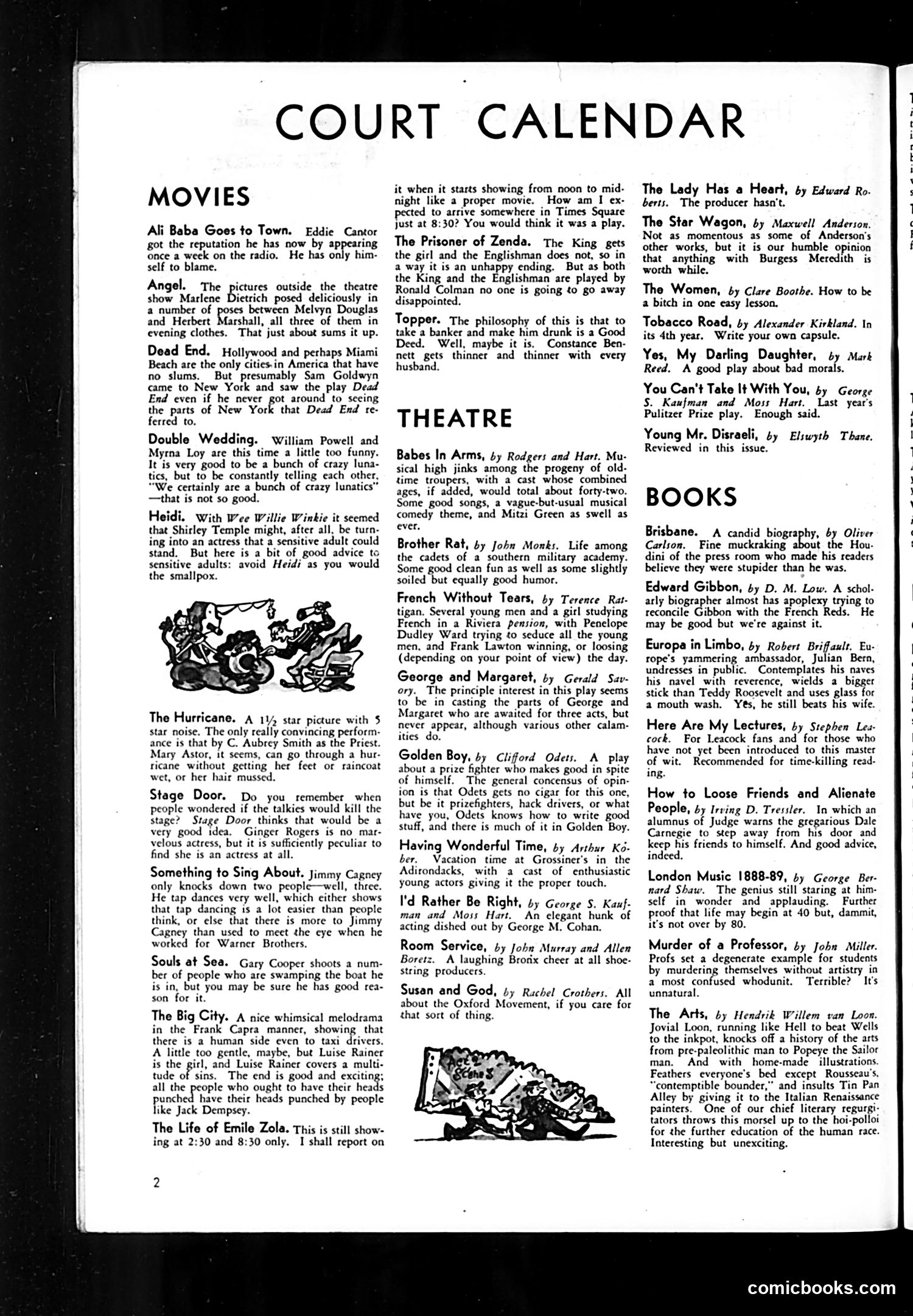
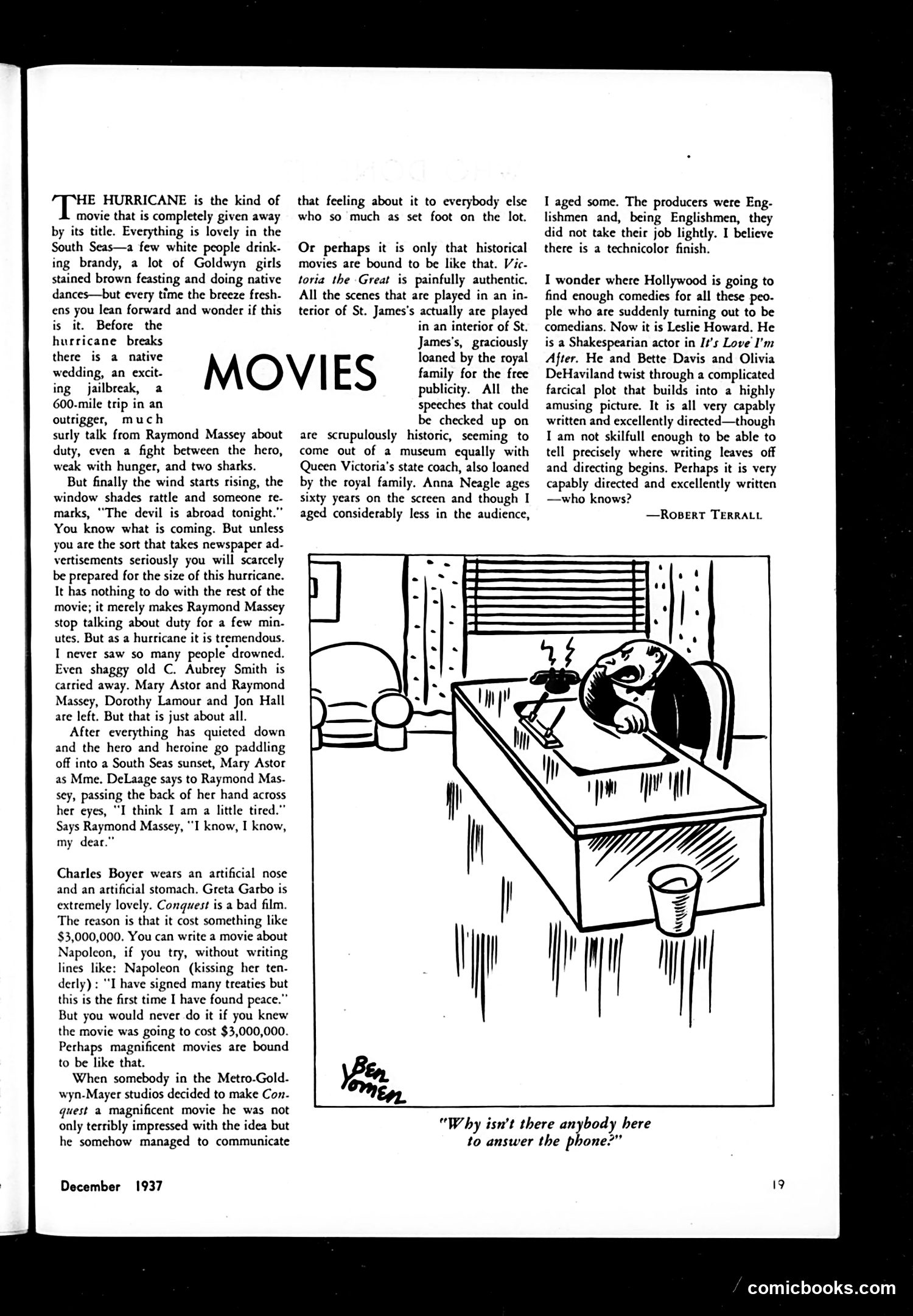
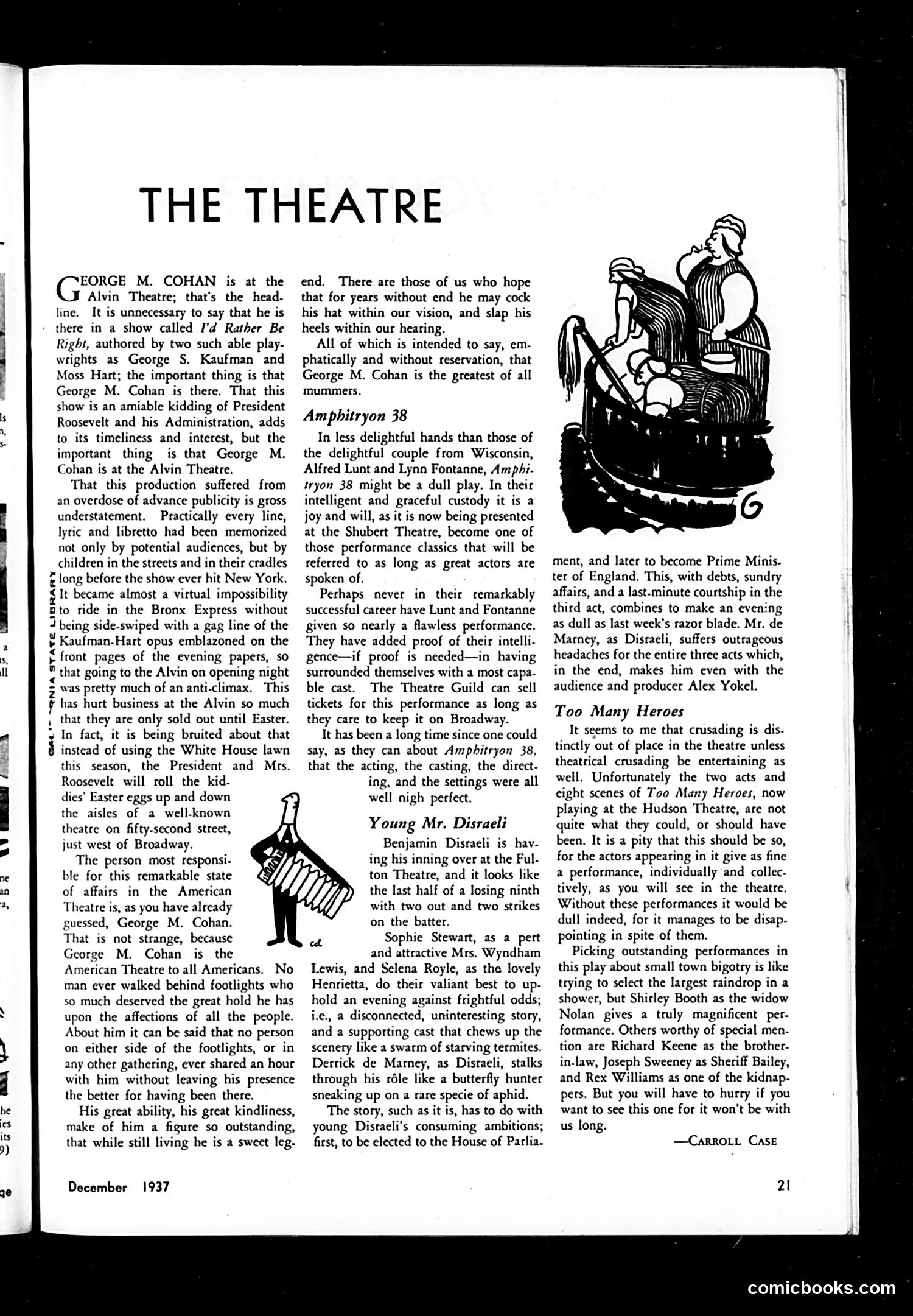
# Court Calendar Page Analysis This page is primarily a **entertainment and culture review section**, not political satire. It contains reviews of movies, theatre productions, and books, typical of Judge magazine's lighter content. The visible **cartoon illustration** at the bottom appears to show a reclining or fallen figure in a sketchy style, but without clearer context from the surrounding text, its specific meaning is unclear. The reviews themselves offer period-appropriate critiques—praising performances, commenting on plot quality, and offering reading recommendations. References to actors like Eddie Cantor and William Powell ground this in early-to-mid 20th century entertainment. This is essentially a **cultural entertainment guide** rather than political commentary, representing Judge's broader editorial range beyond satire.
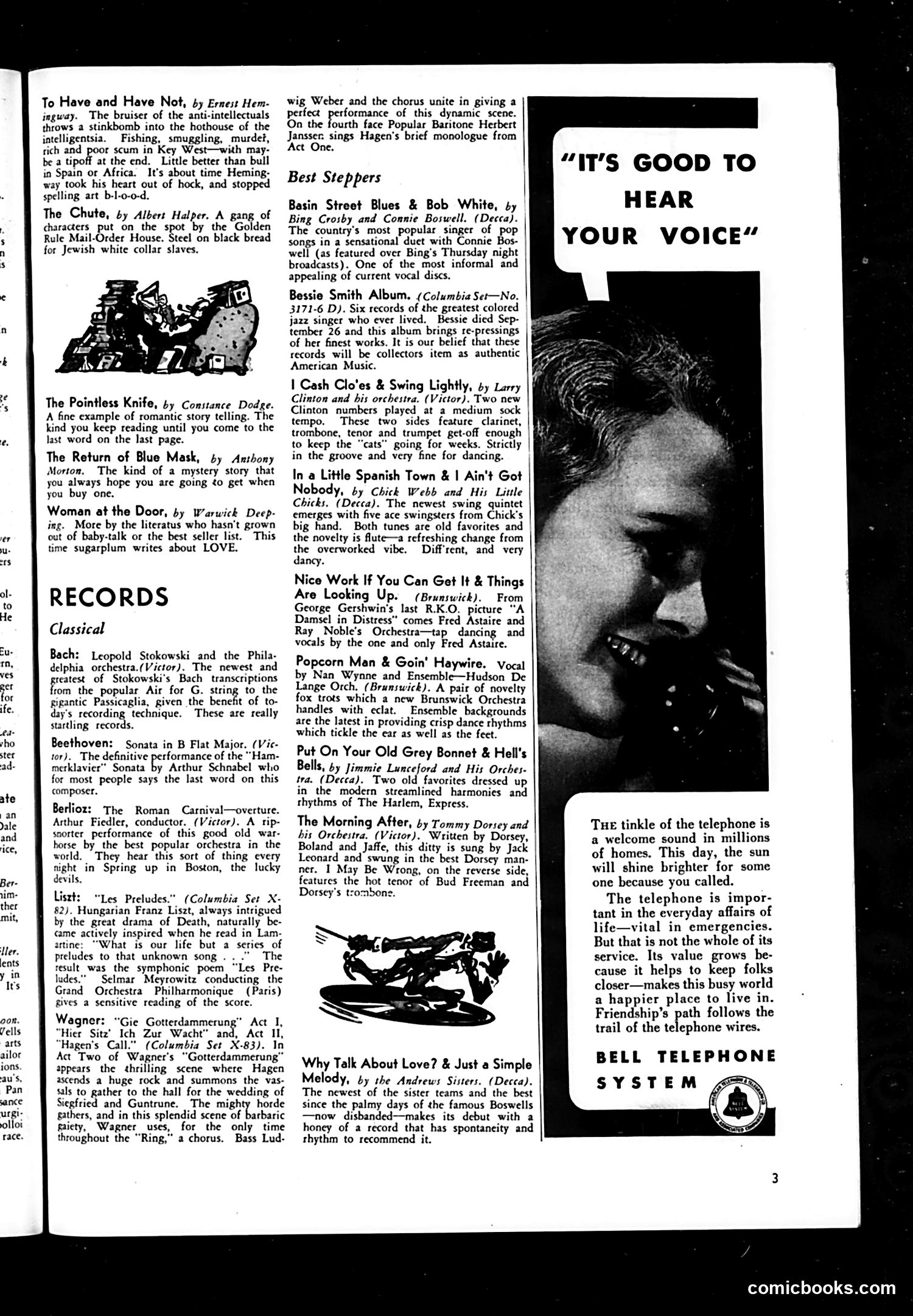
# Page Analysis This page is primarily **record reviews and advertisements** rather than political satire or cartoons. The content includes classical and popular music reviews (Bach, Beethoven, Wagner, and contemporary jazz/swing recordings). There are two small illustrations: one showing a couple dancing or embracing, and another depicting someone reclining. The largest element is a **Bell Telephone System advertisement** with the slogan "It's Good to Hear Your Voice," emphasizing the telephone's role in maintaining relationships and handling emergencies. The ad uses sentimental messaging typical of 1930s-40s corporate advertising, positioning the telephone as essential to modern life and friendship. **No political satire or recognizable caricatures are present on this page.** The content reflects Judge magazine's shift toward entertainment and advertising rather than political commentary.
# Content Analysis This page is **primarily an advertisement**, not satirical content. It's a 1937 insurance marketing piece from Union Central Life Insurance Company promoting their "Family-needs Forecast" service. The ad targets fathers by emphasizing their responsibility for their family's financial security after death. It lists "seven separate needs" a widow and children would face, positioning life insurance as the solution. The small coupon section at bottom includes company officers' names and a mail-in form. **No political cartoon or satire is present.** This is straightforward 1930s-era insurance marketing that appeals to masculine duty and family protection—typical advertising strategy from that era before modern consumer protection regulations. The "Judge" magazine apparently carried substantial paid advertising alongside its satirical content.
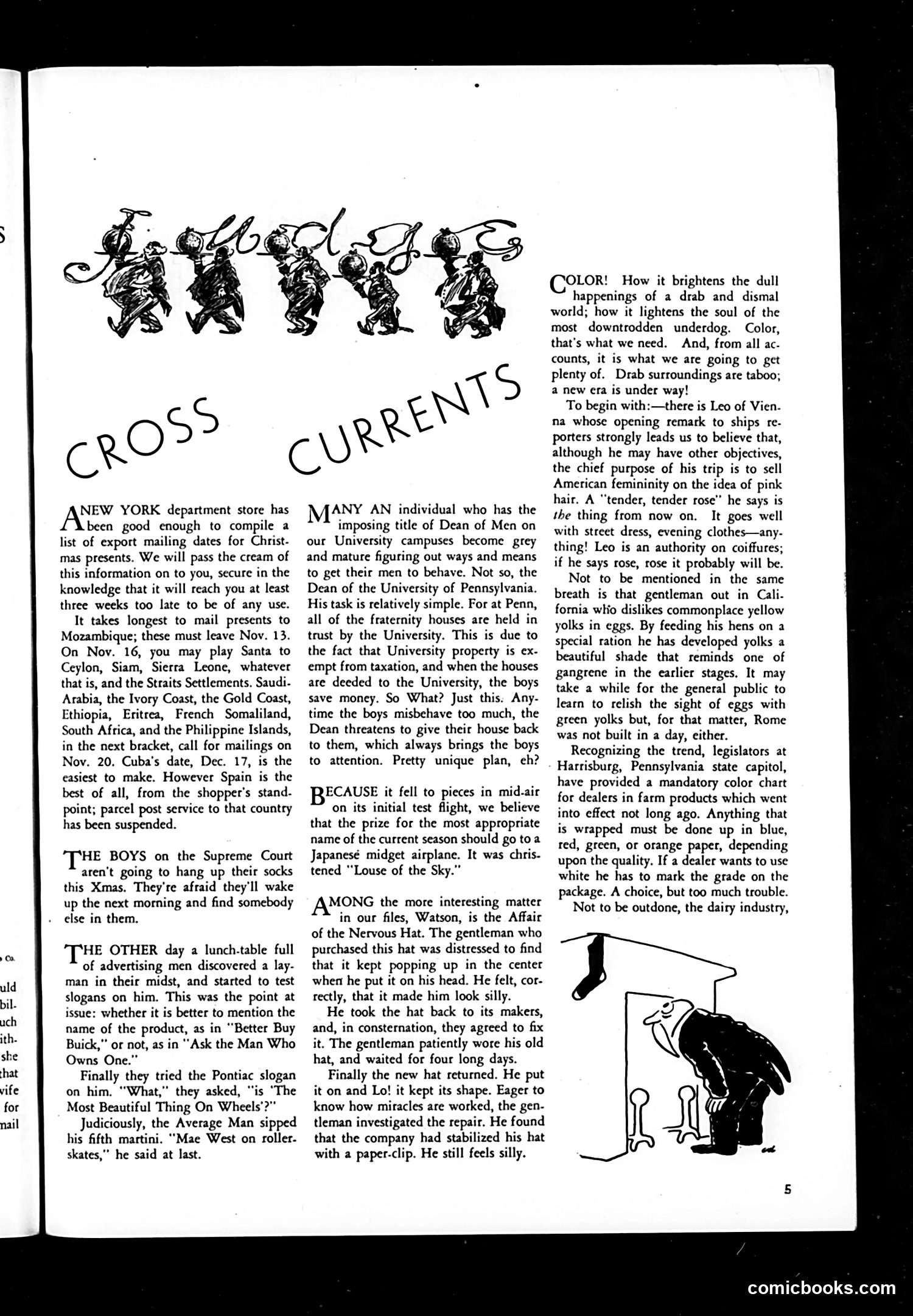
# "Cross Currents" - Judge Magazine Page This page contains three brief satirical items about American life, plus advertisements disguised as editorial content. The main humor targets include: 1. **University of Pennsylvania fraternity houses**: The Dean threatens to reclaim university-owned fraternity properties if boys misbehave—satirizing administrative control and student behavior. 2. **A "Nervous Hat" anecdote**: A gentleman's hat keeps popping up in the center when worn. The manufacturer attempts fixes but ultimately stabilizes it with a paper clip—absurdist humor about poor product design. 3. **Car slogans**: The piece mocks competing automobile advertising claims ("Better Buy Buick" vs. "Ask the Man Who Owns One" vs. "The Most Beautiful Thing On Wheels"), suggesting advertising absurdity. The cartoon at top depicts caricatured figures, though their specific identities are unclear from context alone.
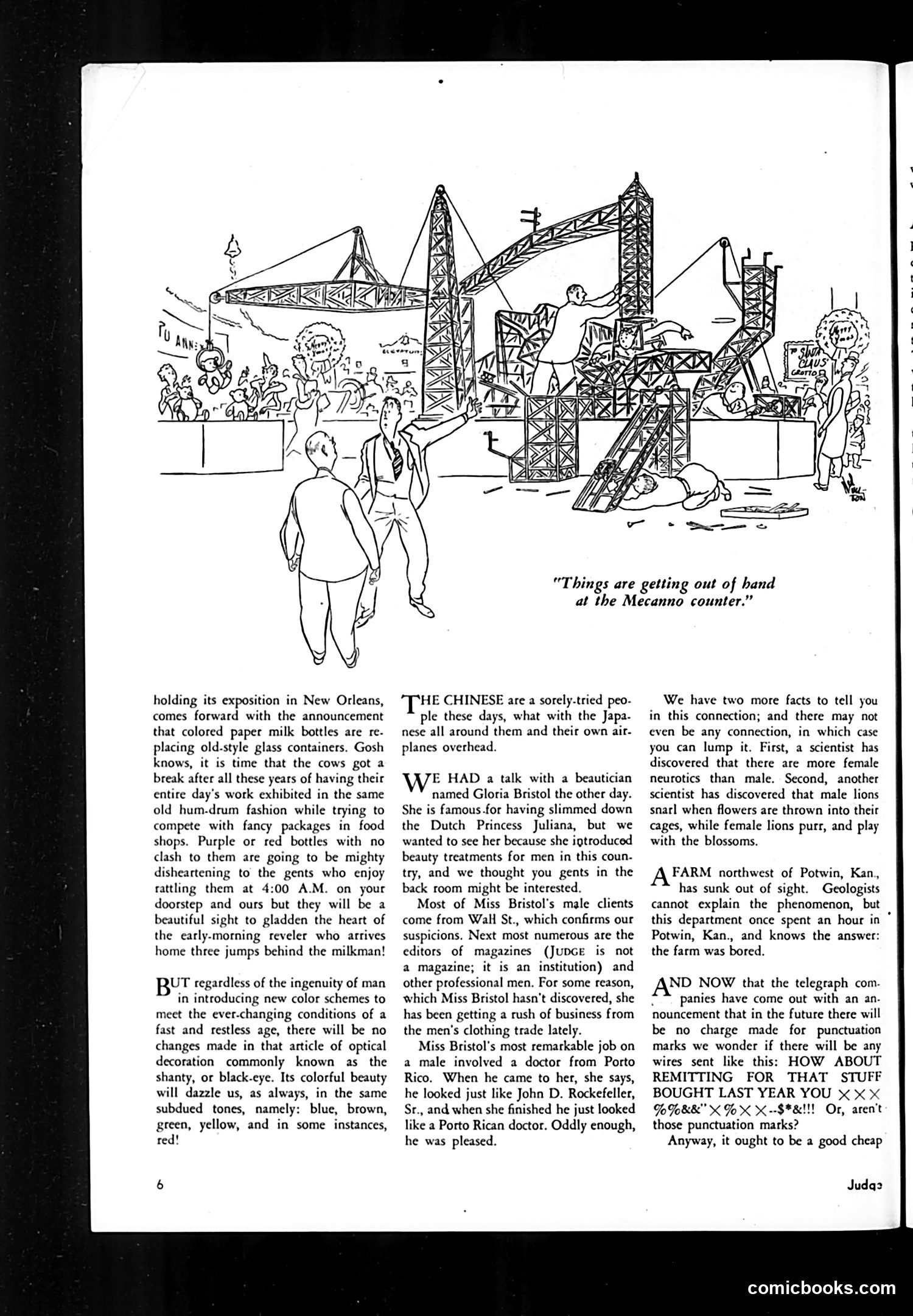
# Analysis The main cartoon depicts an elaborate construction site or exposition with steel framework and crowds. The caption reads: "Things are getting out of hand at the Mecanno counter." **What this means:** Mecanno was a popular construction toy system (metal girders, pulleys, etc.). The joke is that a toy display or counter has spiraled into actual, massive industrial construction—the toy has "gotten out of hand" and become real-scale infrastructure. This is visual satire on consumerism or childhood play run amok. The article text below discusses various social topics: Chinese immigration concerns, a beautician named Gloria Bristol, male neurosis (more females than males), and a boring farm near Potwin, Kansas. The final section jokes about punctuation marks in correspondence. **Context:** This appears to be typical Judge magazine content mixing visual satire with gossipy commentary on contemporary American social trends and absurdities.
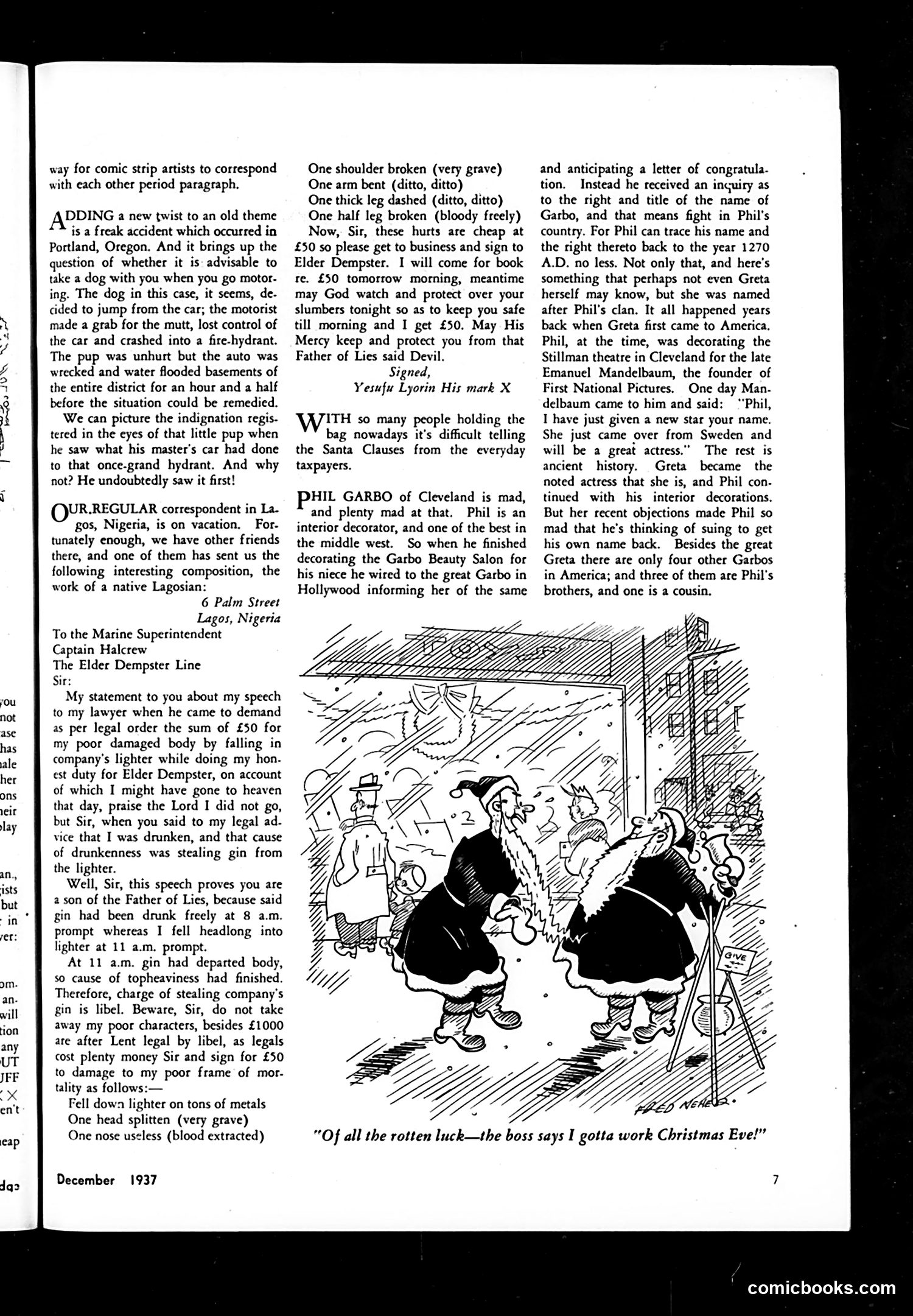
# Analysis of Judge Magazine Page (December 1937) This page contains reader letters and a single cartoon. The main cartoon depicts two men in what appears to be a warehouse or industrial setting, with one saying "Of all the rotten luck—the boss says I gotta work Christmas Eve!" **Context:** The cartoon is a working-class humor piece about holiday employment obligations during the Great Depression era. The joke satirizes the contrast between festive season expectations and economic hardship—workers couldn't afford to refuse shifts even on Christmas Eve. The letters above discuss various topics: a dog accident in Oregon, a decorator named Phil Garbo from Cleveland, and complaints about gin as a liability. The page is primarily editorial content with reader correspondence rather than focused political satire.
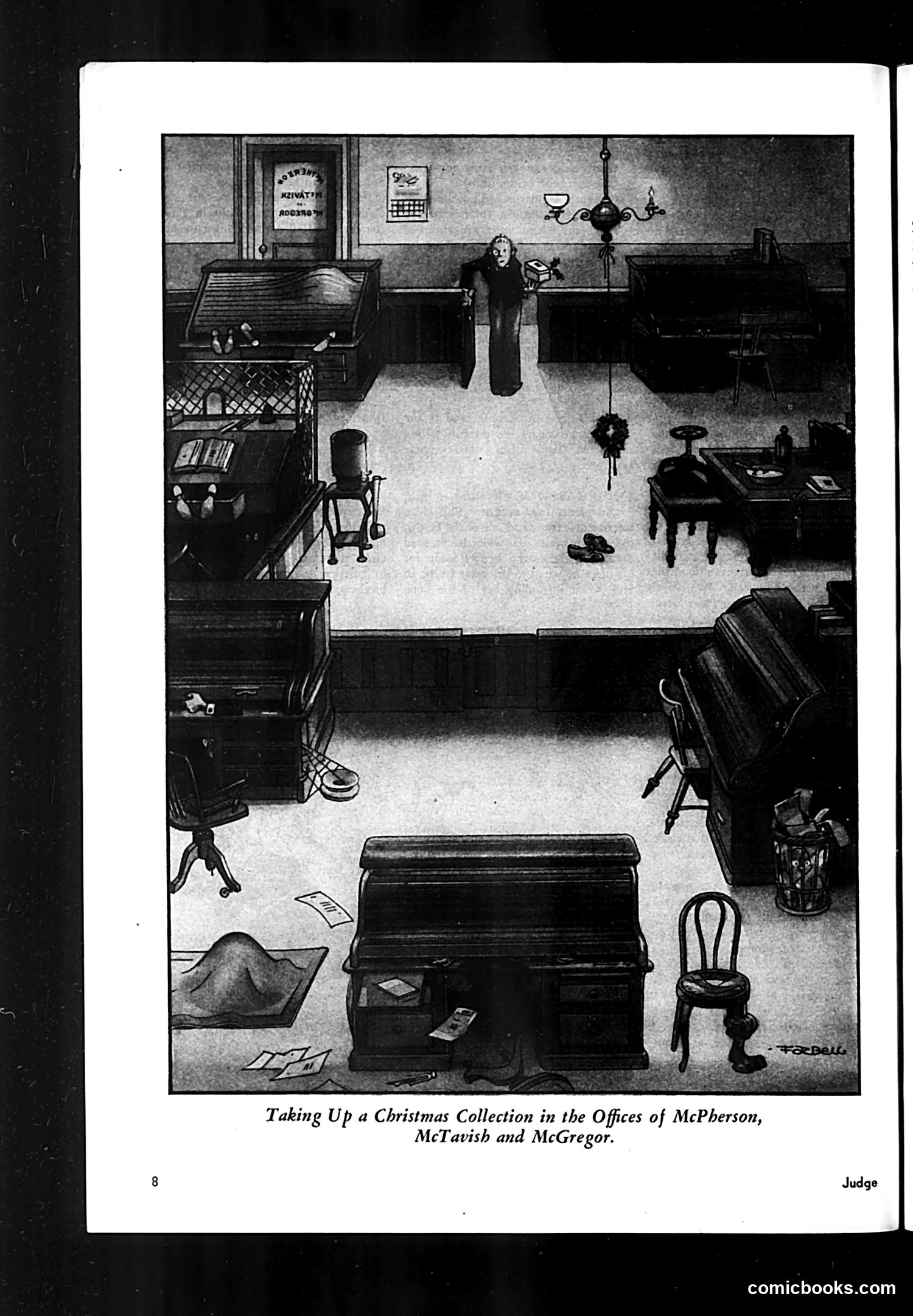
# Judge Magazine Cartoon Analysis This single-panel cartoon depicts a humorous scene of collecting charitable donations for Christmas in a law office. The title identifies the firm as "McPherson, McTavish and McGregor"—Scottish surnames suggesting a Scottish-American legal practice. The joke appears to target stingy lawyers. Despite the office's apparent prosperity (indicated by furniture, fixtures, and equipment), the collection has yielded almost nothing—the trunk contains minimal donations. The lone figure standing in the center office space seems to be the reluctant collector facing the reality that lawyers, despite their wealth, are notoriously unwilling to contribute to charitable causes. The satire mocks the stereotype of wealthy professionals' reluctance to give generously, particularly around Christmas.
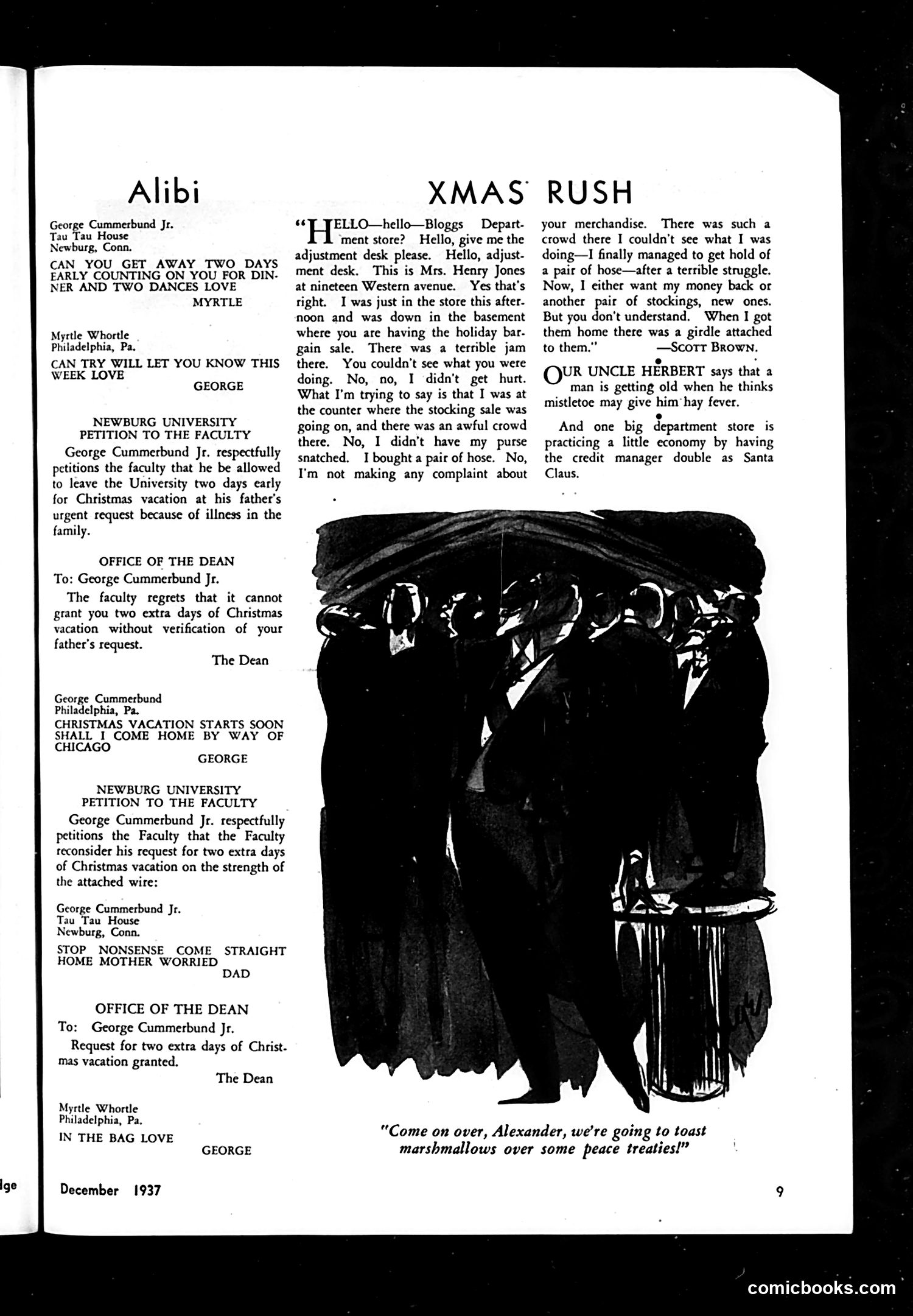
# Judge Magazine, December 1937: Analysis **"Alibi"** (left column): A comedic sequence satirizing college bureaucracy. Student George Cummerbund Jr. requests early Christmas leave, claiming family illness. The Dean denies it without verification. George then resubmits with a telegram from his father ("STOP NONSENSE COME STRAIGHT HOME MOTHER WORRIED DAD"), and the Dean immediately grants it. The joke: the "alibi" works—the father's worried wire serves as sufficient proof, despite being vague about actual illness. **"Xmas Rush"** (right): Two separate humor pieces about Christmas shopping chaos. The main piece (by Scott Brown) features a verbose woman complaining to a department store about crowded holiday sales and mysteriously receiving a girdle with her stockings. A side gag notes that one store economizes by having the credit manager also play Santa Claus, satirizing Depression-era cost-cutting. **The cartoon** depicts carolers or holiday figures, with the caption joking about toasting marshmallows over "peace treaties"—likely referencing 1937's deteriorating international situation as WWII approached.
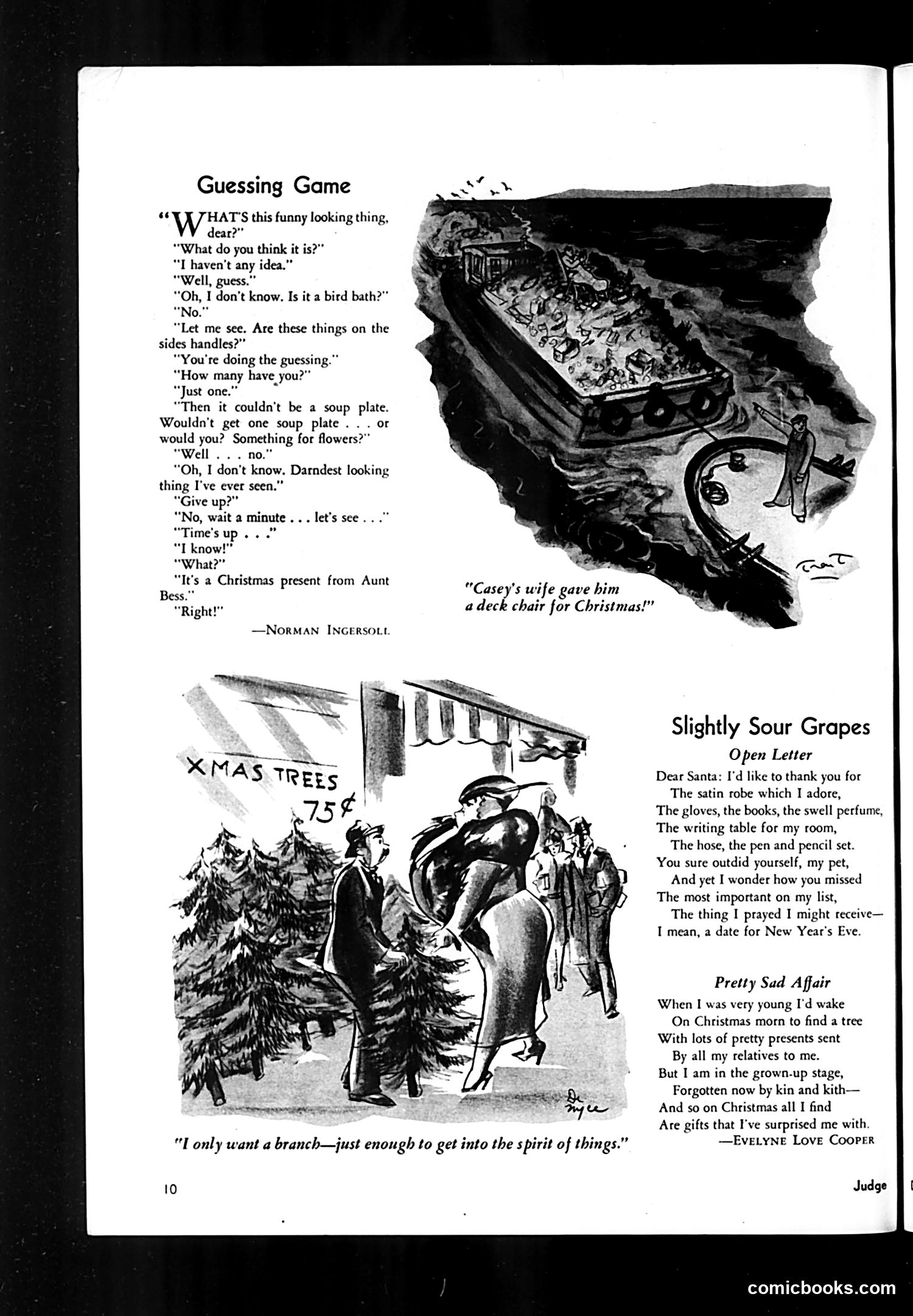
# Judge Magazine Page Analysis This page contains three Christmas-themed humor pieces from Judge magazine: **"Guessing Game"** (top): A dialogue where two people attempt to identify an oddly-shaped object. The punchline reveals it's a deck chair—a mundane, practical gift that hardly seems worthy of Christmas mystery. The satire mocks the disappointment of receiving utilitarian presents disguised as special surprises. **Christmas Trees Advertisement** (bottom left): Shows Santa selecting trees for sale at 75¢. The caption about wanting "just enough of a branch to get into the spirit of things" satirizes economic hardship—suggesting someone so poor they can only afford a single branch rather than a full tree, yet still hoping to participate in Christmas traditions. **"Slightly Sour Grapes"** (right): Two poems expressing gratitude for gifts while lamenting what wasn't received. The first thanks Santa while wishing for a New Year's Eve date; the second contrasts childhood abundance with adult loneliness and self-gift-giving. Together, these pieces humorously expose the gap between Christmas expectations and disappointing realities.