
Judge, 1937-12 · page 25 of 39
Judge — December 1937 — page 25: what you’re looking at
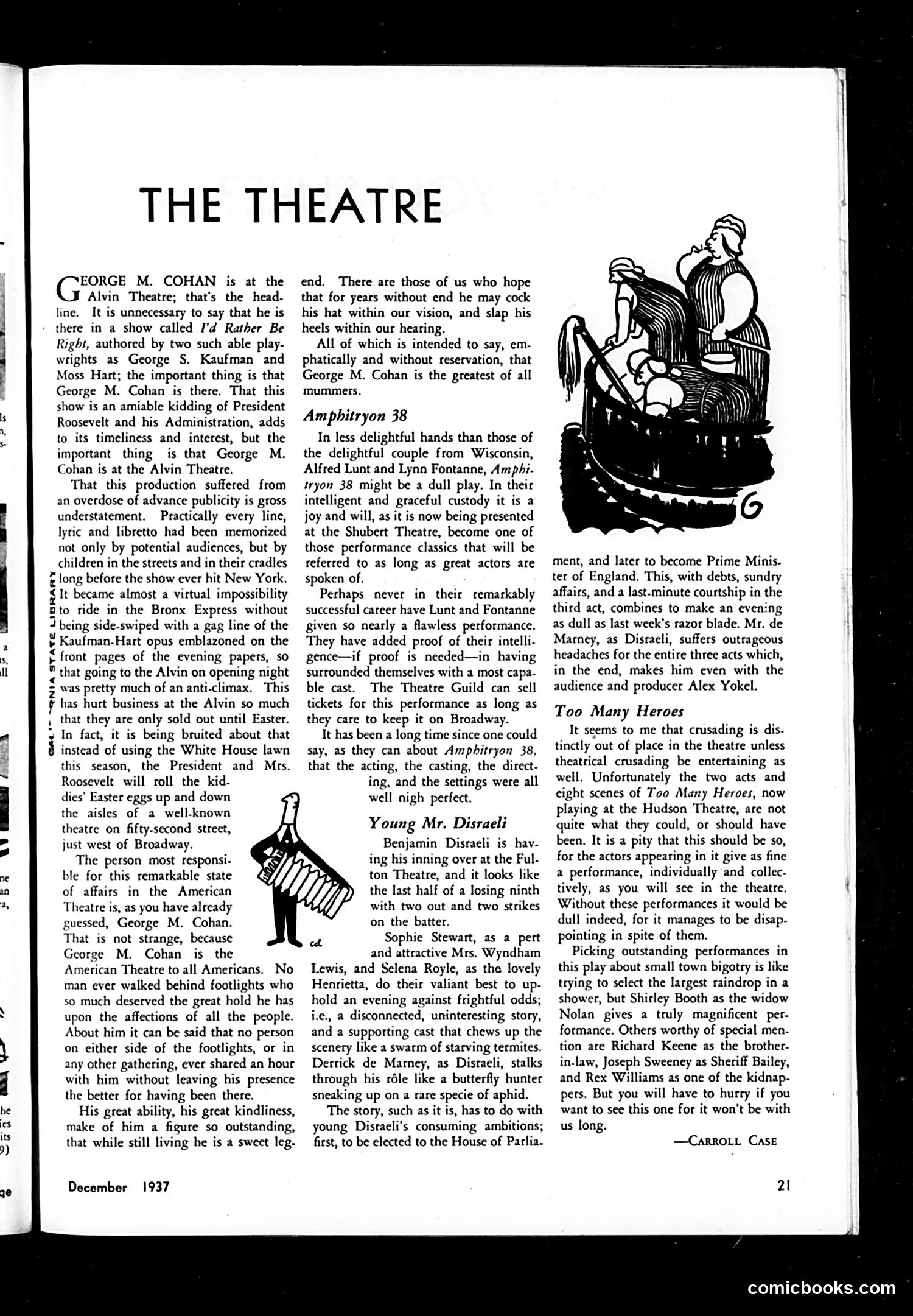
A restored page from Judge, 1937-12. Page through the whole issue in the reader above.
📄 Transcribed text from this page (OCR, searchable)
Machine-transcribed from the original scan — historical spelling and the odd misread are preserved.
THE THEATRE EORGE M. COHAN is at the Alvin Theatre; that’s the head. line. It is unnecessary to say that he is there in a show called I’d Rather Be Right, authored by two such able play- wrights as George S. Kaufman and Moss Hart; the important thing is that George M. Cohan is there. That this show is an amiable kidding of President Roosevelt and his Administration, adds to its timeliness and interest, but the important thing is that George M. Cohan is at the Alvin Theatre. That this production suffered from an overdose of advance publicity is gross understatement. Practically every line, lyric and libretto had been memorized not only by potential audiences, but by children in the streets and in their cradles ¢ long before the show ever hit New York. {lt became almost a virtual impossibility Bto ride in the Bronx Express without 4 being side-swiped with a gag line of the ? Kaufman.Hart opus emblazoned on the front pages of the evening papers, so b that going to the Alvin on opening night 3 Was pretty much of an anti-climax. This has hurt business at the Alvin so much , that they are only sold out until Easter. y In fact, it is being bruited about that $ instead of using the White House lawn this season, the President and Mrs. Roosevelt will roll the kid- dies’ Easter eggs up and down the aisles of a well-known theatre on fifty-second street, just west of Broadway. The person most responsi- ble for this remarkable state of affairs in the American Theatre is, as you have already guessed, George M. Cohan. That is not strange, because George M. Cohan is the American Theatre to all Americans. No man ever walked behind footlights who so much deserved the great hold he has upon the affections of all the people. About him it can be said that no person on either side of the footlights, or in any other gathering, ever shared an hour with him without leaving his presence the better for having been there. His great ability, his great kindliness, make of him a figure so outstanding, that while still living he is a sweet leg- December 1937 end. There are those of us who hope that for years without end he may cock his hat within our vision, and slap his heels within our hearing. All of which is intended to say, em- phatically and without reservation, that George M. Cohan is the greatest of all mummers. Amphitryon 38 In less delightful hands than those of the delightful couple from Wisconsin, Alfred Lunt and Lynn Fontanne, Amphi- tryon 38 might be a dull play. In their intelligent and graceful custody it is a joy and will, as it is now being presented at the Shubert Theatre, become one of those performance classics that will be referred to as long as great actors are spoken of. Perhaps never in their remarkably successful career have Lunt and Fontanne given so nearly a flawless performance. They have added proof of their intelli- gence—if proof is needed—in having surrounded themselves with a most capa- ble cast. The Theatre Guild can sell tickets for this performance as long as they care to keep it on Broadway. It has been a long time since one could say, as they can about Amphitryon 38, that the acting, the casting, the direct- ing, and the settings were all well nigh perfect. Young Mr. Disraeli Benjamin Disraeli is hav- ing his inning over at the Ful- ton Theatre, and it looks like the last half of a losing ninth with two out and two strikes on the batter. a Sophie Stewart, as a pert and attractive Mrs. Wyndham Lewis, and Selena Royle, as the lovely Henrietta, do their valiant best to up- hold an evening against frightful odds; i.e., a disconnected, uninteresting story, and a supporting cast that chews up the scenery like a swarm of starving termites. Derrick de Marney, as Disraeli, stalks through his réle like a butterfly hunter sneaking up on a rare specie of aphid. The story, such as it is, has to do with young Disraeli's consuming ambitions; first, to be elected to the House of Parlia- ment, and later to become Prime Minis. ter of England. This, with debts, sundry affairs, and a last-minute courtship in the third act, combines to make an evening as dull as last week's razor blade. Mr. de Marney, as Disraeli, suffers outrageous headaches for the entire three acts which, in the end, makes him even with the audience and producer Alex Yokel. Too Many Heroes It seems to me that crusading is dis- tinctly out of place in the theatre unless theatrical crusading be entertaining as well. Unfortunately the two acts and eight scenes of Too Many Heroes, now playing at the Hudson Theatre, are not quite what they could, or should have been. It is a pity that this should be so, for the actors appearing in it give as fine a performance, individually and collec- tively, as you will see in the theatre. Without these performances it would be dull indeed, for it manages to be disap- pointing in spite of them. Picking outstanding performances in this play about small town bigotry is like trying to select the largest raindrop in a shower, but Shirley Booth as the widow Nolan gives a truly magnificent per- formance. Others worthy of special men- tion are Richard Keene as the brother- in-law, Joseph Sweeney as Sheriff Bailey, and Rex Williams as one of the kidnap- pers. But you will have to hurry if you want to see this one for it won't be with us long. —CARROLL CASE 21 comicbooks.com