
Judge, 1937-12 · page 2 of 39
Judge — December 1937 — page 2: what you’re looking at
What you’re looking at
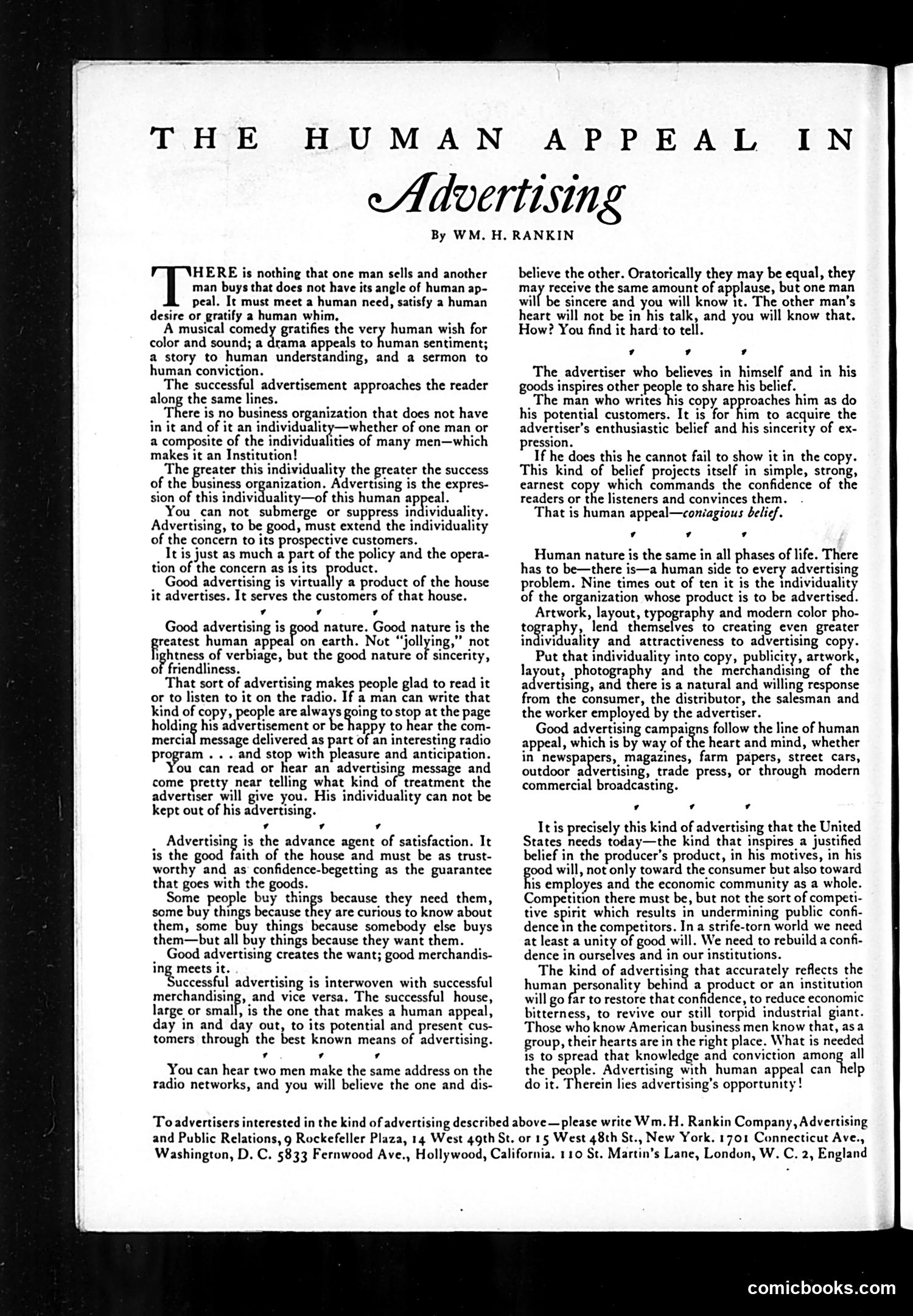
# Content Analysis This page is **not a cartoon or satire**—it's a straightforward advertisement for W.M. H. Rankin Company's advertising and public relations services. The article argues that effective advertising must appeal to human nature and individuality. Rankin advocates for "contagious belief"—sincere, personality-driven marketing that builds consumer confidence. He emphasizes that good advertising should reflect the human character behind a product, and that the United States needs advertising rooted in genuine belief rather than "competitive spirit which results in undermining public confidence." The piece reads as earnest business philosophy about post-industrial American marketing strategy, with no satirical intent or political commentary. It's essentially a professional manifesto for mid-20th century advertising practice.
📄 Transcribed text from this page (OCR, searchable)
Machine-transcribed from the original scan — historical spelling and the odd misread are preserved.
THE HUMAN APPEAL IN eAdvertising By WM. H. RANKIN man buys that does not have its angle of human ap- peal. It must meet a human need, satisfy a human desire or gratify a human whim, A musical comedy gratifies the very human wish for color and sound; a drama appeals to fuman sentiment; a story to human understanding, and a sermon to human conviction. The successful advertisement approaches the reader along the same lines. There is no business organization that does not have in it and of it an individuality—whether of one man or a composite of the individualities of many men—which makes it an Institution! The prcatet this individuality the greater the success of the business organization. Advertising is the expres- sion of this individuality—of this human appeal. You can not submerge or suppress individuality. Advertising, to be good, must extend the individuality of the concern to its prospective customers. It is just as much a part of the policy and the opera- tion of the concern as is its product. Good advertising is virtually a product of the house it advertises. It serves the customers of that house. v [ VHERE is nothing that one man sells and another ’ , ’ Good advertising is good nature. Good nature is the preatest human appeal on earth. Not “jollying,” not 1 htness of verbiage, but the good nature of sincerity, of friendliness. That sort of advertising makes people glad to read it be fo listen to it oo the radio. If a man can write that ind of copy, people are always going to stop at the page holdin, his advertisement or Tehapey to hear the bing mercial message delivered as part of an interesting radio Program + +. and stop with pleasure and anticipation. ou can read or hear an advertising message and come pretty near telling what kind of treatment the advertiser will give you. His individuality can not be kept out of his advertising. ’ , , Advertising is the advance agent of satisfaction. It is the good faith of the house and must be as trust- worthy and as confidence-begetting as the guarantee that goes with the goods. Some people buy things because they need them, some buy things because they are curious to know about them, some buy things because somebody else buys them—but all buy things because they want them. Good advertising creates the want; good merchandis- ing meets it. uccessful advertising is interwoven with successful merchandising and vice versa. The successful house, large or small, is the one that makes a human appeal, day in and day out, to its potential and present cus- tomers through the best known means of advertising. , , , You can hear two men make the same address on the radio networks, and you will believe the one and dis- believe the other. Oratorically they may be equal, they may receive the same amount of applause, but one man will be sincere and you will know it. The other man’s heart will not be in his talk, and you will know that. How? You find it hard to tell. , , ’ The advertiser who believes in himself and in his goods inspires other people to share his belief. The man who writes his copy approaches him as do his potential customers. It is for him to acquire the advertiser's enthusiastic belief and his sincerity of ex- pression. If he does this he cannot fail to show it in the copy. This kind of belief projects itself in simple, strong, earnest copy which commands the confidence of the readers or the listeners and convinces them. That is human appeal—coniagious belief. ’ , ’ Human nature is the same in all phases of life. There has to be—there is—a human side to every advertising problem. Nine times out of ten it is the individualit of the organization whose product is to be advertised. Artwork, layout, typography and modern color pho- tography lend themselves to creating even greater individuality and attractiveness to advertising copy. Put that individuality into copy, publicity, artwork, layout, photography and the merchandising of the advertising, and there is a natural and willing response from the consumer, the distributor, the salesman and the worker employed by the advertiser. Good advertising campaigns follow the line of human appeal, which is by way of the heart and mind, whether in newspapers, magazines, farm papers, street cars, outdoor advertising, trade press, or through modern commercial broadcasting. ’ ’ , It is precisely this kind of advertising that the United States needs today—the kind that inspires a justified belief in the producer’s product, in his motives, in his ‘ood will, not only toward the consumer but also toward fis employes and the economic community as a whole. Competition there must be, but not the sort of competi- tive spirit which results in undermining public confi- dence in the competitors. In a strife-torn world we need at least a unity of good will. We need to rebuild a confi- dence in ourselves and in our institutions. The kind of advertising that accurately reflects the human personality behind a product or an institution will go far to restore that confidence, to reduce economic bitterness, to revive our still torpid industrial giant. Those who know American business men know that, asa group, their hearts are in the right place. What is needed is to spread that knowledge and conviction among all the people. Advertising with human appeal can help do it. Therein lies advertising’s opportunity ! To advertisers interested in the kind of advertising described above—please write Wm.H. Rankin Company, Advertising and Public Relations, 9 Rockefeller Plaza, 14 West 4gth St. or 15 West 48th St., New York. 1701 Connecticut Ave., Washington, D. C. 5833 Fernwood Ave., Hollywood, California. 110 St. Martin’s Lane, London, W. C. 2, England comicbooks.com