
Judge, 1937-12 · page 4 of 39
Judge — December 1937 — page 4: what you’re looking at
What you’re looking at
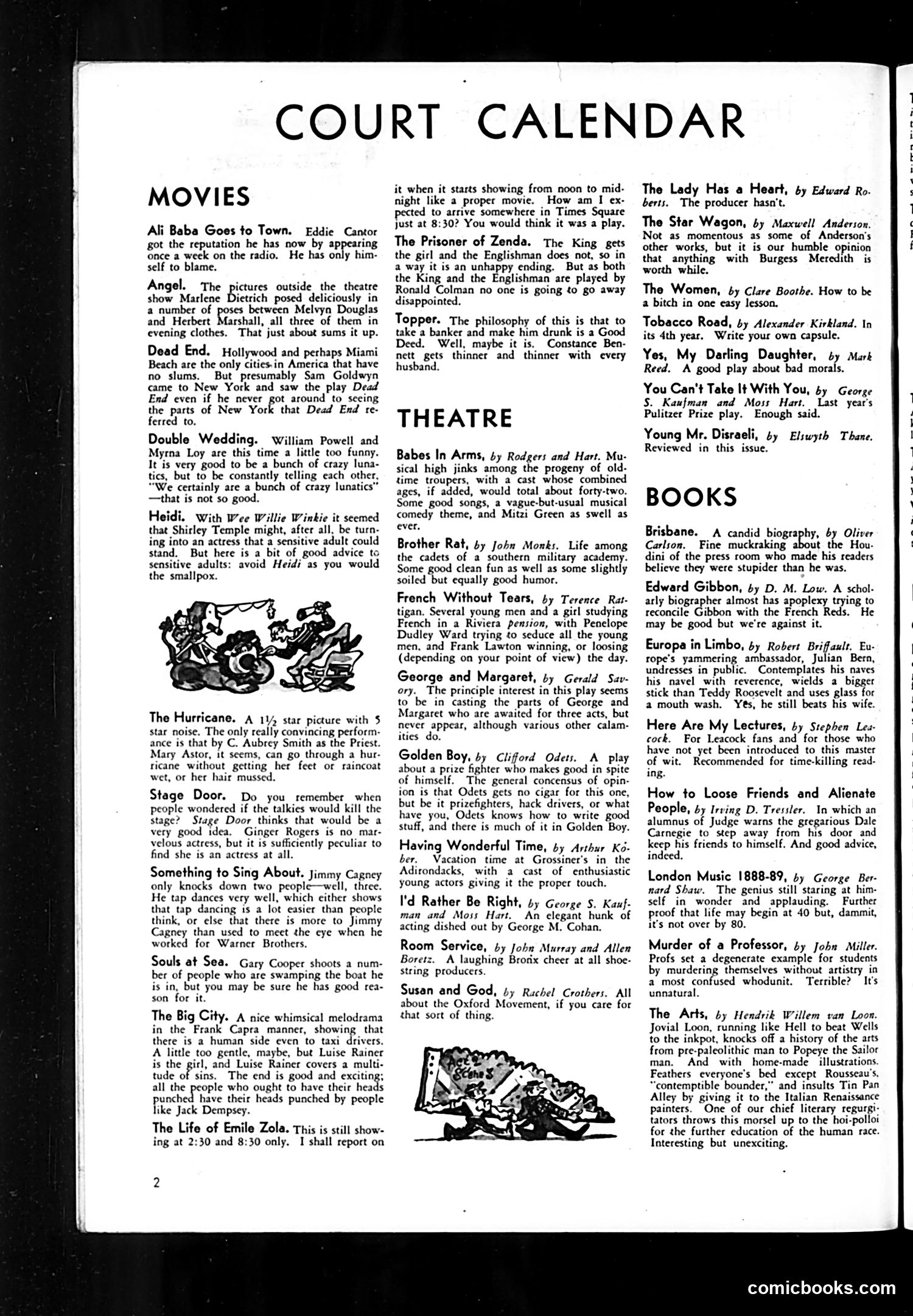
# Court Calendar Page Analysis This page is primarily a **entertainment and culture review section**, not political satire. It contains reviews of movies, theatre productions, and books, typical of Judge magazine's lighter content. The visible **cartoon illustration** at the bottom appears to show a reclining or fallen figure in a sketchy style, but without clearer context from the surrounding text, its specific meaning is unclear. The reviews themselves offer period-appropriate critiques—praising performances, commenting on plot quality, and offering reading recommendations. References to actors like Eddie Cantor and William Powell ground this in early-to-mid 20th century entertainment. This is essentially a **cultural entertainment guide** rather than political commentary, representing Judge's broader editorial range beyond satire.
📄 Transcribed text from this page (OCR, searchable)
Machine-transcribed from the original scan — historical spelling and the odd misread are preserved.
COURT CALENDAR MOVIES Ali Baba Goes to Town. Eddie Cantor got the reputation he has now by appearing once a week on the radio, He has only him- self to blame. Angel. ‘The pictures outside the theatre show Marlene Dietrich posed deliciously in a number of poses between Melvyn Douglas and Herbert Krarshall, all three of them in evening clothes, That just about sums it up. Dead End. Hollywood and perhaps Miami Beach are the only cities-in America that have no slums. But presumably Sam Goldwyn came to New York and saw the play Dead End even if he never £" around to seeing the parts of New York that Dead End re- ferred to. Double Wedding. william Powell and Myrna Loy are this time a little too funny. It is very good to be a bunch of crazy luna- tics, but to be constantly telling each other, “We certainly are a bunch of crazy lunatics” —that is not so good. Heidi. with Wee Willie Winkie it seemed that Shirley Temple might, after all, be turn- ing into an actress that a sensitive adult could stand. But here is a bit of good advice to sensitive adults: avoid Heidi as you would the smallpox. The Hurricane. A 11, star picture with 5 star noise. The only really convincing perform- ance is that by C. Aubrey Smith as the Priest. Mary Astor, it seems, can go through a hur- ricane without getting her feet or raincoat wet, or her hair mussed. Stage Door. Do you remember when people wondered if the talkies would kill the stage? Stage Door thinks that would be a very good idea. Ginger Rogers is no mar- velous actress, but it is sufficiently peculiar to find she is an actress at all. Something to Sing About. Jimmy Cagney only knocks down two people—well, three. He tap dances very well, which either shows that tap dancing is a lot easier than people think, or else that there is more to Jimmy Cagney than used to meet the eye when he worked for Warner Brothers. Souls at Sea. Gary Cooper shoots a num- ber of people who are swamping the boat he is in, but you may be sure he has good rea- son for it. The Big City. A nice whimsical melodrama in the Frank Capra manner, showing that there is a human side even to taxi drivers. A little too gentle, maybe, but Luise Rainer is the girl, and Luise Rainer covers a multi- tude of sins. The end is good and exciting; all the people who ought to have their heads punched 1 have their heads punched by people like Jack Dempsey. The Life of Emile Zola. This is still show- ing at 2:30 and 8:30 only. I shall report on it when it starts showing from noon to mid- night like a proper movie. How am I ex- ted to arrive somewhere in Times Square just at 8:30? You would think it was a play. The Prisoner of Zenda. The King gets the girl and the Englishman does not, so in a way it is an unhappy ending. But as both the King and the Englishman are played by Ronald Colman no one is going to go away disappointed. Topper. The philosophy of this is that to take a banker and make him drunk is a Good Deed. Well, maybe it is. Constance Ben- nett gets thinner and thinner with every husband. THEATRE Babes In Arms, by Rodgers and Hart, Mu- sical high jinks among the progeny of old- time troupers, with a cast whose combined ages, if added, would total about forty-two. Some good songs, a vague-but-usual musical comedy theme, and Mitzi Green as swell as ever. Brother Rat, by John Monks. Life among the cadets of a southern military academy. Some good clean fun as well as some slightly soiled but equally good humor. French Without Tears, by Terence Rat- tigan. Several young men and a girl studying French in a Riviera pension, with Penelope Dudley Ward trying to seduce all the young men, and Frank Lawton winning, or loosing (depending on your point of view) the day. George and Margaret, by Gerald Sav- ory. The principle interest in this play seems to be in casting the parts of George and Margaret who are awaited for three acts, but never appear, although various other calam- ities do. Golden Boy, by Clifford Odets. A play about a prize fighter who makes good in spite of himself. The general concensus of opin- ion is that Odets gets no cigar for this one, but be it prizefighters, hack drivers, or what have you, Odets knows how to write good stuff, and there is much of it in Golden Boy. Having Wonderful Time, by Arthur Ko- ber, Vacation time at Grossiner's in the Adirondacks, with a cast of enthusiastic young actors giving it the proper touch. I'd Rather Be Right, by George S. Kauf- man and Moss Hart. An clegant hunk of acting dished out by George M. Cohan. Room Service, by John Murray and Allen Boretz. A laughing Bronx cheer at all shoe- string producers. Susan and God, by Rachel Crothers. All about the Oxford Movement, if you care for that sort of thing. The Lady Has a Heart, by Edward Ro. berts. The producer hasn't. The Star Wagon, by Maxwell Anderson. Not as momentous as some of Anderson's other works, but it is our humble opinion that anything with Burgess Meredith is worth while. The Women, by Clare Boothe. How to be a bitch in one easy lesson. Tobacco Road, by Alexander Kirkland. In its 4th year. Write your own capsule. Yes, My Darling Daughter, 4y Maré Reed. A good play about bad morals. You Can't Take It With You, by George S. Kaufman and Moss Hart. Last year's Pulitzer Prize play. Enough said. Young Mr. Disraeli, by Elswyth Thane. Reviewed in this issue. BOOKS Brisbane. Carlson. A candid biography, by Oliver Fine muckraking ut the Hou- dini of the press room who made his readers believe they were stupider than he was. Edward Gibbon, ty D. M. Low. A schol- arly biographer almost has apoplexy trying to reconcile Gibbon with the French Reds. He may be good but we're against it. Europa in Limbo, sy Robert Brif ante Eu. rope’s yammering ambassador, Julian Bern, undresses in public. Contemplates his naves his navel with reverence, wields a bigger stick than Teddy Roosevelt and uses glass for a mouth wash. Yes, he still beats his wife. Here Are My Lectures, by Stephen Lea cock. For Leacock fans and for those who have not yet been introduced to this master of wit. Recommended for time-killing read- ing. How to Loose Friends and Alienate People, by Irving D. Tressler. In which an alumnus of Judge warns the gregarious Dale Carnegie to’ step away from his door and Keep his frends to himself. And good advice, indeed. London Music 1888-89, by George Ber- nard Shaw. The genius still staring at him- self in wonder and applauding. Further proof that life may begin at 40 but, dammit, It's not over by 80. Murder of a Professor, by John Miller. Profs set a degenerate example for students by murdering themselves without artistry in a most confused whodunit. Terrible? It's unnatural. The Arts, by Hendrik Willem van Loon. Jovial Loon, running like Hell to beat Wells to the inkpot, knocks off a history of the arts from pre-paleolithic man to Popeye the Sailor man. And with home-made illustrations. Feathers everyone's bed except Rousseau’s, “contemptible bounder,” and insults Tin Pan Alley by giving it to the Italian Renaissance painters. One of our chief literary regurgi- tators throws this morsel up to the hoi-polloi for the further education of the human race. Interesting but unexciting. comicbooks.com