
Judge, 1937-12 · page 5 of 39
Judge — December 1937 — page 5: what you’re looking at
What you’re looking at
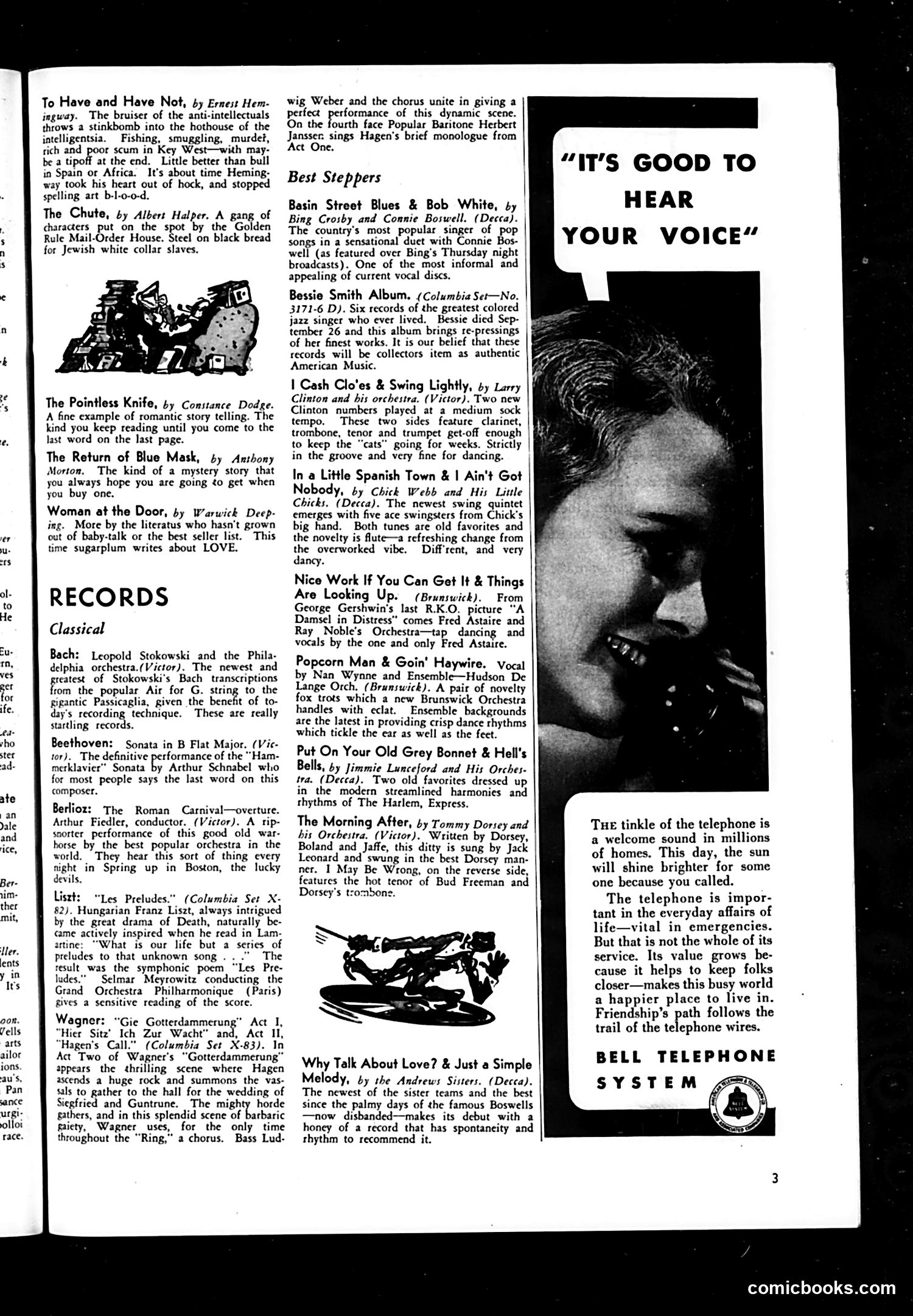
# Page Analysis This page is primarily **record reviews and advertisements** rather than political satire or cartoons. The content includes classical and popular music reviews (Bach, Beethoven, Wagner, and contemporary jazz/swing recordings). There are two small illustrations: one showing a couple dancing or embracing, and another depicting someone reclining. The largest element is a **Bell Telephone System advertisement** with the slogan "It's Good to Hear Your Voice," emphasizing the telephone's role in maintaining relationships and handling emergencies. The ad uses sentimental messaging typical of 1930s-40s corporate advertising, positioning the telephone as essential to modern life and friendship. **No political satire or recognizable caricatures are present on this page.** The content reflects Judge magazine's shift toward entertainment and advertising rather than political commentary.
📄 Transcribed text from this page (OCR, searchable)
Machine-transcribed from the original scan — historical spelling and the odd misread are preserved.
Oe Os 1S ves, er ife. oon. Veils arts ailor ions. a's, Pan ance urgi- olloi race. To Have and Have Not, 4y Ernest Hem- ingway. The bruiser of the anti-intellectuals throws a stinkbomb into the hothouse of the intelligentsia. Fishing, smuggling, murdet, rich and poor scum in Key West—with may- be a tipoff at the end. Little better than bull in Spain or Africa. It's about time Heming- way took his heart out of hock, and stopped spelling art b-l-o-0-d. The Chute, sy Albert Halper. A gang of characters put on the spot by the Golden Rule Mail-Order House. Steel on black bread for Jewish white collar slaves. The Pointless Knife, by Constance Dodge. A fine example of romantic story telling. The kind you keep reading until you come to the last word on the last page. The Return of Blue Mask, 4y Anthony Morton, The kind of a mystery story that you always hope you are going ¢o get when you buy one. Woman at the Door, by Warwick Deep- ing. More by the literatus who hasn't grown out of baby-talk or the best seller list. This time sugarplum writes about LOVE. RECORDS Classical Bach: Leopold Stokowski_and the Phila- delphia orchestra.(Victor). The newest and eatest. of Stokowski's Bach transcriptions rom the popular Air for G. jiring to the gigantic Passicaglia, given the benefit of to- day's recording technique. These are really startling records. Beethoven: Sonata in B Flat Major. (Vic- tor). The definitive performance of the “"Ham- metklavier” Sonata by Arthur Schnabel who for most people says the last word on this composer. Berlioz: The Roman Carnival—overture. Arthur Fiedler, conductor. (Victor). A rip- sorter performance of this good old war- horse by the best popular orchestra in the world. They hear this sort of thing every night in Spring up in Boston, the lucky devils. list: “Les Preludes.” (Columbia Set X- 82). Hungarian Franz Liszt, always intrigued by the great drama of Death, naturally be- came actively inspired when he read in Lam- artine: “What is our life but a series of preludes to that unknown song...” The tesult was the symphonic poem “Les Pre- ludes.”” Selmar Meyrowitz conducting the Grand Orchestra Philharmonique (Paris) gives a sensitive reading of the score. Wagner: “Gie Gotterdammerung” Act I, “Hier Sitz’ Ich Zur Wacht" and, Act II, “Hagen’s Call.” (Columbia Set X-83). In Act Two of Wagner's “Gotterdammerung” appears the thrilling scene where Hagen ascends a huge rock and summons the vas- sals to gather to the hall for the wedding of Siegfried and Guntrune. The mighty horde gathers, and in this splendid scene of barbaric faiety, Wagner uses, for the only time throughout the “Ring,” a chorus. Bass Lud- wig Weber and the chorus unite in giving a perfect performance of this dynamic scene. On the fourth face Popular Baritone Herbert Janssen: sings Hagen’s brief monologue from Act One. Best Steppers Basin Street Blues & Bob White, sy Bing Crosby and Connie Boswell. (Decca). The country’s most popular singer of pop songs in a sensational duet with Connie Bos- well (as featured over Bing’s Thursday night broadcasts). One of the most informal and appealing of current vocal discs. Bessie Smith Album. (Columbia Set—No. 3171-6 D). Six records of the greatest colored jazz singer who ever lived. Bessie died Sep- |¥ tember 26 and this album brings re-pressings of her finest works. It is our belief that these records will be collectors item as authentic American Music. 1 Cash Clo'es & Swing Lightly, 6y Larry Clinton and bis orchestra. (Victor). Two new Clinton numbers played at a medium sock tempo. These two sides feature clarinet, trombone, tenor and trumpet get-off enough to keep the “cats” going for weeks. Strictly in the groove and very fine for dancing. In a Little Spanish Town & | Ain't Got Nobody, by Chick Webb and His Little Chicks. (Decca). The newest swing quintet emerges with five ace swingsters from Chick's big hand. Both tunes are old favorites and the novelty is flute—a refreshing change from the overworked vibe. Diff'rent, and very dancy. Nice Work If You Can Get It & Things Are Looking Up. (Brunswick). From George Gershwin’s last R.K.O. picture “A Damsel in Distress” comes Fred Astaire and Ray Noble's Orchestra—tap dancing and vocals by the one and only Fred Astaire. Popcorn Man & Goin’ Haywire. Vocal by Nan Wynne and Ensemble—Hudson De Lange Orch, (Brunswick). A pait of novelty fox trots which a new Brunswick Orchestra handles with eclat. Ensemble backgrounds are the latest in providing crisp dance rhythms which tickle the ear as well as the feet. Put On Your Old Grey Bonnet & Hell's Bells, by Jimmie Lunceford and His Orches- tra. (Decca). Two old favorites dressed up in the modern streamlined harmonies and thythms of The Harlem, Express. The Morning After, by Tommy Dorsey and his Orchestra. (Victor). Written by Dorsey, Boland and Jaffe, this ditty is sung by Jack Leonard and swung in the best Dorsey man- ner. 1 May Be Wrong, on the reverse side, features the hot tenor of Bud Freeman and Dorsey's trombone. Why Talk About Love? & Just a Simple Melody, by she Andrews Sisters. (Decca). The newest of the sister teams and the best since the palmy days of the famous Boswells —now disbanded—makes its debut with a honey of a record that has spontaneity and rhythm to recommend it. “IT'S GOOD TO HEAR YOUR VOICE” Tue tinkle of the telephone is a welcome sound in millions of homes. This day, the sun will shine brighter for some one because you called. The telephone is impor- tant in the everyday affairs of life—vital in emergencies. But that is not the whole of its service. Its value grows be- cause it helps to keep folks closer—makes this busy world a happier place to live in. Friendship’s path follows the trail of the telephone wires. BELL TELEPHONE SYSTEM comicbooks.com