
Judge, 1937-12 · page 22 of 39
Judge — December 1937 — page 22: what you’re looking at
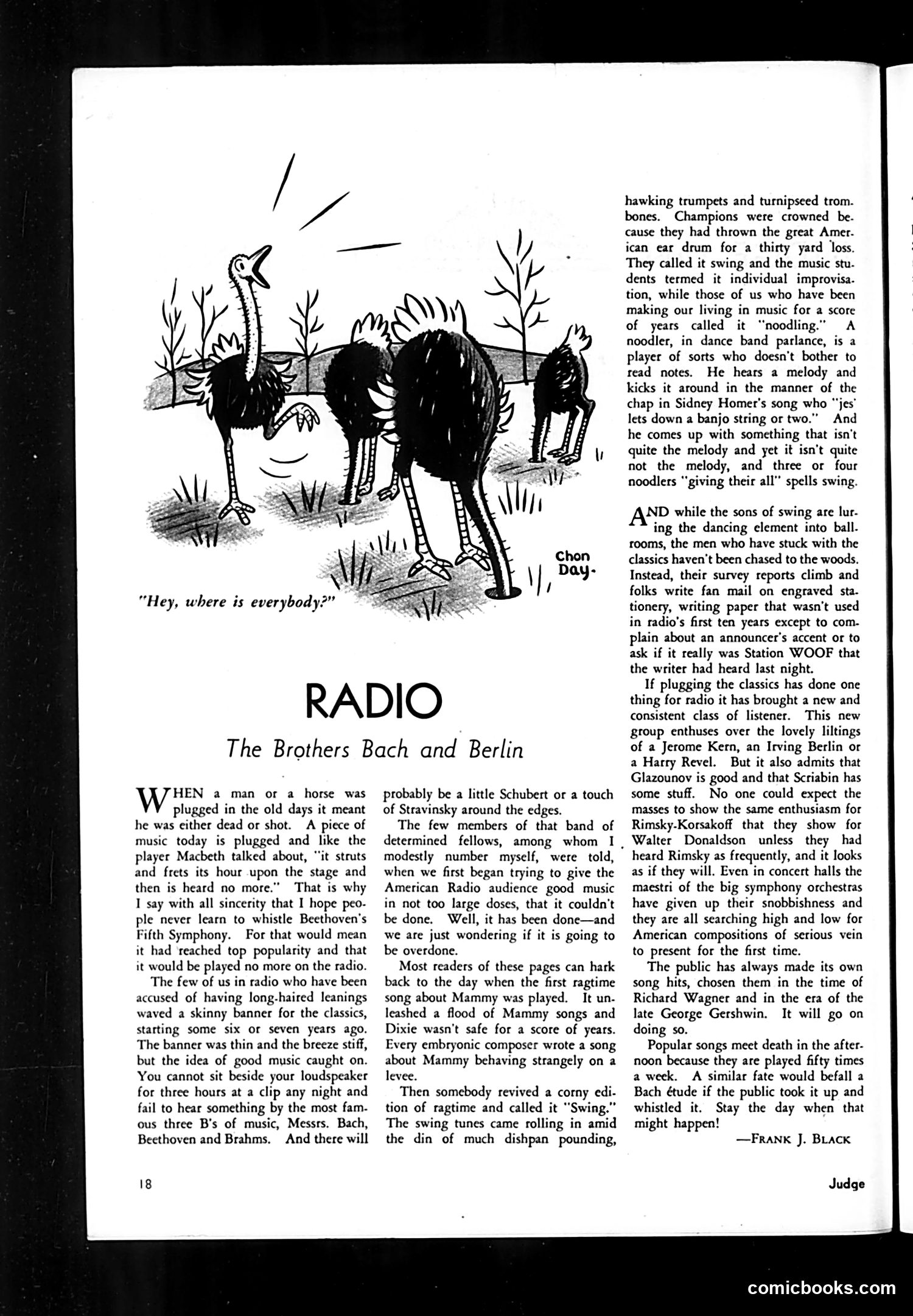
A restored page from Judge, 1937-12. Page through the whole issue in the reader above.
📄 Transcribed text from this page (OCR, searchable)
Machine-transcribed from the original scan — historical spelling and the odd misread are preserved.
The Brothers Bach and Berlin HEN a man or a horse was plugged in the old days it meant he was either dead or shot. A piece of music today is plugged and like the player Macbeth talked about, “it struts and frets its hour upon the stage and then is heard no more.” That is why I say with all sincerity that 1 hope peo- ple never learn to whistle Beethoven's Fifth Symphony. For that would mean it had ‘reached top popularity and that it would be played no more on the radio. The few of us in radio who have been accused of having long-haired leanings waved a skinny banner for the classics, starting some six or seven years ago. The banner was thin and the breeze stiff, but the idea of good music caught on. You cannot sit beside your loudspeaker for three hours at a clip any night and fail to hear something by the most fam- ous three B's of music, Messrs. Bach, Beethoven and Brahms. And there will 18 probably be a little Schubert or a touch of Stravinsky around the edges. The few members of that band of determined fellows, among whom I modestly number myself, were told, when we first began trying to give the American Radio audience good music in not too large doses, that it couldn't be done. Well, it has been done—and we are just wondering if it is going to be overdone. Most readers of these pages can hark back to the day when the first ragtime song about Mammy was played. It un- leashed a flood of Mammy songs and Dixie wasn’t safe for a score of years. Every embryonic composer wrote a song about Mammy behaving strangely on a levee. Then somebody revived a corny edi- tion of ragtime and called it “Swing.” The swing tunes came rolling in amid the din of much dishpan pounding, hawking trumpets and turnipseed trom. bones. Champions were crowned be. cause they had thrown the great Amer. ican ear drum for a thirty yard ‘loss. They called it swing and the music stu. dents termed it individual improvisa- tion, while those of us who have been making our living in music for a score of years called it “noodling.” A noodler, in dance band parlance, is a player of sorts who doesn’t bother to read notes. He hears a melody and kicks it around in the manner of the chap in Sidney Homer's song who “jes’ lets down a banjo string or two.” And he comes up with something that isn’t quite the melody and yet it isn’t quite not the melody, and three or four noodlers “giving their all” spells swing. AND while the sons of swing are lur- ing the dancing element into ball. rooms, the men who have stuck with the classics haven't been chased to the woods. Instead, their survey reports climb and folks write fan mail on engraved sta- tionery, writing paper that wasn’t used in radio's first ten years except to com- plain about an announcer's accent or to ask if it really was Station WOOF that the writer had heard last night. If plugging the classics has done one thing for radio it has brought a new and consistent class of listener. This new group enthuses over the lovely liltings of a Jerome Kern, an Irving Berlin or a Harry Revel. But it also admits that Glazounov is good and that Scriabin has some stuff. No one could expect the masses to show the same enthusiasm for Rimsky-Korsakoff that they show for _ Walter Donaldson unless they had heard Rimsky as frequently, and it looks as if they will. Even in concert halls the maestri of the big symphony orchestras have given up their snobbishness and they are all searching high and low for American compositions of serious vein to present for the first time. The public has always made its own song hits, chosen them in the time of Richard Wagner and in the era of the late George Gershwin. It will go on doing so. Popular songs meet death in the after- noon because they are played fifty times a week. A similar fate would befall a Bach étude if the public took it up and whistled it. Stay the day when that might happen! —FRANK J. BLACK Judge comicbooks.com