A complete issue · 36 pages · 1937
Judge — September 1937
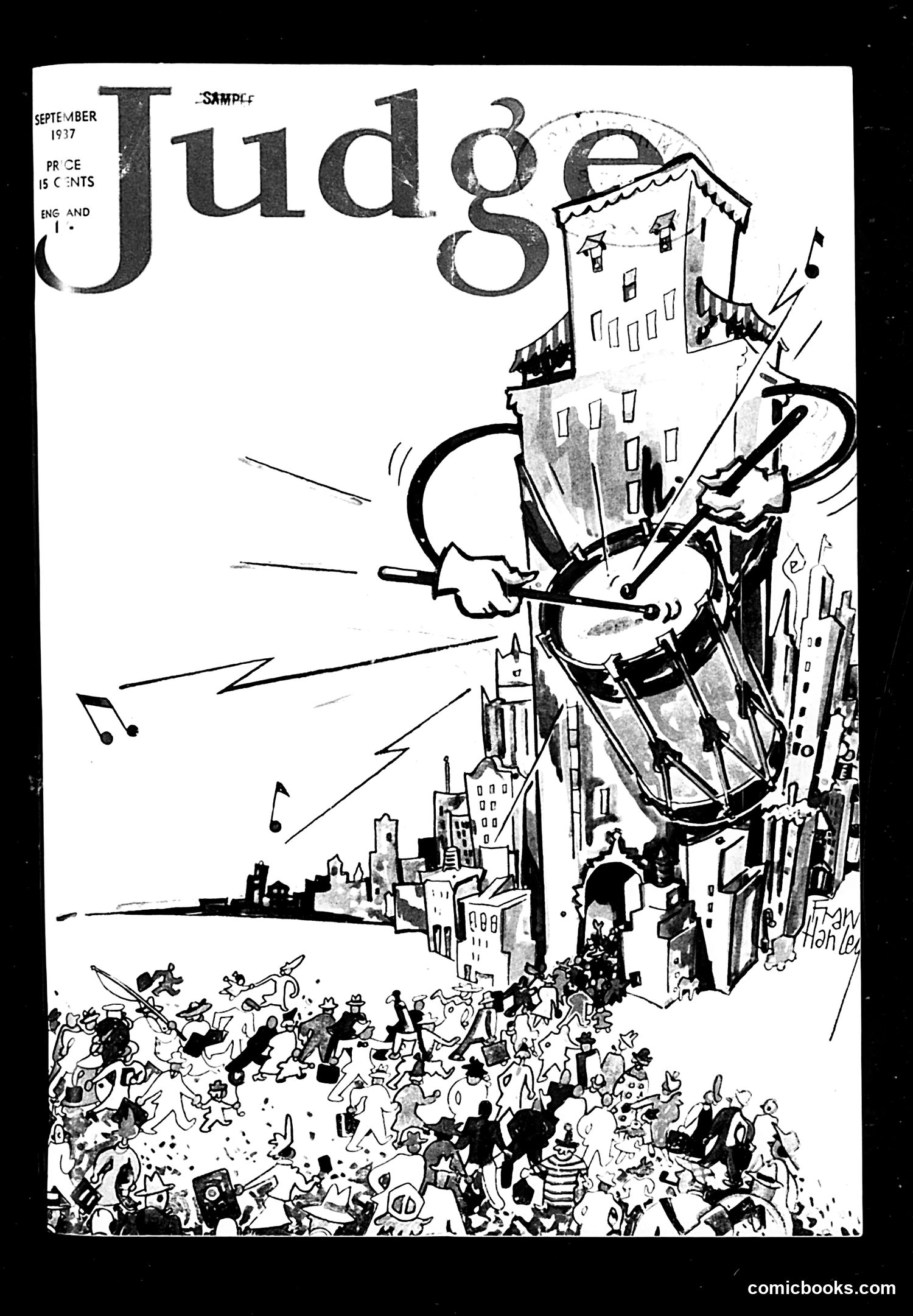
# Judge Magazine Cover Analysis - September 1917 This cover depicts a giant figure playing bagpipes atop a tall building, serenading a crowd of people below in a city street. The giant appears to be a caricatured Scottish figure (suggested by the bagpipes and likely the attire). Given the September 1917 date, this likely references World War I and Scottish involvement. The "Judge" publication was American, and the image appears to satirize either Scottish military contributions or possibly immigration/Scottish cultural presence in America during the war period. The chaotic crowd below and the commanding musical performance suggest commentary on public response to war messaging or military recruiting. However, without clearer identifying details or text, the specific satirical target remains somewhat unclear.
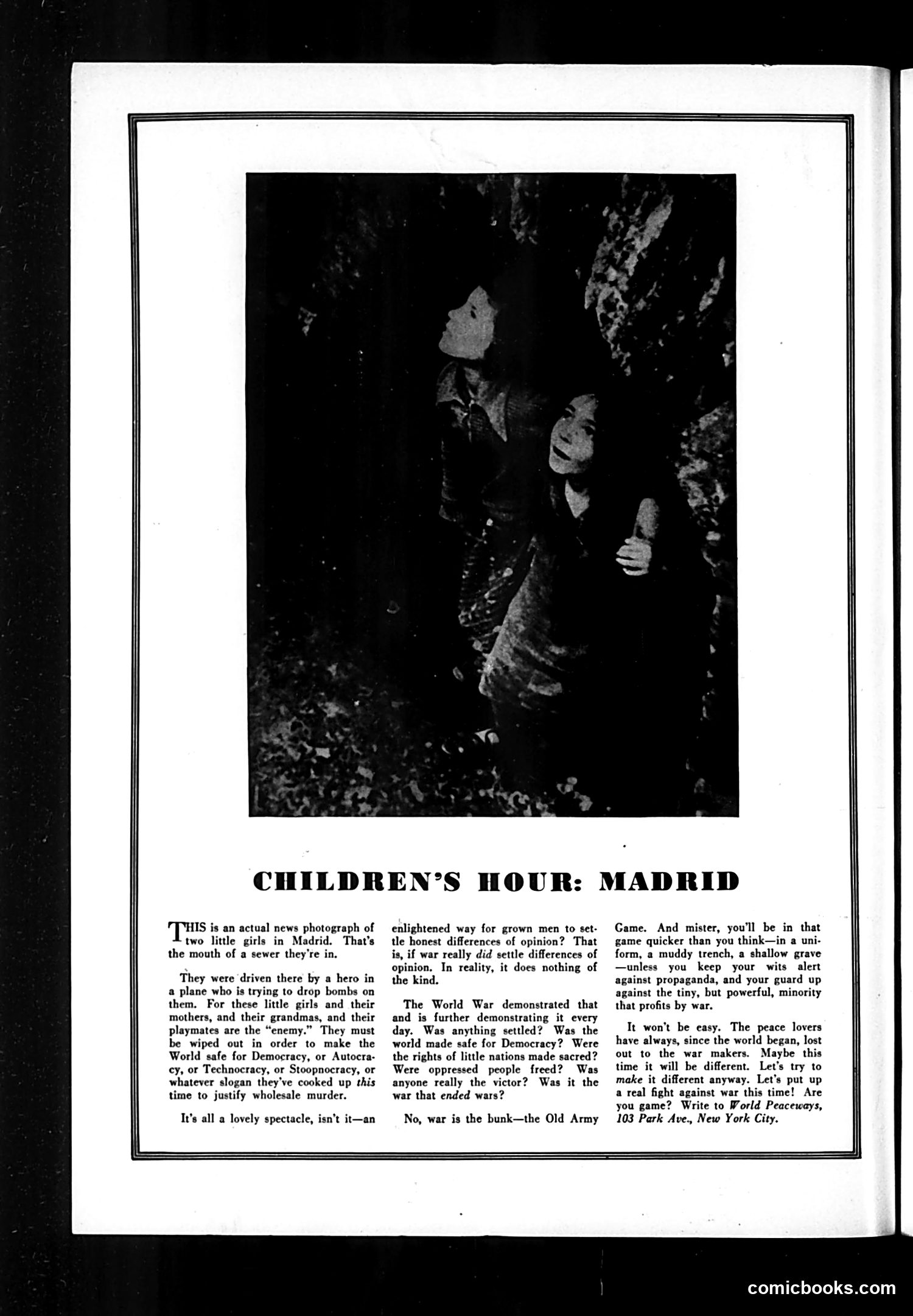
# Analysis: "Children's Hour: Madrid" This is a satirical editorial photograph (not a cartoon) criticizing war's impact on children. The image shows young children in what appears to be a sewer or underground shelter in Madrid, likely during the Spanish Civil War (1936-1939). The text sarcastically asks whether war truly settles ideological differences, arguing it doesn't—it merely justifies wholesale murder. The author challenges readers to reconsider anti-war arguments, specifically addressing "peace lovers" and inviting them to submit alternative solutions to World Peaceways magazine. The satire targets those who defend war as necessary, using the visual evidence of Madrid's children in shelters as irrefutable counter-argument: war's reality is children hiding underground, not noble resolution of disputes.
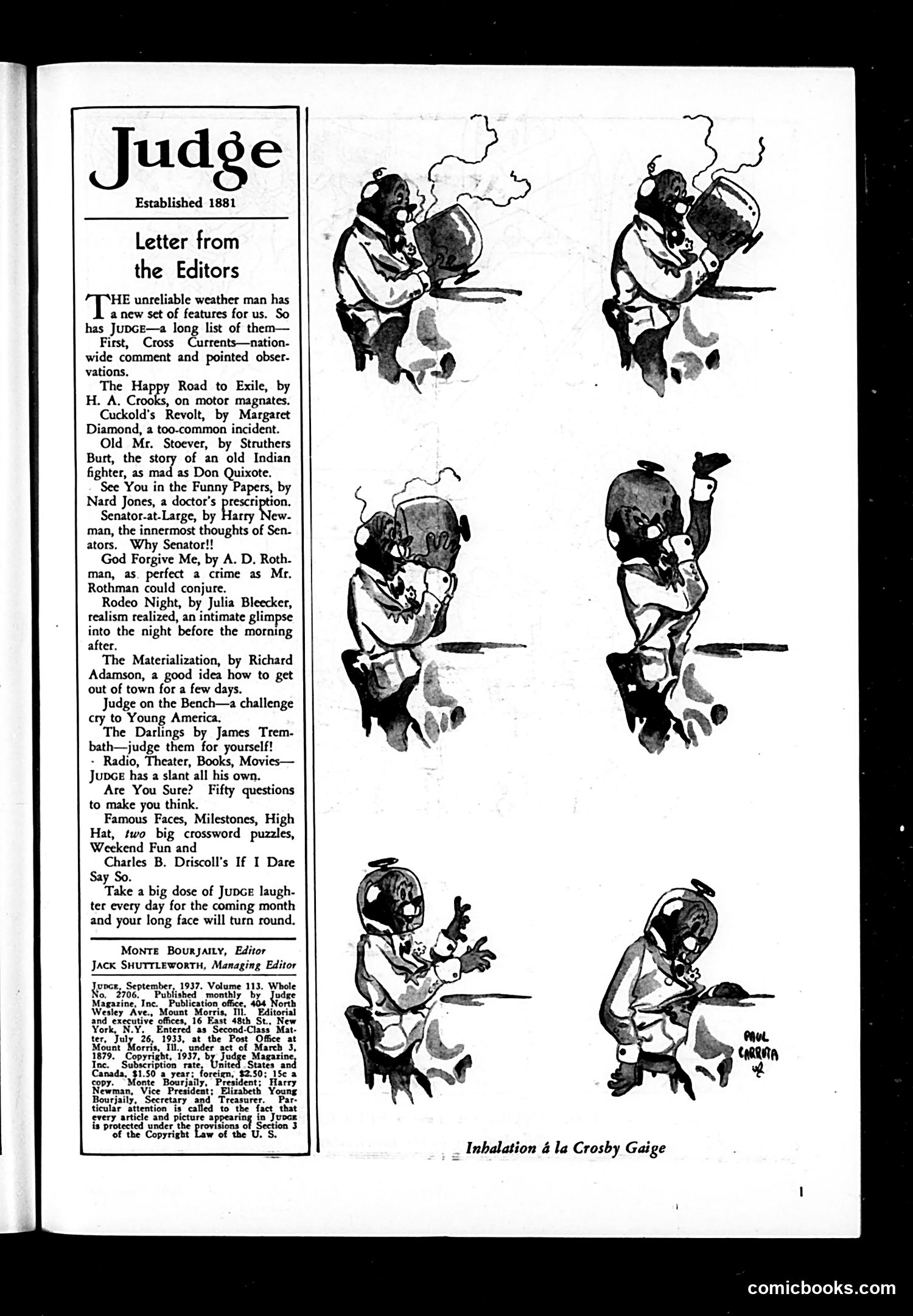
# Judge Magazine Cartoon Analysis This page from Judge (September 1937) features a series of six cartoon panels titled "Inhalation à la Crosby Gaige," satirizing Crosby Gaige, a prominent New York restaurateur and food critic of the era. The cartoons depict a rotund figure in various comedic poses, apparently inhaling or consuming food with exaggerated enthusiasm. The satire targets Gaige's well-known reputation for lavish eating and his considerable girth. The title's French phrasing ("inhalation in the manner of Crosby Gaige") suggests mocking his pretensions to sophisticated dining culture while caricaturing his voracious appetite. The humor relies on visual exaggeration of body shape and eating behavior—standard comic fare of the 1930s—to ridicule a recognizable public figure known for food indulgence.
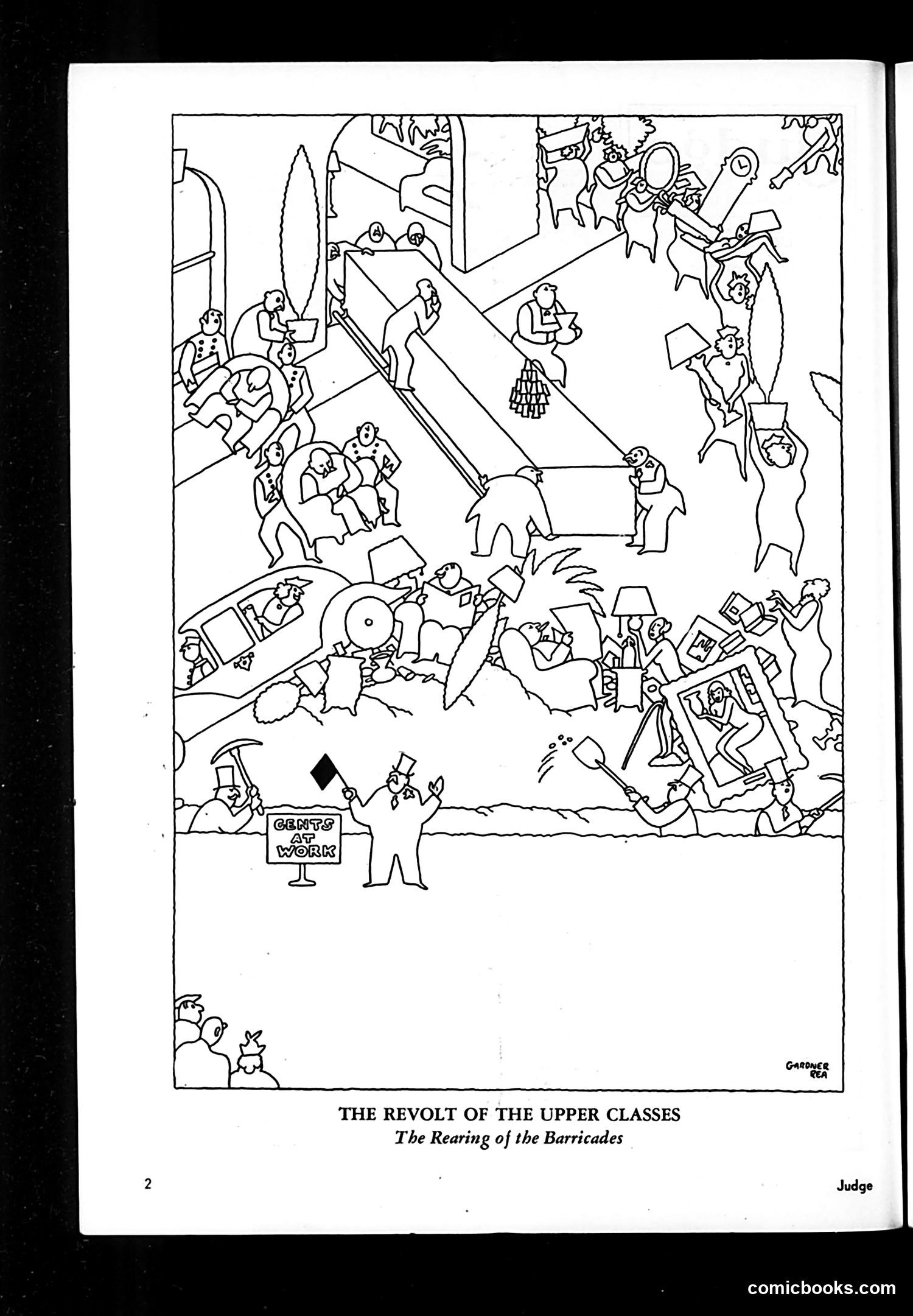
# "The Revolt of the Upper Classes: The Rearing of the Barricades" This Judge magazine cartoon satirizes wealthy elites constructing barricades, apparently in response to some perceived threat. The title suggests irony—traditionally, barricades are associated with working-class revolts, not upper-class ones. The scene depicts chaos among well-dressed figures building fortifications above ground level, with a conductor or ringmaster figure at the center holding a diamond, labeled "CENTS AT WORK" (text partially unclear). The elaborate, comedic architecture suggests the absurdity of the upper classes attempting defensive measures. Without specific dating context, the cartoon likely comments on class anxiety during a period of labor unrest or social upheaval, mocking wealthy fears by inverting the typical revolutionary narrative—positioning the rich as the ones "revolting" or panicking rather than organizing workers.
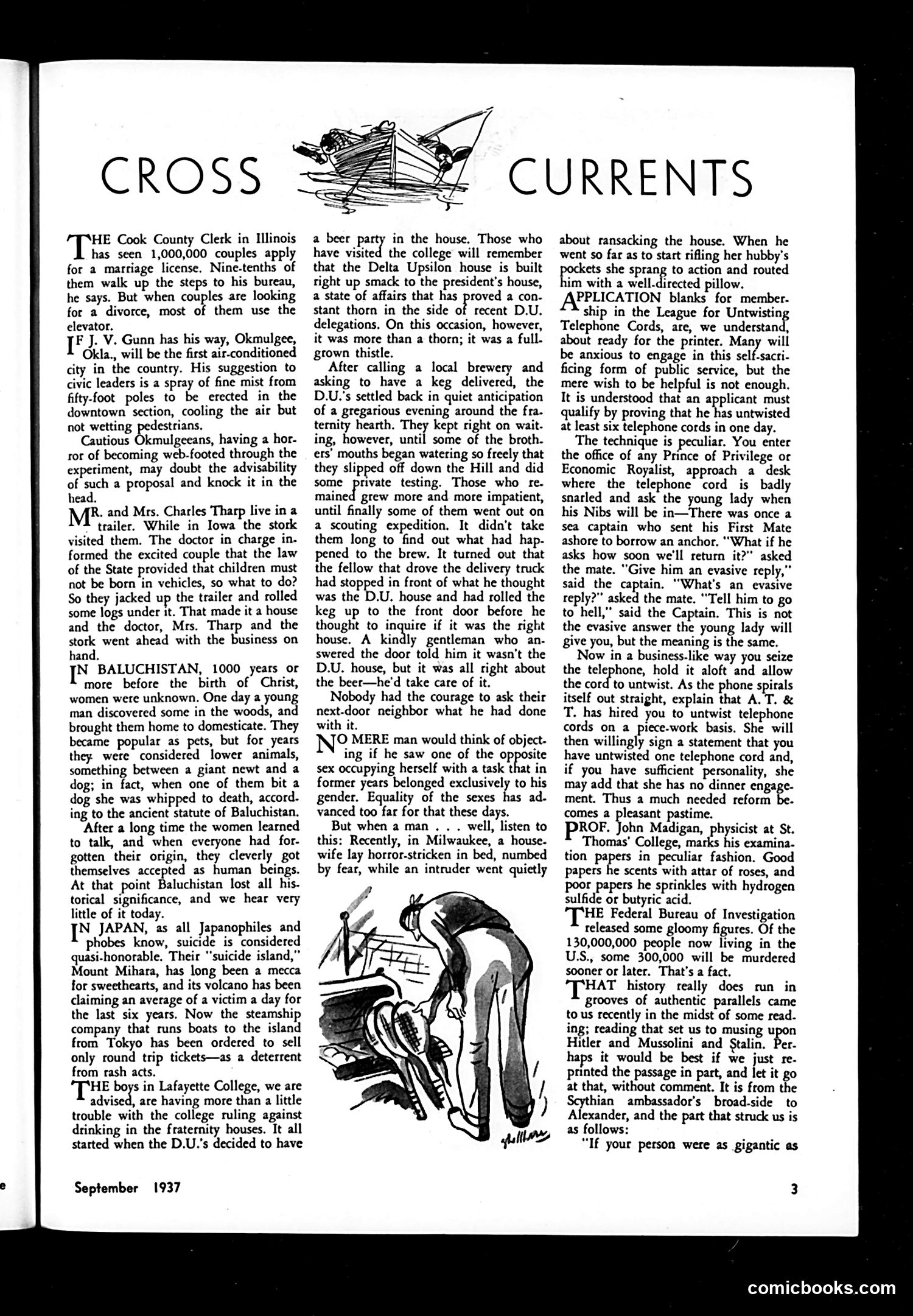
# Cross Currents - September 1937 This page contains multiple brief satirical anecdotes rather than a single cartoon. The illustration shows a person on a motorcycle/scooter being thrown or falling dramatically. The humor targets various social situations: Cook County marriage license seekers using elevators to avoid walking past the clerk's office; a proposal to erect fine mesh poles to keep pedestrians out of downtown Chicago; and college fraternity pranks at what appears to be a Delta Upsilon house involving beer deliveries. Other items mock outdated attitudes toward women (referencing "Baluchistan" and treatment of women as "lower animals"), Japanese militarism and suicide culture, and conclude with statistics about FBI crime figures and a reference to historical dictators Hitler, Mussolini, and Stalin. The satire is broadly social commentary typical of 1930s American humor magazines.
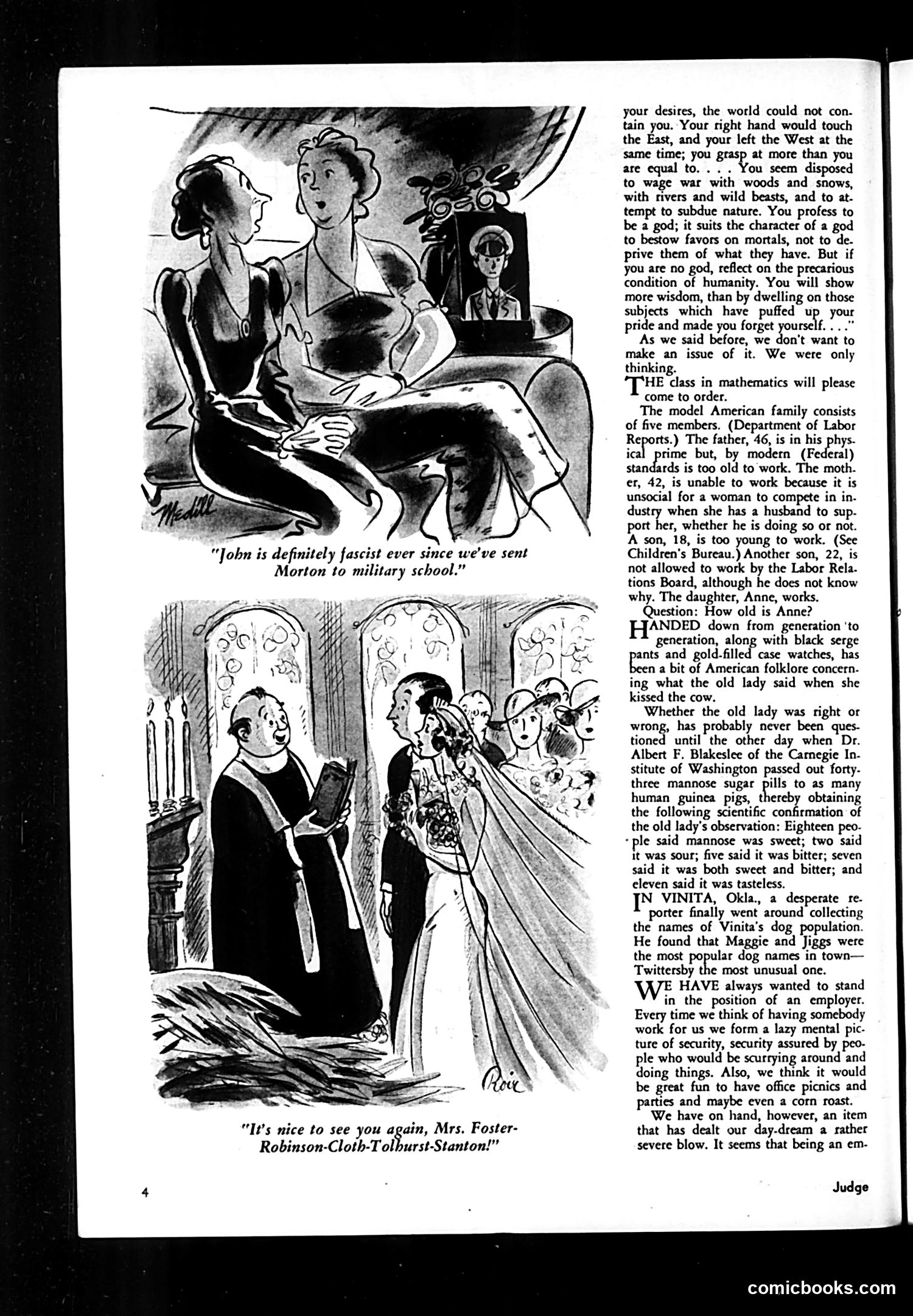
# Analysis of Judge Magazine Page This page contains two cartoons satirizing American social attitudes circa the 1930s-40s. **Top cartoon:** A couple discusses their son John's fascination with fascism after attending military school. The satire criticizes how military education might indoctrinate youth with authoritarian ideologies—a concern during the rise of fascism in Europe. **Bottom cartoon:** A man greets a woman with an extremely long, hyphenated name ("Mrs. Foster-Robinson-Cloth-Tolhurst-Stanton"), satirizing the social pretension of upper-class women who retained multiple surnames through marriages. The joke mocks excessive name-dropping and status-consciousness. The accompanying text discusses labor statistics and a humorous survey of dog names in Vinita, Oklahoma. The overall page reflects 1930s-40s American anxieties about fascism, class affectation, and social change.
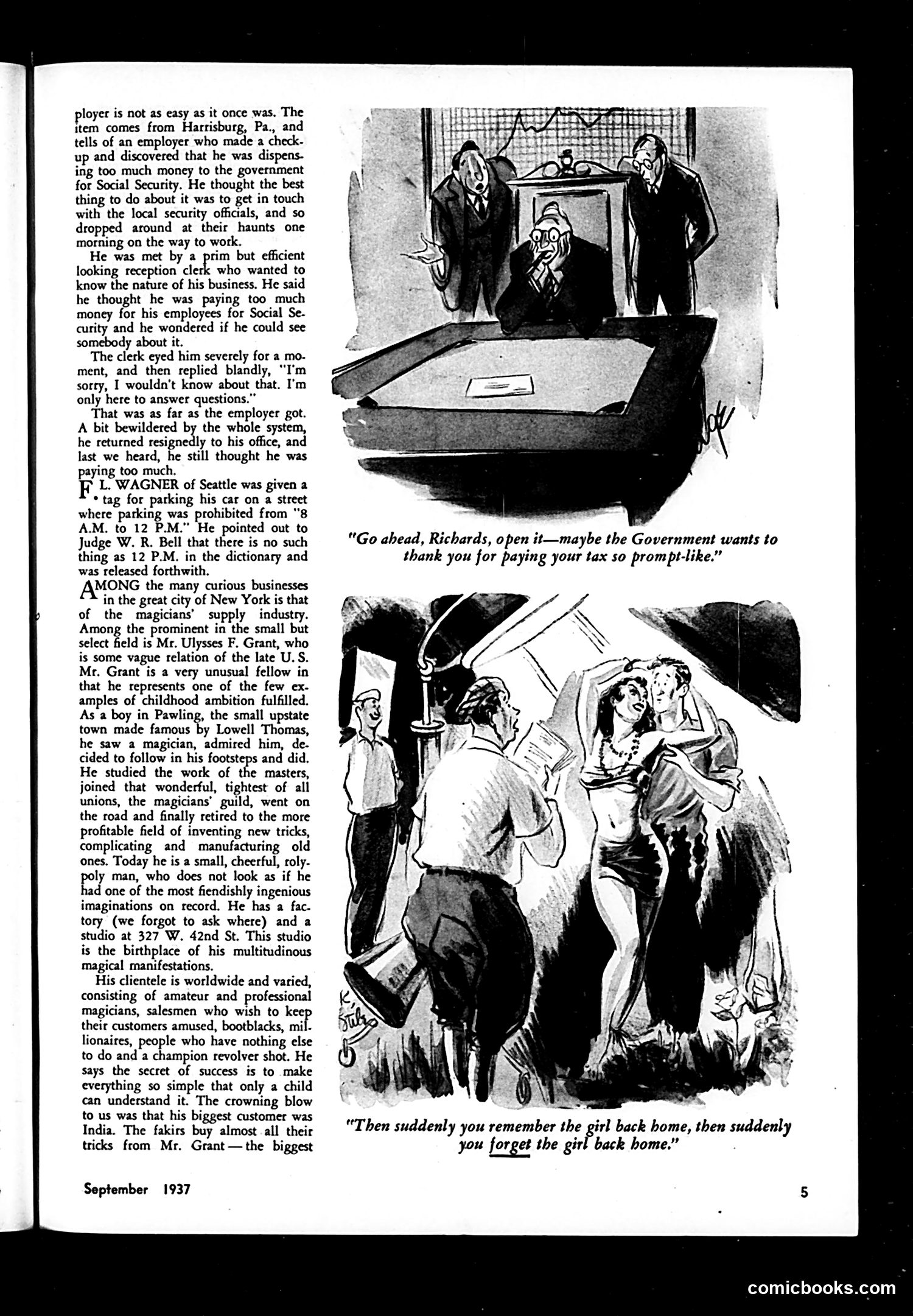
# Judge Magazine - September 1937 **Top Cartoon**: A tax official confronts a citizen named Richards about unpaid taxes. The joke satirizes government inefficiency—the official sarcastically thanks Richards for paying "prompt-like," implying taxpayers are dragging their feet on obligations. **Bottom Cartoon**: Shows a magician performing a trick involving a girl, with the caption "Then suddenly you remember the girl back home, then suddenly you forget the girl back home." This appears to satirize the distraction and sleight-of-hand tricks magicians use—or metaphorically, how easily people's attention and loyalty shift. The page also includes text about Ulysses F. Grant, a magician and inventor of magic tricks whose studio was in New York City, establishing context for the magic-related cartoon.
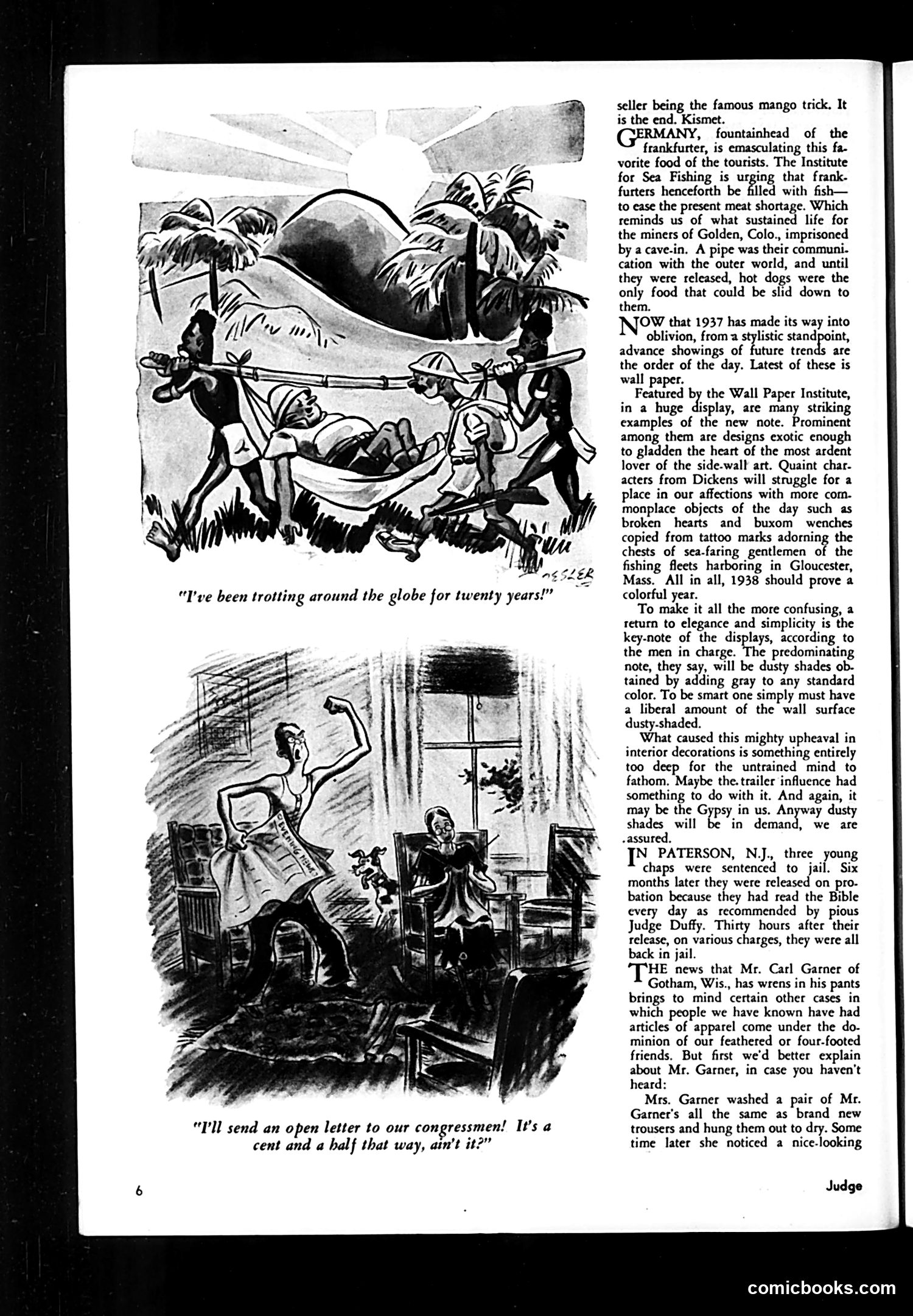
# Judge Magazine Page Analysis This page contains two satirical cartoons and accompanying text commentary typical of Judge magazine's style. **Top cartoon**: Shows figures around a globe, with the caption "I've been trolling around the globe for twenty years!" The satire appears to mock world travelers or adventurers who boast of extensive journeys. **Bottom cartoon**: Depicts someone writing to a congressman, captioned "I'll send an open letter to our congressman! It's a cent and a half that way, ain't it?" This satirizes the common practice of citizens complaining to elected officials, likely mocking both the effectiveness and cost-consciousness of such complaints. The accompanying text discusses various social topics including wallpaper trends for 1938, decorating fashions, and oddly-specific local news items (sentencing in Paterson, N.J., and wrens in Gotham, Wisconsin). The overall tone is humorous and somewhat cynical about American society and politics.
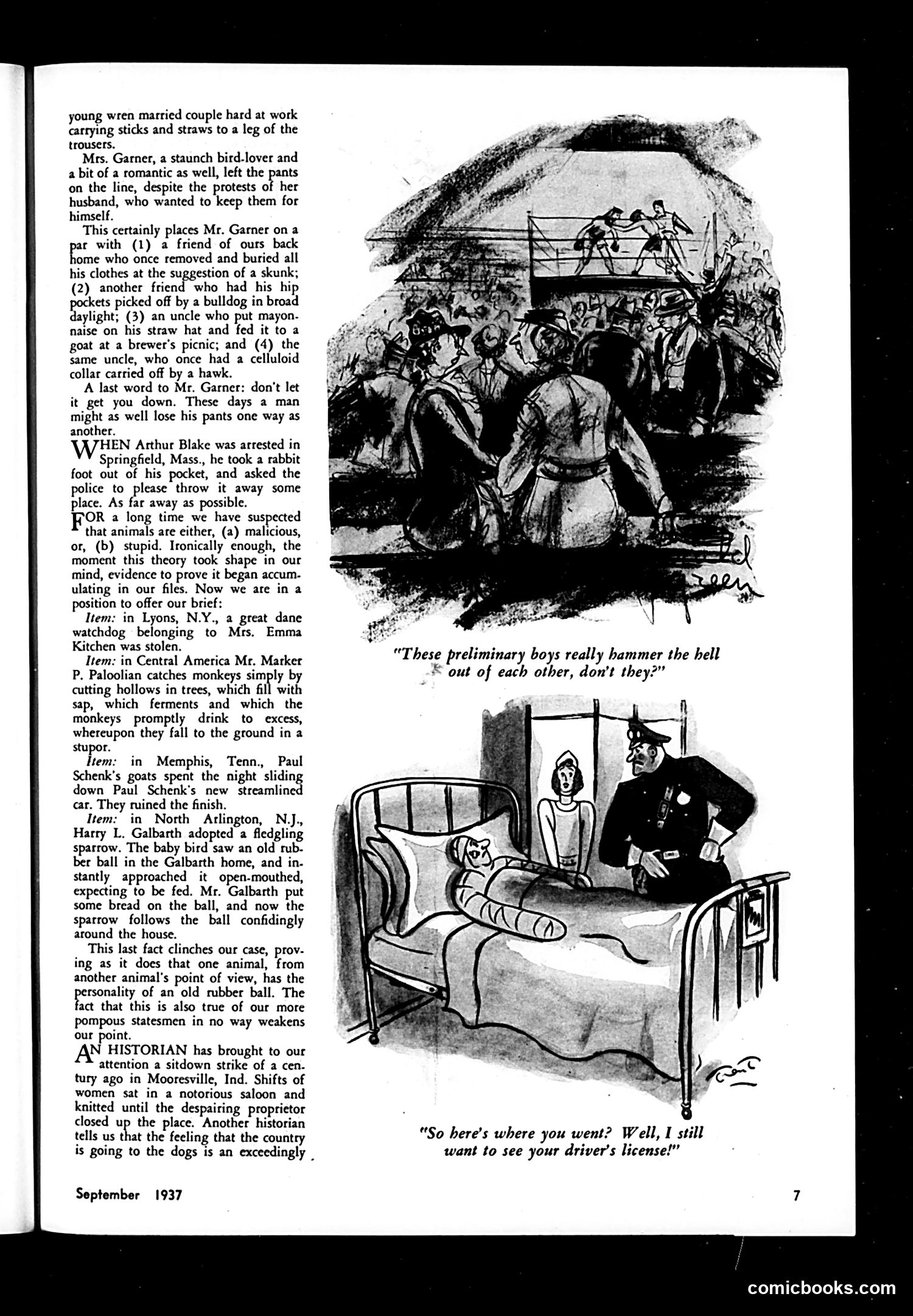
# Analysis of Judge Magazine Page, September 1937 This page contains two cartoon jokes and a humorous column of anecdotes about animal incidents. **Top cartoon**: Shows rowdy boys fighting, captioned "These preliminary boys really hammer the bell out of each other, don't they?" The humor appears to play on the phrase "ring the bell" versus literally "hammering," satirizing rough youth behavior. **Bottom cartoon**: Depicts a police officer in bed with a woman, captioned "So here's where you went? Well, I still want to see your driver's license!" This mocks law enforcement corruption or hypocrisy—a cop ignoring a woman's presence to demand documentation, implying he's more concerned with procedure than the compromising situation. The column above recounts various incidents where animals have caused chaos—dogs, monkeys, goats—illustrating themes about animal behavior and human response to unexpected situations.
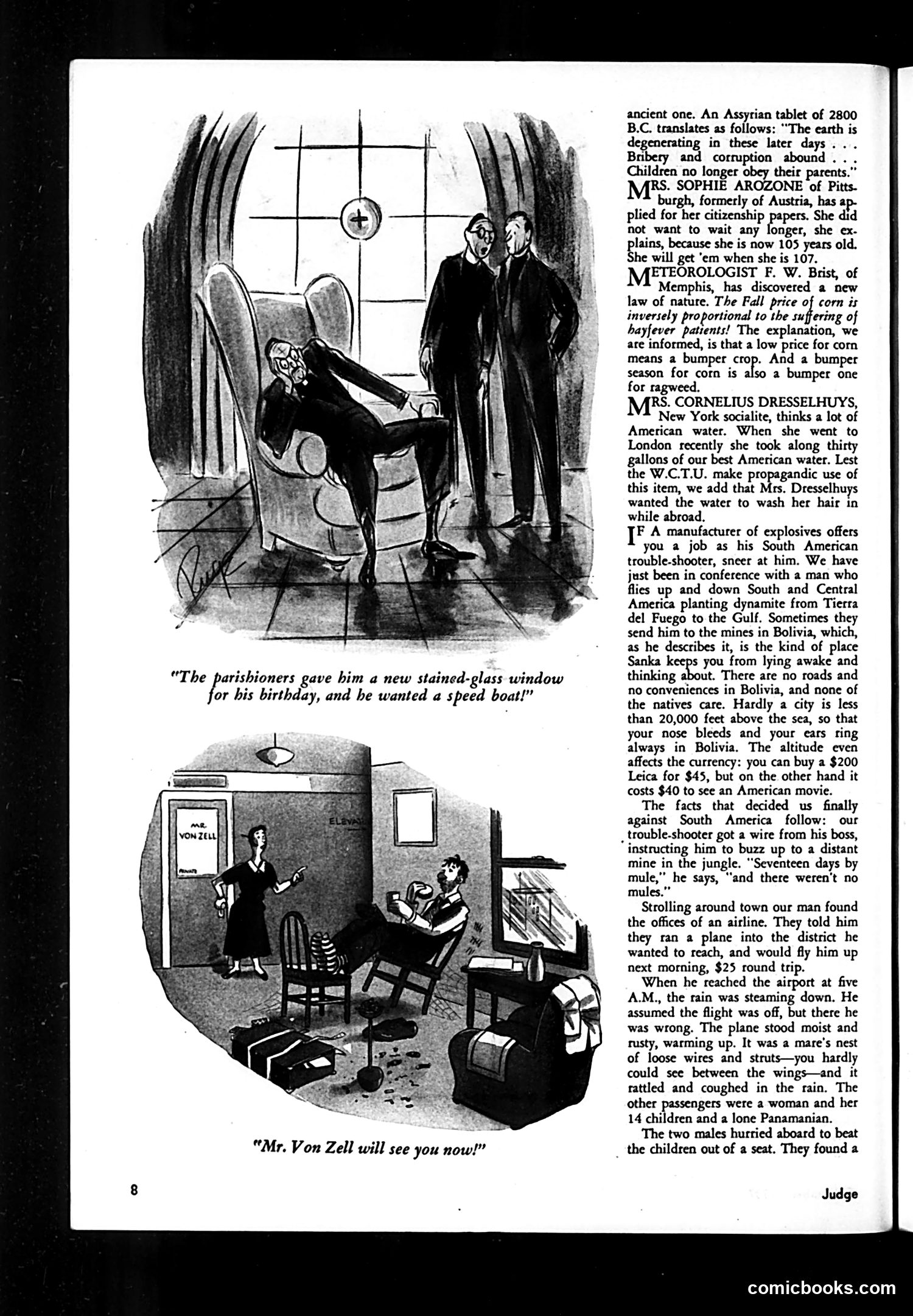
# Judge Magazine Page Analysis This page contains two cartoon vignettes and a humorous anecdote section typical of Judge magazine's satirical format. **Top cartoon**: "The parishioners gave him a new stained-glass window for his birthday, and he wanted a speed boat!" depicts a clergyman receiving an unwanted religious gift, satirizing the gap between donors' intentions and recipients' desires—likely mocking both religious hypocrisy and materialism. **Bottom cartoon**: "Mr. Von Zell will see you now!" shows a crowded, shabby office, appearing to satirize bureaucratic inefficiency or corporate dysfunction (Von Zell's identity is unclear from the image alone). **Text section**: A series of brief anecdotes mocking social pretension: a 105-year-old Austrian woman seeking citizenship, a meteorologist's dubious "discovery," a socialite importing American water to London, and an extended joke about a dynamite engineer's disastrous South American job—all targeting American upper-class affectation and naiveté about foreign conditions. The overall tone ridicules contemporary American social absurdities and class pretension.
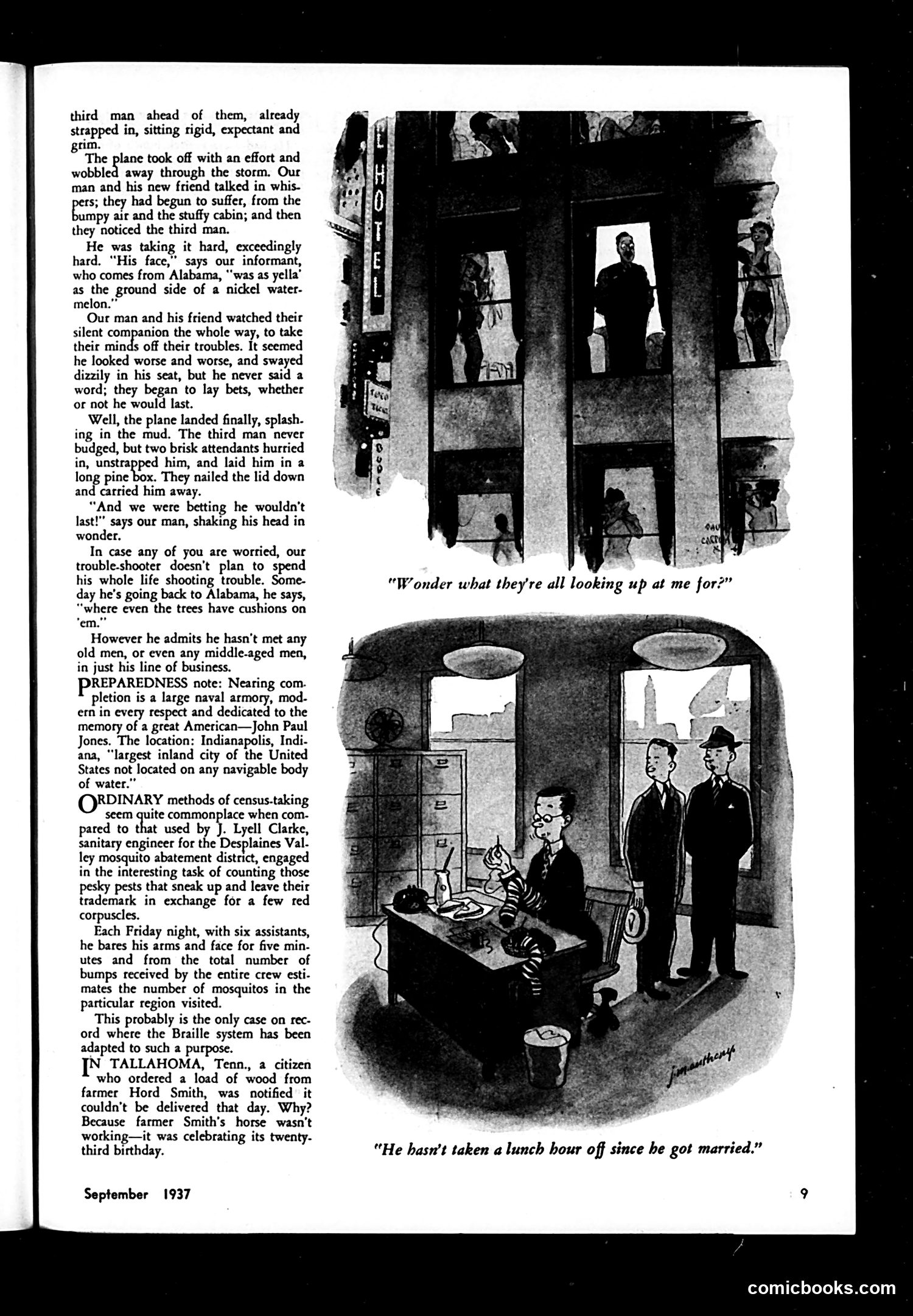
# Judge Magazine, September 1937 - Page Analysis This page contains two distinct pieces of satirical content: **Main Story (with photograph):** A humorous anecdote about an airplane passenger from Alabama who becomes extremely airsick during a flight. The joke's dark punchline reveals the man dies mid-flight and is placed in a coffin upon landing. The satire mocks both air travel's discomforts in the 1930s and the storyteller's casual Alabama dialect. **Bottom Cartoon:** Depicts a married man eating at a desk while two businessmen observe him. The caption "He hasn't taken a lunch hour off since he got married" satirizes the stereotype that marriage domesticates men, making them dutiful rather than carefree. The joke suggests married life keeps him chained to responsibility. **Sidebar Notes:** Include brief items about naval preparedness (Indianapolis armory) and an unusual mosquito census method using human test subjects—absurdist humor about unconventional pest control. The overall tone reflects 1930s American satirical humor: colloquial, sometimes crude, focused on social conformity and domestic life.
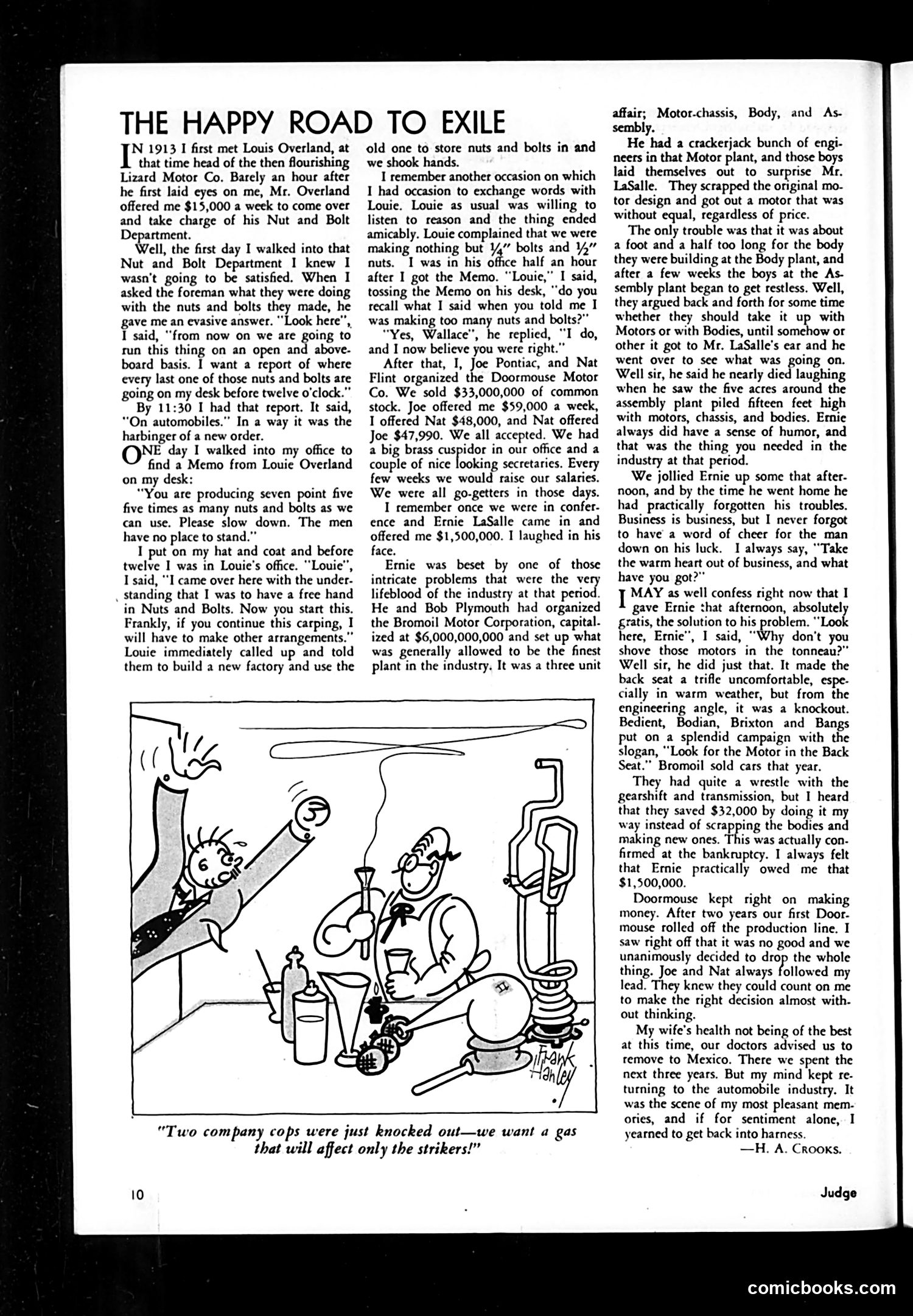
# "The Happy Road to Exile": Political Satire on Early Automotive Industry This is a satirical first-person narrative by H.A. Crooks about the chaotic early automobile industry (circa 1913). The unnamed narrator describes working at "Lizard Motor Co." under Louis Overland, then co-founding the absurdly capitalized "Doormouse Motor Co." with Joe Pontiac and Nat Flint—likely caricatures of real automotive figures. The satire mocks the era's rampant speculation, inflated salaries, and mismanagement: executives constantly raise their own pay while producing nothing practical. The embedded cartoon shows labor unrest, with strikers being attacked—a reference to actual violent industrial conflicts of the period. The "happy road to exile" suggests this unsustainable excess inevitably leads to financial ruin and departure (the narrator later mentions moving to Mexico for health reasons). The story ridicules both the industry's grandiose capitalism and its fundamental dysfunction, where engineering problems go unresolved while executives focus on money and status symbols.