
Judge, 1937-09 · page 25 of 36
Judge — September 1937 — page 25: what you’re looking at
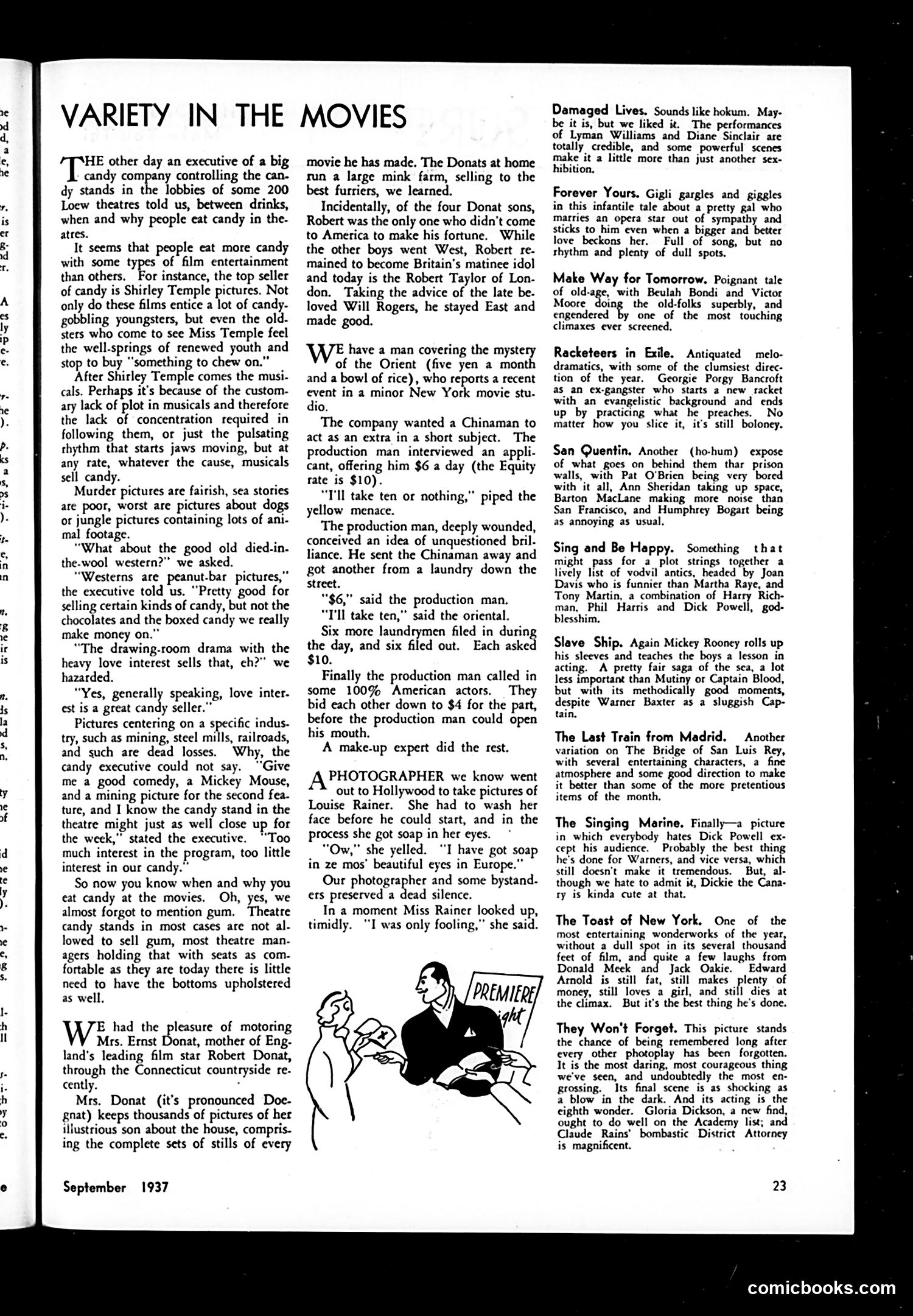
A restored page from Judge, 1937-09. Page through the whole issue in the reader above.
📄 Transcribed text from this page (OCR, searchable)
Machine-transcribed from the original scan — historical spelling and the odd misread are preserved.
VARIETY IN THE MOVIES Te other day an executive of a big candy company controlling the can- dy stands in the lobbies of some 200 Loew theatres told us, between drinks, when and why people eat candy in the- atres. It seems that people eat more candy with some types of film entertainment than others. For instance, the top seller of candy is Shirley Temple pictures. Not only do these films entice a lot of candy- gobbling youngsters, but even the old. sters who come to see Miss Temple feel the well-springs of renewed youth and stop to buy “something to chew on.” After Shirley Temple comes the musi- cals. Perhaps it’s because of the custom. ary lack of plot in musicals and therefore the lack of concentration required in following them, or just the pulsating rhythm that starts jaws moving, but at any rate, whatever the cause, musicals sell candy. Murder pictures are fairish, sea stories are poor, worst are pictures about dogs or jungle pictures containing lots of ani- mal footage. “What about the good old died.in. the-wool western?” we asked. “Westerns are peanut-bar pictures,” the executive told us. “Pretty good for selling certain kinds of candy, but not the chocolates and the boxed candy we really make money on.” “The drawing-room drama with the heavy love interest sells that, eh?” we hazarded. “Yes, generally speaking, love inter- est is a great candy seller.” Pictures centering on a specific indus- try, such as mining, steel mills, railroads, and such are dead losses. Why, the candy executive could not say. “Give me a good comedy, a Mickey Mouse, and a mining picture for the second fea- ture, and I know the candy stand in the theatre might just as well close up for the week,” stated the executive. ‘Too much interest in the program, too little interest in our candy.” So now you know when and why you eat candy at the movies. Oh, yes, we almost forgot to mention gum. Theatre candy stands in most cases are not al- lowed to sell gum, most theatre man- agers holding that with seats as com- fortable as they are today there is little need to have the bottoms upholstered as well. W:t had the pleasure of motoring Mrs. Ernst Donat, mother of Eng- land’s leading film star Robert Donat, through the Connecticut countryside re- cently. Mrs. Donat (it's pronounced Doe- gnat) keeps thousands of pictures of her illustrious son about the house, compris- ing the complete sets of stills of every September 1937 movie he has made. The Donats at home run a large mink farm, selling to the best furriers, we learned. Incidentally, of the four Donat sons, Robert was the only one who didn’t come to America to make his fortune. While the other boys went West, Robert re. mained to become Britain’s matinee idol and today is the Robert Taylor of Lon. don. Taking the advice of the late be- loved Will Rogers, he stayed East and made good. WE have a man covering the myste! of the Orient (five yen a montl and a bowl of rice), who reports a recent great in a minor New York movie stu- 10. The company wanted a Chinaman to act as an extra in a short subject. The production man interviewed an appli- cant, offering him $6 a day (the Equity rate is $10). “T'll take ten or nothing,” piped the yellow menace. The production man, deeply wounded, conceived an idea of unquestioned bril- liance. He sent the Chinaman away and got another from a laundry down the street. “$6,” said the production man. “T'll take ten,” said the oriental. Six more laundrymen filed in durin; the day, and six filed out. Each asked $10. Finally the production man called in some 100% American actors. They bid each other down to $4 for the part, before the production man could open his mouth, A make-up expert did the rest. AA PHOTOGRAPHER we know went out to Hollywood to take pictures of Louise Rainer. She had to wash her face before he could start, and in the process she got soap in her eyes. “Ow,” she yelled. “I have got soap in ze mos’ beautiful eyes in Europe.” Our photographer and some bystand- ers preserved a dead silence. In a moment Miss Rainer looked up, timidly. “I was only fooling,” she said. PREMIERE Damaged Lives. Sounds like hokum. May- be it is, but we liked it. The performances of Lyman Williams and Diane Sinclair are totally credible, and some powerful scenes make it a little more than just another sex- hibition. Forever Yours. Gigli gargles and giggles in this infantile tale about a pretty gal who marries an opera star out of sympathy and sticks to him even when a bigger and better love beckons her. Full of song, but no rhythm and plenty of dull spots. Make Way for Tomorrow. Poignant tale of old-age, with Beulah Bondi and Victor Moore doing the old-folks superbly, and engendered by one of the most touching climaxes ever screened, Racketeers in Exile. Antiquated melo- dramatics, with some of the clumsiest direc- tion of the year. Georgie Porgy Bancroft as an ex-gangster who starts a new racket with an evangelistic background and ends up by practicing what he preaches. No matter how you slice it, it's still boloney. San Quentin. Another (ho-hum) expose of what goes on behind them thar prison walls, with Pat O'Brien being very bored with it all, Ann Sheridan taking up space, Barton MacLane making more noise than San Francisco, and Humphrey Bogart being as annoying as usual. Sing and Be Happy. Something that might pass for a plot strings together a lively list of vodvil antics, headed by Joan Davis who is funnier than Martha Raye, and Tony Martin, a combination of Harry Rich- man, Phil Harris and Dick Powell, god- blesshim. Slave Ship. Again Mickey Rooney rolls up his sleeves and teaches the boys a lesson in acting. A pretty fair saga of the sea, a lot less important than Mutiny or Captain Blood, but with its methodically good moments, despite Warner Baxter as a sluggish Cap- tain, The Last Train from Madrid. Another variation on The Bridge of San Luis Rey, with several entertaining characters, a fine atmosphere and some good direction to make it better than some of the more pretentious items of the month, The Singing Marine. Finally—a picture in which everybody hates Dick Powell ex- cept his audience. Probably the best thing he's done for Warners, and vice versa, whic! still doesn’t make it tremendous. But, al- though we hate to admit it, Dickie the Cana- ty is kinda cute at that. The Toast of New York. One of the most entertaining wonderworks of the year, without a dull spot in its several thousand feet of film, and quite a few laughs from Donald Meck and Jack Oakie. ” Edward Arnold is still fat, ‘still makes plenty of money, still loves a girl, and still dies at the climax. But it’s the best thing he's done. They Won't Forget. This picture stands the chance of being remembered long after every other photoplay has been forgotten. It is the most daring, most courageous thing we've seen, and undoubtedly the most en- grossing. Its final scene is as shocking as a blow in the dark. And its acting is the eighth wonder. Gloria Dickson, a new find, ought to do well on the Academy list; and Claude Rains’ bombastic District Attorney is magnificent. 23 comicbooks.com