
Judge, 1937-09 · page 12 of 36
Judge — September 1937 — page 12: what you’re looking at
What you’re looking at
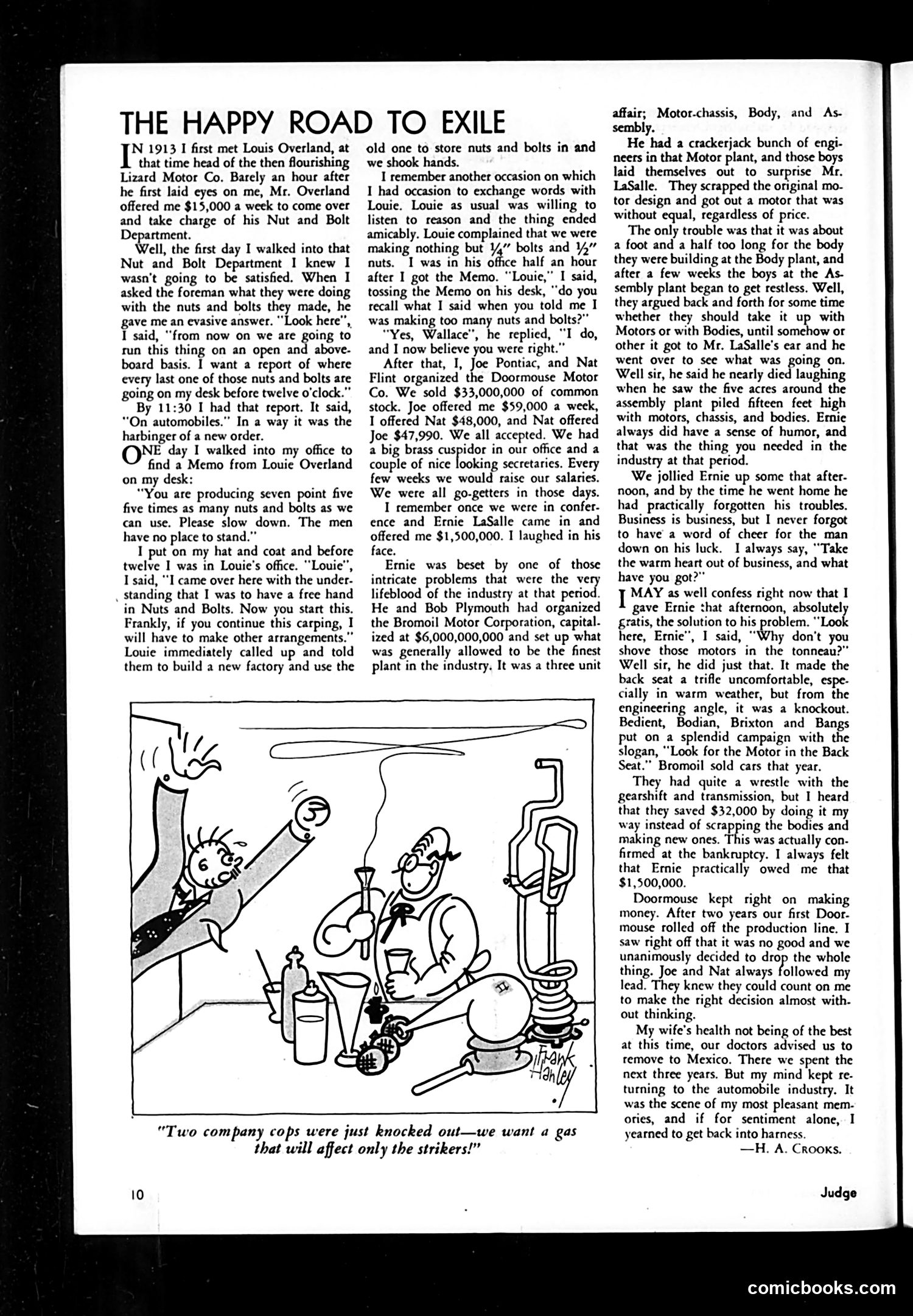
# "The Happy Road to Exile": Political Satire on Early Automotive Industry This is a satirical first-person narrative by H.A. Crooks about the chaotic early automobile industry (circa 1913). The unnamed narrator describes working at "Lizard Motor Co." under Louis Overland, then co-founding the absurdly capitalized "Doormouse Motor Co." with Joe Pontiac and Nat Flint—likely caricatures of real automotive figures. The satire mocks the era's rampant speculation, inflated salaries, and mismanagement: executives constantly raise their own pay while producing nothing practical. The embedded cartoon shows labor unrest, with strikers being attacked—a reference to actual violent industrial conflicts of the period. The "happy road to exile" suggests this unsustainable excess inevitably leads to financial ruin and departure (the narrator later mentions moving to Mexico for health reasons). The story ridicules both the industry's grandiose capitalism and its fundamental dysfunction, where engineering problems go unresolved while executives focus on money and status symbols.
📄 Transcribed text from this page (OCR, searchable)
Machine-transcribed from the original scan — historical spelling and the odd misread are preserved.
THE HAPPY ROAD TO EXILE N 1913 I first met Louis Overland, at that time head of the then flourishing Lizard Motor Co. Barely an hour after he first laid eyes on me, Mr. Overland offered me $15,000 a week to come over and take charge of his Nut and Bolt Department. ell, the first day I walked into that Nut and Bolt Department I knew I wasn't going to be satisfied. When I asked the foreman what they were doing with the nuts and bolts they made, he gave me an evasive answer. “Look here”, I said, “from now on we are going to run this thing on an open and above- board basis. I want a report of where every last one of those nuts and bolts are going on my desk before twelve o'clock.” By 11:30 I had that report. It said, “On automobiles.” In a way it was the harbinger of a new order. ONE day I walked into my office to find a Memo from Louie Overland on my desk: “You are producing seven point five five times as many nuts and bolts as we can use. Please slow down. The men have no place to stand.” I put on my hat and coat and before twelve I was in Louie's office. “Louie”, I said, “I came over here with the under- , Standing that I was to have a free hand in Nuts and Bolts. Now you start this. Frankly, if you continue this carping, I will have to make other arrangements.” Louie immediately called up and told them to build a new factory and use the old one to store nuts and bolts in and we shook hands. I remember another occasion on which I had occasion to exchange words with Louie. Louie as usual was willing to listen to reason and the thing ended amicably. Louie complained that we were making nothing but 14” bolts and 14” nuts. I was in his office half an hour after I got the Memo. “Louie,” I said, tossing the Memo on his desk, “do you recall what I said when you told me I was making too many nuts and bolts?” “Yes, Wallace”, he replied, “I do, and I now believe you were right.” After that, I, Joe Pontiac, and Nat Flint organized the Doormouse Motor Co. We sold $33,000,000 of common stock. Joe offered me $59,000 a week, I offered Nat $48,000, and Nat offered Joe $47,990. We all accepted. We had a big brass cuspidor in our office and a couple of nice looking secretaries. Every few weeks we would raise our salaries. We were all go-getters in those days. I remember once we were in confer- ence and Ernie LaSalle came in and offered me $1,500,000. I laughed in his face. Ernie was beset by one of those intricate problems that were the very lifeblood of the industry at that period. He and Bob Plymouth had organized the Bromoil Motor Corporation, capital- ized at $6,000,000,000 and set up what was generally allowed to be the finest plant in the industry, It was a three unit “Two company cops were just knocked out—we want a gas that will affect only the strikers!” affair; Motor-chassis, Body, and As- sembly. He had a crackerjack bunch of engi- neers in that Motor plant, and those boys laid themselves out to surprise Mr. LaSalle. They scrapped the original mo. tor design and got out a motor that was without equal, regardless of price. The only trouble was that it was about a foot and a half too long for the body they were building at the Body plant, and after a few weeks the boys at the As- sembly plant began to get restless. Well, they argued back and forth for some time whether they should take it up with Motors or with Bodies, until somehow or other it got to Mr. LaSalle’s ear and he went over to see what was going on. Well sir, he said he nearly died laughing when he saw the five acres around the assembly plant piled fifteen feet high with motors, chassis, and bodies. Ernie always did have a sense of humor, and that was the thing you needed in the industry at that period. We jollied Ernie up some that after- noon, and by the time he went home he had practically forgotten his troubles. Business is business, but I never forgot to have a word of cheer for the man down on his luck. I always say, “Take the warm heart out of business, and what have you got?” I MAY as well confess right now that I gave Ernie that afternoon, absolutel §ratis, the solution to his problem. “Look here, Ernie”, I said, “Why don’t you shove those motors in the tonneau?” Well sir, he did just that. It made the back seat a trifle uncomfortable, espe- cially in warm weather, but from the engineering angle, it was a knockout. Bedient, Bodian, Brixton and Bangs put on a splendid campaign with the slogan, “Look for the Motor in the Back Seat.” Bromoil sold cars that year. They had quite a wrestle with the gearshift and transmission, but I heard that they saved $32,000 by doing it my way instead of scrapping the bodies and making new ones. This was actually con- firmed at the bankruptcy. I always felt that Ernie practically owed me that $1,500,000. Doormouse kept right on making money. After two years our first Door- mouse rolled off the production line. I saw right off that it was no good and we unanimously decided to drop the whole thing. Joe and Nat always followed my lead. They knew they could count on me to make the right decision almost with. out thinking. My wife's health not being of the best at this time, our doctors advised us to remove to Mexico. There we spent the next three years. But my mind kept re- turning to the automobile industry. It was the scene of my most pleasant mem- ories, and if for sentiment alone, I yearned to get back into harness. —H. A. Crooks. Judge comicbooks.com