
Judge, 1937-09 · page 7 of 36
Judge — September 1937 — page 7: what you’re looking at
What you’re looking at
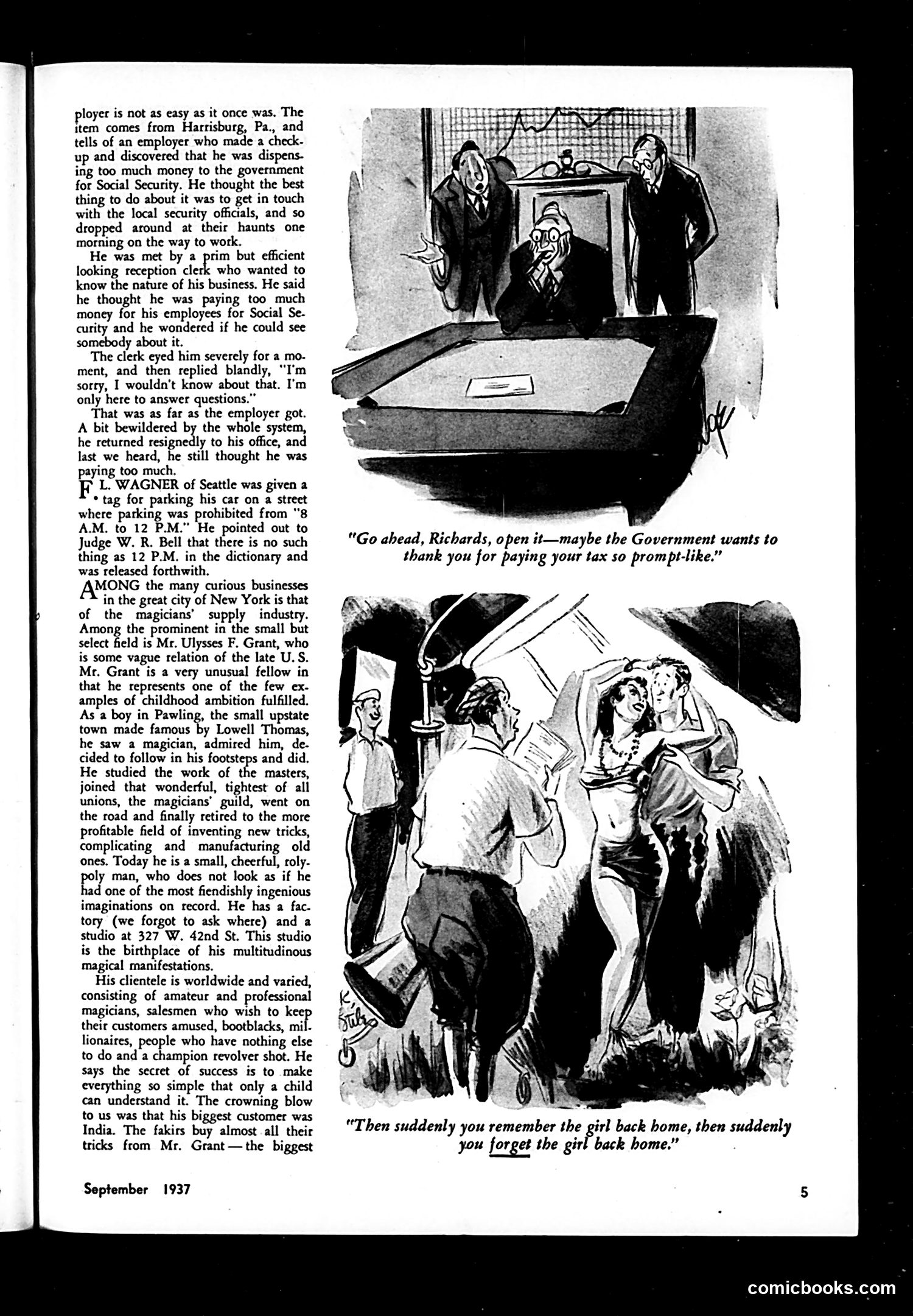
# Judge Magazine - September 1937 **Top Cartoon**: A tax official confronts a citizen named Richards about unpaid taxes. The joke satirizes government inefficiency—the official sarcastically thanks Richards for paying "prompt-like," implying taxpayers are dragging their feet on obligations. **Bottom Cartoon**: Shows a magician performing a trick involving a girl, with the caption "Then suddenly you remember the girl back home, then suddenly you forget the girl back home." This appears to satirize the distraction and sleight-of-hand tricks magicians use—or metaphorically, how easily people's attention and loyalty shift. The page also includes text about Ulysses F. Grant, a magician and inventor of magic tricks whose studio was in New York City, establishing context for the magic-related cartoon.
📄 Transcribed text from this page (OCR, searchable)
Machine-transcribed from the original scan — historical spelling and the odd misread are preserved.
loyer is not as easy as it once was. The item comes from Harrisburg, Pa., and tells of an employer who made a check- up and discovered that he was dispens- ing too much money to the government for Social Security. He thought the best thing to do about it was to get in touch with the local security officials, and so dropped around at their haunts one morning on the way to work. He was met by a prim but efficient looking reception clerk who wanted to know the nature of his business. He said he thought he was paying too much money for his employees for Social Se- curity and he wondered if he could see somebody about it. The clerk eyed him severely for a mo. ment, and then replied blandly, “I'm sorry, I wouldn't know about that. I'm only here to answer questions.” That was as far as the employer got. A bit bewildered by the whole system, he returned resignedly to his office, and last we heard, he still thought he was paying too much, F L. WAGNER of Seattle was given a * tag for parking his car on a street where parking was prohibited from “8 . A.M. to 12 P.M.” He pointed out to . in Judge W. R. Bell that hace is no such "Go ahead, Richards, open it—maybe the Government wants to thing as 12 P.M. in the dictionary and thank you for paying your tax so prompt-like.” was released forthwith. AMONG the many curious businesses in the great city of New York is that of the magicians’ supply industry. Among the prominent in the small but select field is Mr. Ulysses F. Grant, who is some vague relation of the late U.S. Mr. Grant is a very unusual fellow in that he represents one of the few ex- amples of childhood ambition fulfilled. As a boy in Pawling, the small upstate town made famous by Lowell Thomas, he saw a magician, admired him, de- cided to follow in his footsteps and did. He studied the work of the masters, joined that wonderful, tightest of all unions, the magicians’ guild, went on the road and finally retired to the more profitable field of inventing new tricks, complicating and manufacturing old ones. Today he is a small, cheerful, roly- poly man, who does not look as if he had one of the most fiendishly ingenious imaginations on record. He has a fac. tory (we forgot to ask where) and a studio at 327 W. 42nd St. This studio is the birthplace of his multitudinous magical manifestations. His clientele is worldwide and varied, consisting of amateur and professional magicians, salesmen who wish to keey their customers amused, bootblacks, mil- lionaires, people who have nothing else to do and a champion revolver shot. He says the secret of success is to make everything so simple that only a child can understand it. The crowning blow . to us was that his biggest customer w: A india, ‘The fakirs be alae all ther “Then suddenly you remember the girl back home, then suddenly tricks from Mr. Grant —the biggest you forget the girl back home.” September 1937 comicbooks.com