
Judge, 1937-09 · page 19 of 36
Judge — September 1937 — page 19: what you’re looking at
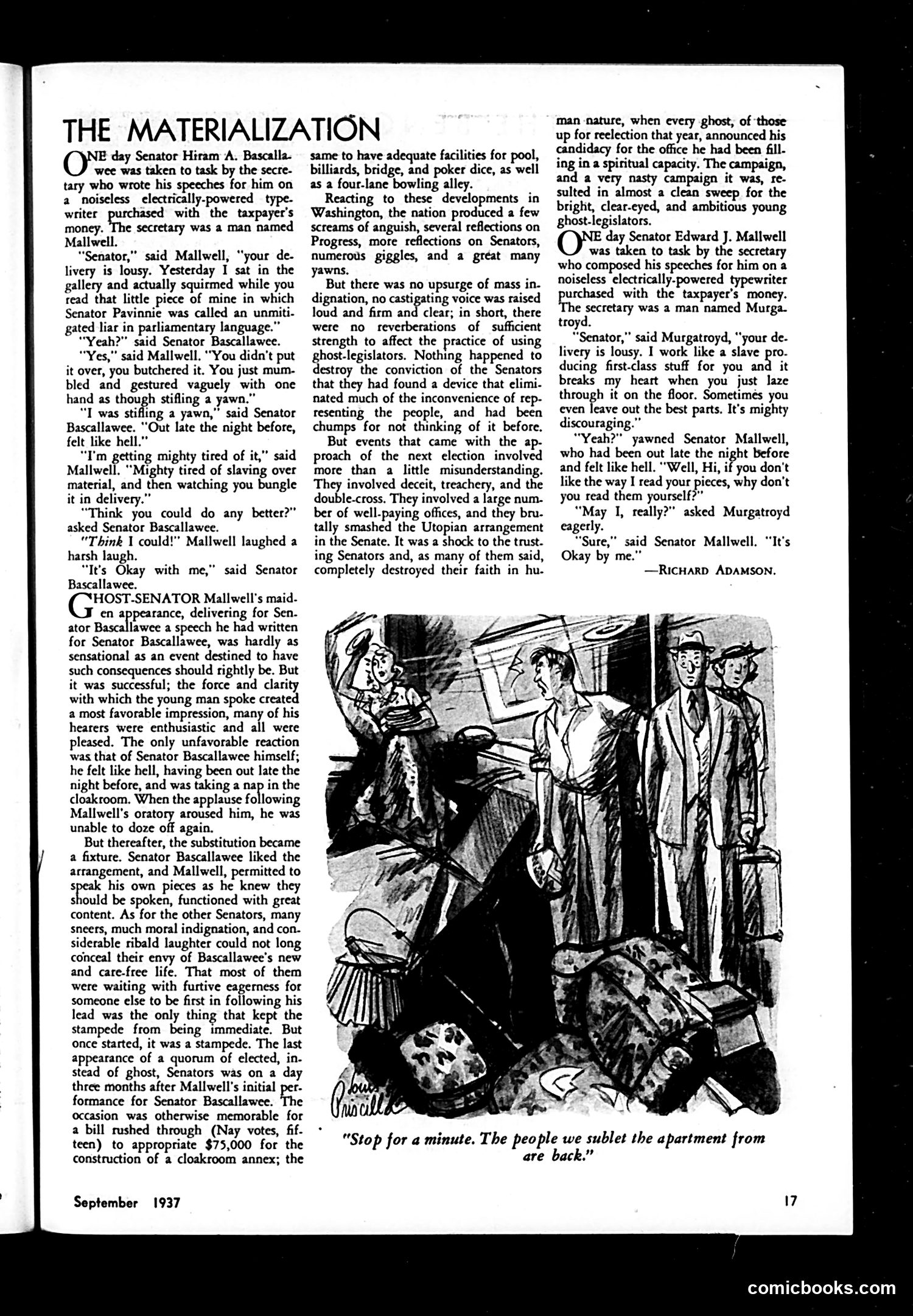
A restored page from Judge, 1937-09. Page through the whole issue in the reader above.
📄 Transcribed text from this page (OCR, searchable)
Machine-transcribed from the original scan — historical spelling and the odd misread are preserved.
THE MATERIALIZATION Om day Senator Hiram A. Bascalla- wee was taken to task by the secre- tary who wrote his speeches for him on a noiseless electrically-powered type. writer purchased with the taxpayer's money. The secretary was a man named Mallwell. “Senator,” said Mallwell, “your de- livery is lousy. Yesterday I sat in the gallery and actually squirmed while you read that little piece of mine in which Senator Pavinnie was called an unmiti- gated liar in parliamentary language.” “Yeah?” said Senator Bascallawee. “Yes,” said Mallwell. “You didn’t put it over, you butchered it. You just mum. bled and gestured vaguely with one hand as though stifling a yawn.” “I was stifling a yawn,” said Senator Bascallawee. “Out late the night before, felt like hell.” “I'm getting mighty tired of it,” said Mallwell. “Mighty tired of slaving over material, and then watching you bungle it in delivery.” “Think you could do any better?” asked Senator Bascallawee. “Think 1 could!” Mallwell laughed a harsh laugh. “It's Okay with me,” said Senator Bascallawee. HOST-SENATOR Mallwell’s maid- en appearance, delivering for Sen- ator Bascallawee a speech he had written for Senator Bascallawee, was hardly as sensational as an event destined to have such consequences should rightly be. But it was successful; the force and clarity with which the young man spoke created a most favorable impression, many of his hearers were enthusiastic and all were pleased. The only unfavorable reaction was that of Senator Bascallawee himself; he felt like hell, having been out late the night before, and was taking a nap in the cloakroom. When the applause following Mallwell’s oratory aroused him, he was unable to doze off again. But thereafter, the substitution became a fixture. Senator Bascallawee liked the arrangement, and Mallwell, permitted to sper his own pieces as he knew they ould be spoken, functioned with great content. As for the other Senators, many sneers, much moral indignation, and con. siderable ribald laughter could not long conceal their envy of Bascallawee's new and care-free life. That most of them were waiting with furtive eagerness for someone else to be first in following his lead was the only thing that kept the stampede from being immediate. But once started, it was a stampede. The last appearance of a quorum of elected, in- stead of ghost, Senators was on a day three months after Mallwell’s initial per- formance for Senator Bascallawee. The occasion was otherwise memorable for a bill rushed through (Nay votes, fif- teen) to appropriate $75,000 for the construction of a cloakroom annex; the September 1937 same to have adequate facilities for pool, billiards, bridge, and poker dice, as well as a four-lane bowling alley. Reacting to these developments in Washington, the nation produced a few screams of anguish, several reflections on Progress, more reflections on Senators, numerous giggles, and a great many yawns. But there was no upsurge of mass in- dignation, no castigating voice was raised loud and firm and clear; in short, there were no reverberations of sufficient strength to affect the practice of using ghost-legislators. Nothing happened to destroy the conviction of the Senators that they had found a device that elimi- nated much of the inconvenience of rep- resenting the people, and had been chumps for not thinking of it before. But events that came with the ap- proach of the next election involved more than a little misunderstanding. They involved deceit, treachery, and the double-cross. They involved a large num. ber of well-paying offices, and they bru- tally smashed the Utopian arrangement in the Senate. It was a shock to the trust. ing Senators and, as many of them said, completely destroyed their faith in hu- man nature, when every ghost, of those up for reelection that year, announced his candidacy for the office he had been fill- ing in a spiritual capacity. The campaign, and a very nasty campaign it was, re- sulted in almost a clean sweep for the bright, clear-eyed, and ambitious young ghost-legislators. Ou day Senator Edward J. Mallwell was taken to task by the secretary who composed his speeches for him on a noiseless electrically-powered typewriter urchased with the taxpayer's money. e secretary was a man named Murga. troyd. “Senator,” said Murgatroyd, “your de- livery is lousy. I work like a slave pro. ducing first-class stuff for you and it breaks my heart when you just laze through it on the floor. Sometimes you even leave out the best parts. It's mighty discouraging.” “Yeah?” yawned Senator Mallwell, who had been out late the night before and felt like hell. “Well, Hi, if you don't like the way I read your pieces, why don’t you read them yourself?” “May I, really?” asked Murgatroyd eagerly. “Sure,” said Senator Mallwell. “It’s Okay by me.” —RIcHARD ADAMSON. “Stop for a minute. The people we sublet the apartment from are back.” comicbooks.com