
Judge, 1937-09 · page 20 of 36
Judge — September 1937 — page 20: what you’re looking at
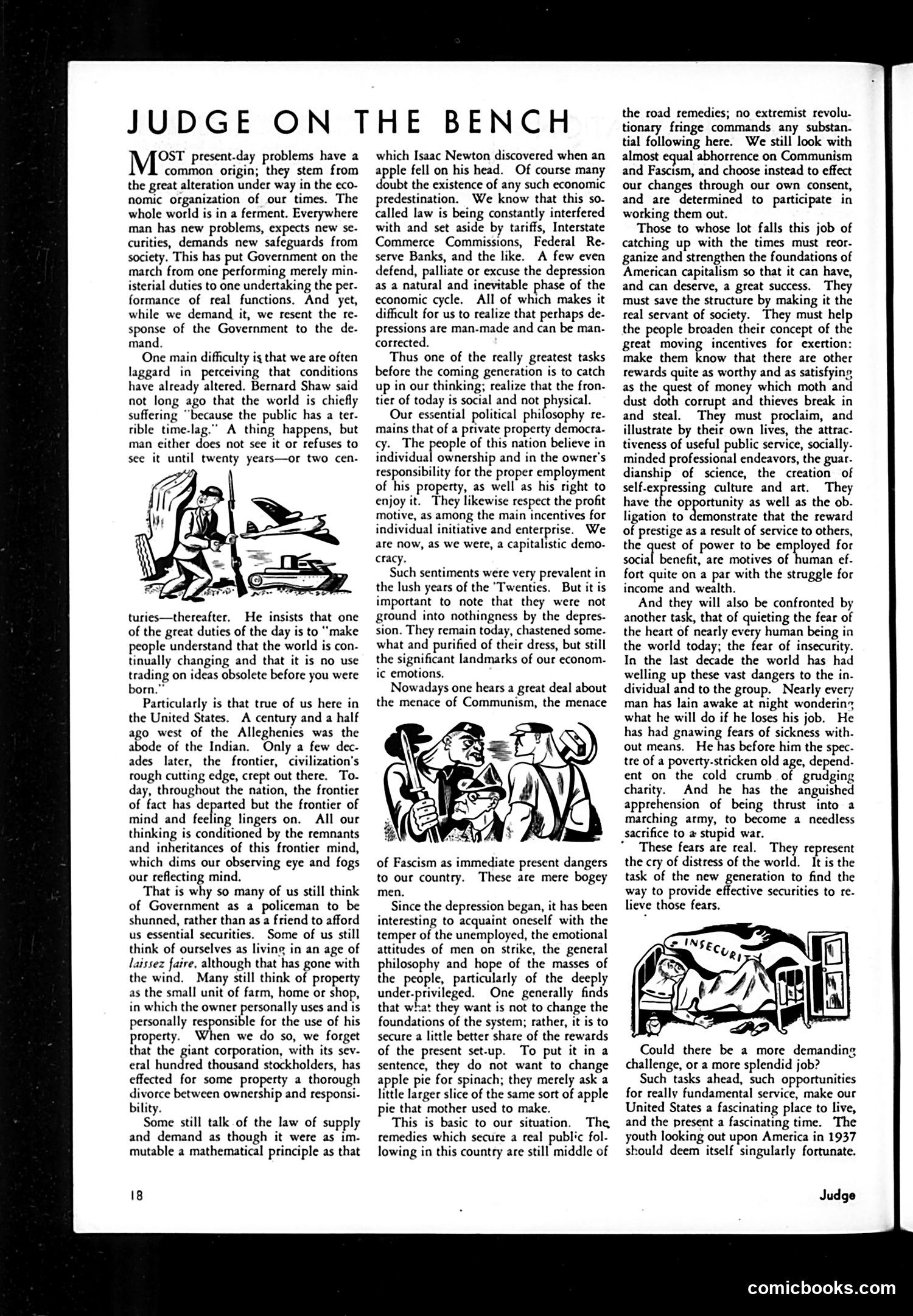
A restored page from Judge, 1937-09. Page through the whole issue in the reader above.
📄 Transcribed text from this page (OCR, searchable)
Machine-transcribed from the original scan — historical spelling and the odd misread are preserved.
JUDGE ON THE BENCH Mc present-day problems have a common origin; they stem from the great alteration under way in the eco- nomic organization of our times. The whole world is in a ferment. Everywhere man has new problems, expects new se- curities, demands new safeguards from society. This has put Government on the march from one performing merely min- isterial duties to one undertaking the per- formance of real functions, And yet, while we demand it, we resent the re- sponse of the Government to the de- mand. One main difficulty ig that we are often laggard in perceiving that conditions have already altered. Bernard Shaw said not long ago that the world is chiefly suffering “because the public has a ter- rible time-lag.” A thing happens, but man either does not see it or refuses to see it until twenty years—or two cen- turies—thereafter. He insists that one of the great duties of the day is to “make people understand that the world is con- tinually changing and that it is no use trading on ideas obsolete before you were born.” Particularly is that true of us here in the United States. A century and a half ago west of the Alleghenies was the abode of the Indian. Only a few dec- ades later, the frontier, civilization’s rough cutting edge, crept out there. To- day, throughout the nation, the frontier of fact has departed but the frontier of mind and feeling lingers on. All our thinking is conditioned by the remnants and inheritances of this frontier mind, which dims our observing eye and fogs our reflecting mind. That is why so many of us still think of Government as a policeman to be shunned, rather than as a friend to afford us essential securities. Some of us still think of ourselves as living in an age of laissez faire, although that has gone with the wind. Many still think of property as the small unit of farm, home or shop, in which the owner personally uses and is personally responsible for the use of his property. When we do so, we forget that the giant corporation, with its sev- eral hundred thousand stockholders, has effected for some property a thorough divorce between ownership and responsi- bility. Some still talk of the law of supply and demand as though it were as im- mutable a mathematical principle as that 18 which Isaac Newton discovered when an apple fell on his head. Of course many doubt the existence of any such economic predestination. We know that this so. called law is being constantly interfered with and set aside by tariffs, Interstate Commerce Commissions, Federal Re- serve Banks, and the like. A few even defend, palliate or excuse the depression as a natural and inevitable phase of the economic cycle. All of which makes it difficult for us to realize that perhaps de- pressions are man-made and can be man- corrected. Thus one of the really greatest tasks before the coming generation is to catch up in our thinking; realize that the fron. tier of today is social and not physical. Our essential political philosophy re- mains that of a private property democra- cy. The people of this nation believe in iddividual ownership and in the owner's responsibility for the proper employment of his property, as well as his right to enjoy it. They likewise respect the profit motive, as among the main incentives for individual initiative and enterprise. We are now, as we were, a capitalistic demo- cracy. Such sentiments were very prevalent in the lush years of the ‘Twenties. But it is important to note that they were not ground into nothingness by the depres- sion. They remain today, chastened some- what and purified of their dress, but still the significant landmarks of our econom. ic emotions. Nowadays one hears a great deal about the menace of Communism, the menace of Fascism as immediate present dangers to our country. These are mere bogey men. Since the depression began, it has been interesting to acquaint oneself with the temper of the unemployed, the emotional attitudes of men on strike, the general philosophy and hope of the masses of the people, particularly of the deeply under-privileged. One generally finds that what they want is not to change the foundations of the system; rather, it is to secure a little better share of the rewards of the present set-up. To put it in a sentence, they do not want to change apple pie for spinach; they merely ask a little larger slice of the same sort of apple pie that mother used to make. This is basic to our situation. The remedies which secure a real public fol- lowing in this country are still middle of the road remedies; no extremist revolu- tionary fringe commands any substan. tial following here. Wee still look with almost equal abhorrence on Communism and Fascism, and choose instead to effect our changes through our own consent, and are determined to participate in working them out. Those to whose lot falls this job of catching up with the times must reor- ganize and strengthen the foundations of American capitalism so that it can have, and can deserve, a great success. They must save the structure by making it the real servant of society. They must help the people broaden their concept of the great moving incentives for exertion: make them know that there are other rewards quite as worthy and as satisfying as the quest of money which moth and dust doth corrupt and thieves break in and steal. They must proclaim, and illustrate by their own lives, the attrac. tiveness of useful public service, socially. minded professional endeavors, the guar. dianship of science, the creation of self-expressing culture and art. They have the opportunity as well as the ob. ligation to demonstrate that the reward of prestige as a result of service to others, the quest of power to be employed for social benefit, are motives of human ef- fort quite on a par with the struggle for income and wealth. And they will also be confronted by another task, that of quieting the fear of the heart of nearly every human being in the world today; the fear of insecurity. In the last decade the world has had welling up these vast dangers to the in- dividual and to the group. Nearly every man has lain awake at night wonderin what he will do if he loses his job. He has had gnawing fears of sickness with. out means. He has before him the spec- tre of a poverty-stricken old age, depend- ent on the cold crumb of grudging charity. And he has the anguished apprehension of being thrust into a marching army, to become a needless sacrifice to a stupid war. These fears are real. They represent the cry of distress of the world. It is the task of the new generation to find the way to provide effective securities to re. lieve those fears. Could there be a more demanding challenge, or a more splendid job? Such tasks ahead, such opportunities for really fundamental service, make our United States a fascinating place to live, and the present a fascinating time. The youth looking out upon America in 1937 should deem itself singularly fortunate. Judge comicbooks.com