
Judge, 1937-09 · page 17 of 36
Judge — September 1937 — page 17: what you’re looking at
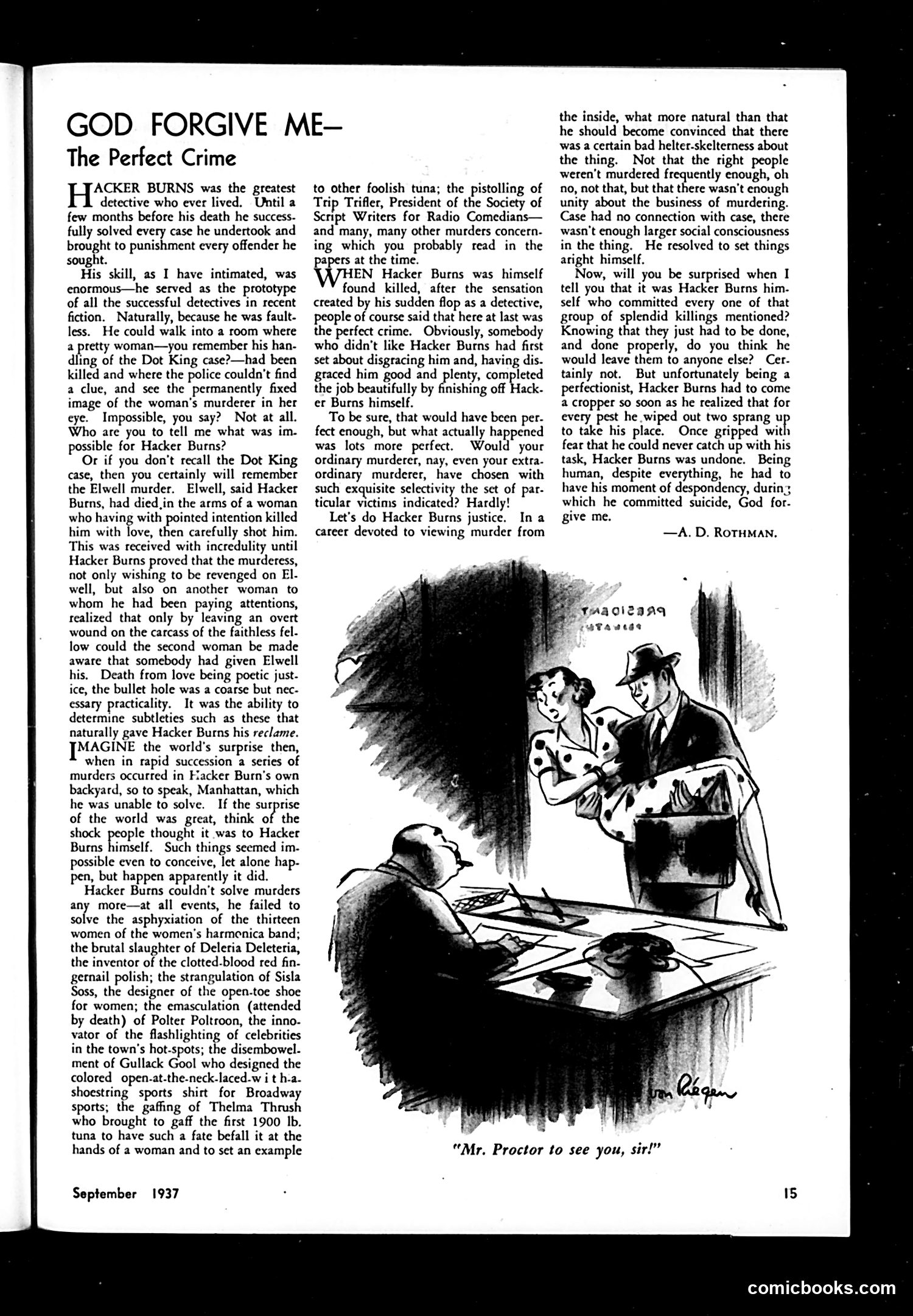
A restored page from Judge, 1937-09. Page through the whole issue in the reader above.
📄 Transcribed text from this page (OCR, searchable)
Machine-transcribed from the original scan — historical spelling and the odd misread are preserved.
GOD FORGIVE ME-— The Perfect Crime ACKER BURNS was the greatest detective who ever lived. Until a few months before his death he success- fully solved every case he undertook and brought to punishment every offender he sought. His skill, as I have intimated, was enormous—he served as the prototype of all the successful detectives in recent fiction. Naturally, because he was fault- less. He could walk into a room where a pretty woman—you remember his han- dling of the Dot King case?—had been killed and where the police couldn't find a clue, and see the permanently fixed image of the woman's murderer in her eye. Impossible, you say? Not at all. Who are you to tell me what was im- possible for Hacker Burns? Or if you don’t recall the Dot King case, then you certainly will remember the Elwell murder. Elwell, said Hacker Burns, had died, in the arms of a woman who having with pointed intention killed him with love, then carefully shot him. This was received with incredulity until Hacker Burns proved that the murderess, not only wishing to be revenged on El- well, but also on another woman to whom he had been paying attentions, realized that only by leaving an overt wound on the carcass of the faithless fel- low could the second woman be made aware that somebody had given Elwell his. Death from love being poetic just- ice, the bullet hole was a coarse but nec- essary practicality. It was the ability to determine subtleties such as these that naturally gave Hacker Burns his reclame. [MAGINE the world’s surprise then, when in rapid succession a series of murders occurred in Hacker Burn’s own backyard, so to speak, Manhattan, which he was unable to solve. If the surprise of the world was great, think of the shock people thought it was to Hacker Burns himself. Such things seemed im- possible even to conceive, let alone hap- pen, but happen apparently it did. Hacker Burns couldn't solve murders any more—at all events, he failed to solve the asphyxiation of the thirteen women of the women’s harmonica band; the brutal slaughter of Deleria Deleteria, the inventor of the clotted-blood red fin- gernail polish; the strangulation of Sisla Soss, the designer of the open-toe shoe for women; the emasculation (attended by death) of Polter Poltroon, the inno- vator of the flashlighting of celebrities in the town’s hot-spots; the disembowel- ment of Gullack Gool who designed the colored open.at-the-neck-laced-w i t h-a- shoestring sports shirt for Broadway sports; the gaffing of Thelma Thrush who brought to gaff the first 1900 Ib. tuna to have such a fate befall it at the hands of a woman and to set an example September 1937 to other foolish tuna; the pistolling of Trip Trifler, President of the Society of Script Writers for Radio Comedians— and many, many other murders concern. ing which you probably read in the papers at the time. EN Hacker Burns was himself found killed, after the sensation created by his sudden flop as a detective, people of course said that here at last was the perfect crime. Obviously, somebody who didn’t like Hacker Burns had first set about disgracing him and, having dis. graced him good and plenty, completed the job beautifully by finishing off Hack. er Burns himself. To be sure, that would have been per- fect enough, but what actually happened was lots more perfect. Would your ordinary murderer, nay, even your extra- ordinary murderer, have chosen with such exquisite selectivity the sct of par- ticular victims indicated? Hardly! Let's do Hacker Burns justice. In a career devoted to viewing murder from the inside, what more natural than that he should become convinced that there was a certain bad helter-skelterness about the thing. Not that the right people weren't murdered frequently enough, oh no, not that, but that there wasn’t enough unity about the business of murdering. Case had no connection with case, there wasn’t enough larger social consciousness in the thing. He resolved to set things aright himself. Now, will you be surprised when I tell you that it was Hacker Burns him. self who committed every one of that group of splendid killings mentioned? Knowing that they just had to be done, and done properly, do you think he would leave them to anyone else? Cer- tainly not. But unfortunately being a perfectionist, Hacker Burns had to come a cropper so soon as he realized that for every pest he wiped out two sprang u to take his place. Once gripped with fear that he could never catch up with his task, Hacker Burns was undone. Being human, despite everything, he had to have his moment of despondency, durin which he committed suicide, God for- give me. —A. D. RoTHMAN, TAADIEDAQ wtawcae “Mr. Proctor to see you, sir!” comicbooks.com