A complete issue · 40 pages · 1933
Judge — March 1933
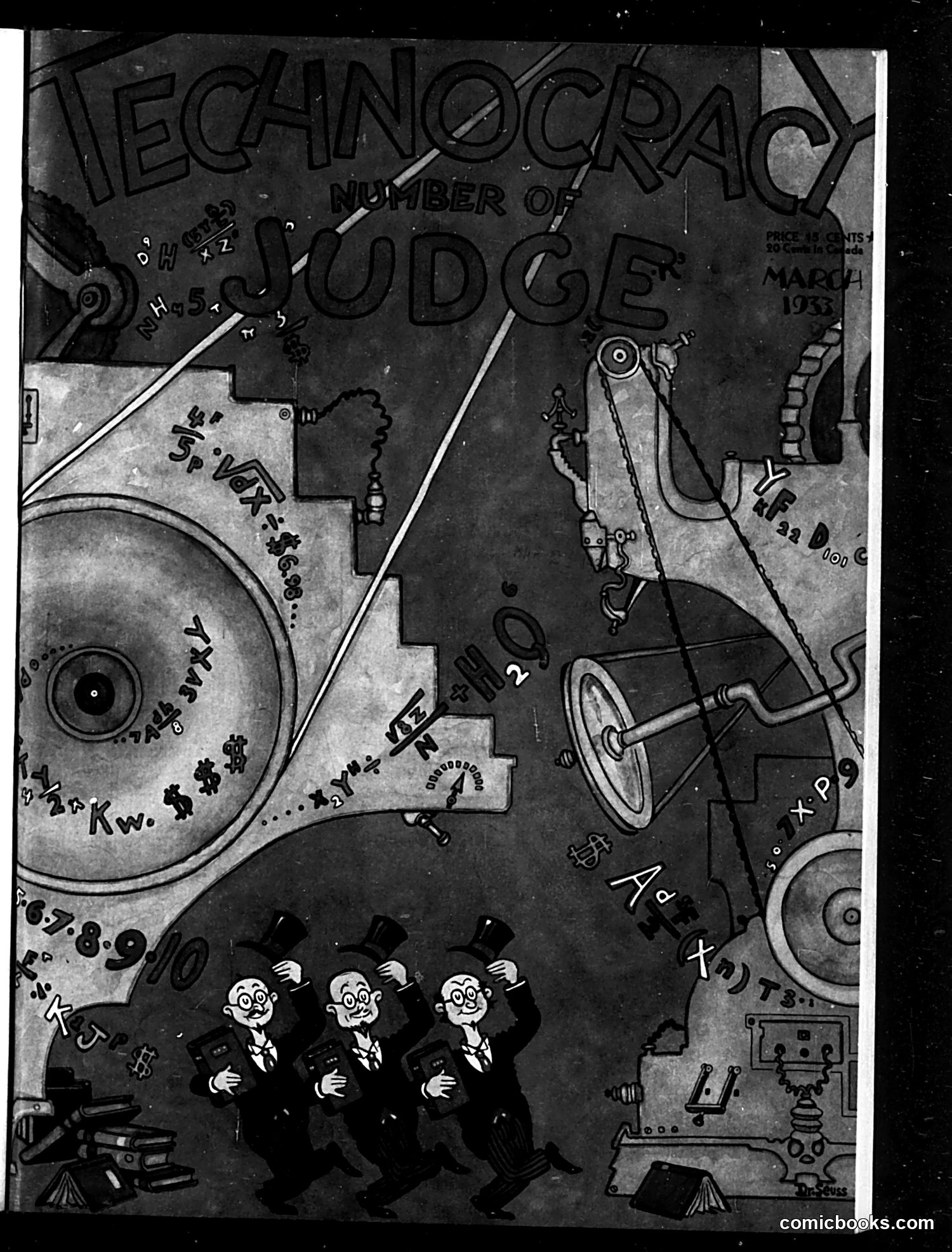
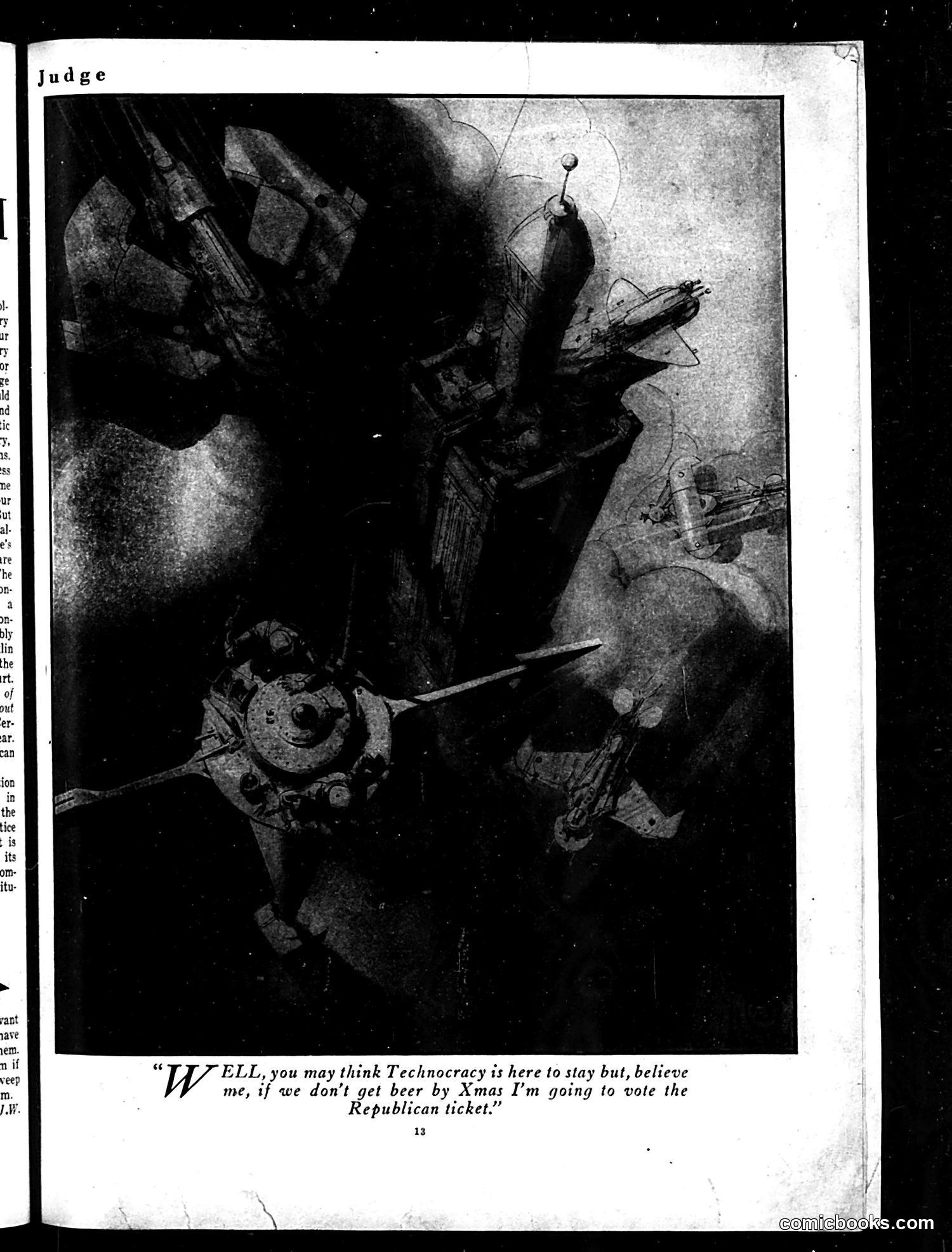
# Analysis of "Technocracy Number of Judge" (March 1933) This cover satirizes the "Technocracy" movement—a 1930s proposal that engineers and scientists should replace politicians to solve economic problems during the Great Depression. The three identical suited figures at bottom likely represent technocrats or their advocates. The mechanical diagram filling the page parodies how technocrats viewed society: as an engineering problem with calculations, gears, and circuits to optimize. The abundance of numbers, formulas, and mechanical components suggest both the movement's pseudo-scientific pretensions and Judge magazine's mockery of reducing human society to mere machinery. The price (15 cents) and date (March 1935—likely 1933 given Technocracy's peak popularity) place this during the Depression when such radical restructuring proposals gained serious traction before being largely discredited.
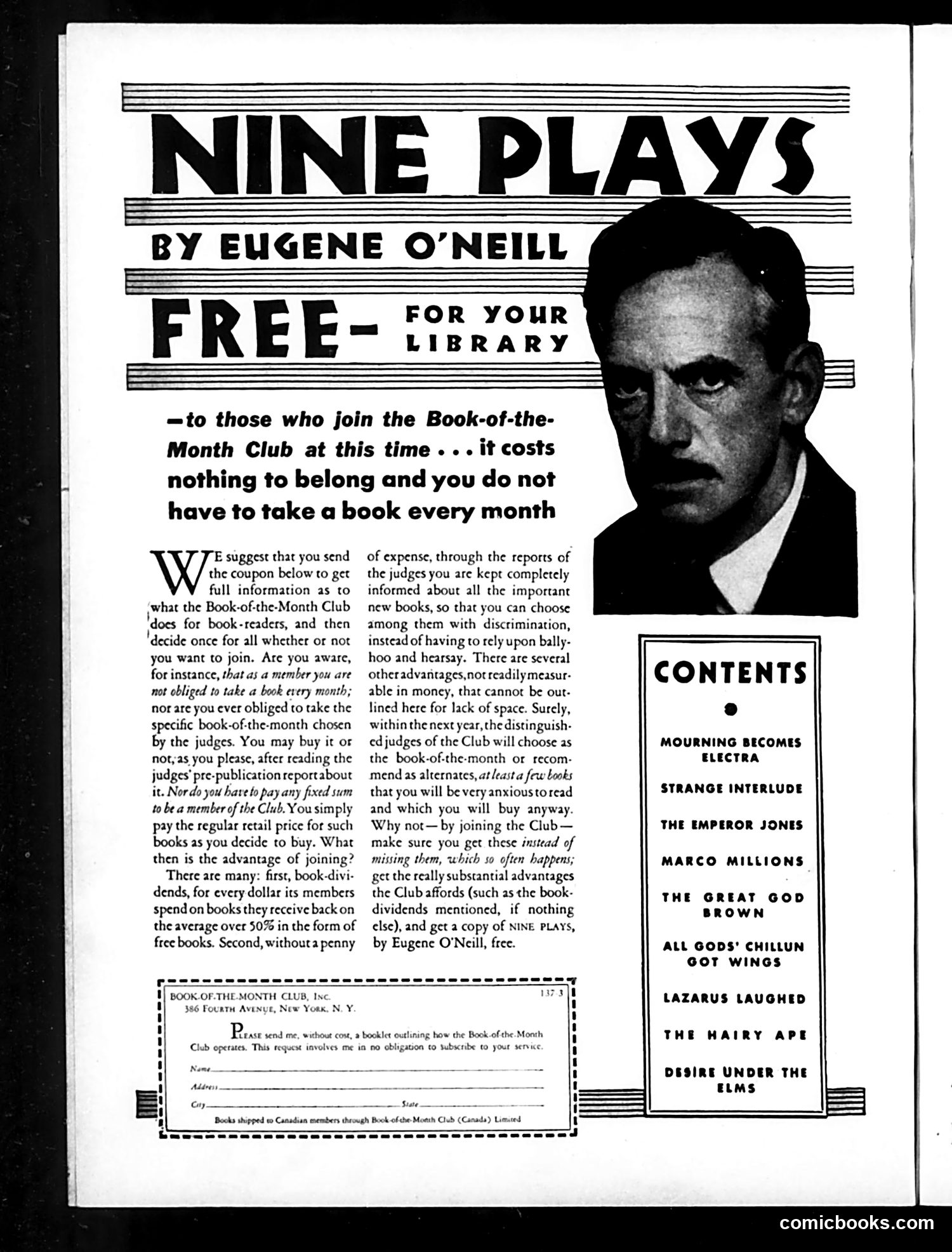
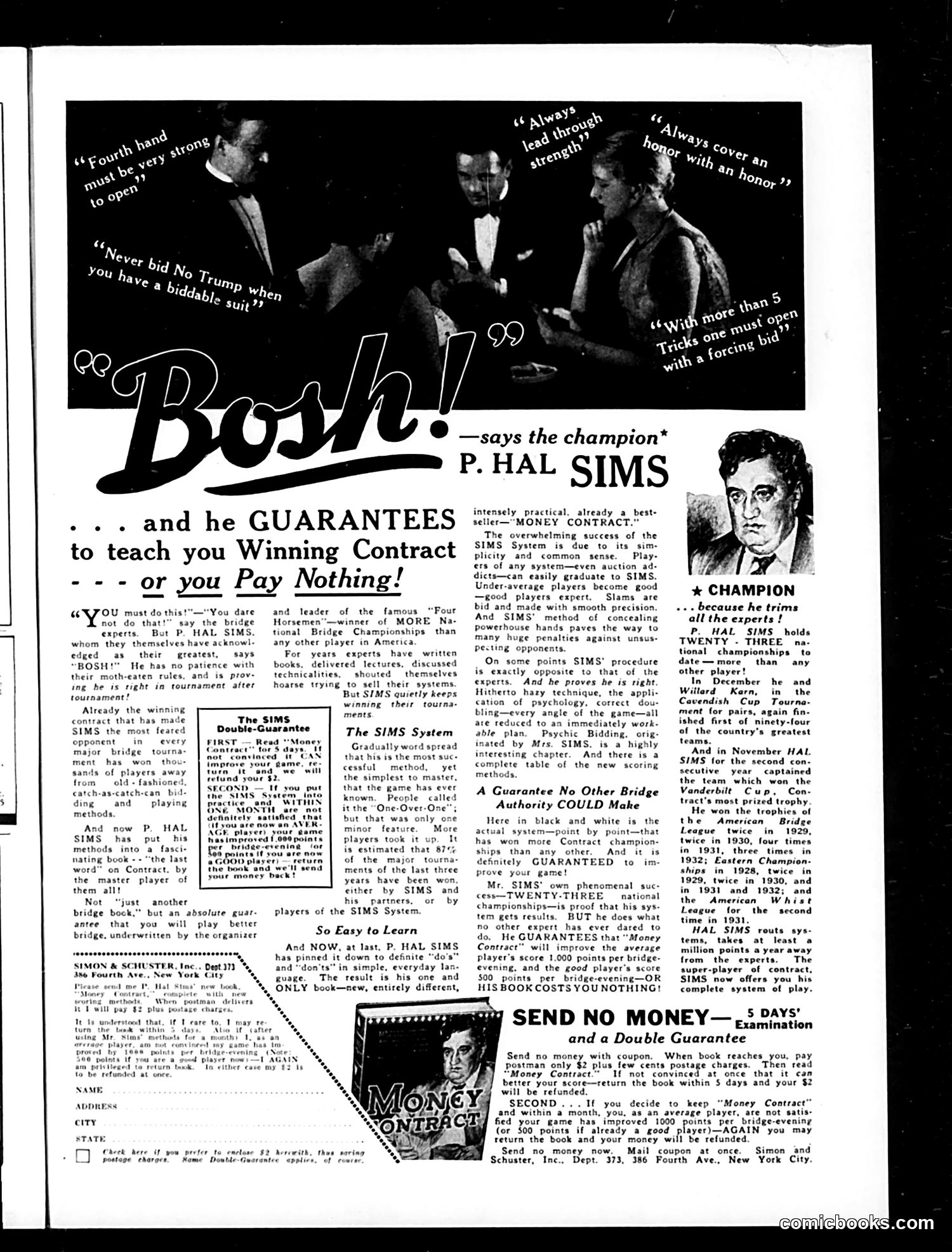
# Analysis This is primarily **advertising, not satire or commentary**. The page promotes the Book-of-the-Month Club by offering Eugene O'Neill's nine plays free to new members. The portrait appears to be **O'Neill himself**, the prominent American playwright, positioned to lend prestige to the offer. The advertisement emphasizes membership benefits: members receive substantial discounts (reportedly 50% savings), enjoy curated book selections without obligation to purchase monthly selections, and get quality editorial guidance. The listed plays in the "Contents" box are O'Neill's actual works. This represents **1920s-30s marketing strategy**—using celebrated authors' prestige to attract subscribers to a then-novel subscription service. No satire is evident; it's straightforward promotional content.
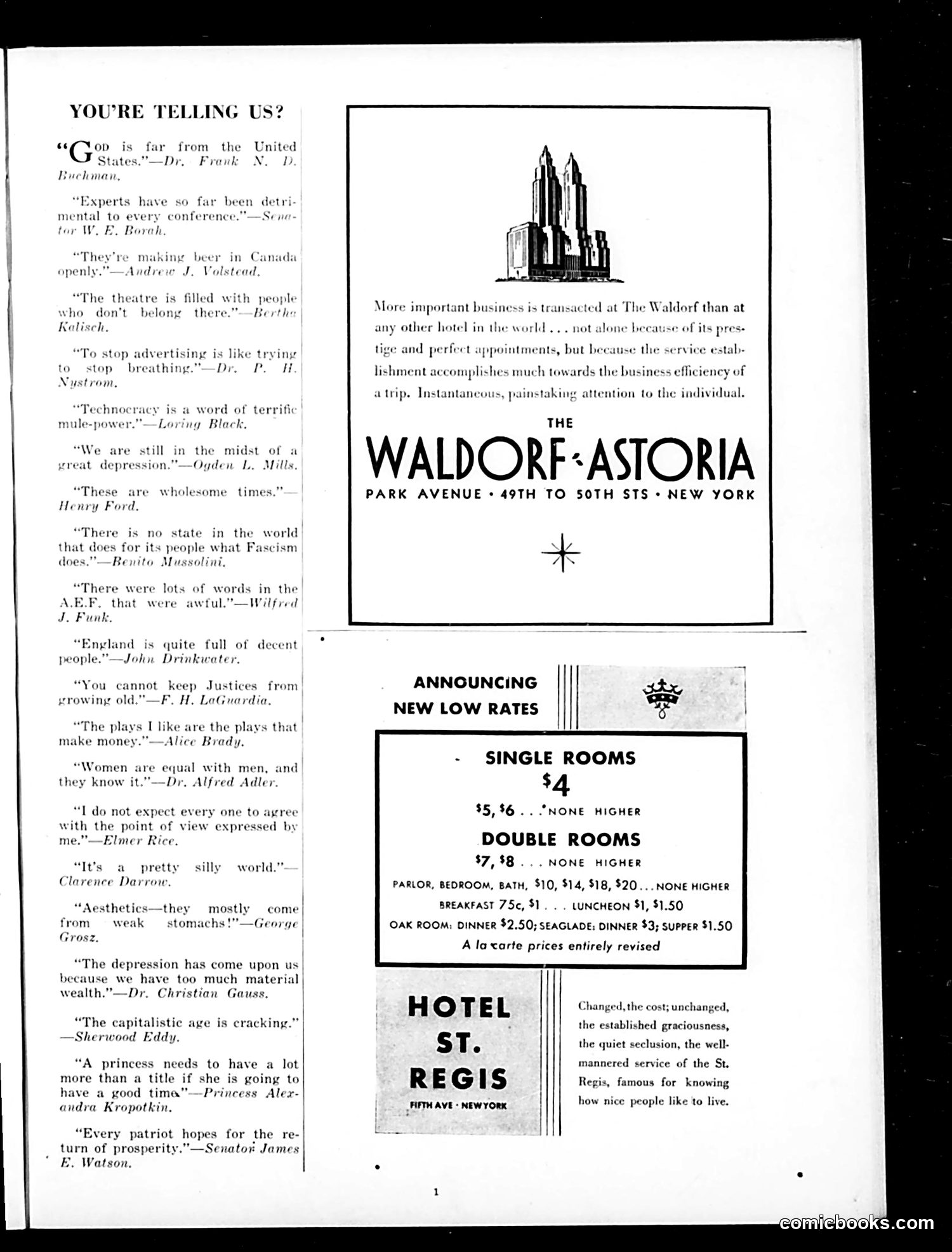
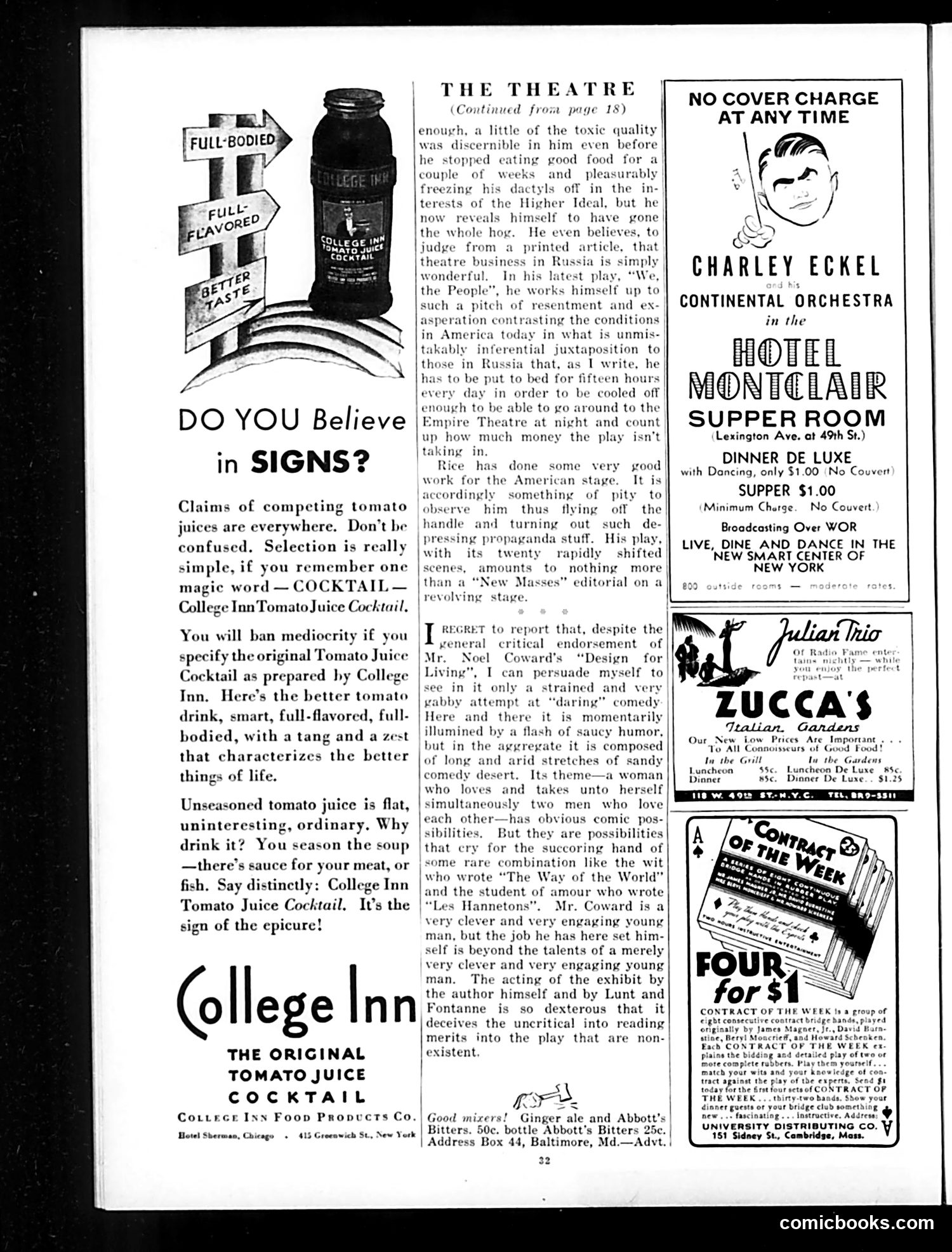
# Page Analysis: Judge Magazine This page is primarily **advertising with minimal editorial content**. The left column features a "You're Telling Us?" section—a common Judge format presenting satirical quotes attributed to public figures commenting on contemporary issues (depression, fascism, women's rights, advertising). The main advertisements promote: - **The Waldorf-Astoria** hotel (Park Avenue, NYC) - **Hotel St. Regis** (Fifth Avenue) - Waldorf-Astoria's "new low rates" for rooms and dining The quotes reference **1930s concerns**: economic depression, World War II-era fascism (Mussolini quote), gender equality debates, and theatrical criticism. Without a publication date visible, the economic language ("depression," "wholesale times") and fascism references suggest **early-to-mid 1930s**. The page reflects how Judge used humor to address serious contemporary anxieties while maintaining advertising revenue.
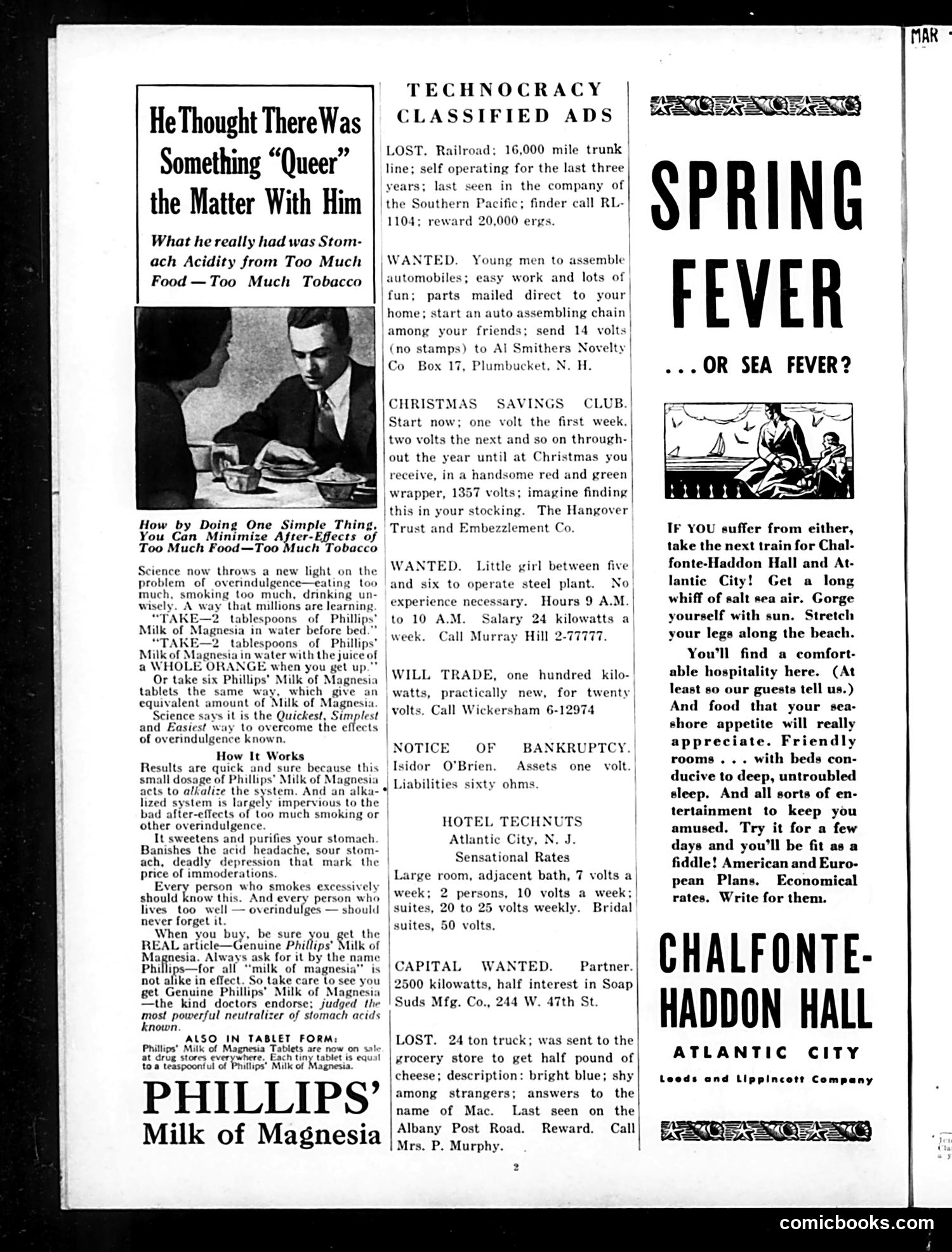
# Analysis This page is primarily **advertising and classified notices**, not political satire. The main content includes: **Left side:** A Phillips' Milk of Magnesia advertisement featuring a man discussing stomach issues caused by overeating and smoking. The ad promotes the antacid as a remedy for acid indigestion and related discomfort. **Right side:** Multiple classified ads (wanting workers, Christmas savings club, hotel rooms) and a prominent advertisement for Chalfonte-Haddon Hall, a resort in Atlantic City, N.J., offering seaside hospitality and relaxation. The page reflects early 20th-century consumer culture and commercial messaging rather than political commentary. The mild humor in the Magnesia ad derives from relatable domestic situations rather than satire of public figures or events.
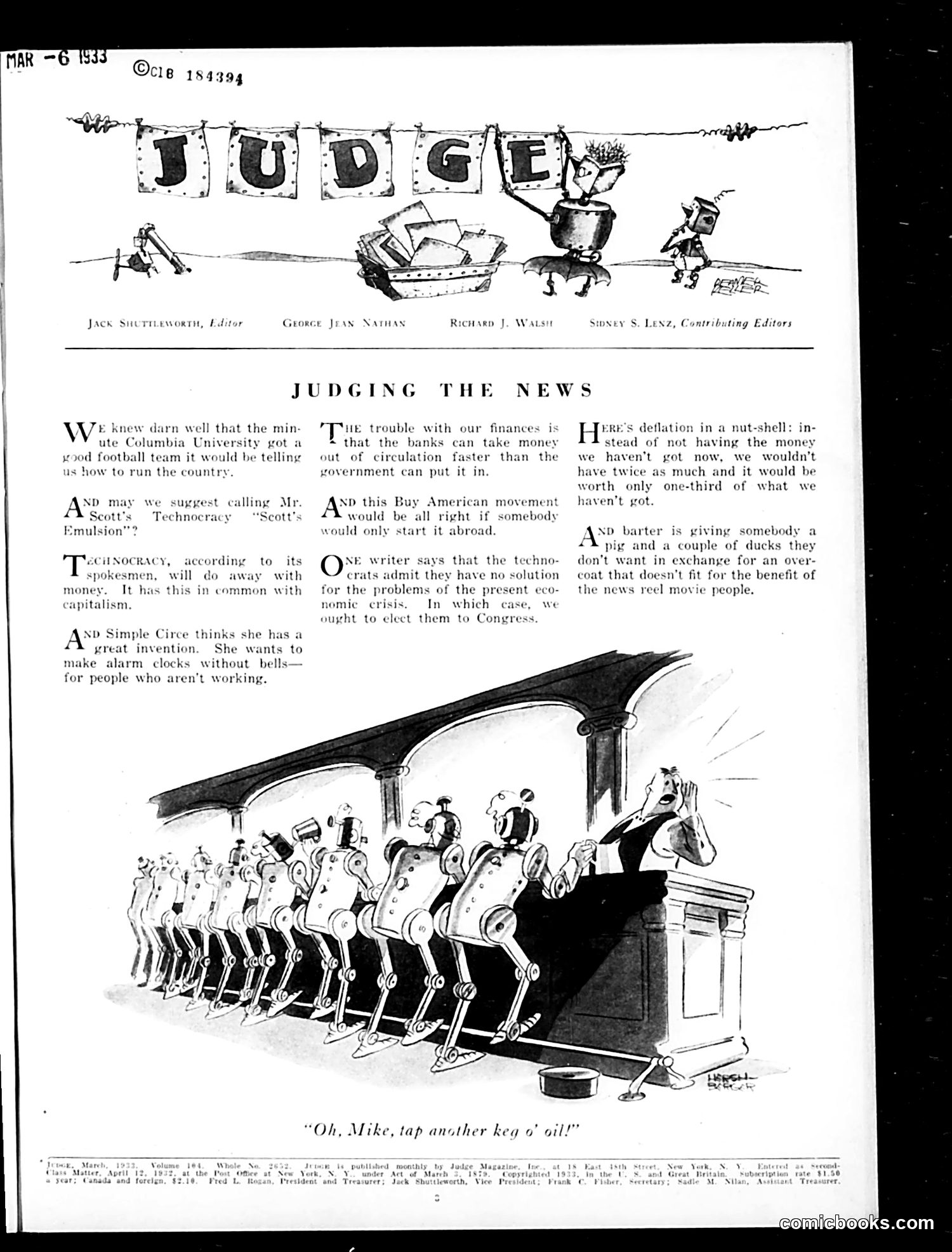
# Analysis This is the March 6, 1933 issue of Judge magazine. The page features "Judging the News," a satirical commentary section on current events. The main cartoon depicts a long line of identical mechanical figures (appearing to be workers or citizens) operating like machines under a large industrial structure, with one figure at a podium commanding "Oh, Mike, tap another keg o' oil!" This appears to satirize **mechanized labor or bureaucratic control** during the Great Depression era. The text snippets above mock various contemporary proposals and problems: financial crisis, the "Buy American" movement, technological unemployment, and political incompetence. The cartoon suggests that people are being treated as interchangeable machine parts rather than individuals—a commentary on industrialization's dehumanizing effects and perhaps the period's economic desperation.
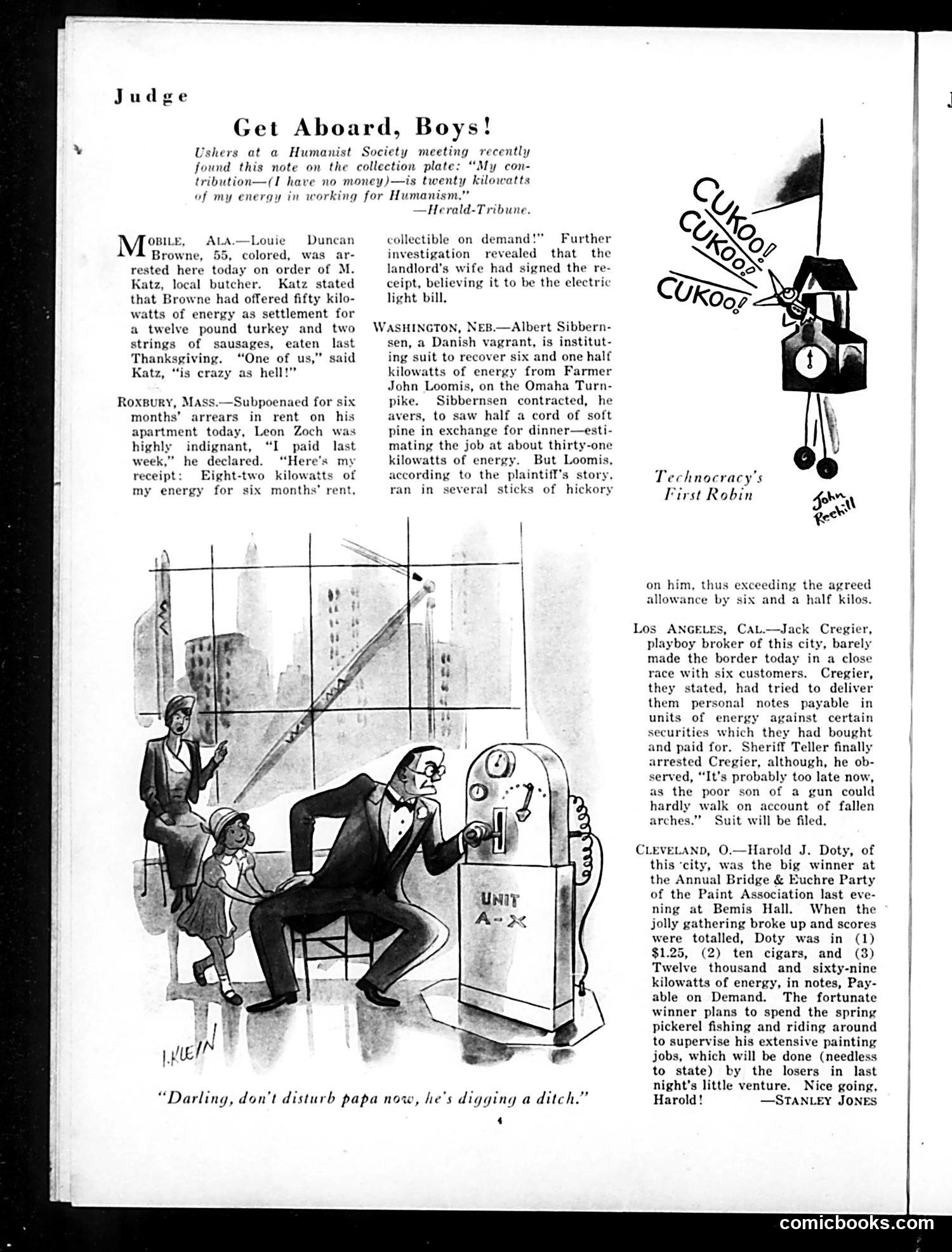
# "Get Aboard, Boys!" - Judge Magazine Satire This page satirizes people attempting to extract energy as payment or settlement. The column reports absurd cases: a butcher offered fifty kilowatts for meat; a tenant demanded rent in "kilowatts of energy"; a vagrant sought compensation in energy units; a playboy broker tried selling energy-backed securities; a raffle winner claimed prizes in kilowatts. The cartoon below shows a man operating a bizarre "energy-extraction machine" labeled "UNIT A-X" while his wife protests: "Darling, don't disturb papa nose, he's digging a ditch." The satire mocks the obsession with converting *everything*—including physical labor and daily life—into measurable energy units, reflecting early 20th-century technocratic enthusiasm taken to ridiculous extremes.
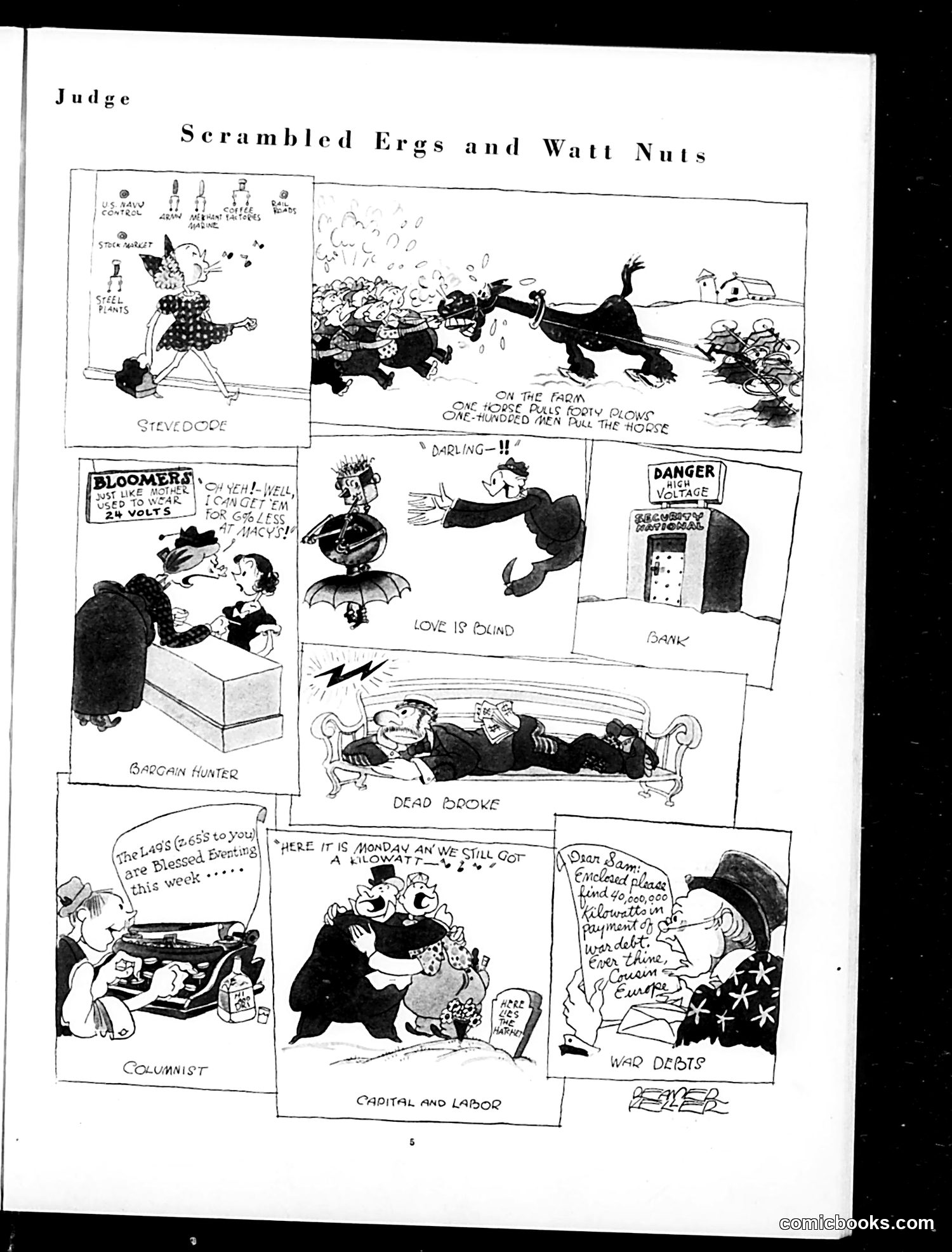
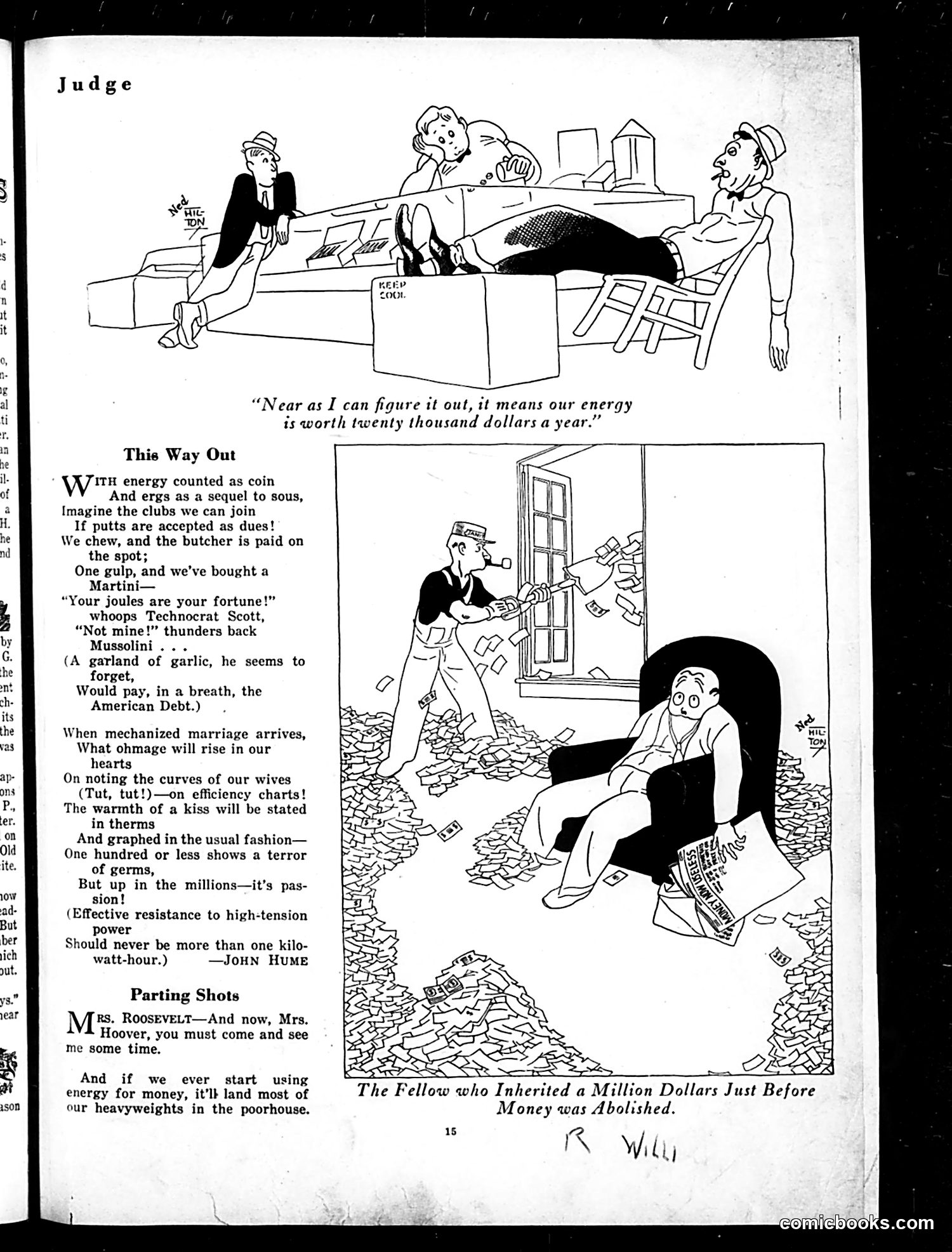
# "Scrambled Eggs and Watt Nuts" This Judge magazine page satirizes American political and social issues through multiple cartoon panels: **Top panel**: A "Stevedore" (dock worker) operates machinery labeled "U.S. Navy Control," with text referencing "Sticks," "Bolts," and "Hams"—likely satirizing labor disputes or industrial management conflicts in naval/dock operations. **Middle panels**: "Bloomers," "Bargain Hunter," "Love is Blind," "Dead Broke," and a "Danger High Voltage Bank" mock consumer behavior, romance, and financial precarity during what appears to be an economic downturn. **Bottom panels**: "Columnist," "Capital and Labor," and "War Debts" panels address post-WWI economic tensions—specifically labor disputes, financial recovery debates, and international war reparations that characterized 1920s American politics. The overall theme critiques economic anxiety and class conflict.
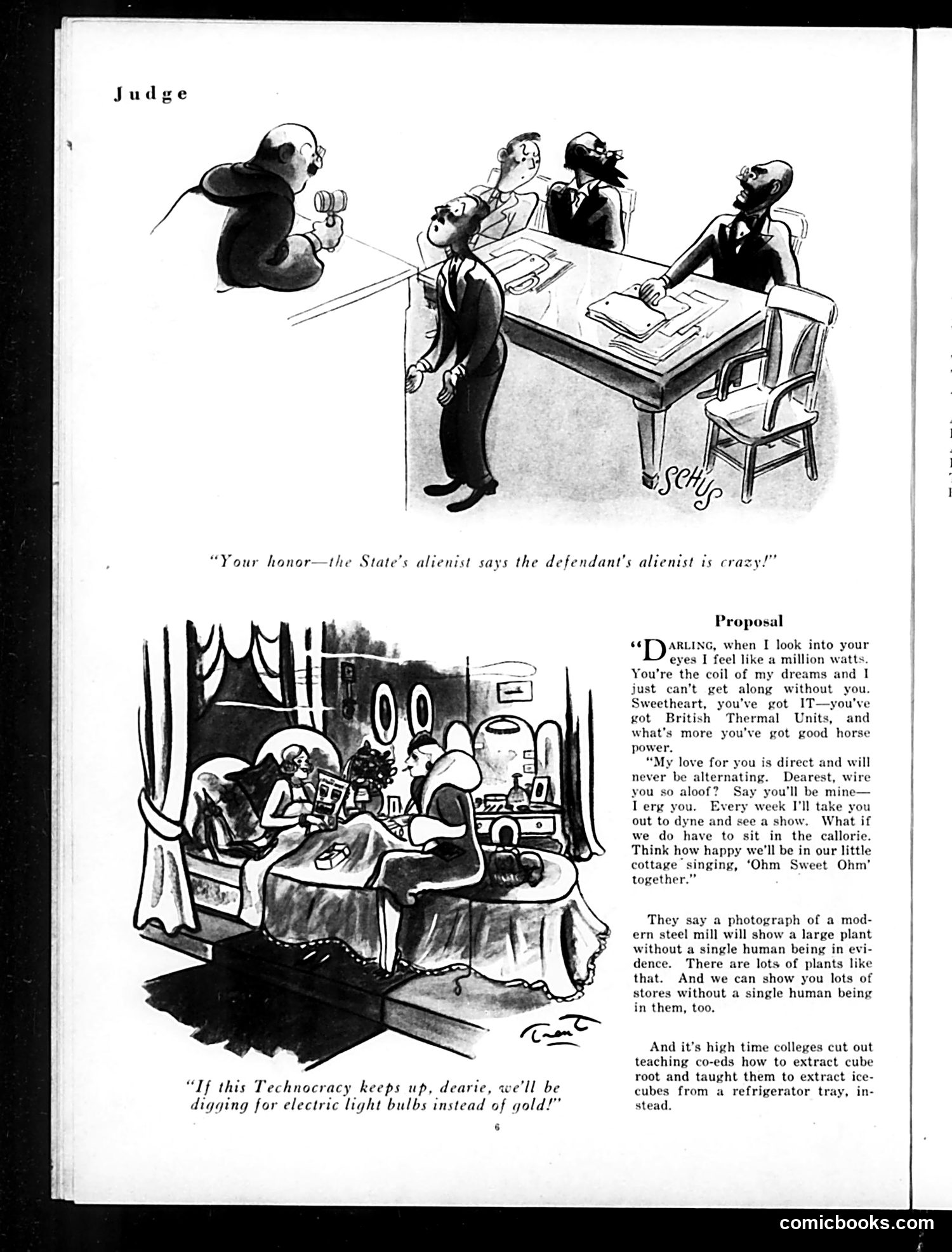
# Analysis of Judge Page **Top Cartoon ("Judge"):** A courtroom scene where a defendant's lawyer argues that the "State's alienist [psychiatrist] says the defendant's alienist is crazy." This satirizes expert witness testimony in legal proceedings—mocking how opposing psychiatric experts contradict each other so thoroughly that their credibility becomes questionable. **Bottom Cartoon ("Proposal"):** A romantic scene where a suitor pitches himself by boasting of owning "British Thermal Units" and "good horse power"—technical measurements. The humor mocks how mechanization and industrial measurement language have infiltrated even romantic expression. The caption about "Technocracy" references the 1930s movement advocating rule by technical experts, suggesting absurd over-mechanization of life itself.
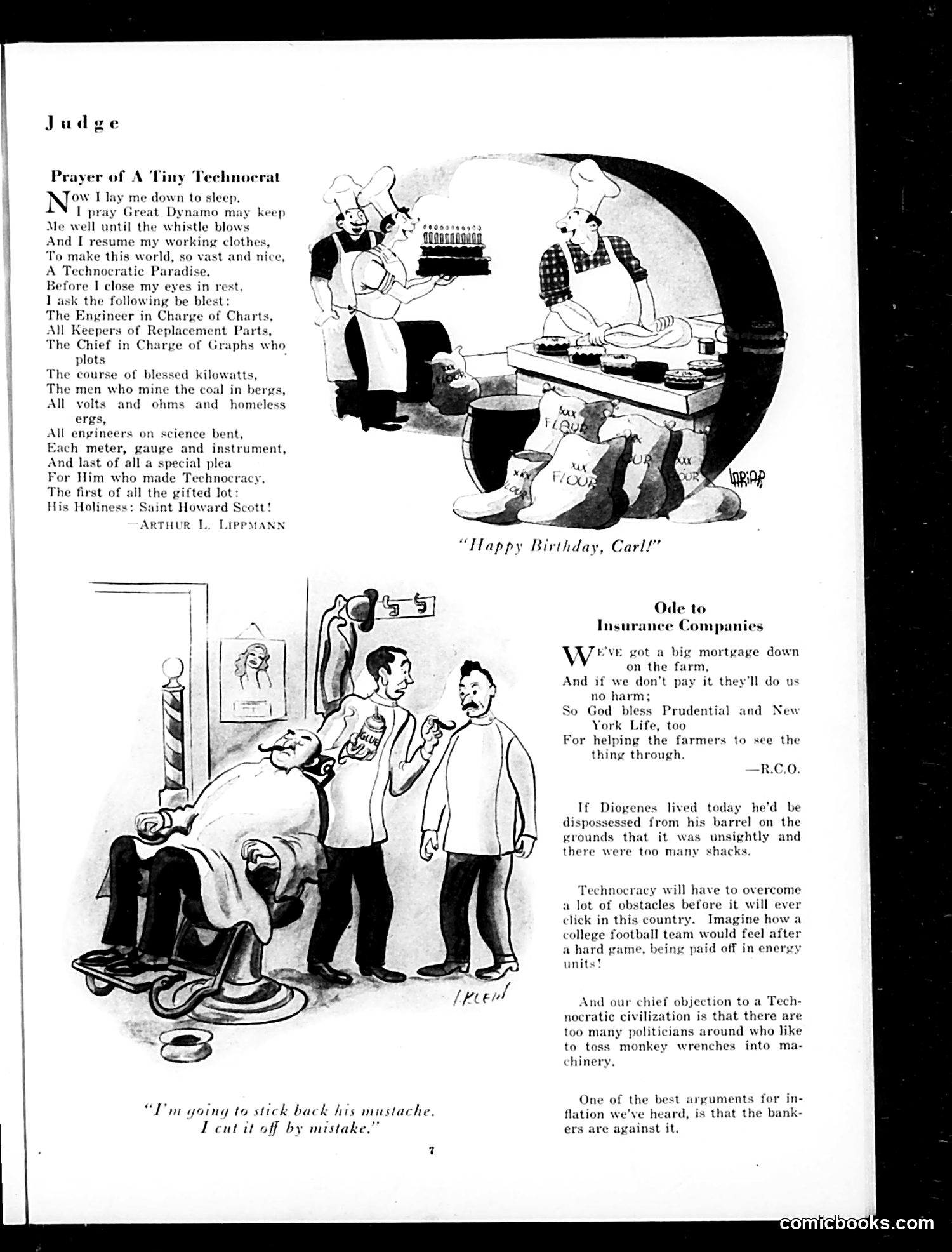
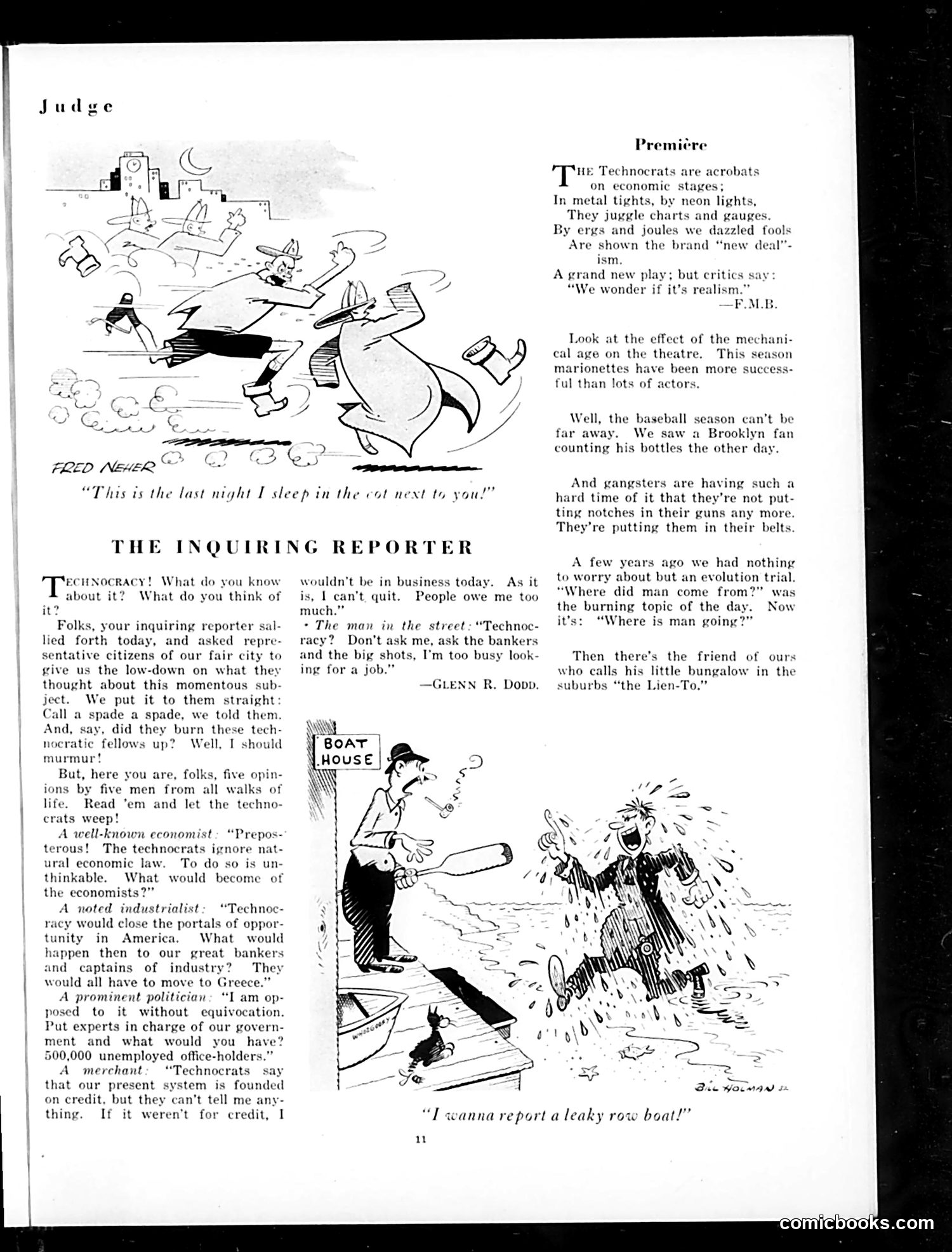
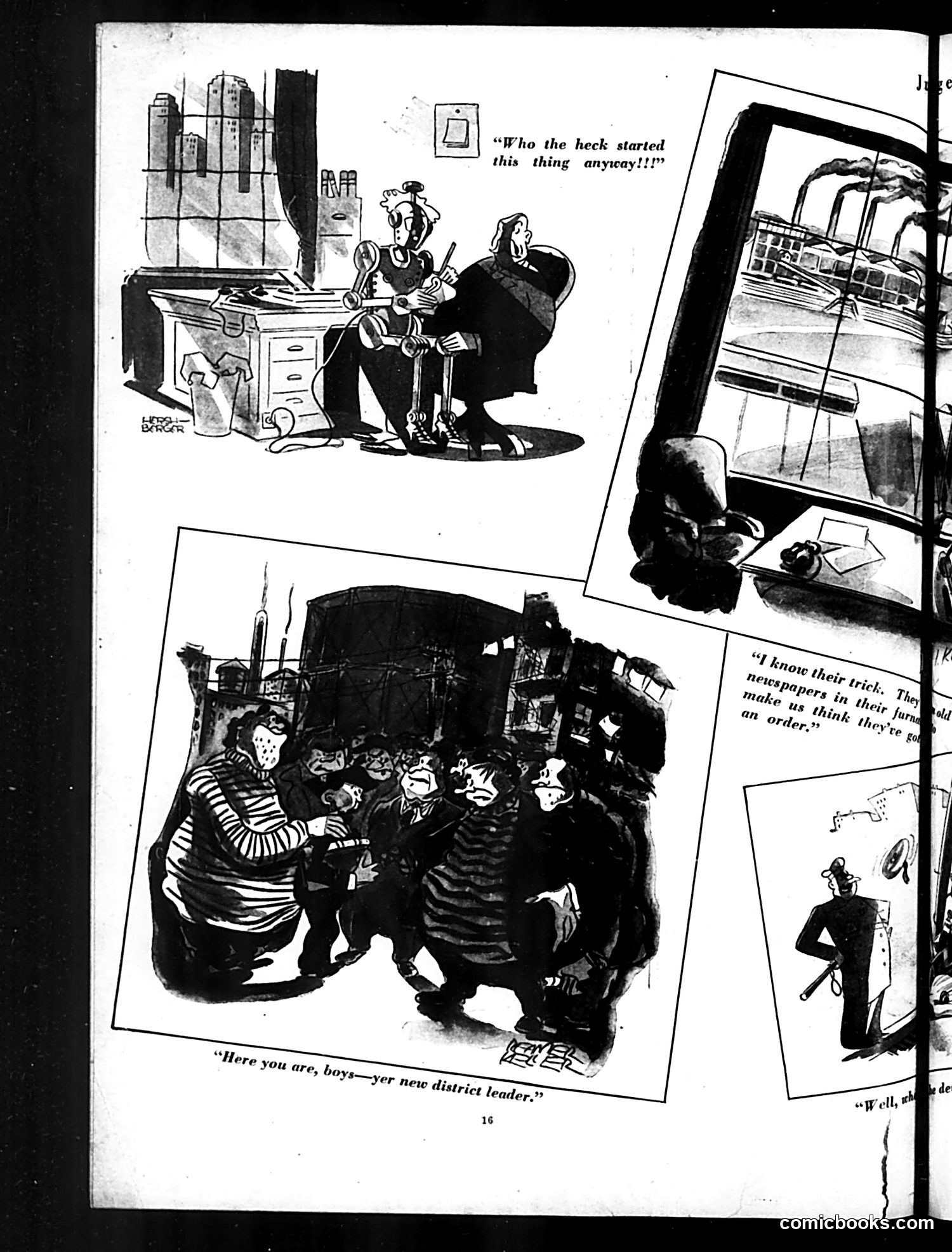
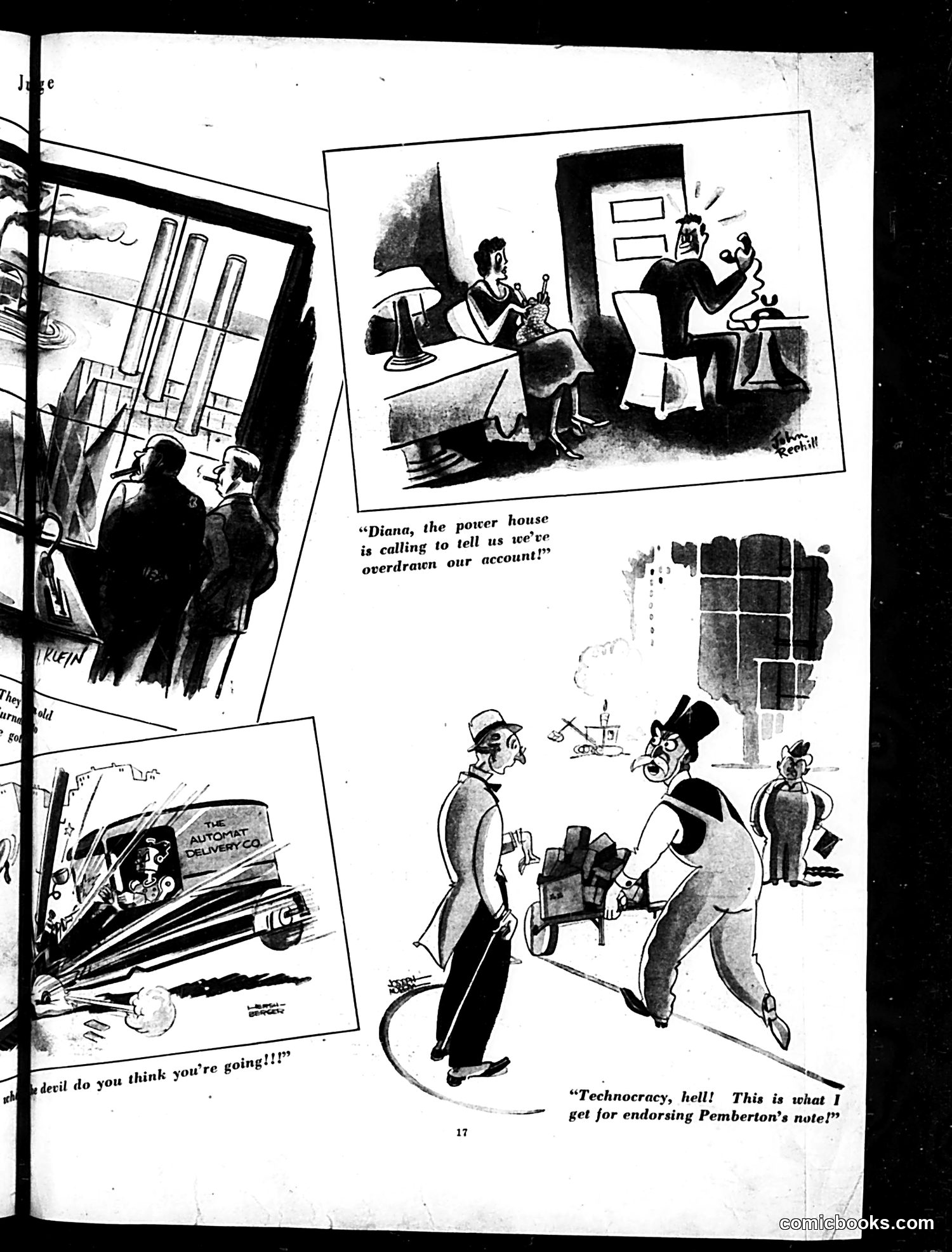
# Judge Magazine Page Analysis This page satirizes **Technocracy**, a 1930s movement advocating rule by technical experts and engineers. **"Prayer of a Tiny Technocrat"** mocks technocrats' quasi-religious devotion to industrial systems, personifying infrastructure (dynamos, kilowatts, engineers) as objects of worship. It references **Howard Scott**, who founded the Technocracy movement, calling him "Saint Howard Scott"—ridiculing the movement's cult-like following. **The cartoon below** shows a man at some kind of medical/mechanical device with observers—the caption jokes about accidentally cutting off someone's mustache, likely satirizing how technocratic solutions cause unintended consequences. **"Ode to Insurance Companies"** employs sarcastic praise to critique how insurance companies profit from farmers' desperation during economic hardship. The page's broader point: Judge mocks Technocracy as an impractical ideology that would replace human judgment with mechanical systems, while politicians would sabotage it anyway. The satire warns that technocratic "solutions" ignore human realities and create more problems than they solve.
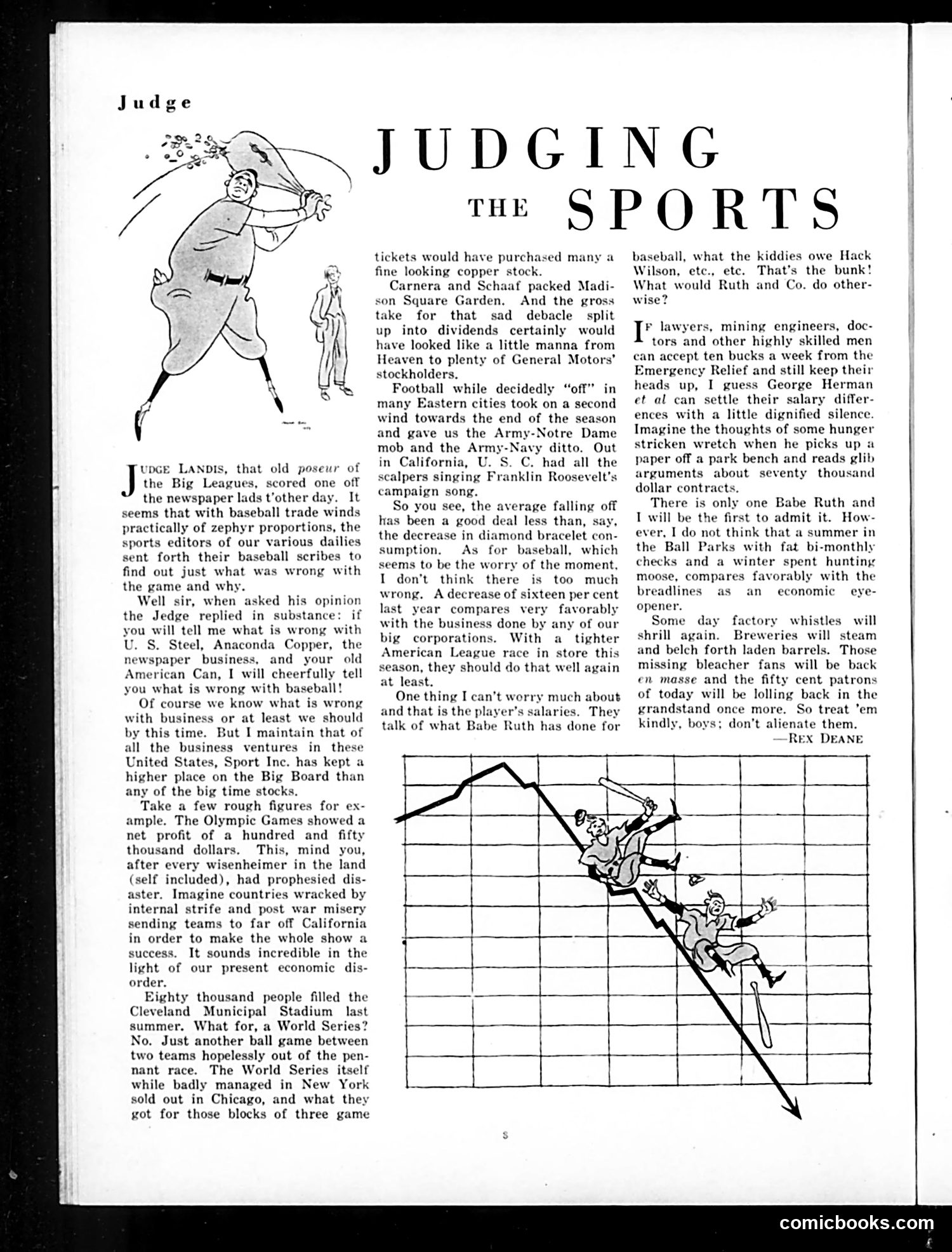
# Analysis of "Judging the Sports" Page This Judge magazine article defends professional sports' financial health during the Great Depression. Judge Landis (baseball's commissioner) argues sports have performed better economically than major industries like U.S. Steel and Anaconda Copper. The author cites successful events: the 1932 Olympics in California, sold-out baseball games, and boxing matches (Carnera-Schaaf at Madison Square Garden). He claims baseball's 16% revenue decrease compares favorably to other businesses. The article's main target is sympathy for high player salaries, especially Babe Ruth's. The satire suggests Ruth and other athletes complaining about wages lack perspective—skilled professionals accept Depression-era emergency relief, so athletes should "settle their salary differences with dignified silence." The chart showing declining attendance illustrates the revenue drop. Overall, the piece uses sports economics to argue workers should accept hardship without complaint during the economic crisis.
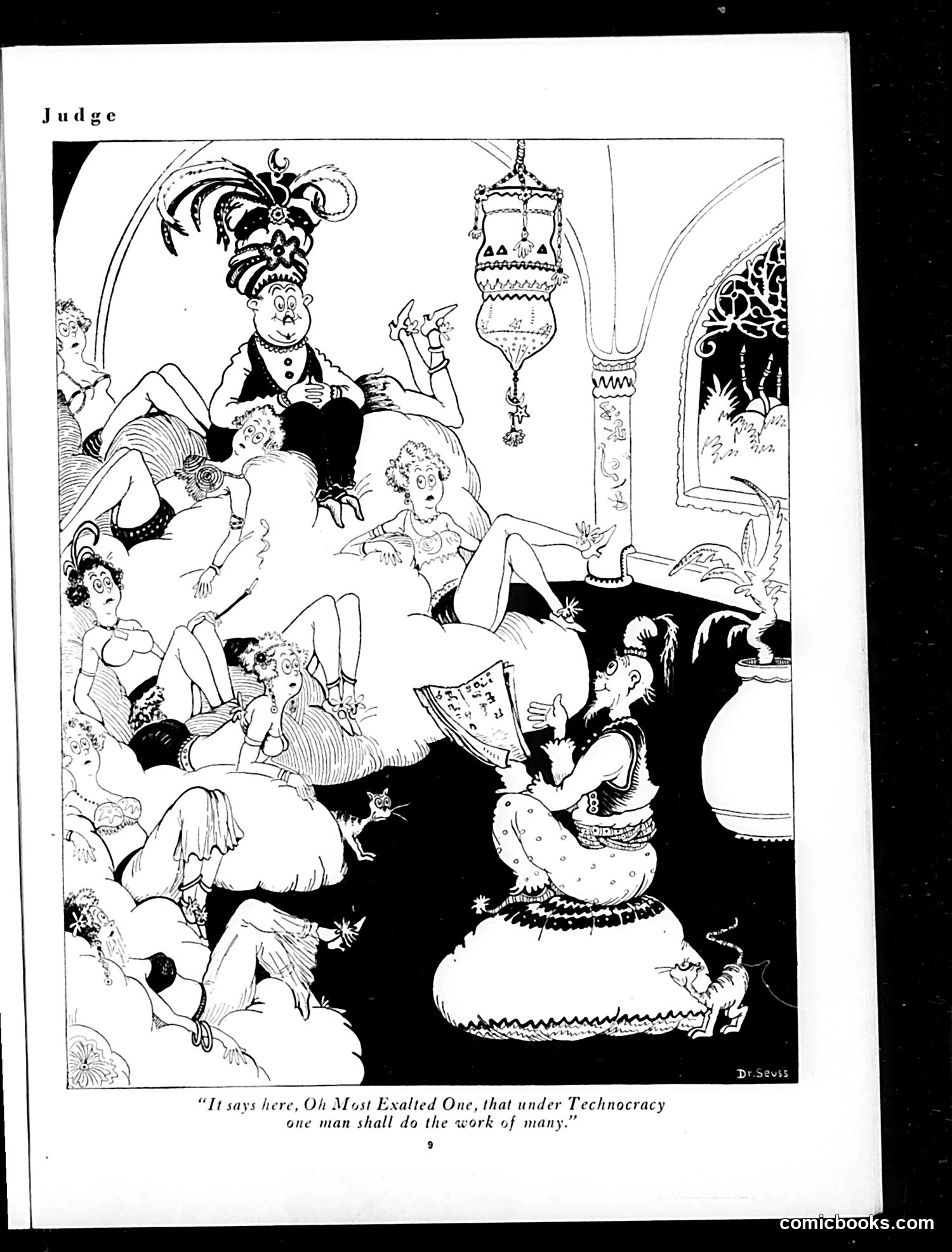
# Judge Cartoon Analysis: "Technocracy" This Dr. Seuss cartoon satirizes the technocracy movement of the early 1930s—a utopian ideology proposing that engineers and technicians should govern society for maximum efficiency. The scene depicts an opulent harem or palace setting with multiple leisure-lounging figures, while a single servant reads the technocracy quote aloud to what appears to be a wealthy authority figure (the "Most Exalted One"). The satire's point: technocracy's promise that machines and efficiency would allow one person to do work previously requiring many sounds appealing in theory, but the cartoon suggests the real result would be concentrated wealth and power—one privileged person enjoying leisure while others labor. It mocks both technocracy's naive optimism and the wealthy's likely co-optation of such systems.
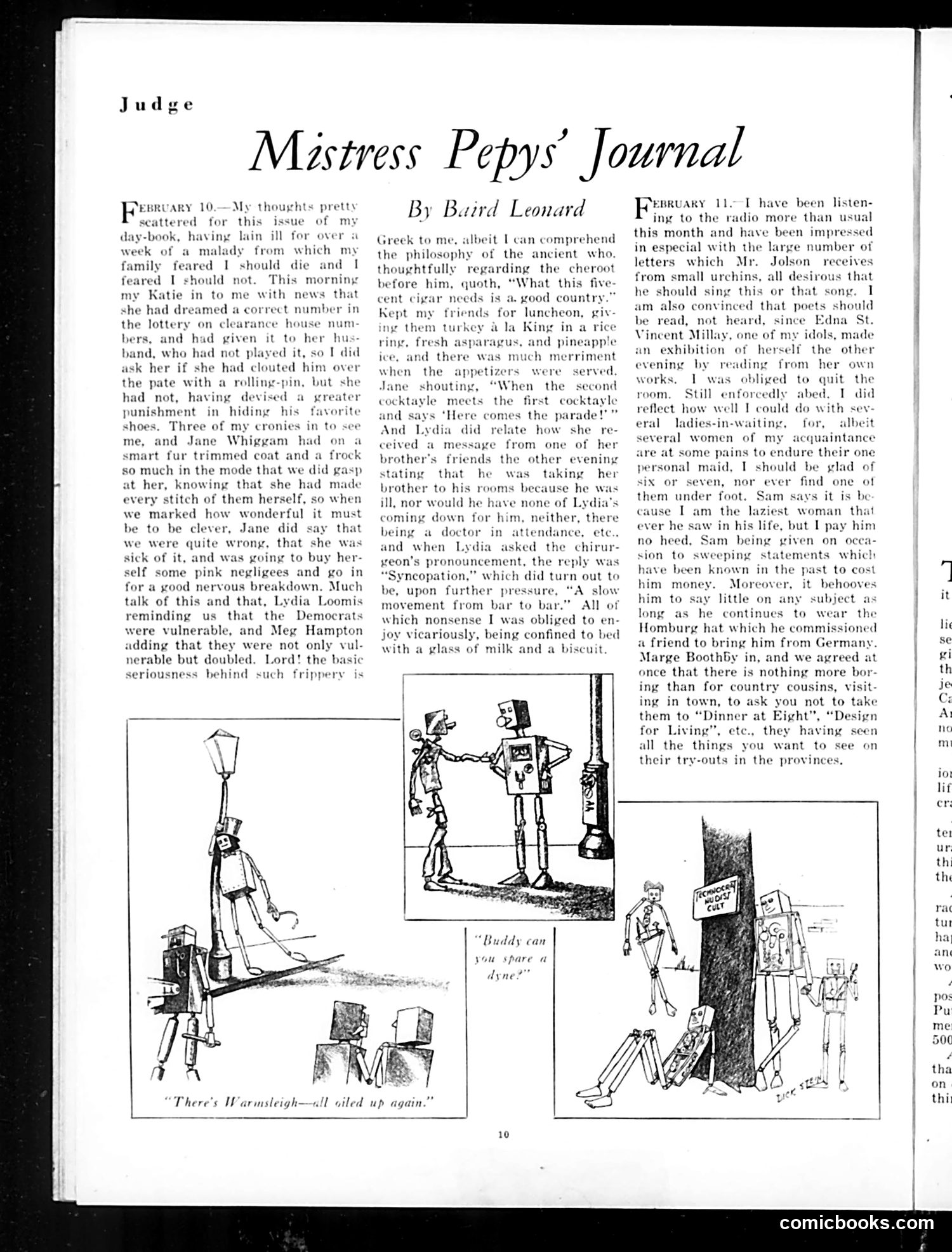
# "Mistress Pepys' Journal" by Baird Leonard This is a humorous society column mimicking Samuel Pepys' famous 17th-century diary, but covering 1930s upper-middle-class domestic life. The narrator (a woman) records trivial social events—luncheons, fashion, gossip—alongside casual references to contemporary culture (radio, Al Jolson, the poet Edna St. Vincent Millay). The three cartoons illustrate jokes from the text: one shows a malfunctioning heating system; another depicts people asking to "spare a dyne" (a physics pun, likely referencing Depression-era economics); the third shows visiting country relatives at a theater. The satire targets both the pretentiousness of society women discussing serious topics (Democrats being "vulnerable") while obsessed with clothes and gossip, and the affectations of imitating Pepys' archaic language for trivial modern matters. The "basic seriousness behind such frippery" is the joke itself—these concerns are fundamentally frivolous.