
Judge, 1933-03 · page 10 of 40
Judge — March 1933 — page 10: what you’re looking at
What you’re looking at
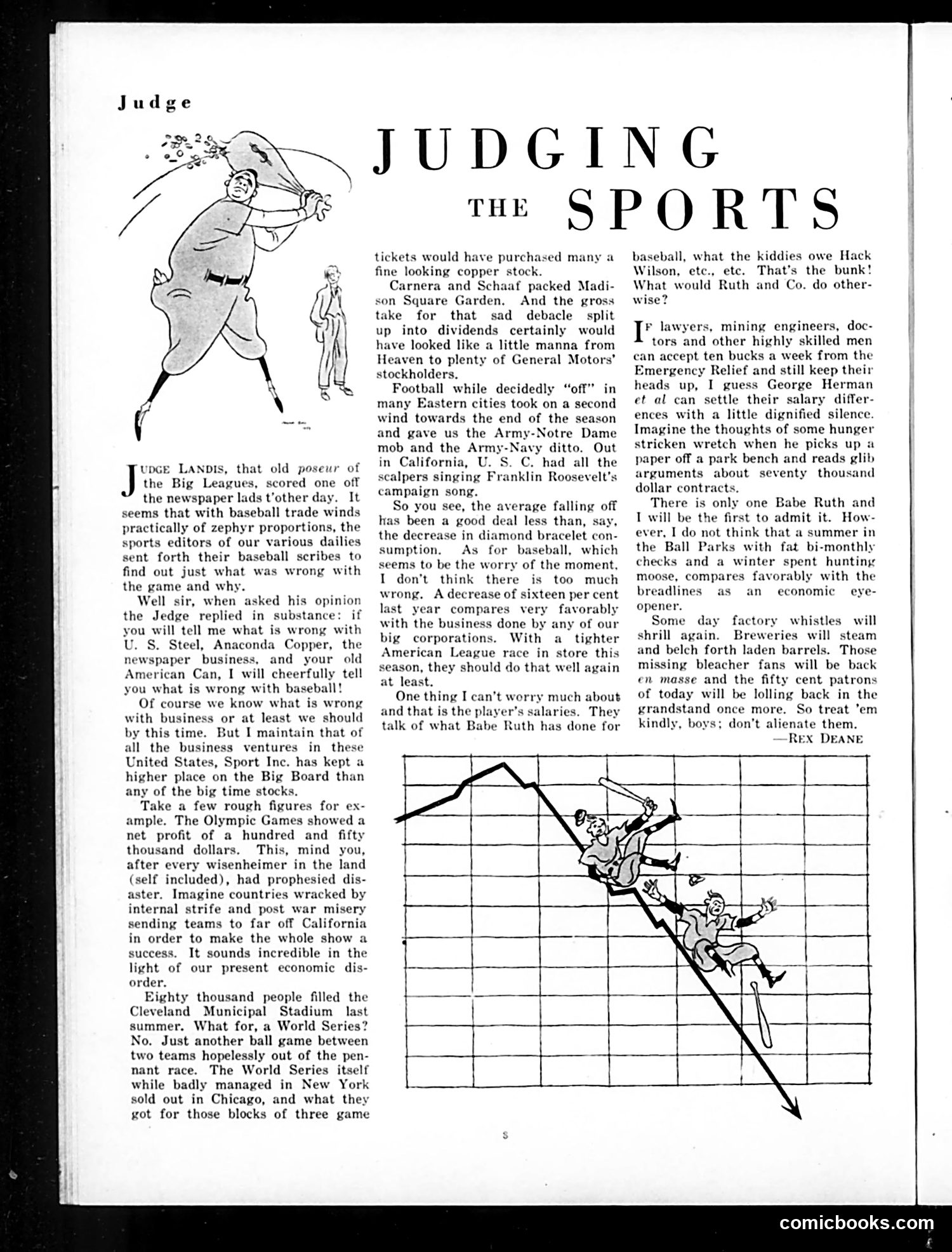
# Analysis of "Judging the Sports" Page This Judge magazine article defends professional sports' financial health during the Great Depression. Judge Landis (baseball's commissioner) argues sports have performed better economically than major industries like U.S. Steel and Anaconda Copper. The author cites successful events: the 1932 Olympics in California, sold-out baseball games, and boxing matches (Carnera-Schaaf at Madison Square Garden). He claims baseball's 16% revenue decrease compares favorably to other businesses. The article's main target is sympathy for high player salaries, especially Babe Ruth's. The satire suggests Ruth and other athletes complaining about wages lack perspective—skilled professionals accept Depression-era emergency relief, so athletes should "settle their salary differences with dignified silence." The chart showing declining attendance illustrates the revenue drop. Overall, the piece uses sports economics to argue workers should accept hardship without complaint during the economic crisis.
📄 Transcribed text from this page (OCR, searchable)
Machine-transcribed from the original scan — historical spelling and the odd misread are preserved.
Judge 4 SS TS ° ( upGe LANbIs, that old poseur of Jive Big Leagues, scored one off the newspaper lads t’other day. It seems that with baseball trade winds practically of zephyr proportions, the sports editors of our various dailies sent forth their baseball scribes to find out just what was wrong with the game and why. Well , When asked his opinion the Jedge replied in substance: if you will tell me what is wrong with S. Steel, Anacon Copper, the per business, and your old an Can, I will cheerfully tell you what is wrong with baseball! Of course we know what is wrong with business or at least we should by this time. But I maintain that of all the business ventures in these United States, Sport Inc. has kept a higher place on the Big Board than any of the big time stocks. Take a few rough figures for ex- ample. The Olympic Games showed a net profit of a hundred and fifty thousand dollars. This, mind you, after every wisenheimer in the land (self included), had prophesied dis- aster. Imagine countries wracked by internal strife and post war misery sending teams to far off California in order to make the whole show a success. It sounds incredible in the light of our present economic dis- order. Eighty thousand people filled the Cle nd Municipal Stadium last summer. What for, a World Series? No. Just another ball game between two teams hopelessly out of the pen- nant race. The World Series itself while badly managed in New York sold out in Chicago, and what they got for those blocks of three game JU DGING me SPORTS tickets would have purchased many a fine looking copper stock. Carnera and Schaaf packed Madi- son Square Garden, And the gross take for that sad debacle split up into dividends certainly would have looked like a little manna from Heaven to plenty of General Motors’ stockholders. Football while decidedly “off” in many Eastern cities took on a second wind towards the end of the season and gave us the Army-Notre Dame mob and the Arm. Out in California, U. C, had all the scalpers singing Franklin Roosevelt's campaign song. So you see, the average falling off has been a good deal less than, say, the decrease in diamond bracelet con- sumption. As for baseball, which seems to be the worry of the moment, I don't think there too much wrong. A decrease of sixteen per cent last year compares very favorably with the business done by any of our big corporations. With tighter American League race in store this season, they should do that well again at least. One thing I can’t worry much about and that is the player's salaries. They talk of what Babe Ruth has done for baseball, what the kiddies Wilson, etc., ete. That’s the bunk! What would Ruth and Co. do other- wise? F lawyers, mining engineers, doc- tors and other highly skilled men can accept ten bucks a week from the Emergency Relief and still keep their heads up, I guess George Herman et al can settle their salary differ- ences with a little dignified silence. Imagine the thoughts of some hunger stricken wretch when he picks up a paper off a park bench and reads glib arguments about seventy thousand dollar cont There is only one Babe Ruth and I will be the first to admit it. How- ever, I do not think that a summer in the Ball Parks with bi-monthly checks and a winter spent hunting moose, compares favorably with the breadlines as an conomic eye- opener. Some day factory whistles will shrill again. Breweries will steam and belch forth laden barrels. Those missing bleacher fans will be back en masse and the fifty cent patrons of today will be lolling back in the grandstand once more. So treat ’em kindly, boys; don’t alie Rex DEANE comicbooks.com