
Judge, 1933-03 · page 20 of 40
Judge — March 1933 — page 20: what you’re looking at
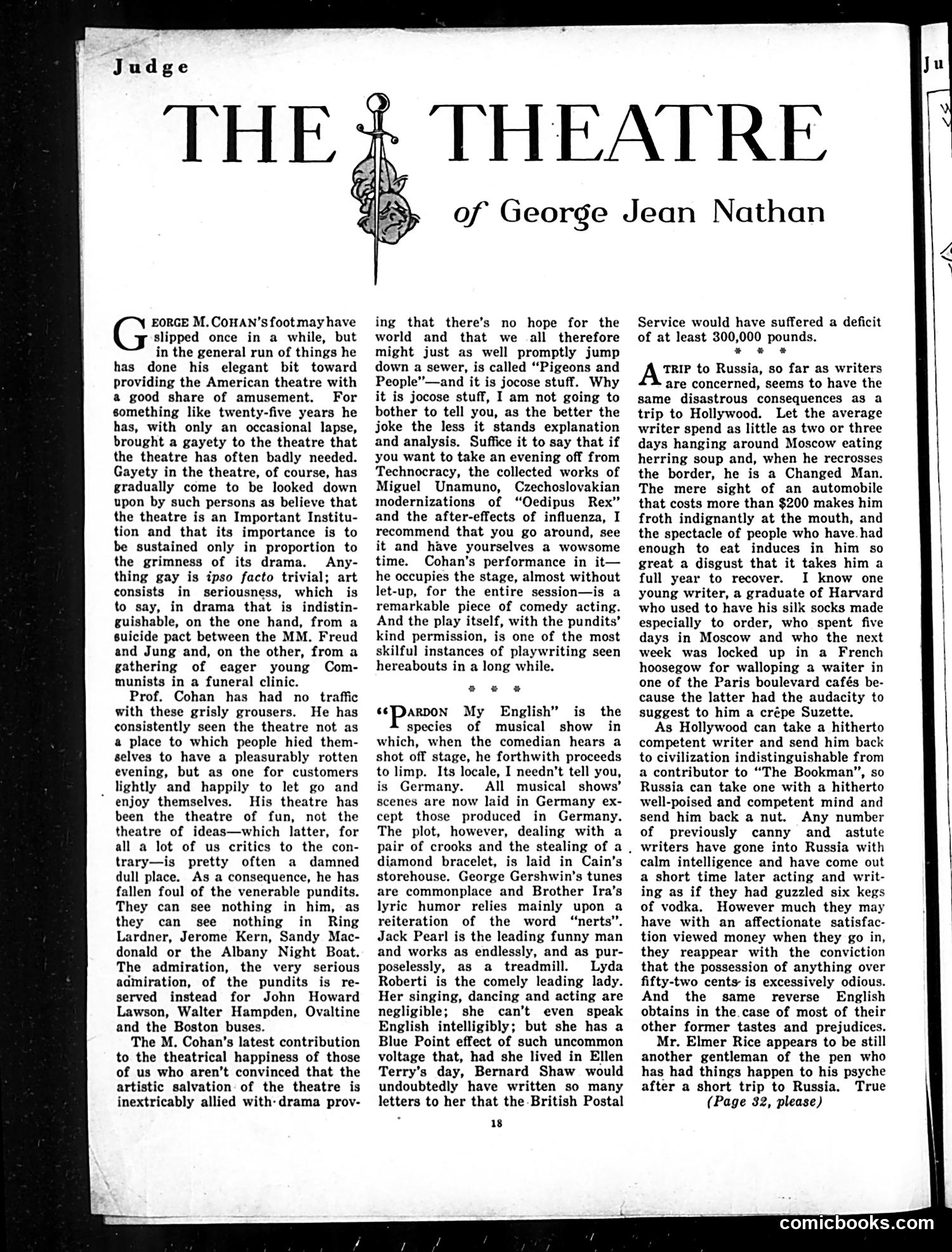
A restored page from Judge, 1933-03. Page through the whole issue in the reader above.
📄 Transcribed text from this page (OCR, searchable)
Machine-transcribed from the original scan — historical spelling and the odd misread are preserved.
THE EORGE M. CoHAN’S footmay have G slipped once in a while, but in the general run of things he has done his elegant bit toward providing the American theatre with a good share of amusement. For something like twenty-five years he has, with only an occasional lapse, brought a gayety to the theatre that the theatre has often badly needed. Gayety in the theatre, of course, has gradually come to be looked down upon by such persons as believe that the theatre is an Important Institu- tion and that its importance is to be sustained only in proportion to the grimness of its drama. Any- thing gay is ipso facto trivial; art consists in seriousness, which is to say, in drama that is indistin- guishable, on the one hand, from a suicide pact between the MM. Freud and Jung and, on the other, from a gathering of eager young Com- munists in a funeral clinic. Prof. Cohan has had no traffic with these grisly grousers. He has consistently seen the theatre not as a place to which people hied them- selves to have a pleasurably rotten evening, but as one for customers lightly and happily to let go and * enjoy themselves. His theatre has been the theatre of fun, not the theatre of ideas—which latter, for all a lot of us critics to the con- trary—is pretty often a damned dull place. As a consequence, he has fallen foul of the venerable pundits. They can see nothing in him, as they can see nothing in Ring Lardner, Jerome Kern, Sandy Mac- donald or the Albany Night Boat. The admiration, the very serious admiration, of the pundits is re- served instead for John Howard Lawson, Walter Hampden, Ovaltine and the Boston buses. The M. Cohan’s latest contribution to the theatrical happiness of those of us who aren’t convinced that the artistic salvation of the theatre is inextricably allied with-drama prov- THEATRE of George Jean Nathan ing that there’s no hope for the world and that we all therefore might just as well promptly jump down a sewer, is called “Pigeons and People’”—and it is jocose stuff. Why it is jocose stuff, I am not going to bother to tell you, as the better the joke the less it stands explanation and analysis. Suffice it to say that if you want to take an evening off from Technocracy, the collected works of Miguel Unamuno, Czechoslovakian modernizations of “Oedipus Rex” and the after-effects of influenza, I recommend that you go around, see it and have yourselves a wowsome time. Cohan’s performance in it— he occupies the stage, almost without let-up, for the entire session—is a remarkable piece of comedy acting. And the play itself, with the pundits’ kind permission, is one of the most skilful instances of playwriting seen hereabouts in a long while. eo & # 6¢PDarDoN My English” is the species of musical show in which, when the comedian hears a shot off stage, he forthwith proceeds to limp. Its locale, I needn't tell you, is Germany. All musical shows’ scenes are now laid in Germany ex- cept those produced in Germany. The plot, however, dealing with a pair of crooks and the stealing of a , diamond bracelet, is laid in Cain’s storehouse. George Gershwin’s tunes are commonplace and Brother Ira’s lyric humor relies mainly upon a reiteration of the word “nerts”. Jack Pearl is the leading funny man and works as endlessly, and as pur- poselessly, as a treadmill. Lyda Roberti is the comely leading lady. Her singing, dancing and acting are negligible; she can’t even speak English intelligibly; but she has a Blue Point effect of such uncommon voltage that, had she lived in Ellen Terry’s day, Bernard Shaw would undoubtedly have written so many letters to her that the British Postal 18 Service would have suffered a deficit of at least 300,000 pounds. * 8 * TRIP to Russia, so far as writers are concerned, seems to have the same disastrous consequences as a trip to Hollywood. Let the average writer spend as little as two or three days hanging around Moscow eating herring soup and, when he recrosses the border, he is a Changed Man. The mere sight of an automobile that costs more than $200 makes him froth indignantly at the mouth, and the spectacle of people who have. had enough to eat induces in him so great a disgust that it takes him a full year to recover. I know one young writer, a graduate of Harvard who used to have his silk socks made especially to order, who spent five days in Moscow and who the next week was locked up in a French hoosegow for walloping a waiter in one of the Paris boulevard cafés be- cause the latter had the audacity to suggest to him a crépe Suzette. As Hollywood can take a hitherto competent writer and send him back to civilization indistinguishable from a contributor to “The Bookman”, so Russia can take one with a hitherto well-poised and competent mind and send him back a nut. Any number of previously canny and astute writers have gone into Russia with calm intelligence and have come out a short time later acting and writ- ing as if they had guzzled six kegs of vodka. However much they may have with an affectionate satisfac- tion viewed money when they go in, they reappear with the conviction that the possession of anything over fifty-two cents is excessively odious. And the same reverse English obtains in the.case of most of their other former tastes and prejudices. Mr. Elmer Rice appears to be still another gentleman of the pen who has had things happen to his psyche after a short trip to Russia. True (Page 82, please) comicbooks.com