
Judge, 1933-03 · page 14 of 40
Judge — March 1933 — page 14: what you’re looking at
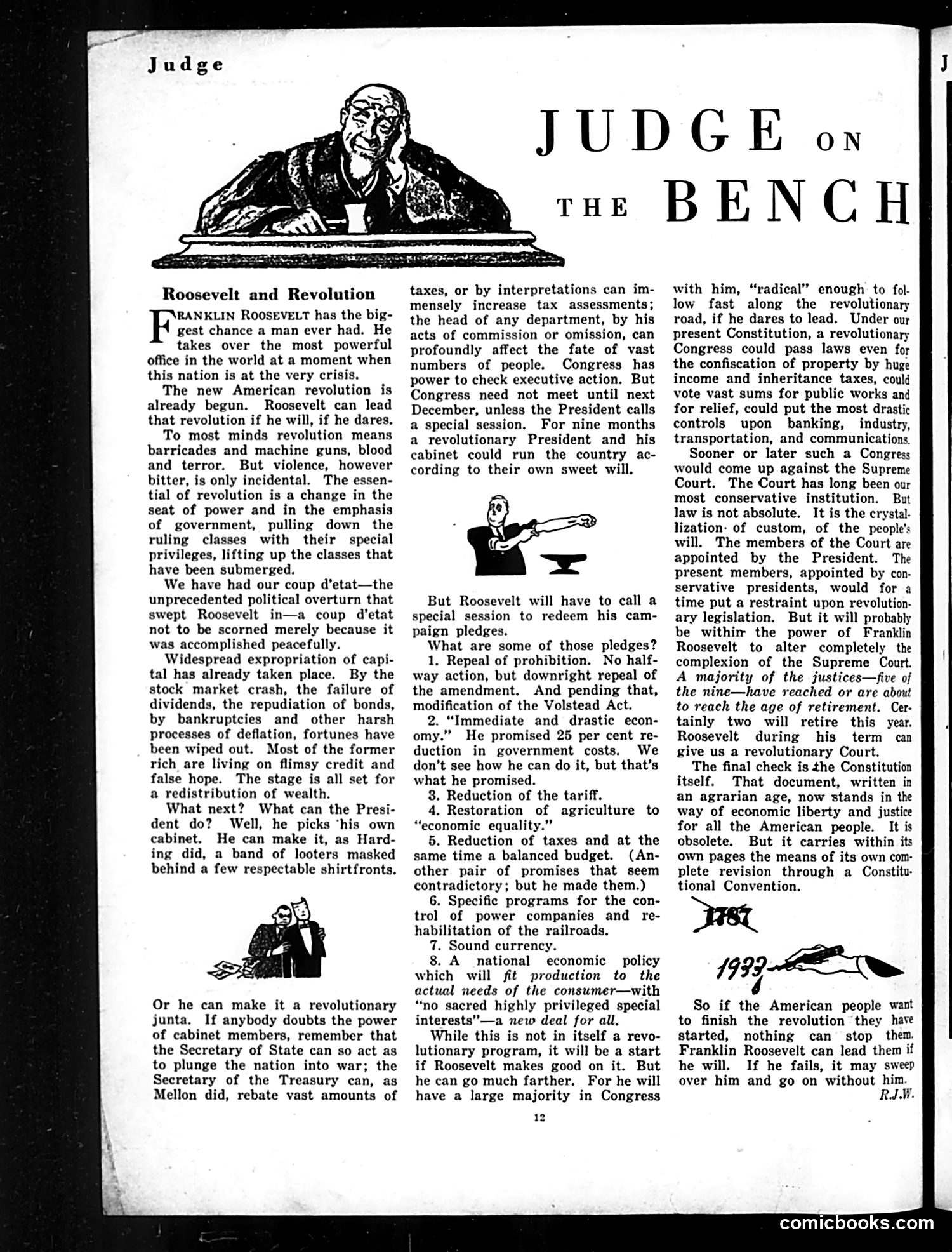
A restored page from Judge, 1933-03. Page through the whole issue in the reader above.
📄 Transcribed text from this page (OCR, searchable)
Machine-transcribed from the original scan — historical spelling and the odd misread are preserved.
Roosevelt and Revolution RANKLIN ROOSEVELT has the big- gest chance a man ever had. He takes over the most powerful office in the world at a moment when this nation is at the very crisis. The new American revolution is already begun. Roosevelt can lead that revolution if he will, if he dares. To most minds revolution means barricades and machine guns, blood and terror. But violence, however bitter, is only incidental. The essen- tial of revolution is a change in the seat of power and in the emphasis of government, pulling down the ruling classes with their special privileges, lifting up the classes that have been submerged. We have had our coup d’etat—the unprecedented political overturn that swept Roosevelt in—a coup d’etat not to be scorned merely because it was accomplished peacefully. Widespread expropriation of capi- tal has already taken place. By the stock market crash, the failure of dividends, the repudiation of bonds, by bankruptcies and other harsh processes of deflation, fortunes have been wiped out. Most of the former rich are living on flimsy credit and false hope. The stage is all set for a redistribution of wealth. What next? What can the Presi- dent do? Well, he picks ‘his own cabinet. He can make it, as Hard- ing did, a band of looters masked behind a few respectable shirtfronts, Or he can make it a revolutionary junta. If anybody doubts the power of cabinet members, remember that the Secretary of State can so act as to plunge the nation into war; the Secretary of the Treasury can, as Mellon did, rebate vast amounts of tHe BENCH taxes, or by interpretations can im- mensely increase tax assessments; the head of any department, by his acts of commission or omission, can profoundly affect the fate of vast numbers of people. Congress has power to check executive action. But Congress need not meet until next December, unless the President calls a special session. For nine months a revolutionary President and his cabinet could run the country ac- cording to their own sweet will. But Roosevelt will have to call a special session to redeem his cam- paign pledges. What are some of those pledges? 1. Repeal of prohibition. No half- way action, but downright repeal of the amendment. And pending that, modification of the Volstead Act. 2. “Immediate and drastic econ- omy.” He promised 25 per cent re- duction in government costs. We don’t see how he can do it, but that’s what he promised. 3. Reduction of the tariff. 4. Restoration of agriculture to “economic equality.” 5. Reduction of taxes and at the same time a balanced budget. (An- other pair of promises that seem contradictory; but he made them.) 6. Specific programs for the con- trol of power companies and re- habilitation of the railroads. 7. Sound currency. 8. A national economic policy which will fit production to the actual needs of the consumer—with “no sacred highly privileged special interests”—a new deal for all. While this is not in itself a revo- lutionary program, it will be a start if Roosevelt makes good on it. But he can go much farther. For he will have a large majority in Congress 12 with him, “radical” enough to fol- low fast along the revolutionary road, if he dares to lead. Under our present Constitution, a revolutionary Congress could pass laws even for the confiscation of property by huge income and inheritance taxes, could vote vast sums for public works and for relief, could put the most drastic controls upon banking, industry, transportation, and communications, Sooner or later such a Congress would come up against the Supreme Court. The Court has long been our most conservative institution. But law is not absolute. It is the crystal- lization: of custom, of the people's will. The members of the Court are appointed by the President. The present members, appointed by con- servative presidents, would for a time put a restraint upon revolution- ary legislation. But it will probably be withim the power of Franklin Roosevelt to alter completely the complexion of the Supreme Court. A majority of the justices—five of the nine—have reached or are about to reach the age of retirement. Cer- tainly two will retire this year. Roosevelt during his term can give us a revolutionary Court. The final check is the Constitution itself. That document, written in an agrarian age, now stands in the way of economic liberty and justice for all the American people. It is obsolete. But it carries within its own pages the means of its own com- plete revision through a Constitu- tional Convention. Big 1999 Em So if the American people want to finish the revolution they have started, nothing can stop them. Franklin Roosevelt can lead them if he will. If he fails, it may sweep over him and go on without him. RAW. comicbooks.com