
Judge, 1933-03 · page 22 of 40
Judge — March 1933 — page 22: what you’re looking at
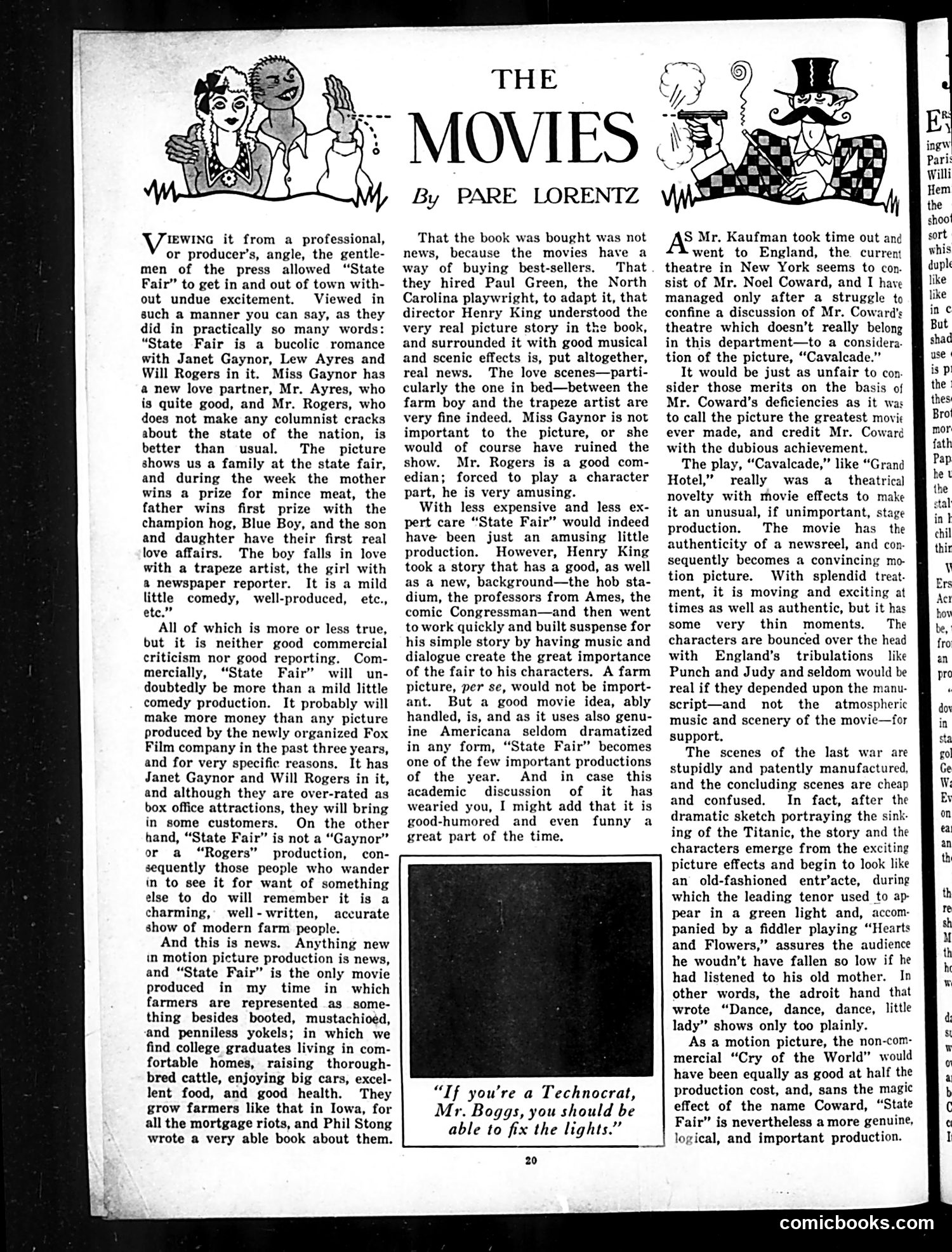
A restored page from Judge, 1933-03. Page through the whole issue in the reader above.
📄 Transcribed text from this page (OCR, searchable)
Machine-transcribed from the original scan — historical spelling and the odd misread are preserved.
ViEwine it from a professional, or producer’s, angle, the gentle- men of the press allowed “State Fair” to get in and out of town with- out undue excitement. Viewed in such a manner you can say, as they did in practically so many words: “State Fair is a bucolic romance with Janet Gaynor, Lew Ayres and Will Rogers in it. Miss Gaynor has a new love partner, Mr. Ayres, who is quite good, and Mr. Rogers, who does not make any columnist cracks about the state of the nation, is better than usual. The picture shows us a family at the state fair, and during the week the mother wins a prize for mince meat, the father wins first prize with the champion hog, Blue Boy, and the son and daughter have their first real love affairs. The boy falls in love with a trapeze artist, the girl with a newspaper reporter. It is a mild little comedy, well-produced, etc., All of which is more or less true, but it is neither good commercial criticism nor good reporting. Com- mercially, “State Fair’ will un- doubtedly be more than a mild little comedy production. It probably will make more money than any picture produced by the newly organized Fox Film company in the past three years, and for very specific reasons. It has Janet Gaynor and Will Rogers in it, and although they are over-rated as box office attractions, they will bring in some customers. On the other hand, “State Fair” is not a “Gaynor” or a “Rogers” production, con- sequently those people who wander in to see it for want of something else to do will remember it is a charming, well-written, accurate show of modern farm people. And this is news. Anything new in motion picture production is news, and “State Fair” is the only movie produced in my time in which farmers are represented as some- thing besides booted, mustachioed, and penniless yokels; in which we find college graduates living in com- fortable homes, raising thorough- bred cattle, enjoying big cars, excel- lent food, and good health. They grow farmers like that in Iowa, for all the mortgage riots, and Phil Stong wrote a very able book about them. THE MOVIES By PARE LORENTZ That the book was bought was not news, because the movies have a way of buying best-sellers. That they hired Paul Green, the North Carolina playwright, to adapt it, that director Henry King understood the very real picture story in the book, and surrounded it with good musical and scenic effects is, put altogether, real news. The love scenes—parti- cularly the one in bed—between the farm boy and the trapeze artist are very fine indeed. Miss Gaynor is not important to the picture, or she would of course have ruined the show. Mr. Rogers is a good com- edian; forced to play a character part, he is very amusing. With less expensive and less ex- pert care “State Fair” would indeed have been just an amusing little production. However, Henry King took a story that has a good, as well as a new, background—the hob sta- dium, the professors from Ames, the comic Congressman—and then went to work quickly and built suspense for his simple story by having music and dialogue create the great importance of the fair to his characters. A farm picture, per se, would not be import- ant. But a good movie idea, ably handled, is, and as it uses also genu- ine Americana seldom dramatized in any form, “State Fair” becomes one of the few important productions of the year. And in case this academic discussion of it has wearied you, I might add that it is good-humored and even funny a great part of the time. “Tf you’re a Technocrat, Mr. Boggs, you should be able to fix the lights.” \ en S Mr. Kaufman took time out and went to England, the current theatre in New York seems to con. sist of Mr. Noel Coward, and I have managed only after a struggle to confine a discussion of Mr. Coward's theatre which doesn’t really belong in this department—to a considera. tion of the picture, “Cavalcade.” It would be just as unfair to con. sider those merits on the basis of Mr. Coward’s deficiencies as it was to call the picture the greatest movie ever made, and credit Mr. Coward with the dubious achievement. The play, “Cavalcade,” like “Grand Hotel,” really was a_ theatrical novelty with movie effects to make it an unusual, if unimportant, stage production. The movie has the authenticity of a newsreel, and con- sequently becomes a convincing mo- tion picture. With splendid treat- ment, it is moving and exciting at times as well as authentic, but it has some very thin moments. The characters are bounced over the head with England’s tribulations like Punch and Judy and seldom would be real if they depended upon the manu- script—and not the atmospheric music and scenery of the movie—for support. The scenes of the last war are stupidly and patently manufactured, and the concluding scenes are cheap and confused. In fact, after the dramatic sketch portraying the sink- ing of the Titanic, the story and the characters emerge from the exciting picture effects and begin to look like an old-fashioned entr’acte, during which the leading tenor used to ap- pear in a green light and, accom- panied by a fiddler playing “Hearts and Flowers,” assures the audience he woudn’t have fallen so low if he had listened to his old mother. In other words, the adroit hand that wrote “Dance, dance, dance, little lady” shows only too plainly. As a motion picture, the non-com- mercial “Cry of the World” would have been equally as good at half the production cost, and, sans the magic effect of the name Coward, “State Fair” is nevertheless a more genuine, logical, and important production. comicbooks.com