A complete issue · 36 pages · 1932
Judge — November 1932
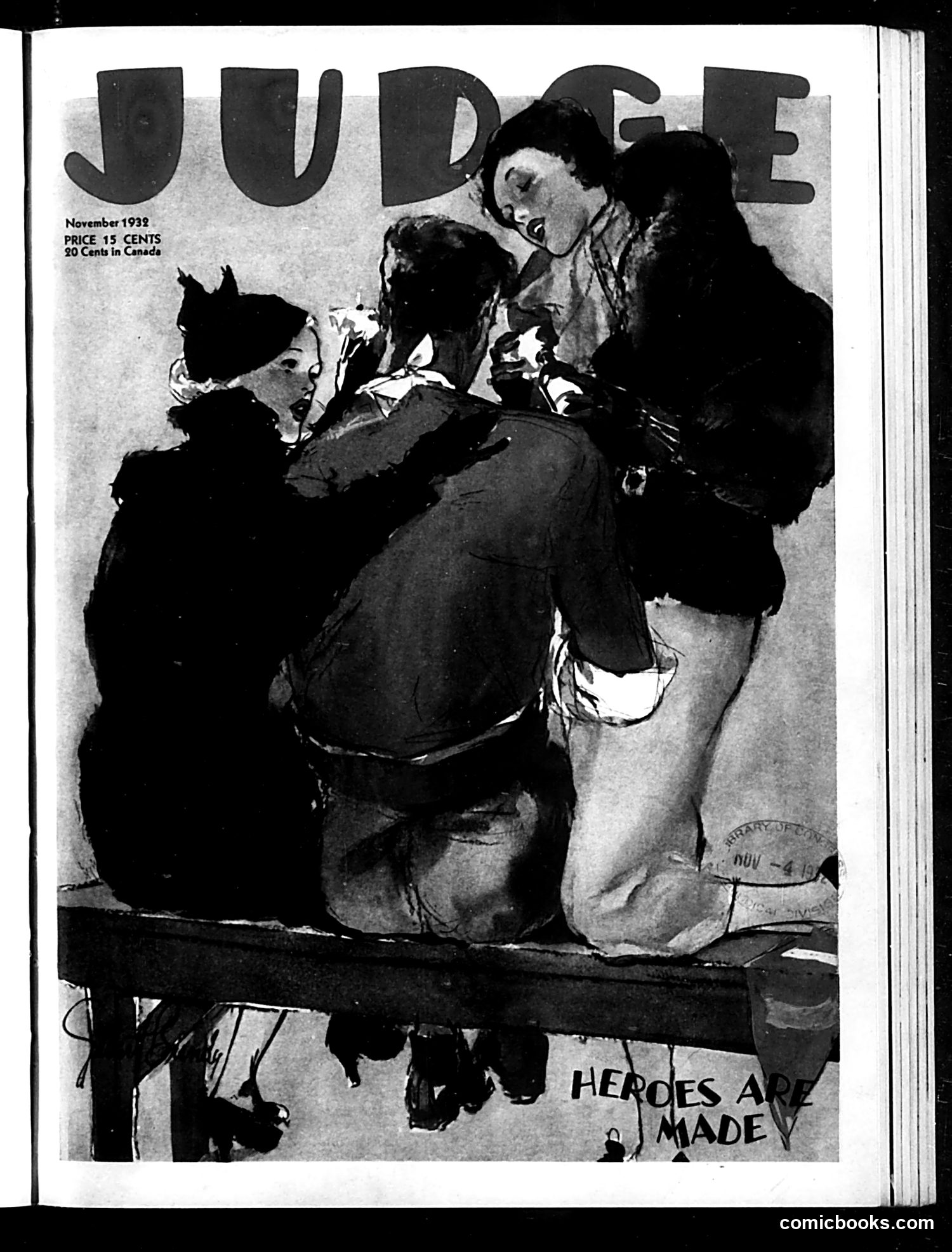
# Analysis of Judge Magazine Cover, November 1939 This cover depicts four figures in winter clothing huddled together on what appears to be a wooden beam or ledge. The tagline reads "HEROES ARE MADE," suggesting commentary on heroism or courage under duress. Given the November 1939 date and the imagery of people crowded together in difficult conditions, this likely references contemporary European situations—possibly refugees or victims of conflict during the early stages of World War II. The composition emphasizes human vulnerability and struggle. However, without clearer identification of the specific figures or a readable main article, the exact satirical target remains unclear. The cover appears to critique either the conditions these people face or perhaps attitudes toward those enduring hardship during this turbulent historical period.
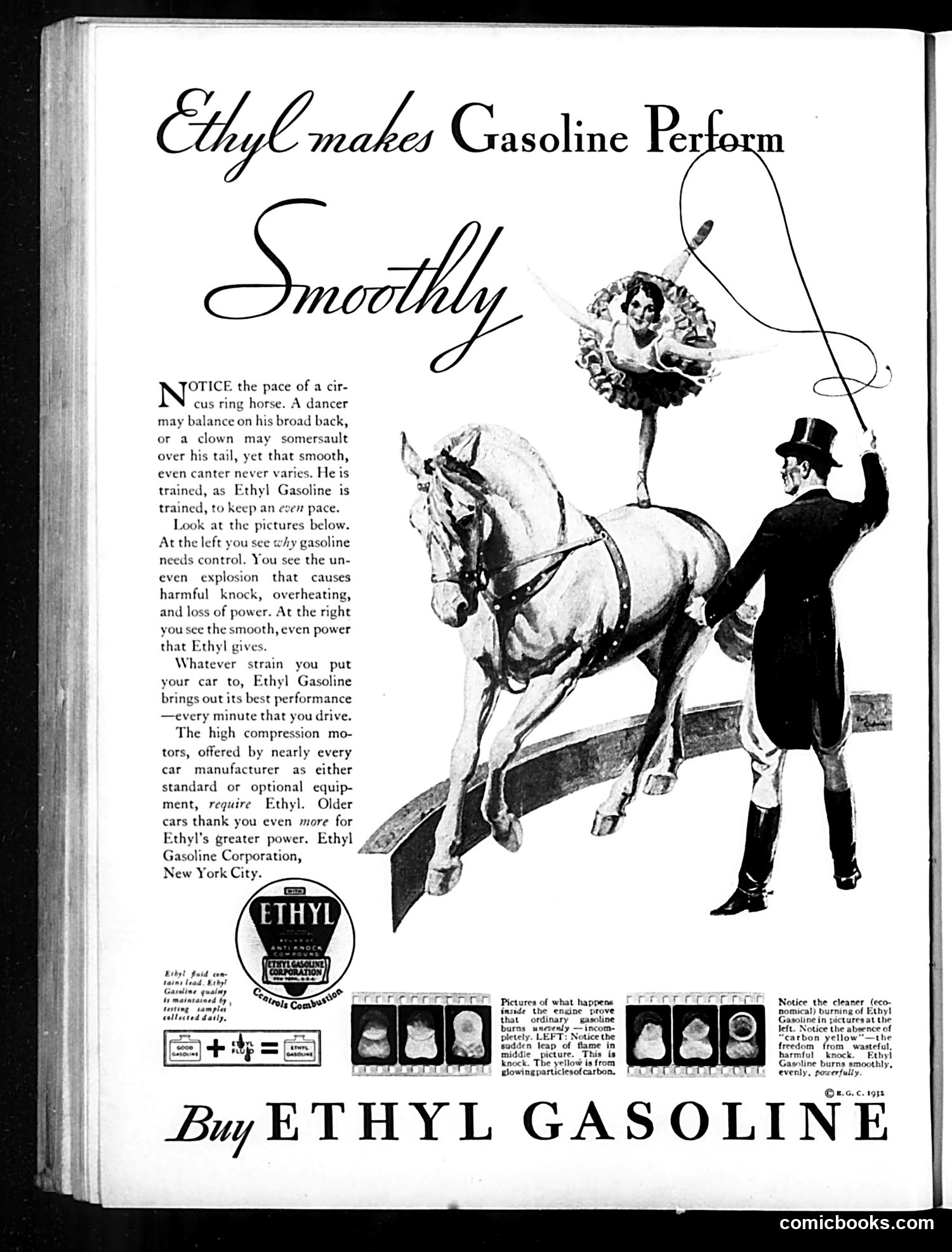
# Analysis of "Ethyl Makes Gasoline Perform Smoothly" This is primarily **an advertisement for Ethyl Gasoline**, not satire. The page uses an extended metaphor comparing gasoline performance to a circus performer's control. The image shows a ringmaster controlling a circus horse with a whip—the horse represents an automobile engine. The metaphor suggests that just as a trained horse maintains "even pace" under a skilled handler, Ethyl Gasoline provides smooth, controlled engine performance. The text claims Ethyl prevents "uneven explosion," "knock," overheating, and power loss. The small engine diagrams at bottom purport to show combustion differences. There is **no apparent political satire here**—this is straightforward early automotive advertising using circus imagery as a performance analogy. The date appears to be 1920s-era based on styling.
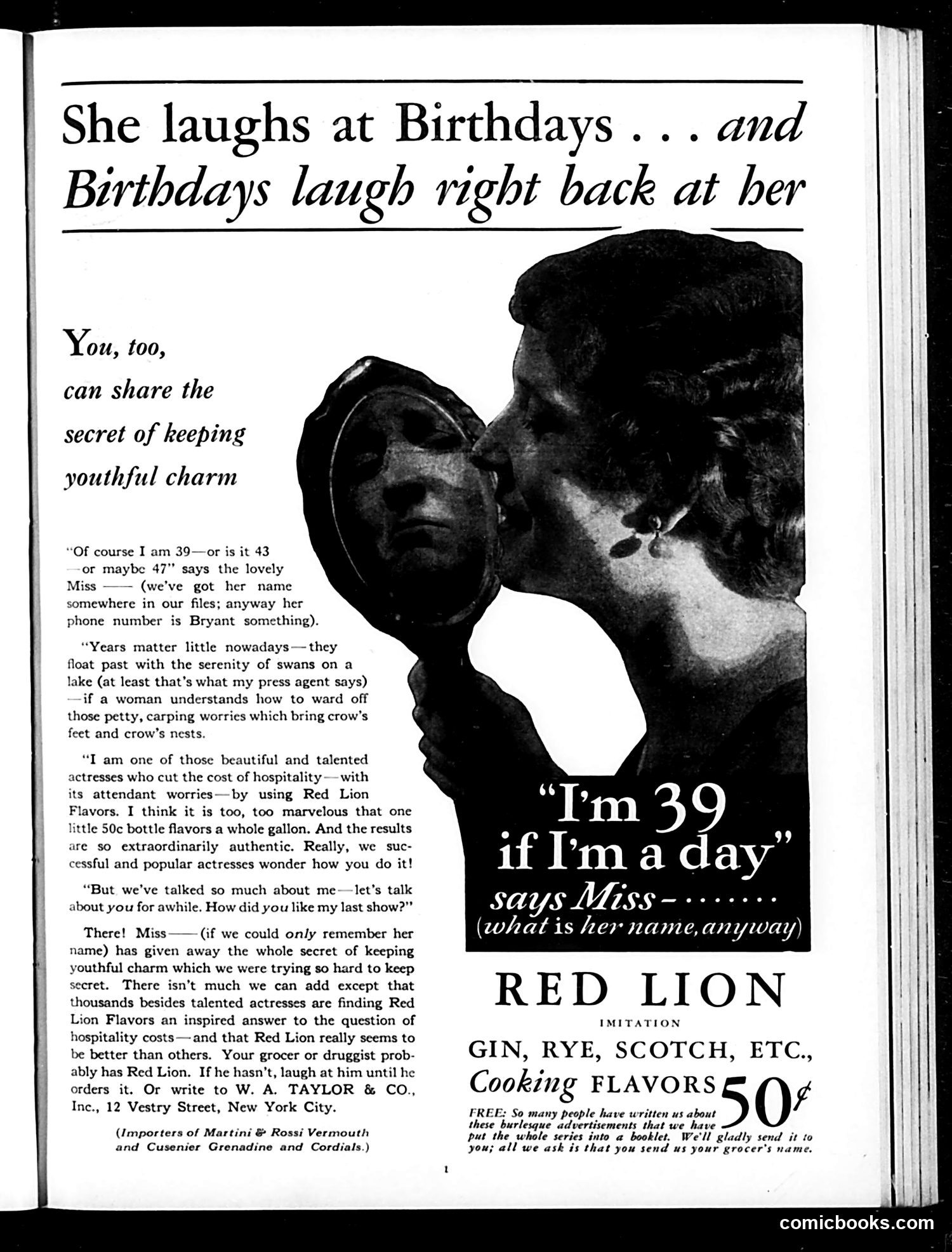
# Analysis This page is primarily **advertising for Red Lion cooking flavors** rather than political satire. The advertisement uses humor to pitch a product by portraying an unnamed actress (identified only as "Miss") who claims to be 39 years old "if I'm a day"—a joke about women misrepresenting their age. The ad suggests that Red Lion Flavors are the "secret" to maintaining youthful charm, implying that using the product helps actresses appear younger and maintain their careers. The humor relies on contemporary stereotypes about actresses' vanity and anxiety about aging, while the accompanying text humorously frames the product as a solution to hospitality costs. This is essentially a consumer advertisement using period-appropriate comedic conventions rather than political commentary.

# Analysis This page is **not a cartoon or satire**—it's a straightforward advertisement for General Electric Mazda Lamps. The ad promotes GE's trademark (the "GE" circle mark on bulbs) as a guarantee of quality and efficiency. The visual shows various light bulbs, with the left one appearing darker or defective to contrast with the brighter, properly-functioning bulbs on the right. The messaging emphasizes that consumers should look for the GE mark to ensure they receive reliable lighting at low cost, and to avoid wasted electricity from inferior bulbs that "blacken quickly" or burn out prematurely. This represents early 20th-century consumer education advertising—establishing brand trust through trademark recognition rather than satire or political commentary.
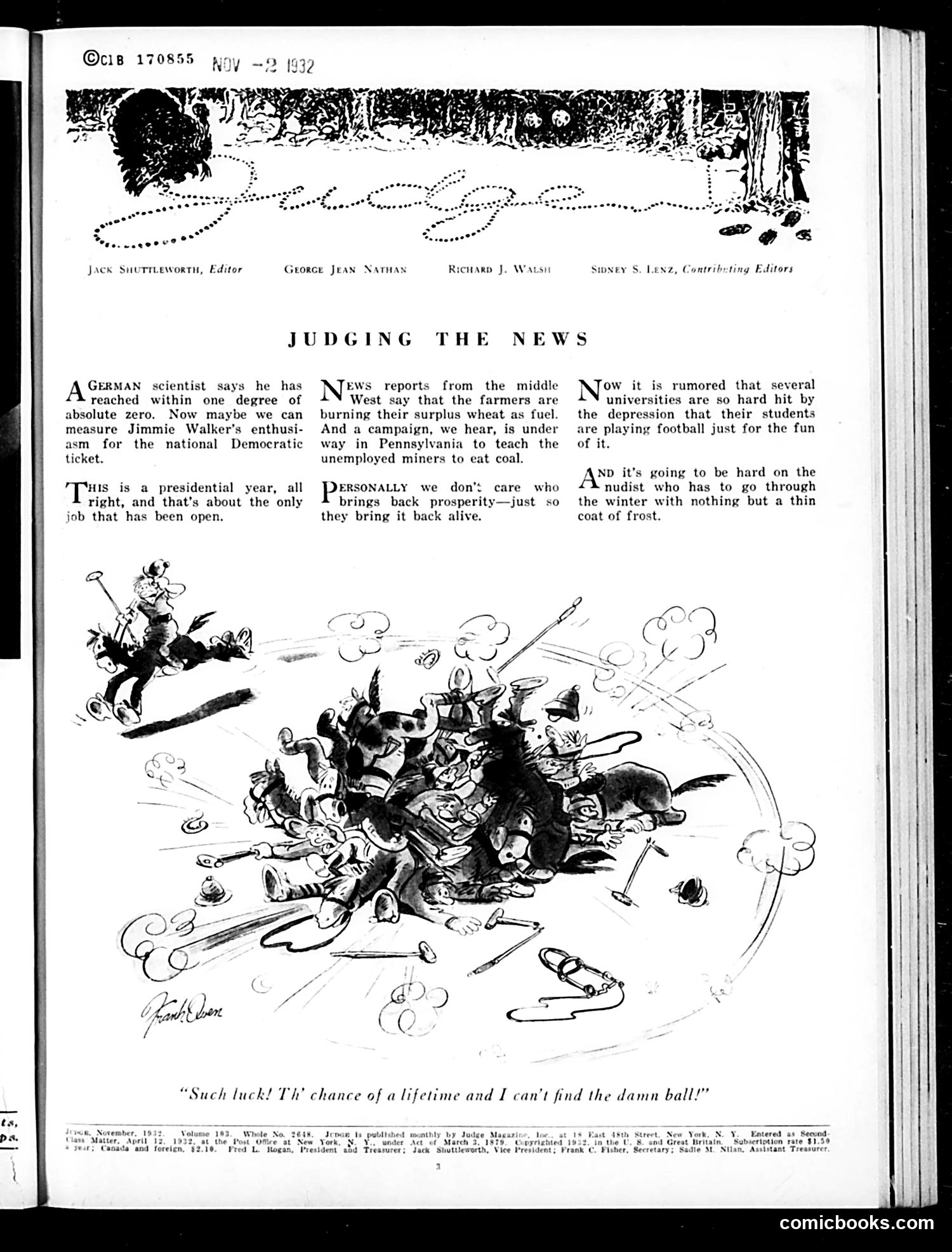
# "Judging the News" - Judge Magazine, November 1932 This page contains editorial commentary and a political cartoon satirizing the Great Depression era. The main cartoon depicts a chaotic pile of figures engaged in violent struggle, with the caption "Such luck! I'h' chance of a lifetime and I can't find the damn ball!" The imagery suggests political/economic chaos—likely depicting competing interests (politicians, businessmen, workers) fighting over resources during the Depression. The "ball" appears to represent prosperity or economic opportunity that everyone seeks but cannot grasp. The brief text items mock contemporary news: German scientists' claims, farmers burning wheat as fuel, Pennsylvania's coal-feeding proposals, and universities cutting sports budgets. These snippets illustrate economic absurdities of the Depression period—destroying food and fuel while people starved—which the magazine presents as evidence of widespread dysfunction.
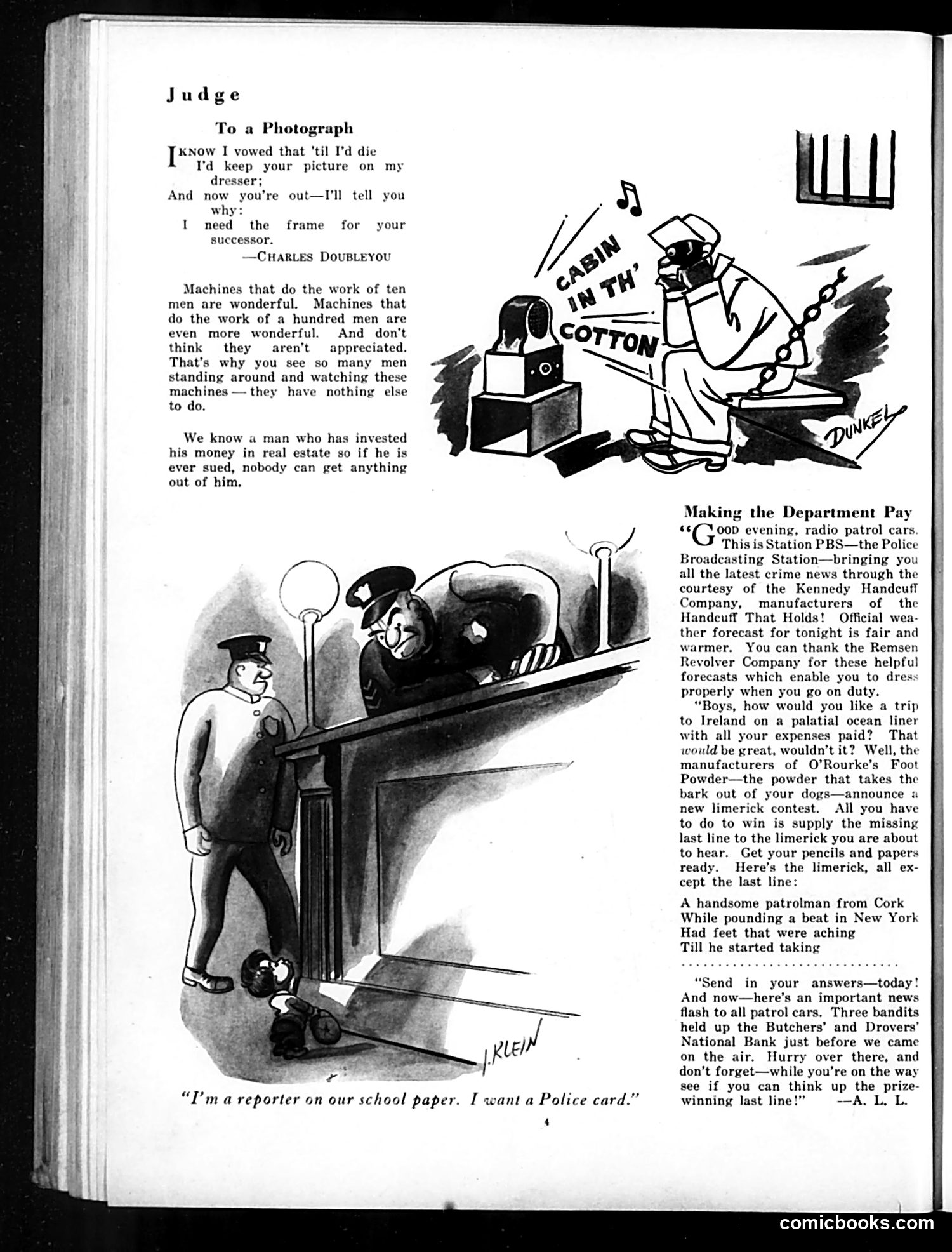
# Analysis of Judge Magazine Page This page combines poetry, satirical commentary, and advertising humor typical of Judge magazine. **"Judge to a Photograph"** is a poem by Charles Doubleday mocking someone who kept a photograph as a memento, now admitting he needed the picture frame for his successor—a cutting joke about replacability. **The cartoons** include workplace scenes: one shows a man seeking a police card as a school paper reporter; another depicts radio patrol cars and police broadcasting, referencing early 20th-century law enforcement technology. **The advertising content** dominates the right side, promoting products like Kennedy Handcuff Company's handcuffs, Remsen Revolver Company items, and O'Rourke's Foot Powder. There's a humorous "limerick contest" encouraging readers to submit entries for prizes. The overall tone reflects Jazz Age-era satire: workplace absurdities, modern technology humor, and consumerist messaging blended together.
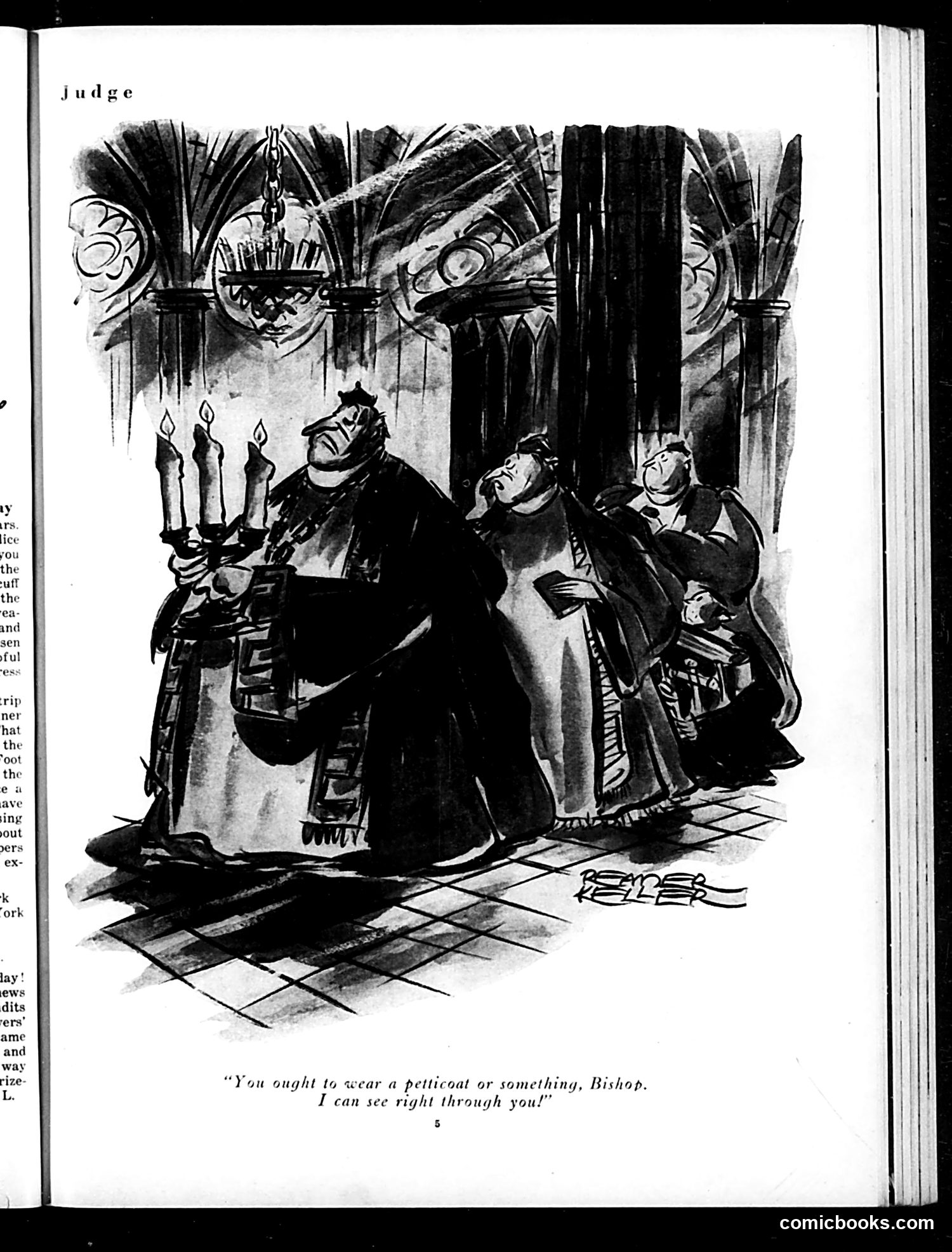
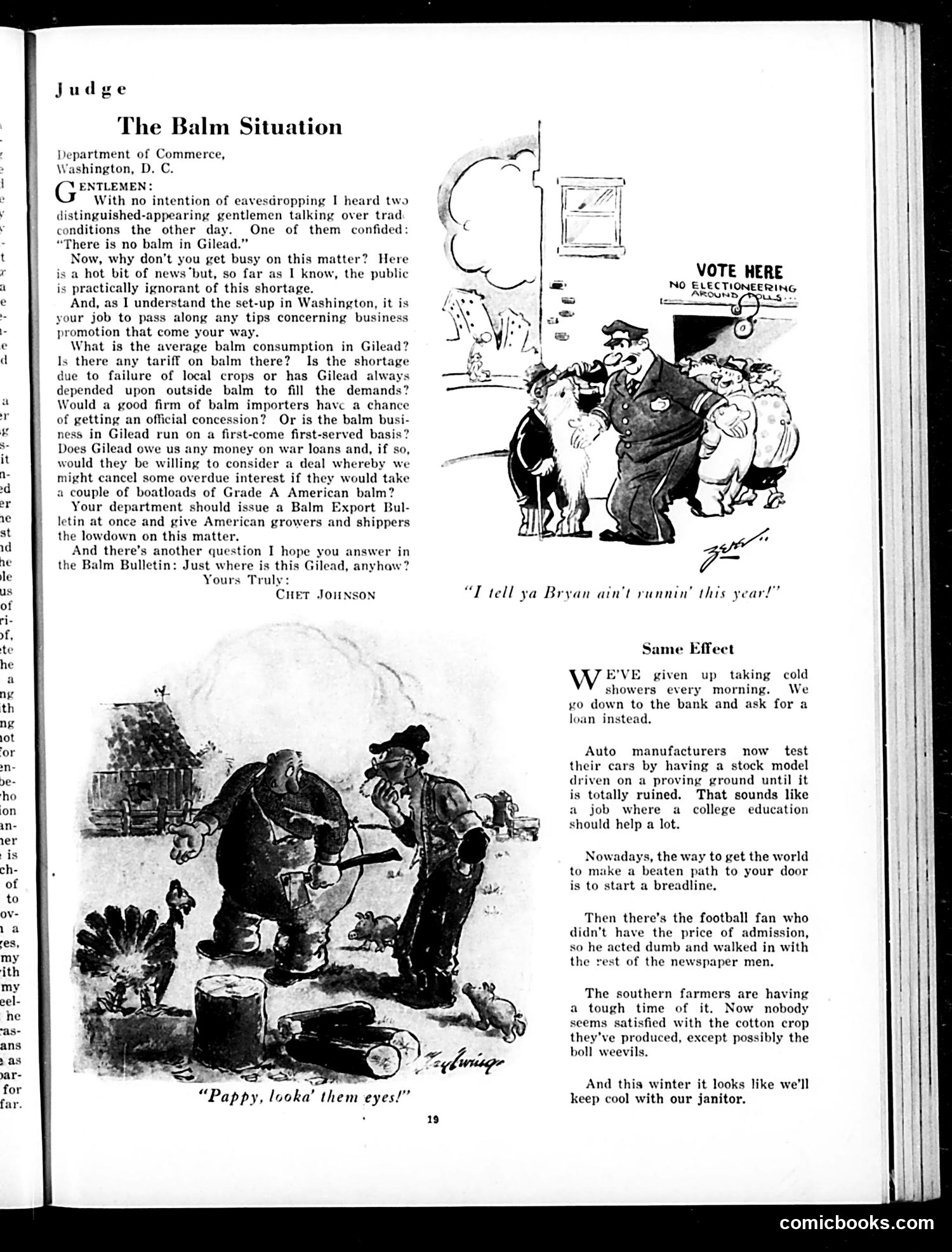
# Analysis of "Judge" Cartoon Page This page titled "Judge" contains a single political cartoon depicting three figures in formal ecclesiastical robes in what appears to be a cathedral setting, with ornate decorative elements above. The caption reads: "You ought to wear a petticoat or something, Bishop. I can see right through you!" This is a satirical jab at the transparent hypocrisy or lack of substance of a bishop or religious figure. The cartoon suggests the clergy member has no real depth or integrity—one can "see right through" him metaphorically. The humor relies on the double meaning: literally seeing through thin clothing versus perceiving someone's moral emptiness or duplicity. Without additional context about the specific date or religious controversies of the period, the exact target remains unclear, though it likely critiques clerical corruption or moral failings.
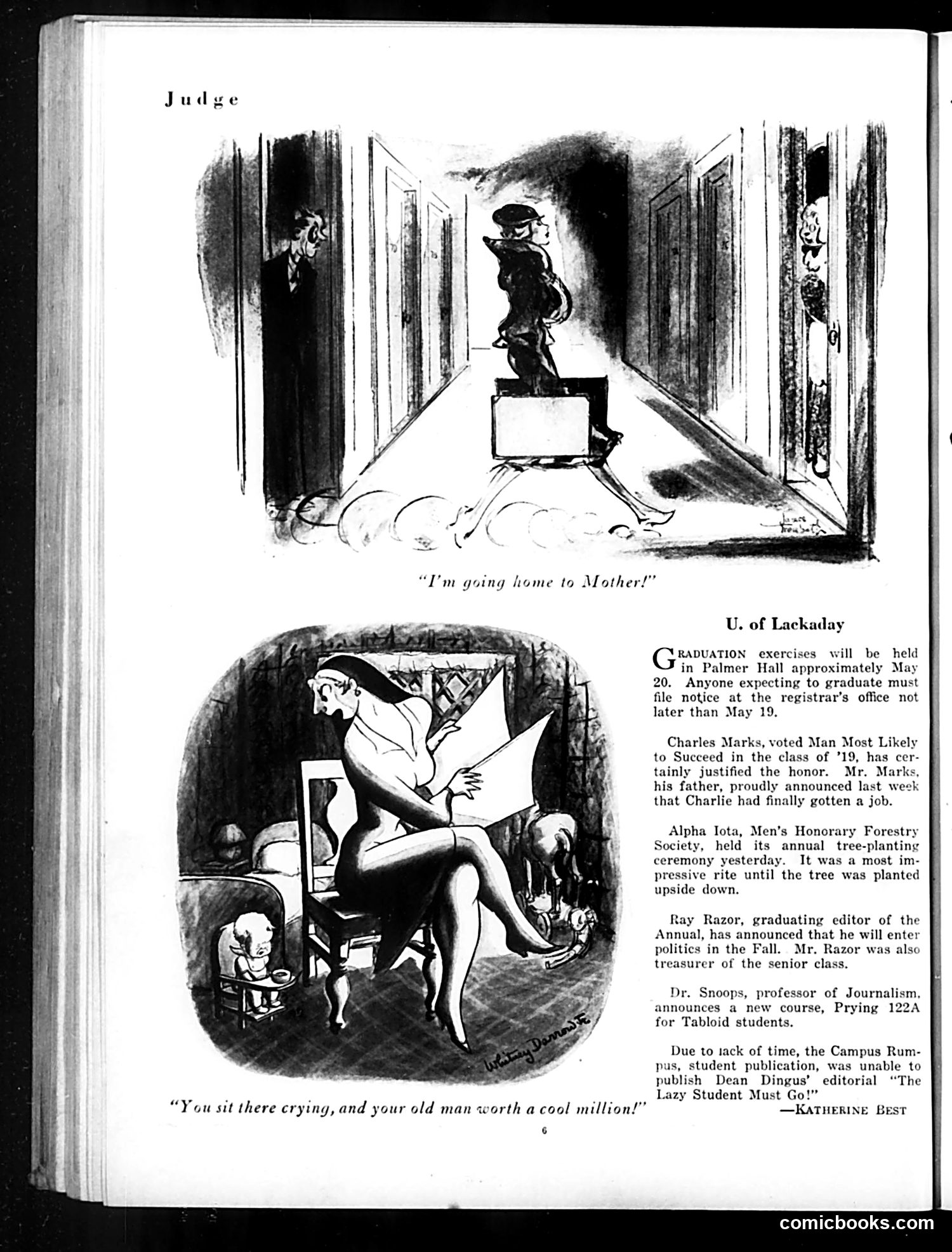
# Judge Magazine Page Analysis This page contains two satirical cartoons and university news items from the **University of Lackaday** (a fictional institution used for humor). **Top cartoon:** "I'm going home to Mother!" depicts a figure fleeing down a hallway with a suitcase, suggesting shame or defeat—likely mocking students who abandon education when facing difficulty or failure. **Bottom cartoon:** "You sit there crying, and your old man's worth a cool million!" shows a wealthy person's child crying despite paternal riches, satirizing the entitled, emotionally fragile offspring of the wealthy who expect money to solve all problems. Both cartoons employ class-based humor typical of early 20th-century Judge satire, mocking privileged youth, parental indulgence, and the supposed softness of wealthy Americans' children.
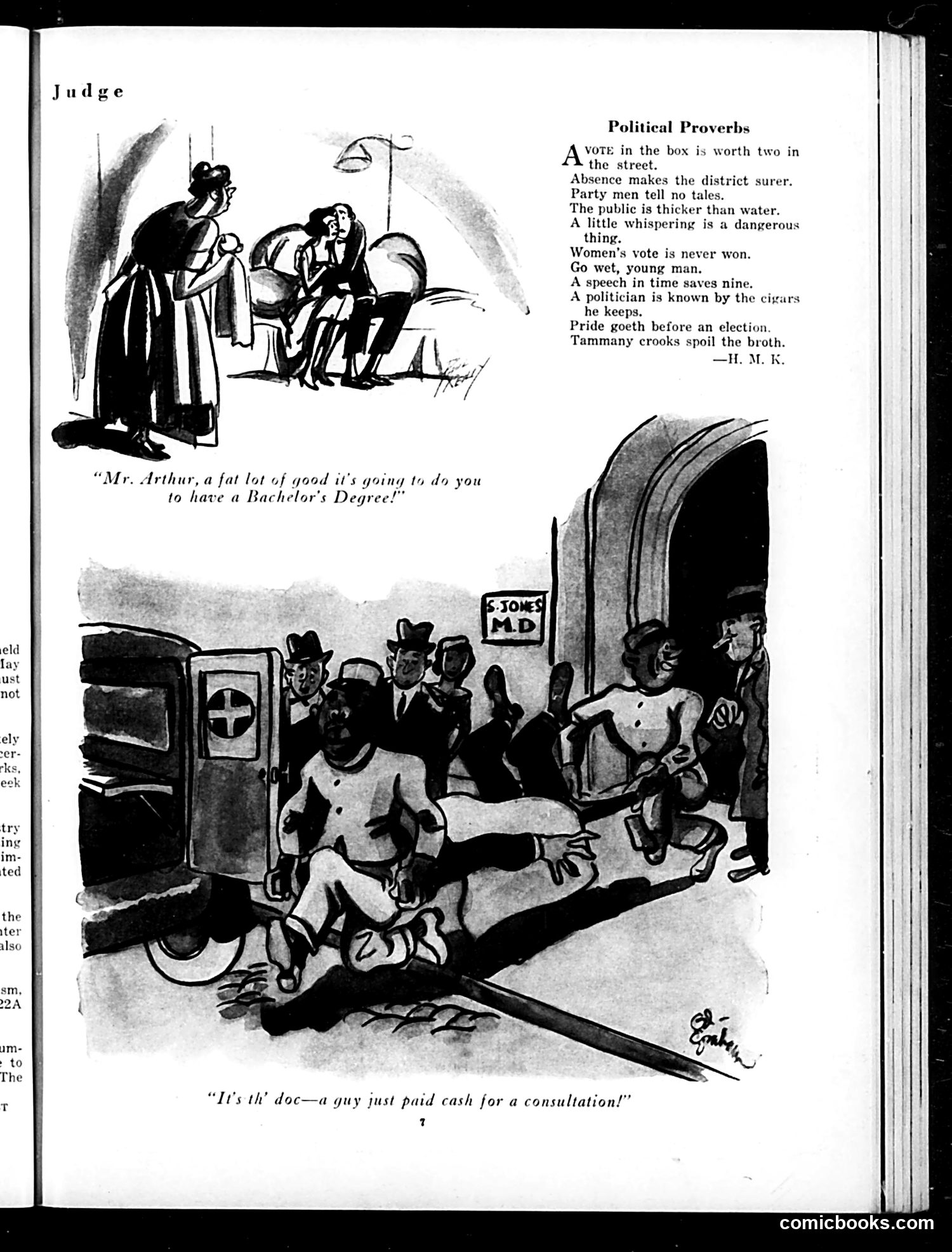
# Political Satire in Judge Magazine This page contains two distinct cartoons mocking American politics and social pretension. **Top cartoon**: References "Mr. Arthur" receiving a Bachelor's Degree, with figures suggesting the credential is worthless—likely satirizing how education fails to guarantee success or respectability in a corrupt political system. **Bottom cartoon**: Shows a doctor ("S. Jones M.D.") being dragged away by what appear to be Tammany Hall operatives (recognizable by period dress and caricatured features). The caption "a guy just paid cash for a consultation" suggests bribery or corruption—the doctor has been paid off, possibly to provide false medical testimony or suppress evidence. **"Political Proverbs"** section (right): Mock-serious sayings satirize voter corruption ("vote in the box"), women's disenfranchisement ("Women's vote is never won"), and machine politics. The final line references **Tammany Hall**—New York's notorious Democratic political machine known for graft and corruption. The satire targets institutional corruption permeating American politics and professional life.
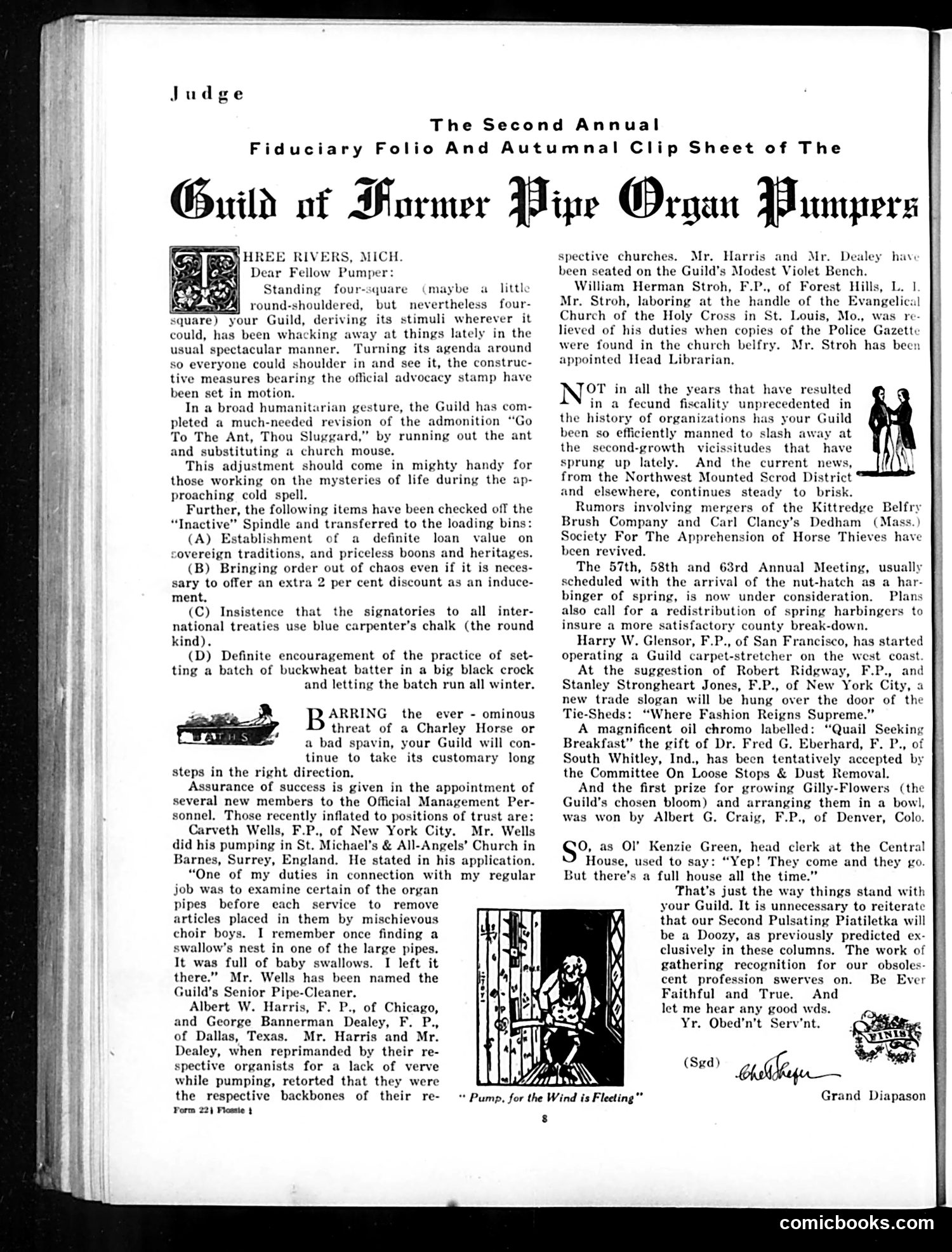
# Analysis of Judge Magazine Page This page satirizes the self-important bureaucracy of a fictional "Guild of Former Pipe Organ Pumpers"—workers who manually pumped air into church organs before electric motors existed. **The humor:** The text mockingly presents mundane or absurd "accomplishments" in grandiose language: replacing "Go To The Ant, Thou Sluggard" with a church mouse, encouraging buckwheat fermentation, requiring blue carpenter's chalk in international treaties. These are meaningless busywork dressed up as serious organizational policy. **The illustration** shows a pipe organ pumper at work, captioned "Pump, for the Wind is Fleeting"—a wry reference to the obsolescence of the profession itself. **The satire targets:** Self-aggrandizing fraternal organizations that create elaborate bureaucracy and meaningless honors ("Modest Violet Bench," "Senior Pipe-Cleaner") to justify their continued existence despite their role becoming irrelevant. The invented personnel appointments and their comical dismissals (Stroh found with Police Gazette in the belfry) mock pretentious guild governance. This is Judge magazine's typical early 20th-century satirical approach: mocking institutional pomposity through absurdist exaggeration.
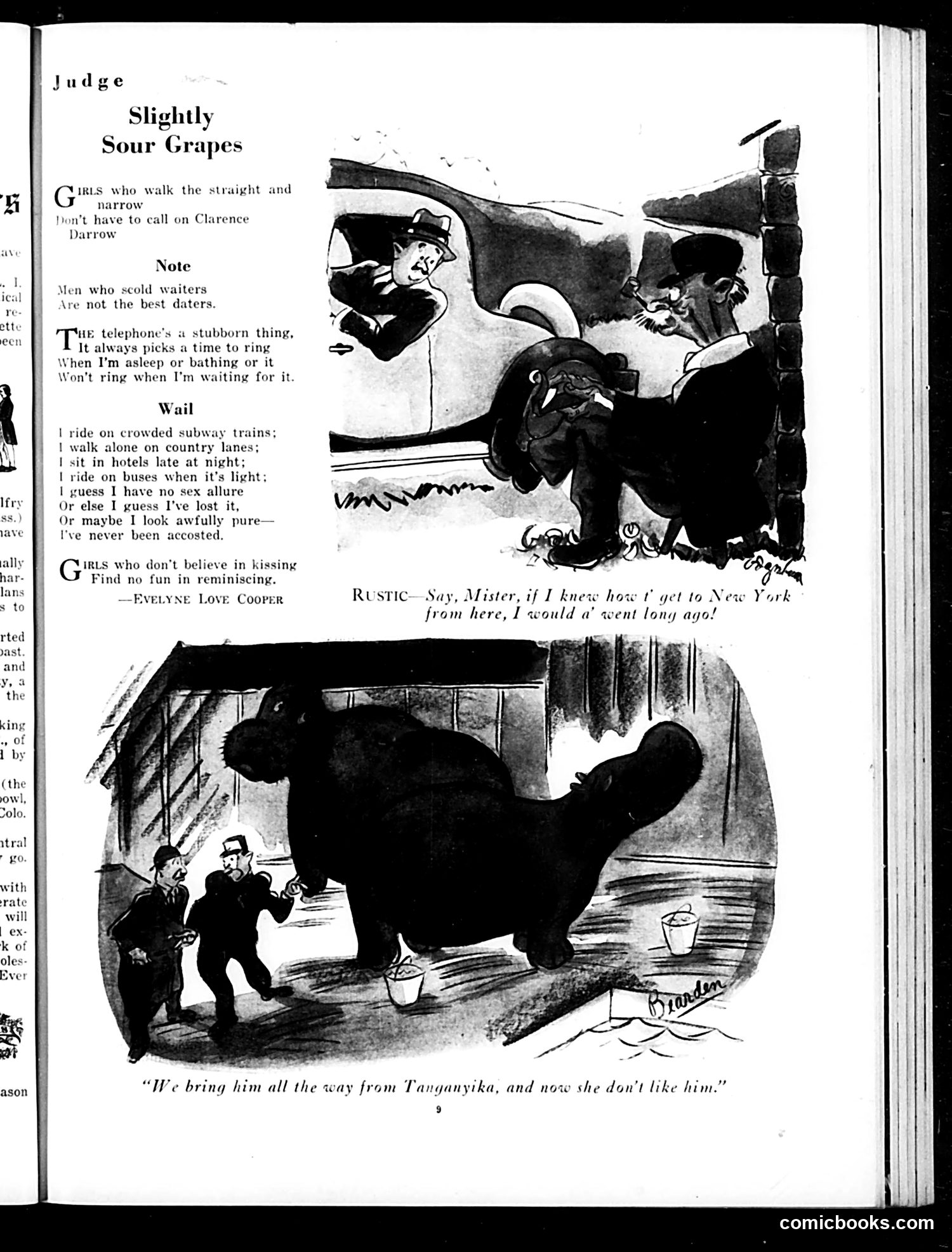
# Analysis for Modern Readers This page from *Judge* magazine contains several short satirical pieces about dating and social behavior: **"Slightly Sour Grapes"** mocks women who claim disinterest in romance while secretly wanting attention—the "straight and narrow" girls avoid calling on men like Clarence. **The "Note" and "Wail" sections** are humorous complaints: one about inconsiderate men scolding waiters; another about a woman who takes precautions against unwanted advances (riding crowded trains, staying in hotels) yet complains she's never been "accosted" (approached romantically), ironically suggesting she actually wanted attention. **The top cartoon** depicts a rustic man asking directions to New York, implying rural ignorance. **The bottom cartoon** shows a couple with what appears to be an exotic animal (brought "all the way from Tanganyika"—then a British colonial territory in Africa), with the woman rejecting it. This satirizes wealthy people's capricious tastes and wasteful consumption of exotic imported goods. All pieces reflect early 20th-century attitudes toward gender, romance, and class.
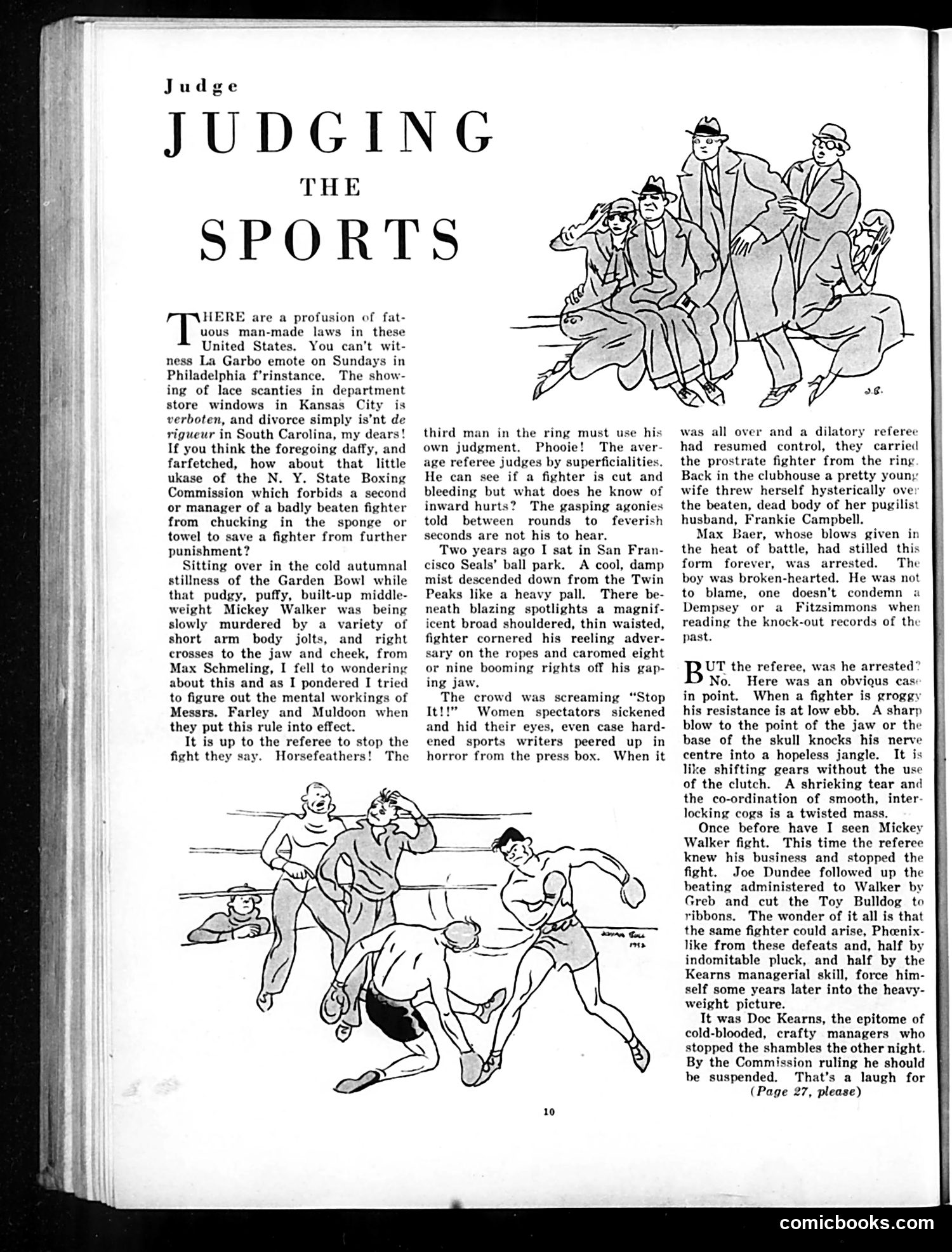
# "Judging the Sports" - Judge Magazine Satire This article critiques New York State Boxing Commission rules that prohibit a fighter's manager from throwing in the towel to stop a badly beaten match. The author argues the rule is absurd because referees lack the judgment to know when a fighter is truly finished—they only see external injuries, not internal damage. The piece uses real boxing examples: Mickey Walker's brutal fight with Max Schmeling, and the tragic Frankie Campbell death (likely 1930), where manager Joe Dundee wisely stopped the fight after Campbell was beaten by Max Baer. The author's point: experienced managers like Doc Kearns understand a fighter's condition better than referees do. The Commission should praise Kearns for stopping "the shambles," not suspend him—hence "that's a laugh." The satire exposes the Commission's rule as counterproductive to fighter safety.