
Judge, 1932-11 · page 12 of 36
Judge — November 1932 — page 12: what you’re looking at
What you’re looking at
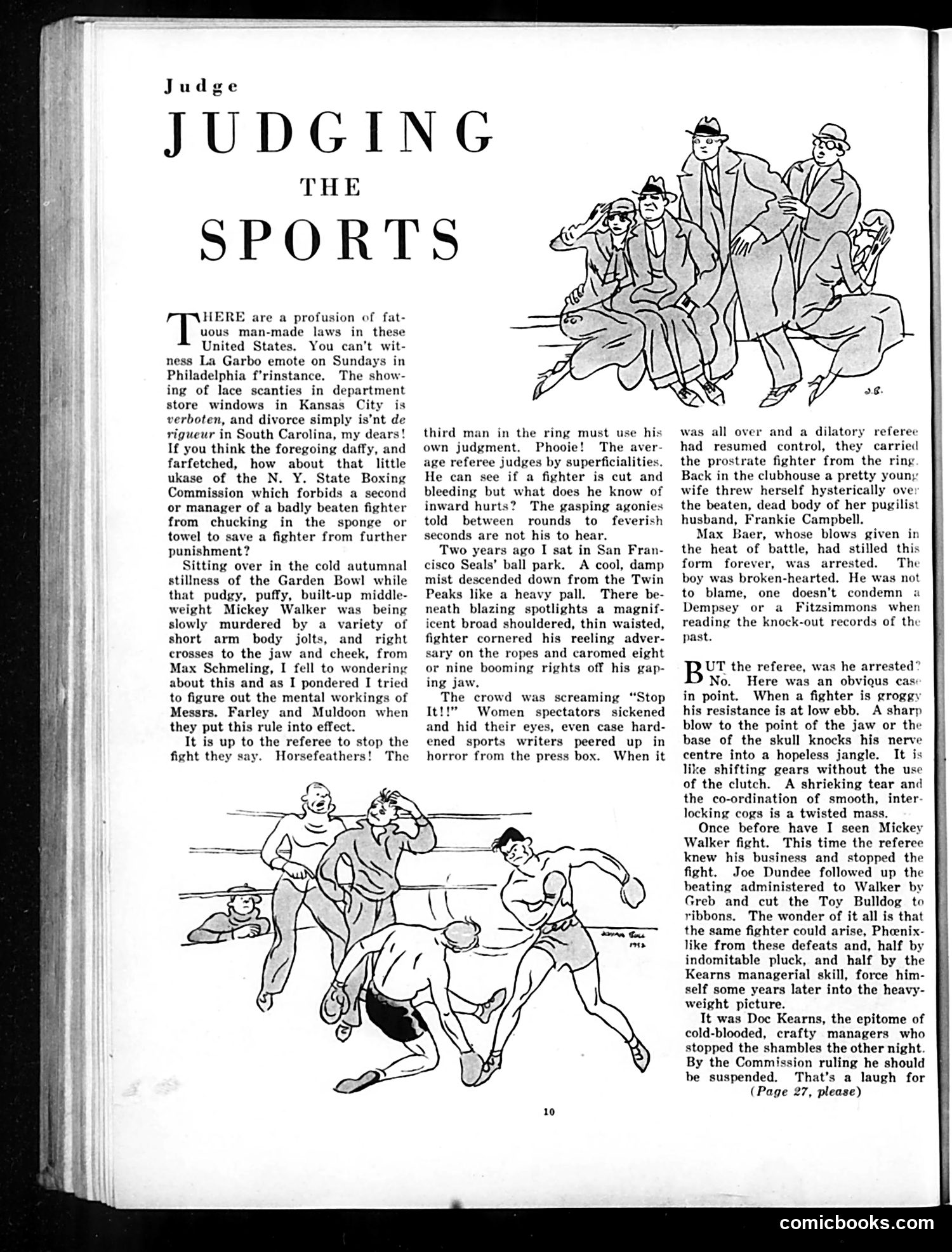
# "Judging the Sports" - Judge Magazine Satire This article critiques New York State Boxing Commission rules that prohibit a fighter's manager from throwing in the towel to stop a badly beaten match. The author argues the rule is absurd because referees lack the judgment to know when a fighter is truly finished—they only see external injuries, not internal damage. The piece uses real boxing examples: Mickey Walker's brutal fight with Max Schmeling, and the tragic Frankie Campbell death (likely 1930), where manager Joe Dundee wisely stopped the fight after Campbell was beaten by Max Baer. The author's point: experienced managers like Doc Kearns understand a fighter's condition better than referees do. The Commission should praise Kearns for stopping "the shambles," not suspend him—hence "that's a laugh." The satire exposes the Commission's rule as counterproductive to fighter safety.
📄 Transcribed text from this page (OCR, searchable)
Machine-transcribed from the original scan — historical spelling and the odd misread are preserved.
Judge JUDGING THE SPORTS HERE are a profusion of fat- | uous man-made laws in these United States. You can’t wit- ness La Garbo emote on Sunda; Philadelphia f’rinstance. The show- ing of lace scanties in department store windows in Kansas City is verboten, and divorce simply is'nt de rigueur in South Carolina, my dears! If you think the foregoing daffy, and farfetched, how about that little ukase of the N. Y. State Boxing Commission which forbids a second or manager of a badly beaten fighter from chucking in the sponge or towel to save a fighter from further punishment? Sitting over in the cold autumnal stillness of the Garden Bowl while that pudgy, puffy, built-up middle- weight Mickey Walker being slowly murdered by a variety of short arm body jolts, and right crosses to the jaw and cheek, from Max Schmeling, I fell to wondering about this and as I pondered I tried to figure out the mental workings of Messrs. Farley and Muldoon when they put this rule into effect. It is up to the referee to stop the fight they say. Horsefeathers! The third man in the ring must use his own judgment. Phooie! The aver- age referee judges by superficialities. He can see if a fighter is cut and bleeding but what does he know of inward hurts? The gasping agonies told between rounds to feverish seconds are not his to hear. Two years ago I sat in San Fran- cisco Seals’ ball park. A cool, damp mist descended down from the Twin Peaks like a heavy pall. There be- neath blazing spotlights a magnif- icent broad shouldered, thin waisted, fighter cornered his reeling adver- sary on the ropes and caromed eight or nine booming rights off his gap- ing jaw. The crowd was screaming “Stop It!!” Women spectators sickened and hid their eyes, even case hard- ened sports writers peered up in horror from the press box. When it was all over and a dilatory referee had resumed control, they carried the prostrate fighter from the ring Back in the clubhouse a pretty youny wife threw herself hysterically ove the beaten, dead body of her pugilist husband, Frankie Campbell. Max Baer, whose blows given in the heat of battle, had stilled this form forever, was arrested. The boy was broken-hearted. He was not to blame, one doesn’t condemn a Dempsey or a Fitzsimmons when reading the knock-out records of the past. UT the referee, was he arrested” No. Here was an obviqus cas: in point. When a fighter is groggy his resistance is at low ebb. A sharp blow to the point of the jaw or the base of the skull knocks his nerve centre into a hopeless jangle. It is like shifting gears without the use of the clutch. A shrieking tear and the co-ordination of smooth, inter- locking cogs is a twisted mass. Once before have I seen Mickey Walker fight. This time the referee knew his business and stopped the fight. Joe Dundee followed up the beating administered to Walker by Greb and cut the Toy Bulldog to ribbons. The wonder of it all is that the same fighter could arise, Phenix- like from these defeats and, half by indomitable pluck, and half by the Kearns managerial skill, force him- self some years later into the heavy- weight picture. It was Doc Kearns, the epitome of cold-blooded, crafty managers who stopped the shambles the other night. By the Commission ruling he should be suspended. That’s a laugh for (Page 27, please) comicbooks.com