
Judge, 1932-11 · page 18 of 36
Judge — November 1932 — page 18: what you’re looking at
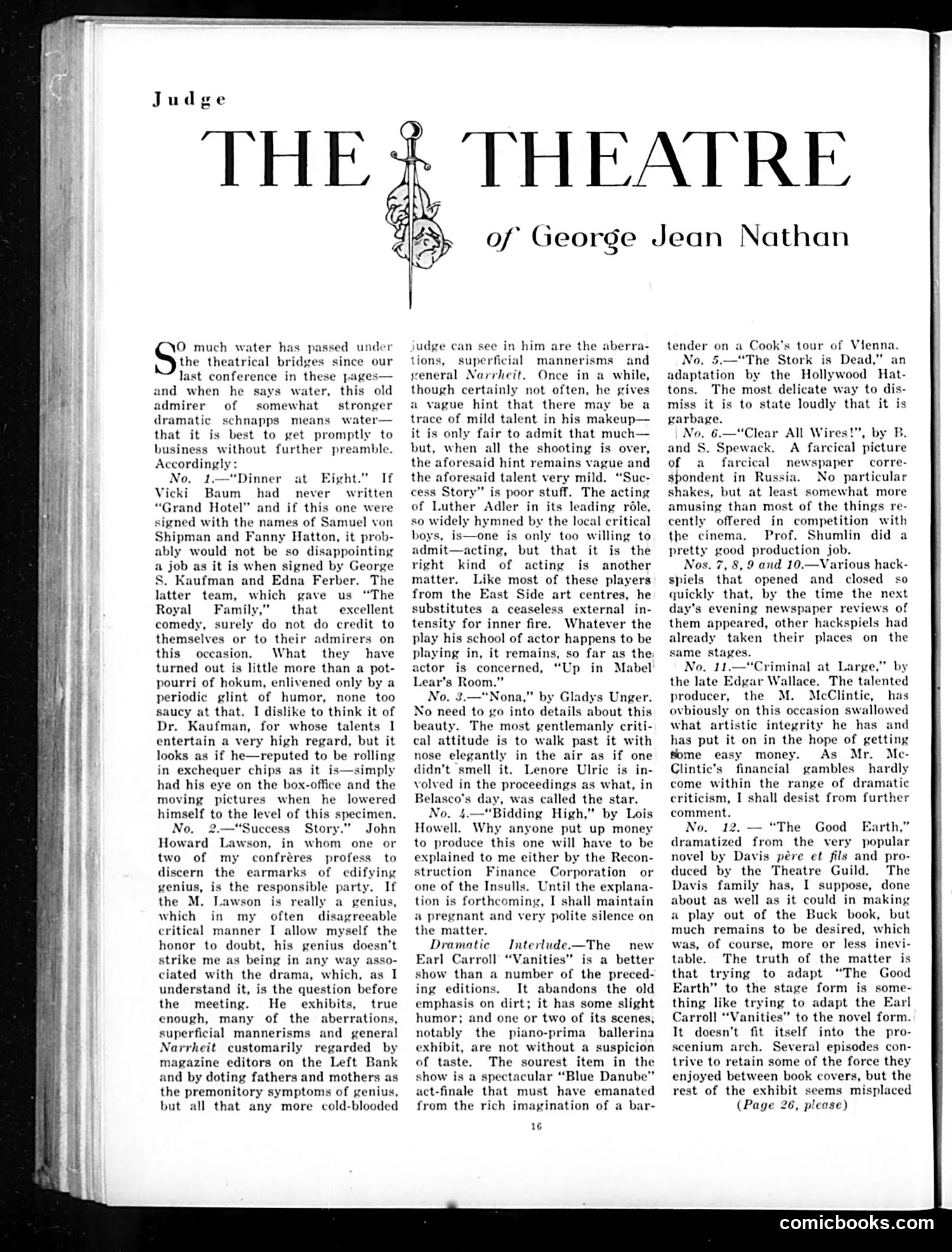
A restored page from Judge, 1932-11. Page through the whole issue in the reader above.
📄 Transcribed text from this page (OCR, searchable)
Machine-transcribed from the original scan — historical spelling and the odd misread are preserved.
‘NO much vw ed under Sine theatr since our last conference in these pages— says water, this old admirer of somewhat — stronger dramatic schnapps means water— that it is best to get promptly to business without further preamble. Accordingly: No. 1.—“Dinner at Eight.” If Vicki Baum had never written “Grand Hotel” and if this one were signed with the names of Samuel von Shipman and Fanny Hatton, it prob- ably would not be so disappointing job as it is when signed by George Kaufman and Edna Ferber. The latter team, which gave us “The Royal Family,” that — excellent comedy, surely do not do credit to themselves or to their admirers on this occasion. What they have turned out is little more than a pot- pourri of hokum, enlivened only by a periodic glint of humor, none too saucy at that. I dislike to think it of aufman, for whose talents I a very high regard, but it looks as if he—reputed to be rolling in exchequer chips as it is—simply had his eye on the box-office and the moving pictures when he lowered himself to the level of this specimen. No. 2.—‘“Success Story.” John Howard Lawson, in whom one or two of my confréres profess to discern the earmarks of edifying yenius, is the responsible pa the M. Lawson is really genius, which in my often disagreeable critical manner I allow myself the honor to doubt, his genius doesn't strike me as being in any way asso- ciated with the drama, which, as I understand it, is the question before the meeting. He exhibits, true enough, many of the aberrations, superficial mannerisms and general Narrheit customarily regarded by magazine editors on the Left Bank and by doting fathers and mothers as the premonitory symptoms of ius, but all that any more cold-blooded and when he THEATRE of George Jean Nathan udge can see in him are the aberra- tions, superfici mannerisms and general Narrheit. Once in a while, though certainly not often, he gives a vague hint that there may be a trace of mild talent in his makeup— it is only fair to admit that much— but, when all the shooting is over, the aforesaid hint remains vague and the aforesaid talent very mild. “Suc- cess Story” is poor stuff. The acting of Luther Adler in its leading réle, so widely hymned by the local critical boy —one is only too willing to admit—acting, but that it is the right kind of acting is another matter. Like most of these players from the East Side art centres, he substitutes a ceaseless external in- tensity for inner fire. Whatever the play his school of actor happens to be playing in, it rema so far as the actor is concerned, “Up in Mabel Lear’s Room.” No. 3.—*Nona,” by Gladys Unger. No need to yo into details about this beauty. The most gentlemanly criti- cal attitude is to walk past it with nose elegantly in the air as if one didn’t smell it. Lenore Ulric is in- volved in the proceedings as what, in Belasco’s day, was called No. 4.—“Bidding High,” by Lois Howell. Why anyone put up money to produce this one will have to be explained to me either by the Recon- struction Finance Corporation or one of the Insulls. Until the explana- tion is forthcoming, I shall maintain a pregnant and very polite silence on the matter. Dramatic Interlude.-—The new Earl Carroll “Vanities” is a better show than a number of the preced- ing editions. It abandons the old emphasis on dirt; it has some slight humor; and one or two of its scenes, notably the piano-prima ballerina exhibit, are not without a suspicion of taste. The sourest item in the show is a spectacular “Blue Danube” act-finale that must have emanated from the rich imagination of a bar- 16 tender on a Cook's tour of Vienna. No, 5.—“The Stork is Dead,” an japtation by the Hollywood Hat- tons. The most delicate way to dis miss it is to state loudly that it is garbage. - 6.—"Cl and S. Spewac! of a farcics spondent in Russia. rticular shakes, but at le somewhat more amusing than most of the things r cently offered in competition with the cinema. Prof. Shumlin did a pretty good production job. Nos. 7, 8, 9 and 10.—Various hack- spiels that opened and closed so quickly that, by the time the next day’s evening newspaper reviews of them appeared, other hackspiels had already taken their places on the same stages. No, 11.—“Criminal at Large,” by the late Edgar Wallace. The talented producer, the M. McClin ovbiously on this occasion s' what artistic integrity he has and has put it on in the hope of getting Some easy money. As Mr. Mc- Clintic’s financial gambles hardly come within the range of dramatic criticism, I shall desist from further comment. No. 12, — “The Good Earth,” dramatized from the very popular novel by Davis pére et fils and pro- duced by the Theatre Guild. The Davis family has, I suppose, done about as well as it could in making a play out of the Buck book, but much remains to be desired, which was, of course, more or less inevi- table. The truth of the matter is that trying to adapt “The Good Earth” to the stage form is some- thing like ing to adapt the 1 Carroll “Vanities” to the novel form. It doesn't fit itself into the pro- scenium arch. Several episodes con- trive to retain some of the force they enjoyed between book covers, but the rest of the exhibit seems misplaced (Page 26, please) corre- comicbooks.com