
Judge, 1932-11 · page 22 of 36
Judge — November 1932 — page 22: what you’re looking at
A restored page from Judge, 1932-11. Page through the whole issue in the reader above.
📄 Transcribed text from this page (OCR, searchable)
Machine-transcribed from the original scan — historical spelling and the odd misread are preserved.
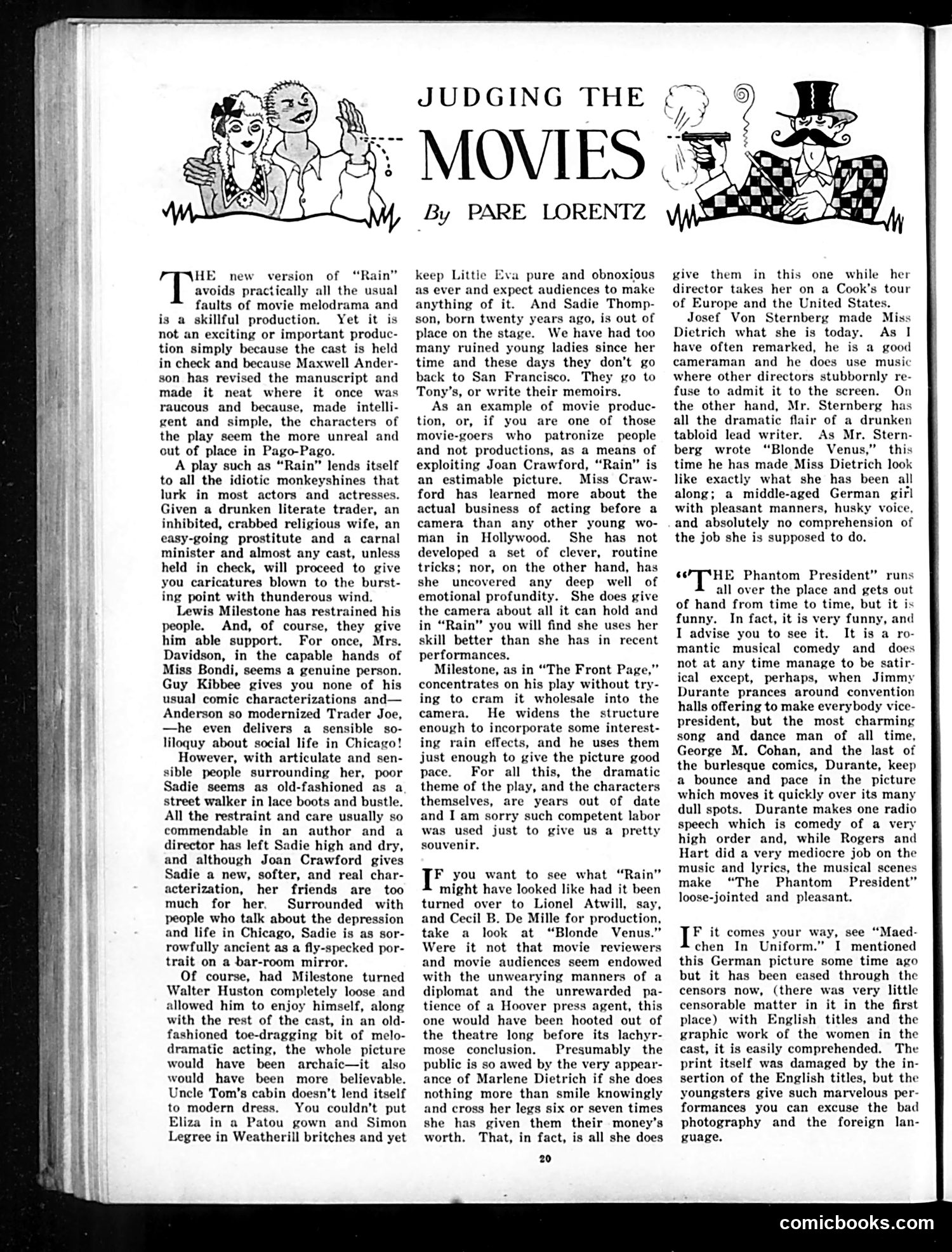
T= new version of “Rain” avoids practically all the usual faults of movie melodrama and is a skillful production. Yet it is not an exciting or important produc- tion simply because the cast is held in check and because Maxwell Ander- son has revised the manuscript and made it neat where it once was raucous and because, made intelli- gent and simple, the characters of the play seem the more unreal and out of place in Pago-Pago. A play such as “Rain” lends itself to all the idiotic monkeyshines that lurk in most actors and actresses. Given a drunken literate trader, an inhibited, crabbed religious wife, an easy-going prostitute and a carnal minister and almost any cast, unless held in check, will proceed to give you caricatures blown to the burst- ing point with thunderous wind. Lewis Milestone has restrained his people. And, of course, they give him able support. For once, Mrs. Davidson, in the capable hands of Miss Bondi, seems a genuine person. Guy Kibbee gives you none of his usual comic characterizations and— Anderson so modernized Trader Joe, —he even delivers a sensible so- liloquy about social life in Chicago! However, with articulate and sen- sible people surrounding her, poor Sadie seems as old-fashioned as a street walker in lace boots and bustle. All the restraint and care usually so commendable in an author and a director has left Sadie high and dry, and although Joan Crawford gives Sadie a new, softer, and real char- acterization, her friends are too much for her, Surrounded with people who talk about the depression and life in Chicago, Sadie is as sor- rowfully ancient as a fly-specked por- trait on a bar-room mirror. Of course, had Milestone turned Walter Huston completely loose and allowed him to enjoy himself, along with the rest of the cast, in an old- fashioned toe-dragging bit of melo- dramatic acting, the whole picture would have been archaic—it also would have been more believable. Uncle Tom’s cabin doesn’t lend itself to modern dress. You couldn’t put Eliza in a Patou gown and Simon Legree in Weatherill britches and yet JUDGING THE MOVIES . \ By PARE LORENTZ keep Littie Eva pure and obnoxious as ever and expect audiences to make anything of it. And Sadie Thomp- son, born twenty years ago, is out of place on the stage. We have had too many ruined young ladies since her time and these days they don’t go back to San Francisco. They yo to Tony’s, or write their memoirs. As an example of movie produc- tion, or, if you are one of those movie-goers who patronize people and not productions, as a means of exploiting Joan Crawford, “Rain” is an estimable picture. Miss Craw- ford has learned more about the actual business of acting before a camera than any other young wo- man in Hollywood. She has not developed a set of clever, routine tricks; nor, on the other hand, has she uncovered any deep well of emotional profundity. She does give the camera about all it can hold and in “Rain” you will find she uses her skill better than she has in recent performances. Milestone, as in “The Front Page,” concentrates on his play without try- ing to cram it wholesale into the camera. He widens the structure enough to incorporate some interest- ing rain effects, and he uses them just enough to give the picture good pace. For all this, the dramatic theme of the play, and the characters themselves, are years out of date and I am sorry such competent labor was used just to give us a pretty souvenir. F you want to see what “Rain” might have looked like had it been turned over to Lionel Atwill, say, and Cecil B. De Mille for production, take a look at “Blonde Venus.” Were it not that movie reviewers and movie audiences seem endowed with the unwearying manners of a diplomat and the unrewarded pa- tience of a Hoover press agent, this one would have been hooted out of the theatre long before its lachyr- mose conclusion. Presumably the public is so awed by the very appear- ance of Marlene Dietrich if she does nothing more than smile knowingly and cross her legs six or seven times she has given them their money’s worth, That, in fact, is all she does 20 ‘ give them in this one while her director takes her on a Cook's tour of Europe and the United State Josef Von Sternberg made Miss Dietrich what she is today. As I have often remarked, he is a good cameraman and he does use music where other directors stubbornly re- fuse to admit it to the screen. On the other hand, Mr. Sternberg has all the dramatic flair of a drunken tabloid lead writer. As Mr. Stern- berg wrote “Blonde Venus,” this time he has made Miss Dietrich look like exactly what she has been all along; a middle-aged German girl with pleasant manners, husky voice, and absolutely no comprehension of the job she is supposed to do. 67 T°HE Phantom President” runs all over the place and gets out of hand from time to time, but it is funny. In fact, it is very funny, and I advise you to see it. It is a ro- mantic musical comedy and does not at any time manage to be sati ical except, perhaps, when Jimmy Durante prances around convention halls offering to make everybody vice- president, but the most charming song and dance man of all time, George M. Cohan, and the last of the burlesque comics, Durante, keep a bounce and pace in the picture which moves it quickly over its many dull spots. Durante makes one radio speech which is comedy of a very high order and, while Rogers and Hart did a very mediocre job on the music and lyrics, the musical scenes make “The Phantom President” loose-jointed and pleasant. F it comes your way, see “Maed- chen In Uniform.” I mentioned this German picture some time ago but it has been eased through the censors now, (there was very little censorable matter in it in the first place) with English titles and the graphic work of the women in the cast, it is easily comprehended. The print itself was damaged by the in- sertion of the English titles, but the youngsters give such marvelous per- formances you can excuse the bad photography and the foreign lan- guage. comicbooks.com