
Judge, 1932-11 · page 15 of 36
Judge — November 1932 — page 15: what you’re looking at
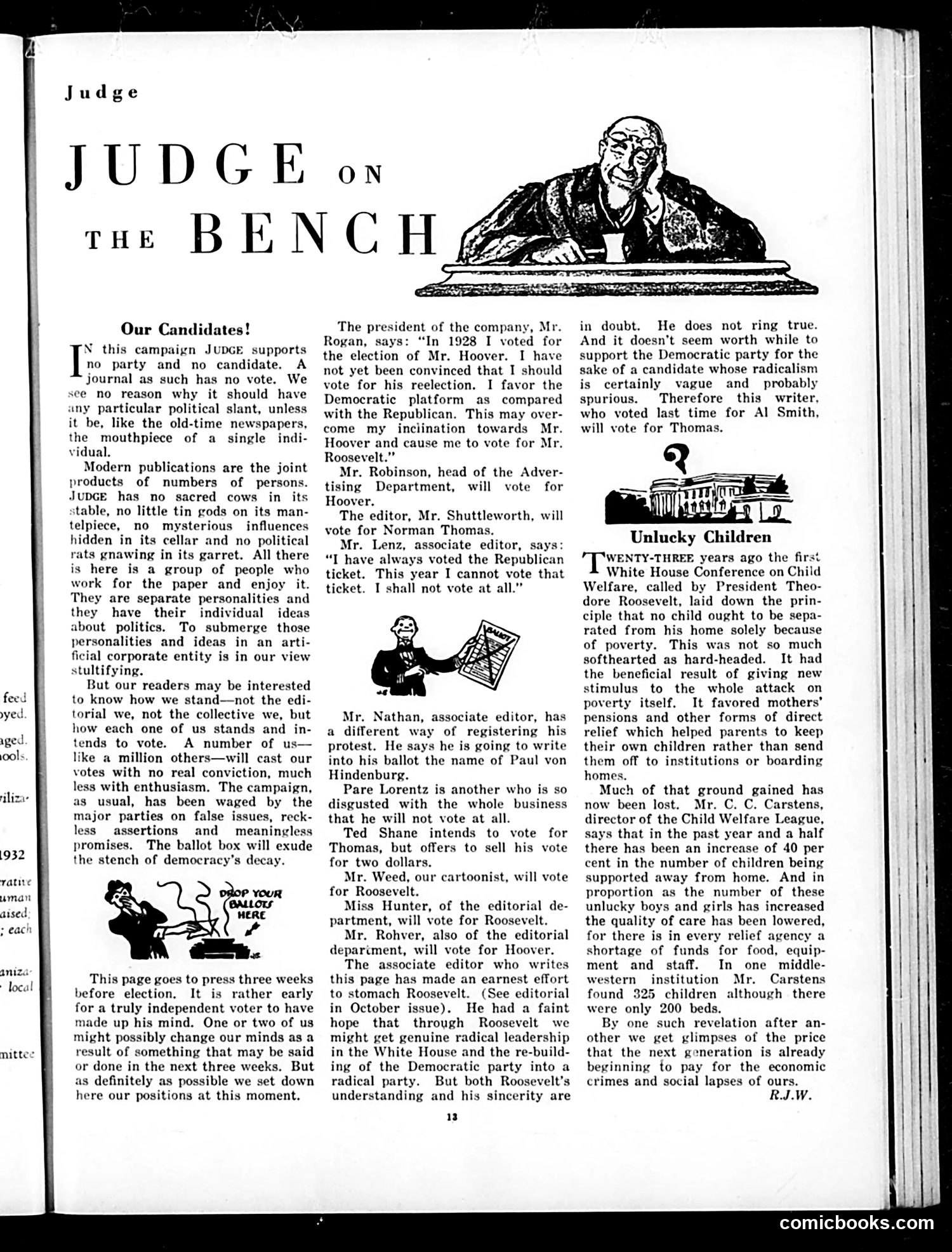
A restored page from Judge, 1932-11. Page through the whole issue in the reader above.
📄 Transcribed text from this page (OCR, searchable)
Machine-transcribed from the original scan — historical spelling and the odd misread are preserved.
1932 rative uman aised ; each Judge JUDGE ON roe BENCH Our Candidates! N this campaign JUDGE supports [= party and no candidate. A journal as such has no vote. We see no reason why it should have any particular political slant, unless it be, like the old-time newspapers, the mouthpiece of a single indi- vidual. Modern publications are the joint products of numbers of persons. JUDGE has no sacred cows in its table, no little tin gods on its man- telpiece, no mysterious influences hidden in its cellar and no political rats gnawing in its garret. All there is here is a group of people who work for the paper and enjoy it. They are separate personalities and they have their individual ideas about politics. To submerge those personalities and ideas in an arti- ficial corporate entity is in our view stultifying. But our readers may be interested to know how we stand—not the edi- torial we, not the collective we, but how each one of us stands and in- tends to vote. A number of us— like a million others—will cast our votes with no real conviction, much less with enthusiasm. The campaign, as usual, has been waged by the major parties on false issues, reck- less assertions and meaningless promises. The ballot box will exude the stench of democracy’s decay. YOUR ‘GALLOTS WERE - es. This page goes to press three weeks before election. It is rather early for a truly independent voter to have made up his mind. One or two of us might possibly change our minds as a result of something that may be said or done in the next three weeks. But as definitely as possible we set down here our positions at this moment. The president of the company, Mr. Rogan, says: “In 1928 I voted for the election of Mr. Hoover. I have not yet been convinced that I should vote for his reelection. I favor the Democratic platform as compared with the Republican. This may over- come my inclination towards Mr. Hoover and cause me to vote for Mr. Roosevelt.” Mr. Robinson, head of the Adver- tising Department, will vote for Hoover. The editor, Mr. Shuttleworth, will vote for Norman Thomas. Mr. Lenz, associate editor, s: : “I have always voted the Republican ticket. This year I cannot vote that ticket. I shall not vote at all.” Mr. Nathan, associate editor, has a different v of registering his protest. He says he is going to write into his ballot the name of Paul von Hindenburg. Pare Lorentz is another who is so disgusted with the whole business that he will not vote at all. Ted Shane intends to vote for Thomas, but offers to sell his vote for two dollars. Mr. Weed, our for Roosevelt. Miss Hunter, of the editorial de- partment, will vote for Roosevelt. Mr. Rohver, also of the editorial depariment, will vote for Hoover. The associate editor who writes this page has made an earnest effort to stomach Roosevelt. (See editorial in October issue). He had a faint hope that through Roosevelt we might get genuine radical leadership in the White House and the re-build- ing of the Democratic party into a radical party. But both Roosevelt’s understanding and his sincerity are rtoonist, will vote 13 in doubt. He does not ring true. And it doesn’t seem worth while to support the Democratic party for the sake of a candidate whose radicalism is certainly vague and_ probably spurious. Therefore this writer, who voted last time for Al Smith, will vote for Thomas. Unlucky Children WENTY-THREE years ago the first White House Conference on Child Welfare, called by President Theo- dore Roosevelt, laid down the prin- ciple that no child ought to be sepa- rated from his home solely because of poverty. This was not so much softhearted as hard-headed. It had the beneficial result of giving new stimulus to the whole attack on poverty itself. It favored mothers’ pensions and other forms of direct relief which helped parents to keep their own children rather than send them off to institutions or boarding homes. Much of that ground gained has now been lost. Mr. C. C. Carstens, director of the Child Welfare League, says that in the past year and a half there has been an increase of 40 per cent in the number of children being supported away from home. And in proportion the number of these unlucky boys and girls has increased the quality of care has been lowered, for there is in every relief agency a shortage of funds for food, equip- ment and staff. In one middle- western institution Mr. Carstens found 325 children although there were only 200 beds. By one such revelation after an- other we get glimpses of the price that the next generation is already beginning to pay for the economic crimes and social lapses of ours. RJ.W. comicbooks.com