A complete issue · 36 pages · 1932
Judge — August 1932
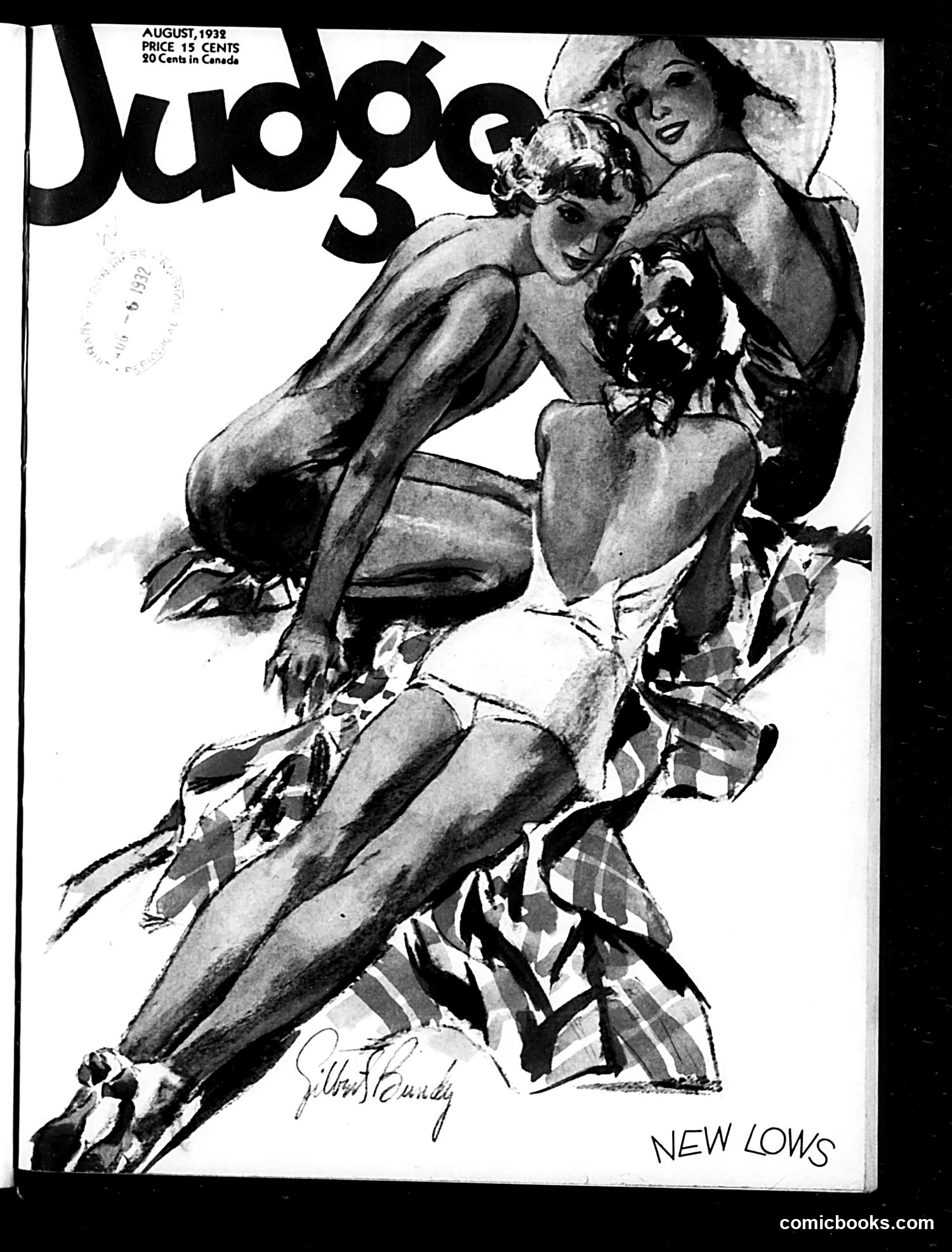
# Judge Magazine, August 1938 This is primarily a **magazine cover** rather than a political cartoon. The illustration, signed by artist Gilbert Bundy, depicts three women in swimwear in a playful, flirtatious pose. The caption "NEW LOWS" appears to be a double entendre—likely referring both to new fashion trends (lower-cut or more revealing swimwear designs) and the women's physical positioning. The cover reflects 1938 summer leisure culture and emerging changes in acceptable beachwear. Judge magazine used such illustrated covers to attract readers with lighthearted humor and attractive imagery typical of American magazines during this era. This represents entertainment content rather than political satire.

# Analysis This is primarily a **liquor advertisement** for Red Lion flavoring extracts, not political satire. The page uses a humor hook to sell the product. The visual joke shows three male faces labeled with days of the week (MON, TUES, WED) and chemical formulas (Ha, Ha·dia; Ha·Cha·Cha), depicting increasingly cheerful expressions. The headline claims these flavor extracts make users "3 Degrees Happier In 3 Days." The accompanying text satirizes the marketing language itself—admitting they *could* make grandiose health claims (like competitors do) but instead honestly say the product simply tastes good and costs 50¢. The tone mocks both the exaggerated advertising of patent medicines and the notion that melancholy is unnatural and purchasable. This reflects Prohibition-era workarounds, where "flavoring extracts" were often covers for alcohol sales.
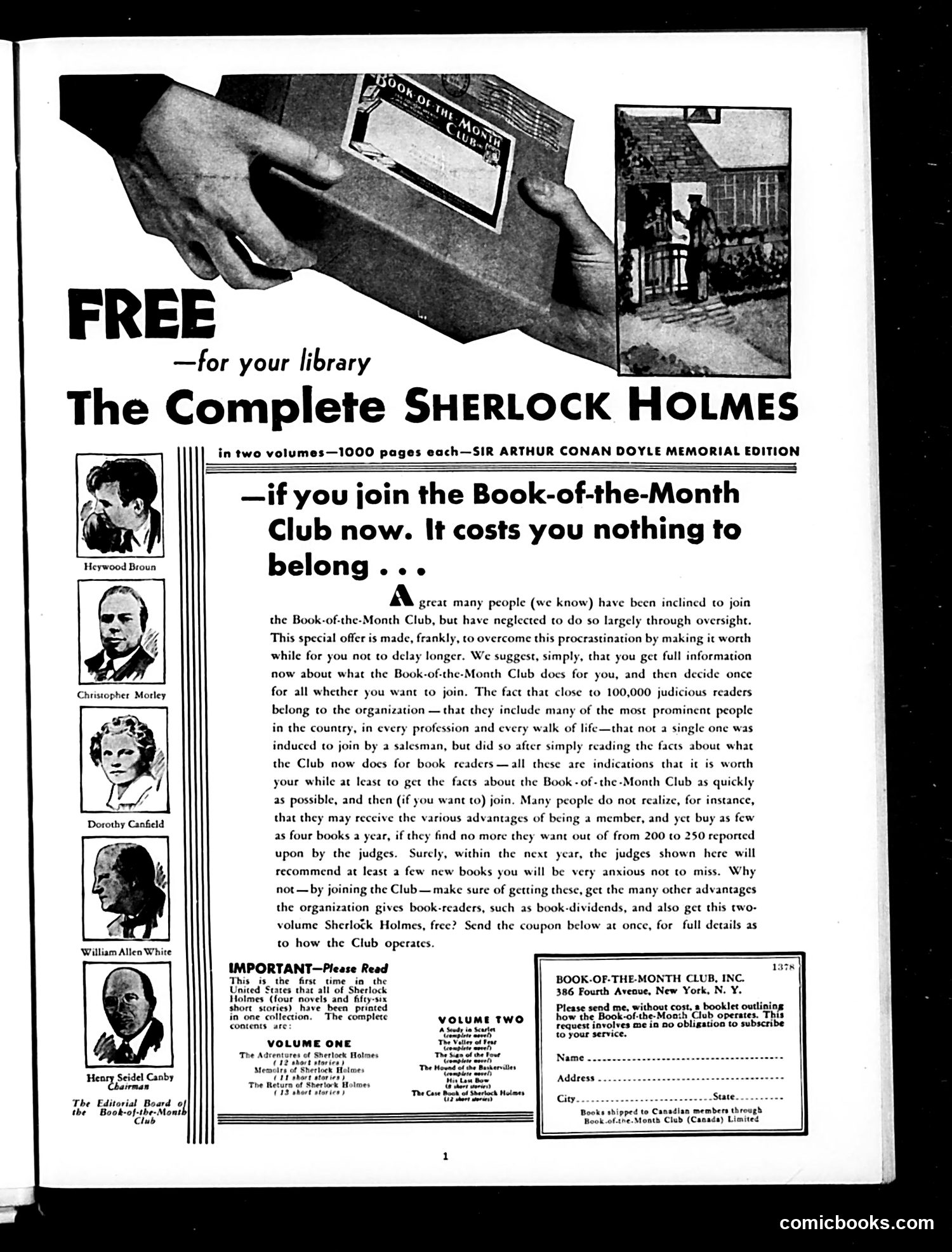
# Analysis This page is **primarily advertising**, not satire or political commentary. It promotes the Book-of-the-Month Club's offer of a free, two-volume "Complete Sherlock Holmes" (Sir Arthur Conan Doyle Memorial Edition) to new members. The left sidebar features **portraits of five judges** who select the club's monthly books—identified as Heywood Broun, Christopher Morley, Dorothy Canfield, William Allen White, and Henry Seidel Canby. These were prominent American literary figures of the era, lending credibility to the club's selections. The advertisement emphasizes that membership is "free to join" and highlights the club's prestigious membership. A small photo shows what appears to be a book club gathering or distribution event. This represents **mid-20th century book club marketing**—leveraging celebrity endorsement and the prestige of literary gatekeepers to encourage subscription.
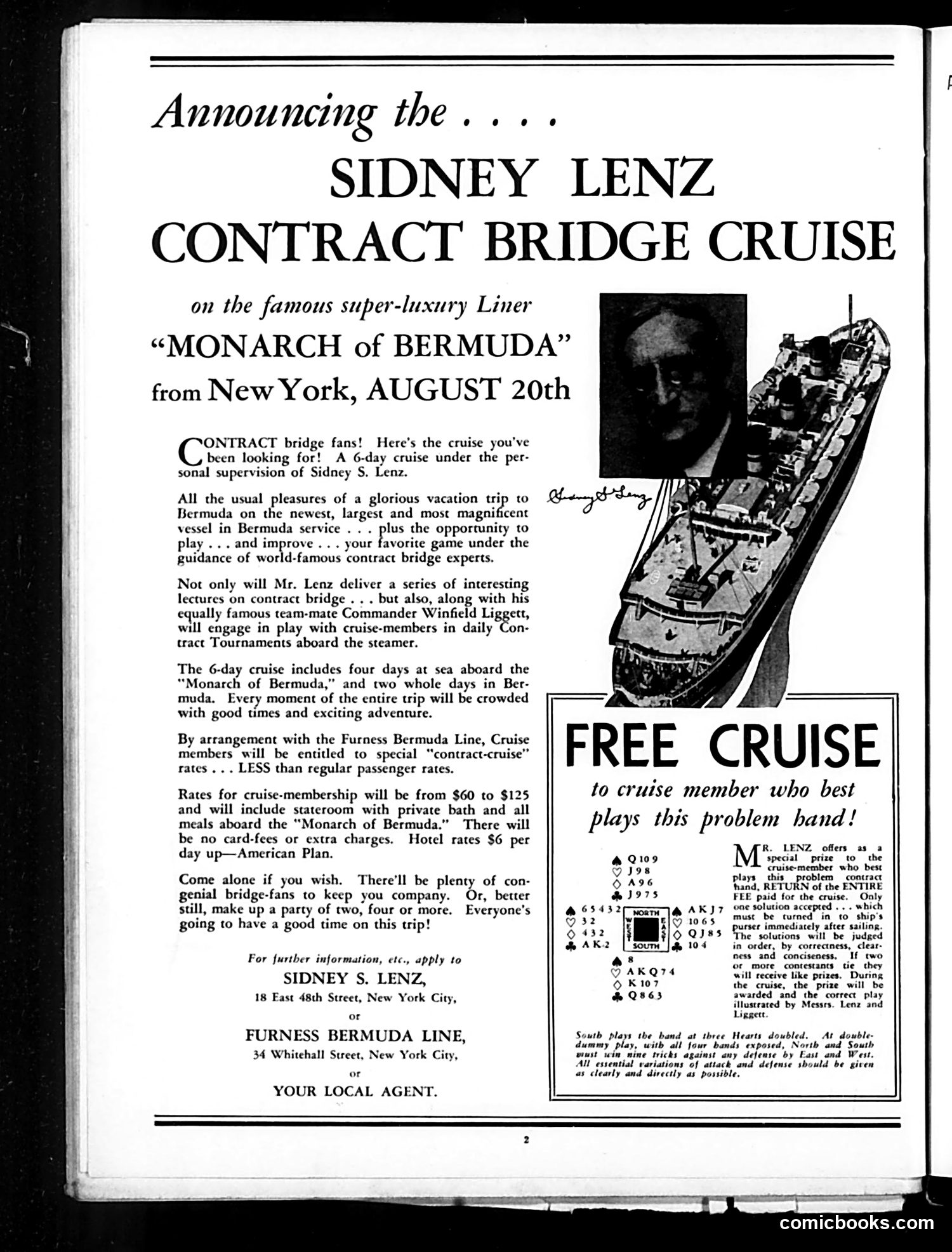
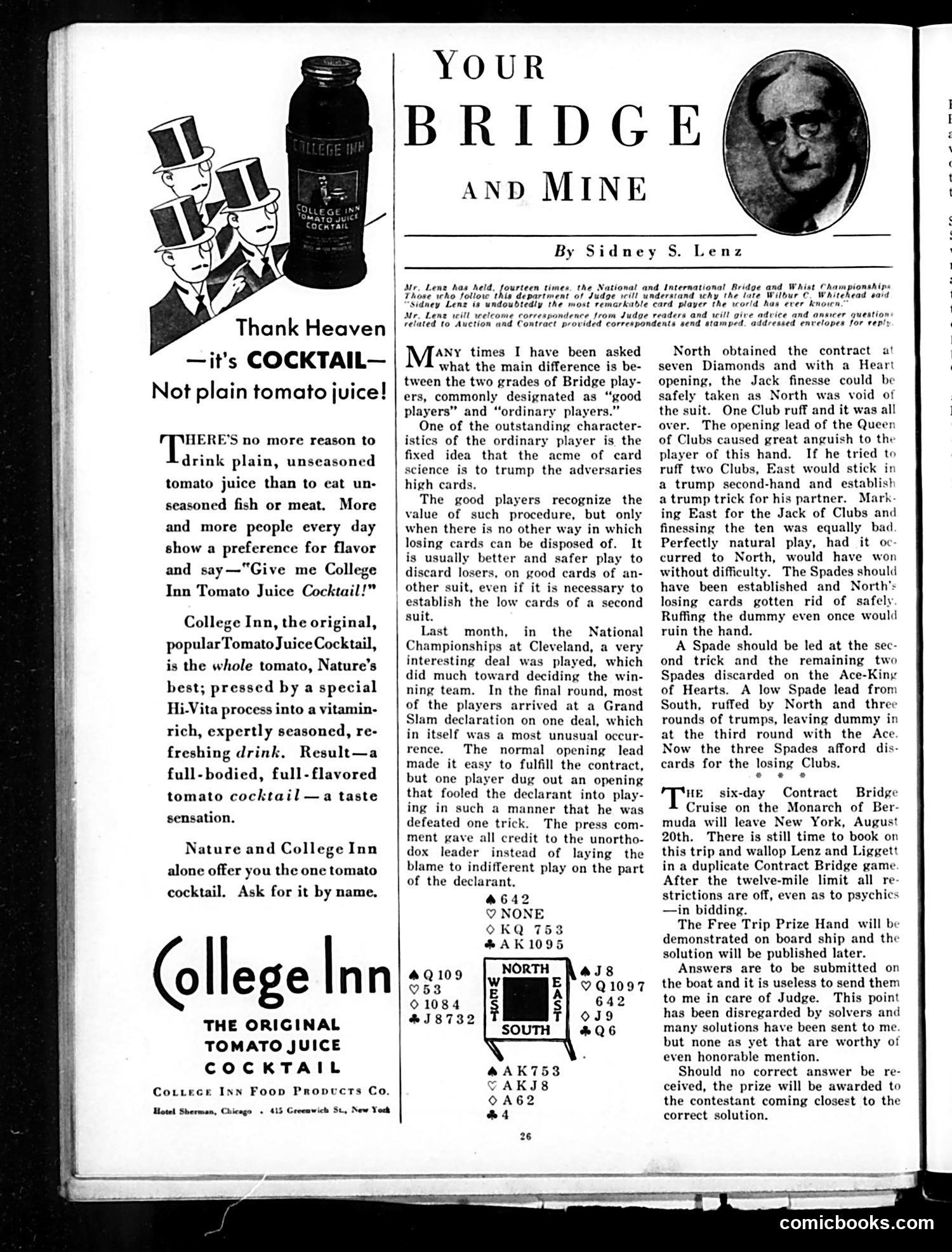
# Page Analysis This page is primarily **advertising** for a cruise rather than editorial content or satire. The main advertisement announces a "Sidney Lenz Contract Bridge Cruise" departing from New York on August 20th aboard the luxury liner *Monarch of Bermuda*. Sidney Lenz was a famous contract bridge expert of this era. The right sidebar contains a **bridge puzzle** (a card game problem) with the heading "FREE CRUISE to cruise member who best plays this problem hand!" This gamifies the cruise marketing—participants solving the bridge problem correctly could win a free cruise ticket. The page reflects Judge magazine's audience: affluent readers interested in leisure travel and the increasingly popular game of contract bridge. The puzzle element makes the advertisement itself interactive entertainment for that demographic.
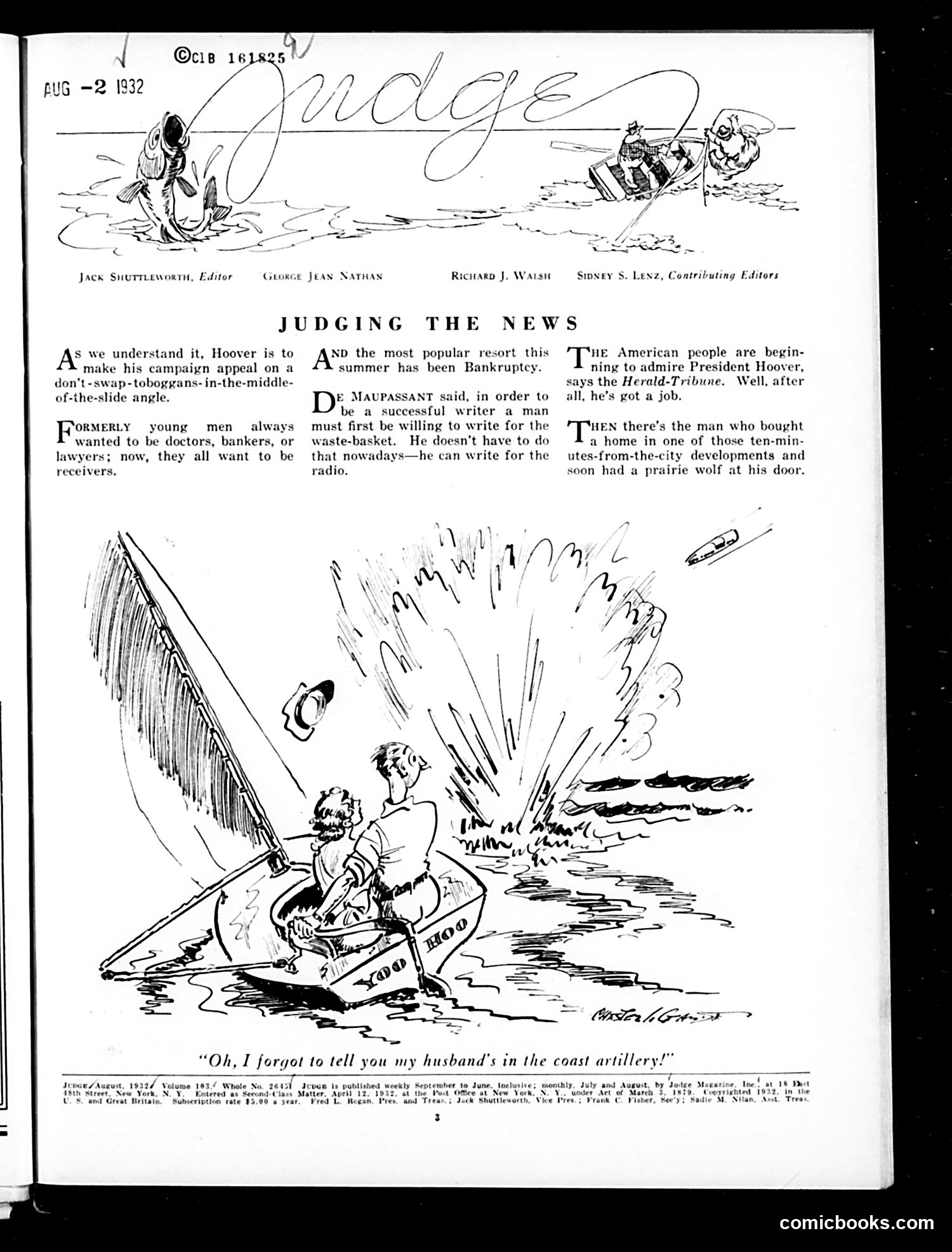
# "Judging the News" - Judge Magazine, August 1932 This page contains satirical commentary on early Depression-era America. The "Judging the News" section critiques President Hoover's campaign strategy and changing career aspirations during the economic crisis. The main cartoon depicts a couple in a sinking boat labeled "1900" amid stormy seas—a metaphor for economic collapse. The woman says, "Oh, I forgot to tell you my husband's in the coast artillery!"—likely satirizing how people's professional identities became irrelevant amid financial ruin. The accompanying text mocks Hoover's campaign appeal and notes that Americans are "beginning to admire President Hoover" because "he's got a job"—biting commentary on Depression-era unemployment. It also jabs at career shifts: formerly aspiring doctors, bankers, and lawyers now want to be "receivers" (bankruptcy administrators), reflecting economic devastation.
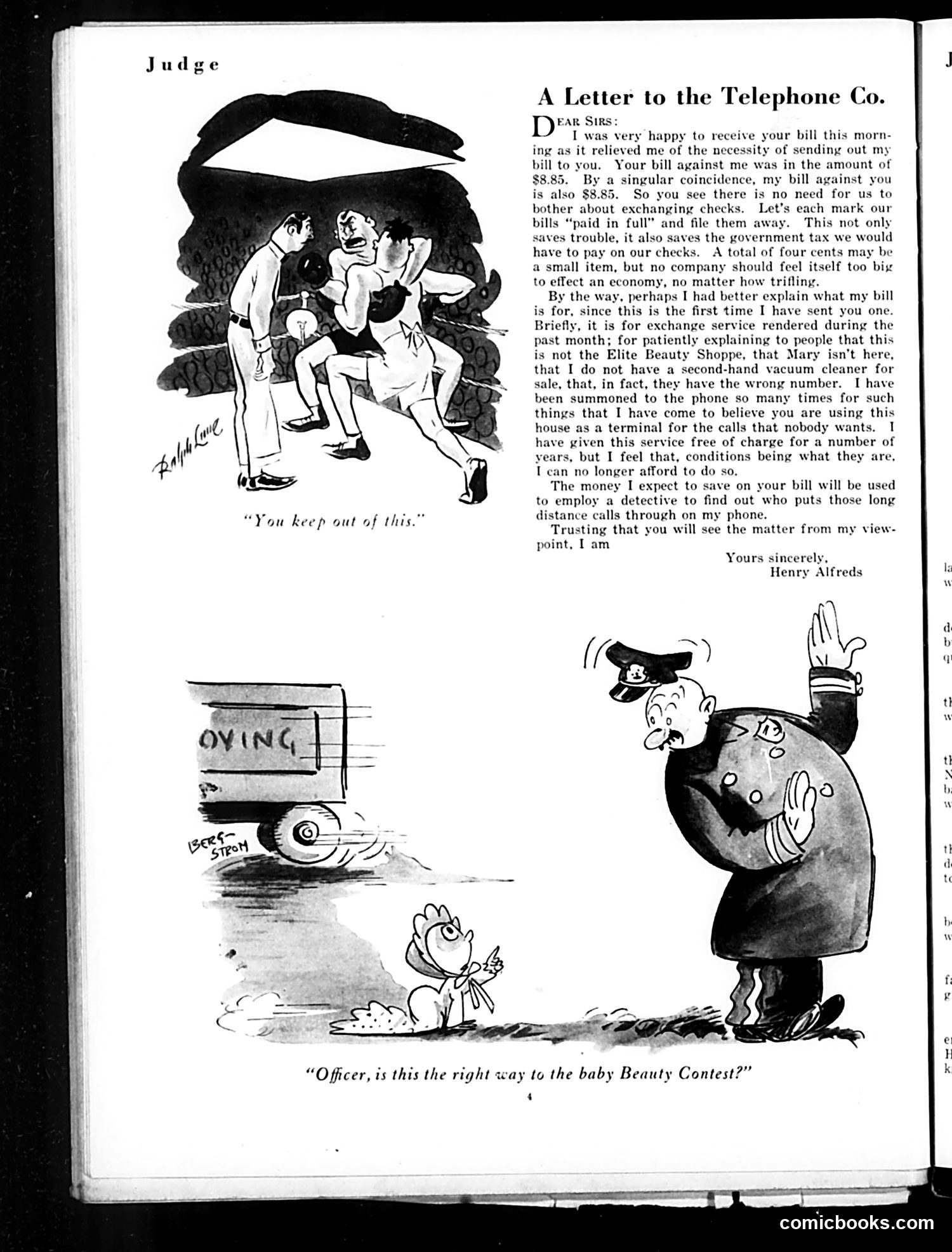
# Judge Magazine Page Analysis This page features satirical commentary on telephone company practices. The main letter from Henry Alfreds complains that the telephone company bills him $8.85 for "exchange service," matching his prior month's bill exactly—suggesting no actual service was rendered, just a duplicate charge. Alfreds humorously proposes the company simply mark bills "paid in full" to save on check-processing costs, arguing this benefits everyone equally. The top cartoon depicts people squeezed uncomfortably together, captioned "You keep out of this"—mocking crowded telephone booth conditions. The bottom cartoon shows a man being directed toward "Baby Beauty Contest" by an officer, appearing to confuse the destination—likely satirizing absurd misunderstandings or the frivolous nature of such contests. The satire targets corporate billing inefficiency and poor service quality.
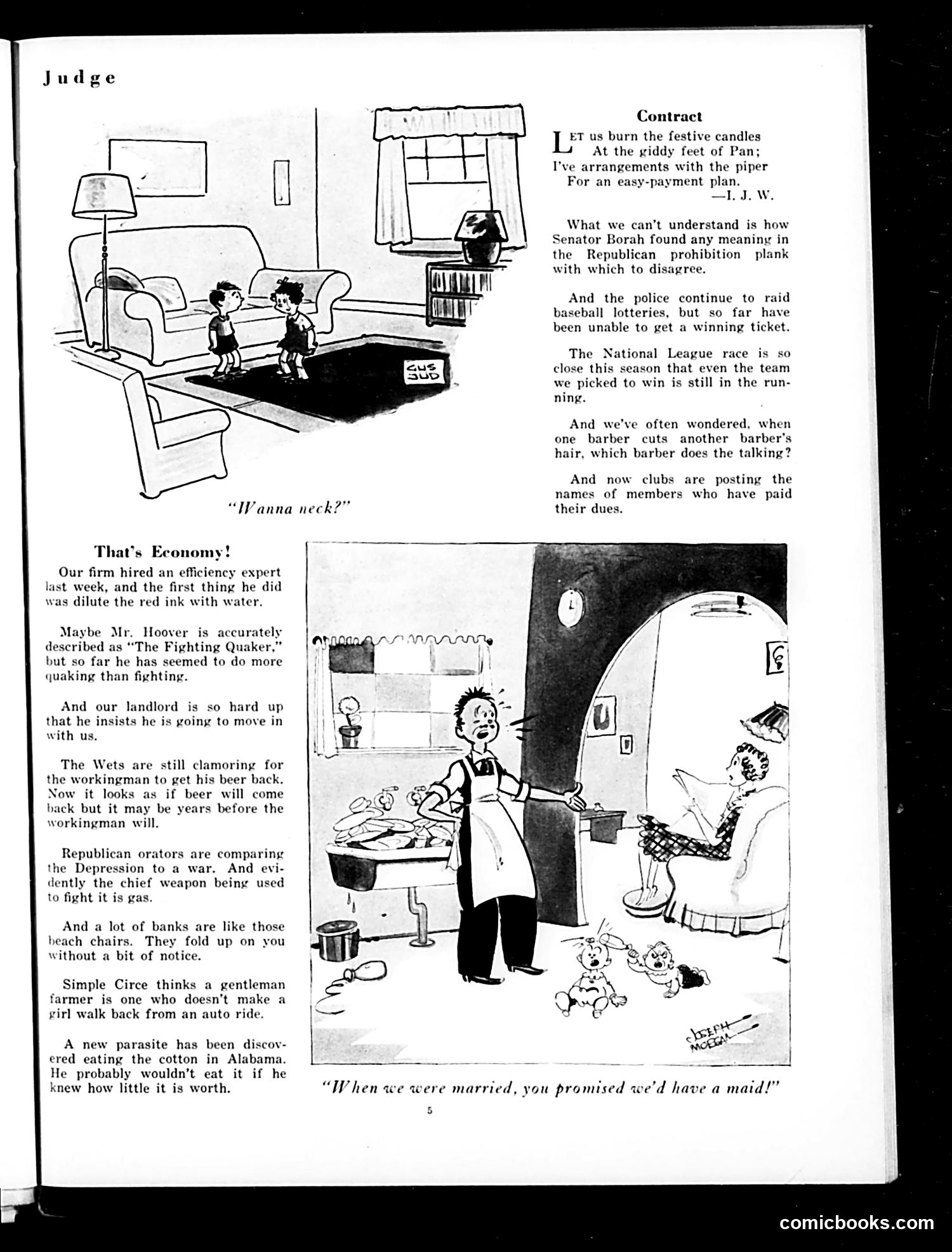
# Judge Magazine Page Analysis This page contains satirical commentary and cartoons from Judge magazine's "Contract" section. The top cartoon shows two children asking "Wanna neck?" — likely mocking 1920s dating slang and changing social mores. The larger cartoon depicts a frustrated husband and domestic chaos, captioned "When we were married, you promised we'd have a maid!" This satirizes post-WWI economic struggles and the servant shortage, as working-class families could no longer afford household help. The accompanying text mocks various targets: inefficient "efficiency experts," landlords, the Wets (Prohibition opponents), Republican rhetoric about the Depression, banking practices, and agricultural problems. The satire reflects early-1930s economic anxiety and political frustration during the Great Depression era.
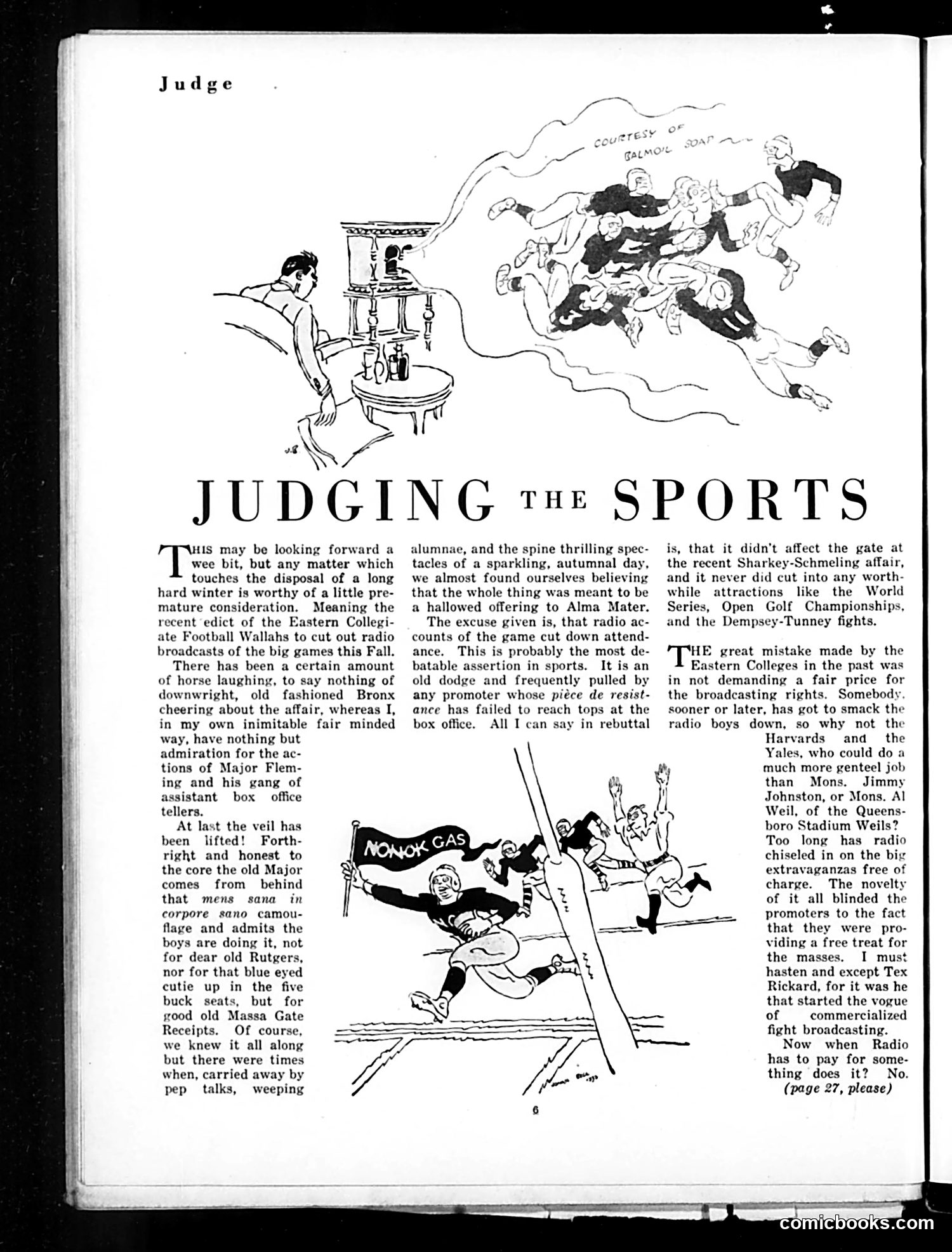
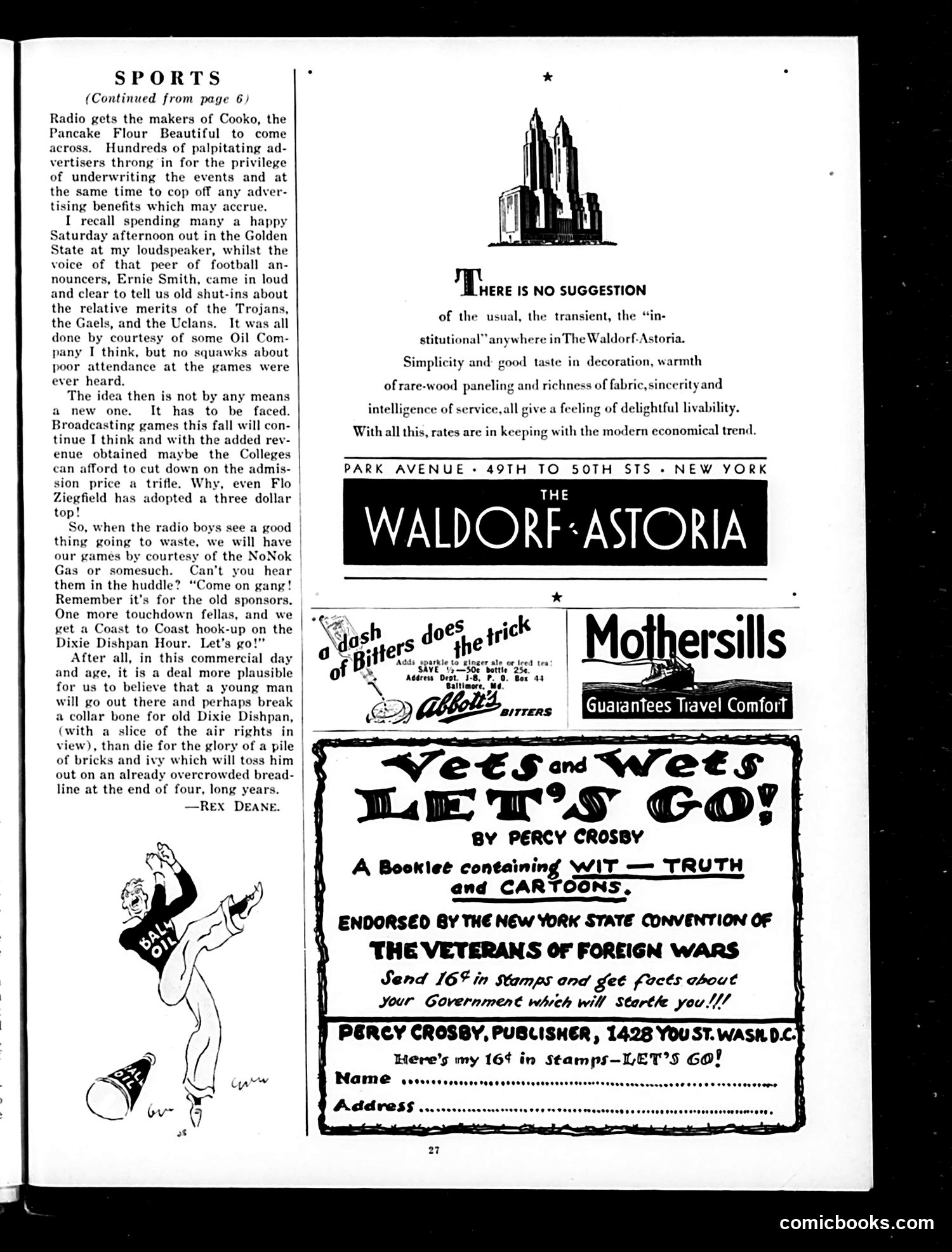
# "Judging the Sports" This article critiques Eastern Colleges' radio broadcasts of football games. The author argues that colleges failed to demand fair payment from radio stations, allowing free transmission that hurt gate receipts. He contrasts this with Harvard and Yale—which "could do much more rented job than Mons"—and praises Tex Rickard for pioneering paid sports broadcasting. The piece mocks the naïveté of colleges that provided "free treat for the masses" without recognizing radio's commercial value. A cartoon labeled "HONOR GAS" depicts a figure being knocked down, likely satirizing the explosive consequences of this broadcasting mistake. The article addresses early 1920s debates over radio's relationship to live sports attendance—a novel problem in the emerging broadcast era.
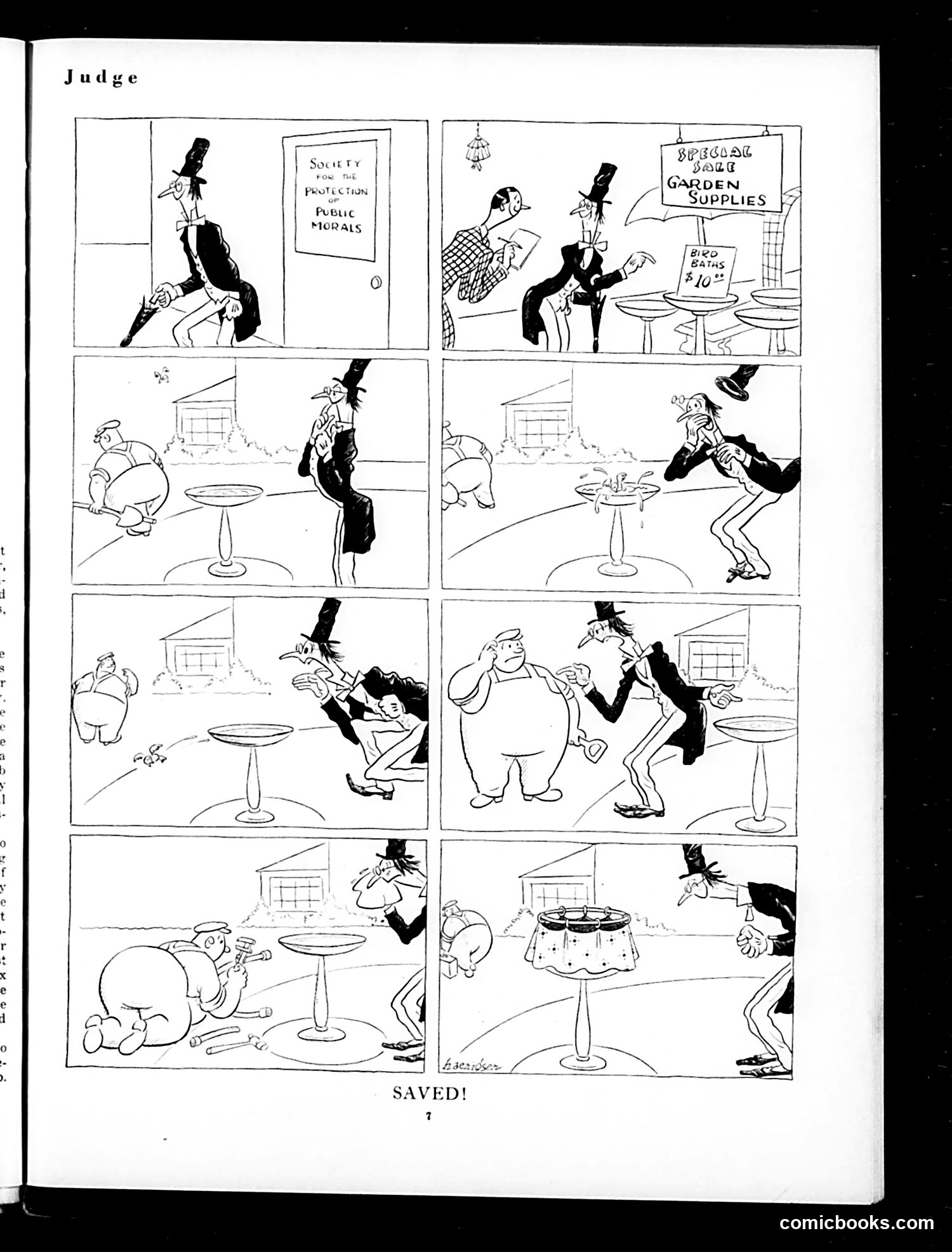
# Judge Cartoon Analysis: "Saved!" This multi-panel satire depicts a tall, thin man in a top hat (appearing to represent a morality crusader or censor) attempting to "protect public morals." The sequence shows him lecturing a rotund figure about morality, then pursuing what appears to be a woman in a garden-supply store. His manic behavior—jumping, gesticulating wildly—escalates through the panels. The punchline arrives when he's finally stopped: a birdbath or garden fixture crashes down, literally restraining his chaotic crusading. The joke targets self-righteous moral activists whose zealous policing of "public morals" creates more chaos than the perceived problem they're fighting. The cartoon suggests such crusaders are hypocritical or destructively counterproductive.
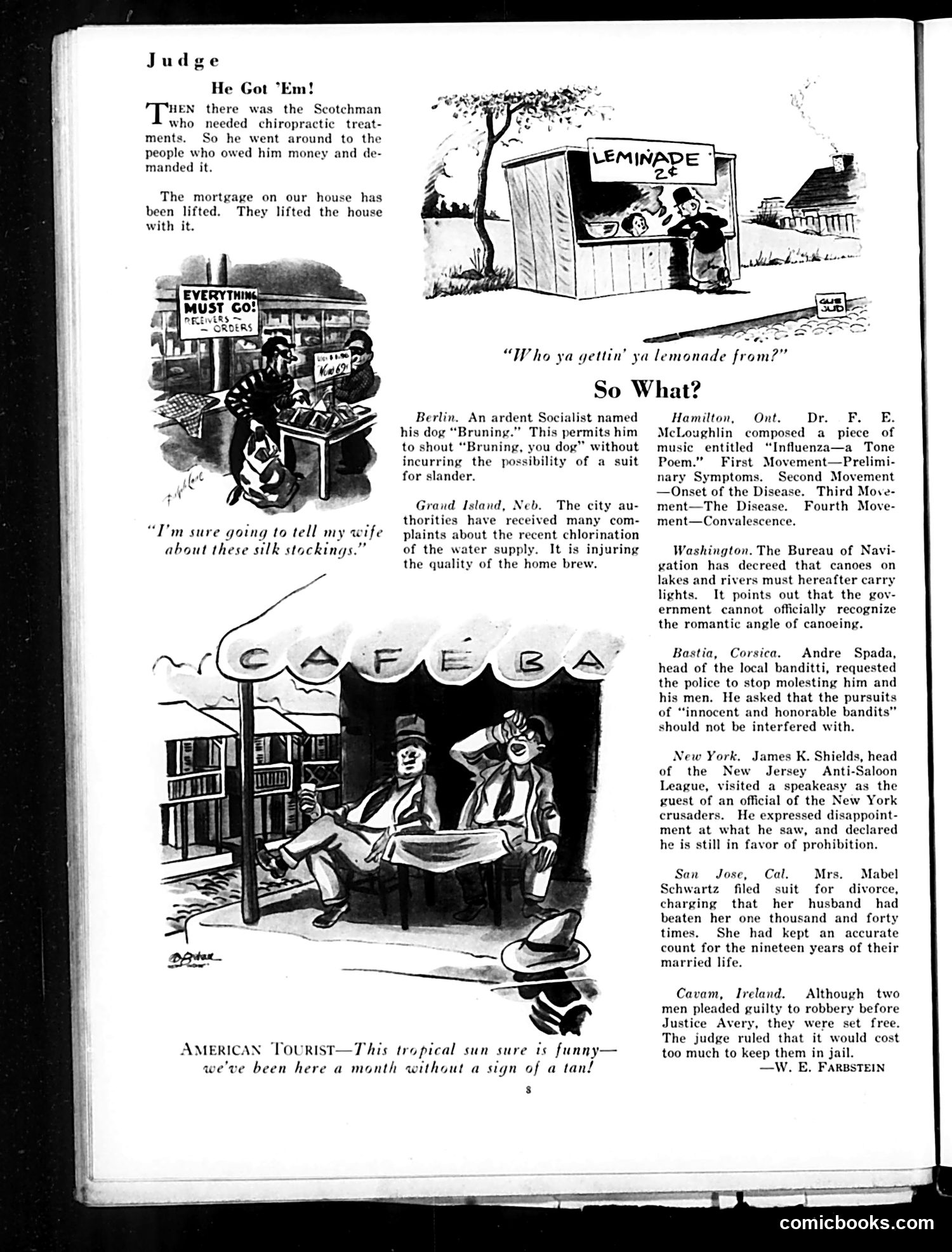
# Judge Magazine Page Analysis This page collects satirical "news briefs" mocking contemporary social issues, circa 1920s-30s. The cartoons ridicule: 1. **Economic hardship**: A Scotsman demands payment from debtors for chiropractic care; a family's house is literally repossessed with the mortgage. 2. **Prohibition's failure**: Grand Island complains chlorinated water "injures" home brew quality—mocking speakeasies and illegal alcohol production despite the law. 3. **Political hypocrisy**: A New Jersey Anti-Saloon League leader visits a speakeasy and remains "in favor of prohibition"—exposing moral inconsistency. 4. **Absurd bureaucracy**: The Bureau of Navigation mandates lights on canoes, destroying romance through regulation. 5. **Justice system failures**: An Irish judge frees confessed robbers because jail costs too much; a woman endures 1,040 beatings over nineteen years. The humor targets government incompetence, legal corruption, class inequality, and the disconnect between stated values and actual behavior during Prohibition-era America.
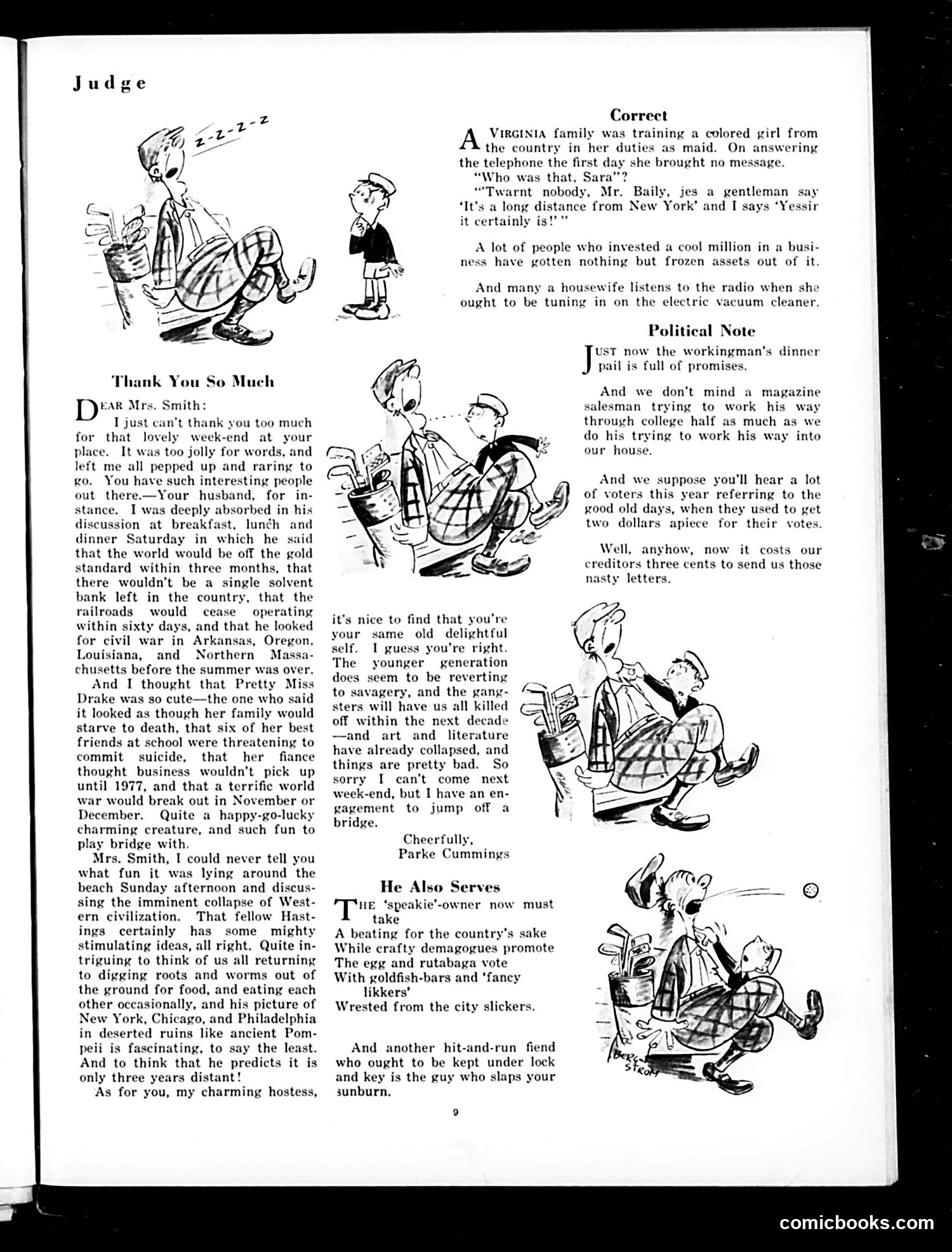
# Judge Magazine Page Analysis This page of **Judge** satirizes 1930s economic pessimism and frivolous socializing. The "Thank You So Much" letter mockingly describes a weekend visit where guests discuss apocalyptic predictions: business collapse, bank failures, imminent war, and societal breakdown—all presented as cheerful dinner conversation. The satire targets wealthy people who entertain themselves with doom-saying while remaining insulated from actual hardship. The cartoons accompanying the text show exaggerated, bouncing figures illustrating these catastrophic scenarios, emphasizing the absurdity of treating civilizational collapse as parlor entertainment. The "Political Note" section adds commentary on Depression-era politics: politicians' empty promises, voter corruption (buying votes for two dollars), and the irony that creditors must spend three cents to collect debts—suggesting economic collapse has made debt collection pointless. Overall, the page satirizes how the wealthy discuss economic disaster casually while detached from ordinary people's suffering, and criticizes political corruption and failed economic promises of the era.
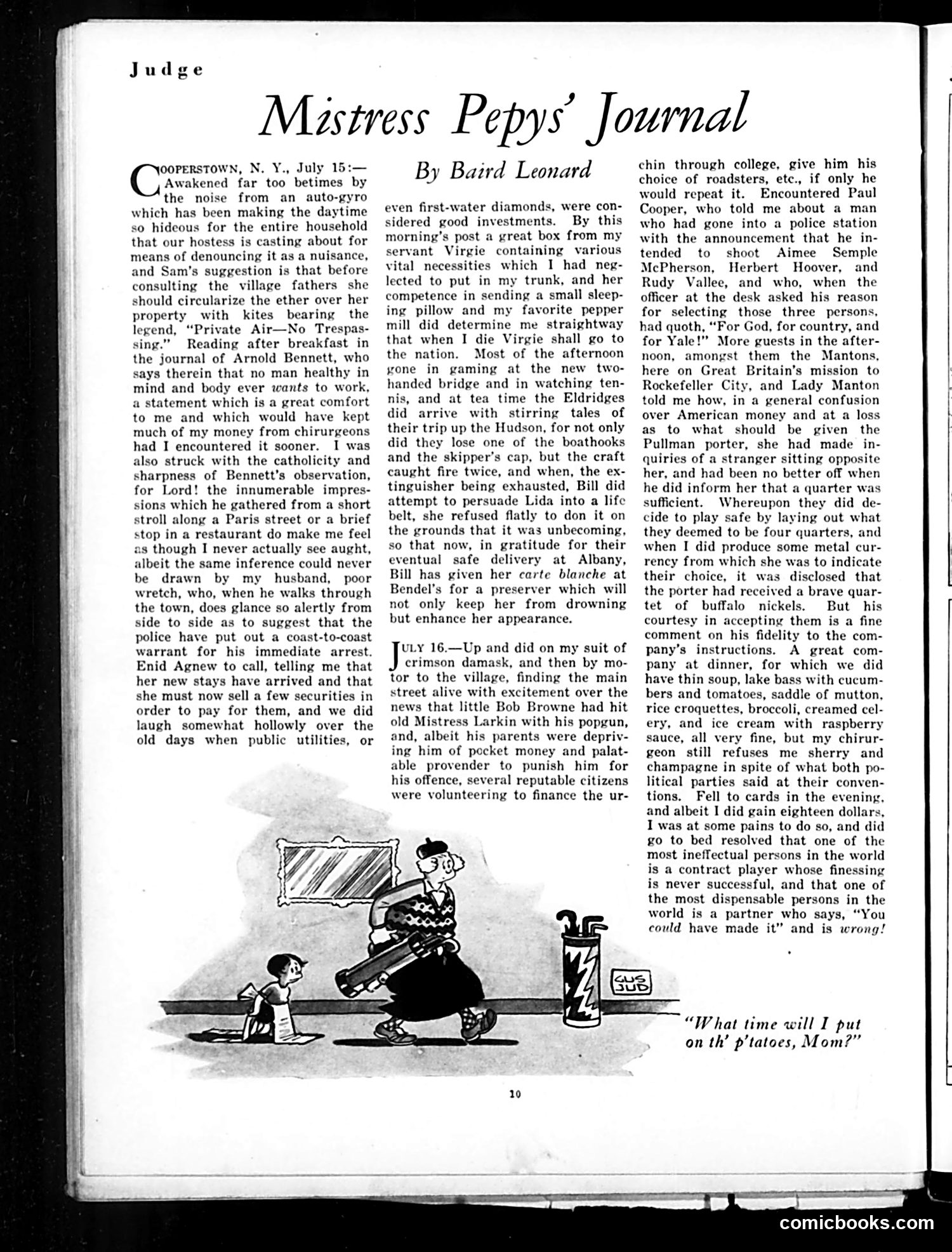
# "Mistress Pepys' Journal" – Judge Magazine Satire This is a humorous column mimicking Samuel Pepys' famous 17th-century diary, but set in contemporary 1920s America. The author (Baird Leonard) uses the conceit to satirize modern social life and celebrity culture. **Key satirical targets visible here:** - **Auto-gyros** disrupting rural peace—mocking new aviation technology's nuisance - **Arnold Bennett's philosophy** on work avoidance—poking fun at intellectual pretensions - **Wealth anxieties**: characters selling securities to buy girdles; discussing investments in "utilities or diamonds" - **Social climbing**: the Eldridges' boating misadventure; Bendel's shopping spree - **Celebrity mockery**: reference to Aimee Semple McPherson (evangelist), Herbert Hoover, and Rudy Vallee as targets of a would-be shooter—satirizing their overexposure and cultural dominance - **The Yale reference**: "For God, for country, and for Yale"—skewering elite university loyalty **The cartoon** shows a mother with a child asking about dinner timing—a domestic vignette reinforcing the journal's focus on upper-class housekeeping concerns. The satire targets 1920s American materialism, celebrity obsession, and social pretension through witty, diary-style observation.