
Judge, 1932-08 · page 14 of 36
Judge — August 1932 — page 14: what you’re looking at
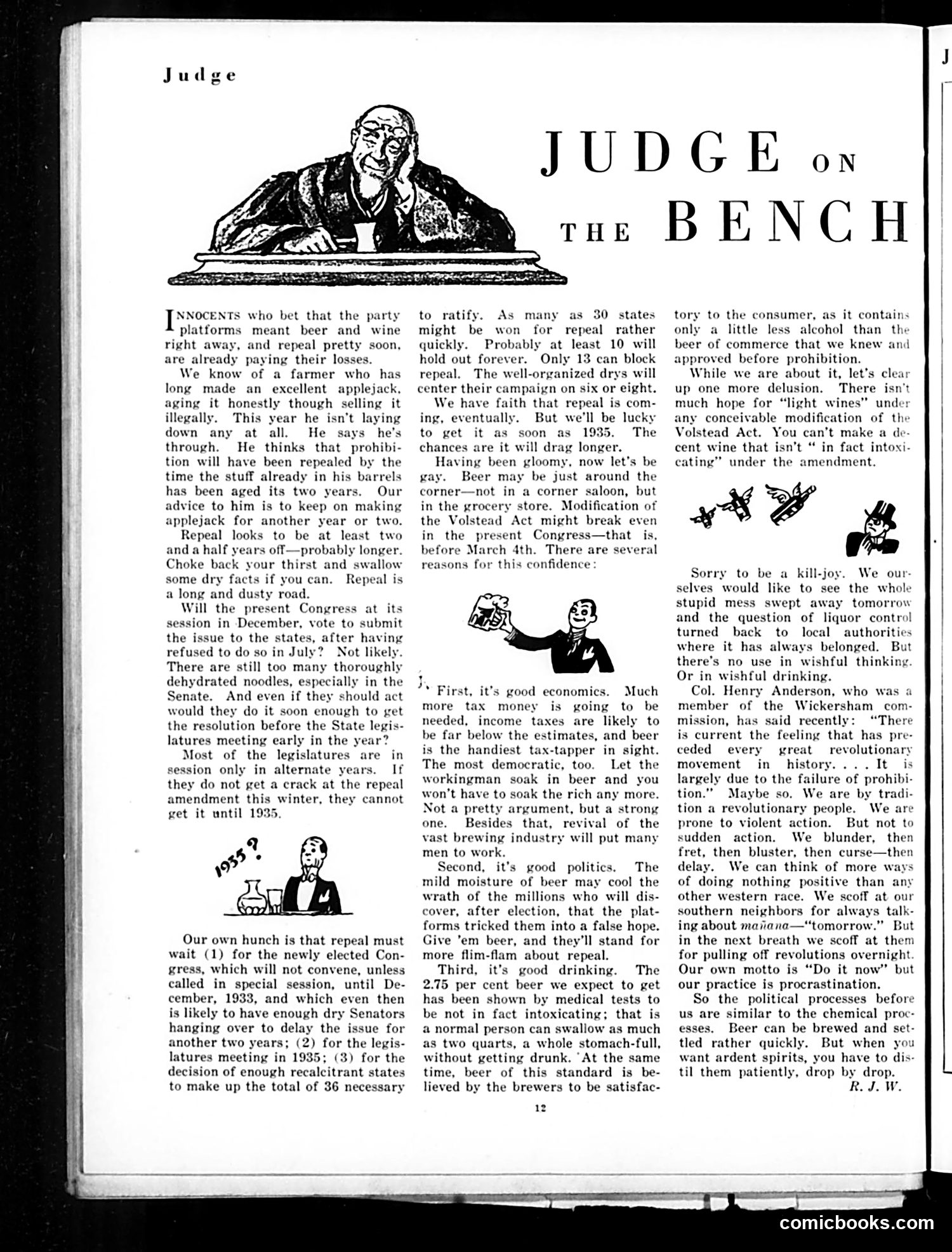
A restored page from Judge, 1932-08. Page through the whole issue in the reader above.
📄 Transcribed text from this page (OCR, searchable)
Machine-transcribed from the original scan — historical spelling and the odd misread are preserved.
NOCENTS who bet that the party platforms meant beer and wine right and repeal pretty soon, are already ng their los We know of a farmer who has long made an excellent applejack, aging it honestly though selling it i This year he isn’t laying down any at all. He ys he’s through. He thinks that prohibi- tion will have been repealed by the time the stuff already in his barrels has been aged its two years. Our advice to him is to keep on making applejack for another year or two. Repeal looks to be at least two anda half years off—probably longer. Choke back your thirst and swallow some dry facts if you can. Repeal is a long and dusty road. Will the present Congress at its session in December, vote to submit the issue to the states, after having refused to do so in July? Not likely. There are still too many thoroughly dehydrated noodles, especially in the Senate. And even if they should act would they do it soon enough to get the resolution before the State leg latures meeting early in the year? Most of the legislatures are in session only in alternate y If they do not get a crack at the repeal amendment this winter, they cannot get it until 1935. Our own hunch is that repeal must wait (1) for the newly elected Con- gress, which will not convene, unless called in special session, until De- cember, 1933, and which even then is likely to have enough dry Senators hanging over to delay the issue for another two years; (2) for the legis- latures meeting in 1935; (3) for the decision of enough recalcitrant states to make up the total of 36 necessary to ratify. As many as 30. states might be won for repeal rather quickly. Probably at least 10 will hold out forever. Only 13 can block repeal. The well-organized drys will center their campaign on six or eight. We have faith that repeal is com- ing, eventually. But we'll be lucky to get it as soon as 1935. The chances are it will drag longe Having been gloomy, now let’s be gay. Beer may be just around the corner—not in a corner saloon, but in the grocery store. Modification of the Volstead Act might break even in the pr nt Congress—that is, before March 4th. There are several reasons for this confidence: First, it’s good economics. more tax money is needed, income xes are likely to be far below the estimates, and beer is the handiest tax-tapper in sight. The most democratic, too. Let the workingman soak in beer and you won't have to soak the rich any more. Not a pretty argument, but a strong one. Besides that, val of the vast brewing industry will put many men to work. Second, it’s good politics. The mild moisture of beer may cool the wrath of the millions who will dis- cover, after election, that the plat- forms tricked them into a false hope. Give ’em beer, and they'll stand for more flim-flam about repeal. Third, it’s good drinking. The 2.75 per cent beer we expect to get has been shown by medical tests to be not in fact intoxicating; that is a normal person can swallow as much as two quarts, a whole stomach-full, without getting drunk. “At the same time, beer of this standard is be- lieved by the brewers to be satisfac- going to be 1z only a little less alcohol than the beer of commerce that we knew and approved before prohibition. While we are about it, let’s cl up one more delusion. There isn’ much hope for “light wines” under any conceivable modification of the Volstead Act. You can’t make a de cent wine that isn’t “ in fact intoxi- cating” under the amendment. wh B of Sorry to be a kill-joy. We ou selves would like to see the whole stupid mess swept away tomorrow and the question of liquor control turned back to local authorities where it has always belonged. But there’s no use in wishful thinking. Or in wishful drinking. Col. Henry Anderson, who was a member of the Wickersham com- mission, has said recentl, is current the feeling t ceded every great movement in history... largely due to the failure of prohibi- tion.” Maybe so, We are by tradi- tion a revolutionary people. We are prone to violent action. But not to sudden action. We blunder, then fret, then bluster, then curse—then delay. We can think of more ways of doing nothing po: e than any other western race. We scoff at our southern neighbors for always talk- ing about matiana—"tomorrow.” But in the next breath we scoff at them for pulling off revolutions overnight Our own motto is “Do it now” but our practice is procrastination. So the political processes before us are similar to the chemical proc- esses. Beer can be brewed and set- tled rather quickly. But when ye want ardent spirits, you have to dis- til them patiently, drop by drop. R.J.W. comicbooks.com