
Judge, 1932-08 · page 24 of 36
Judge — August 1932 — page 24: what you’re looking at
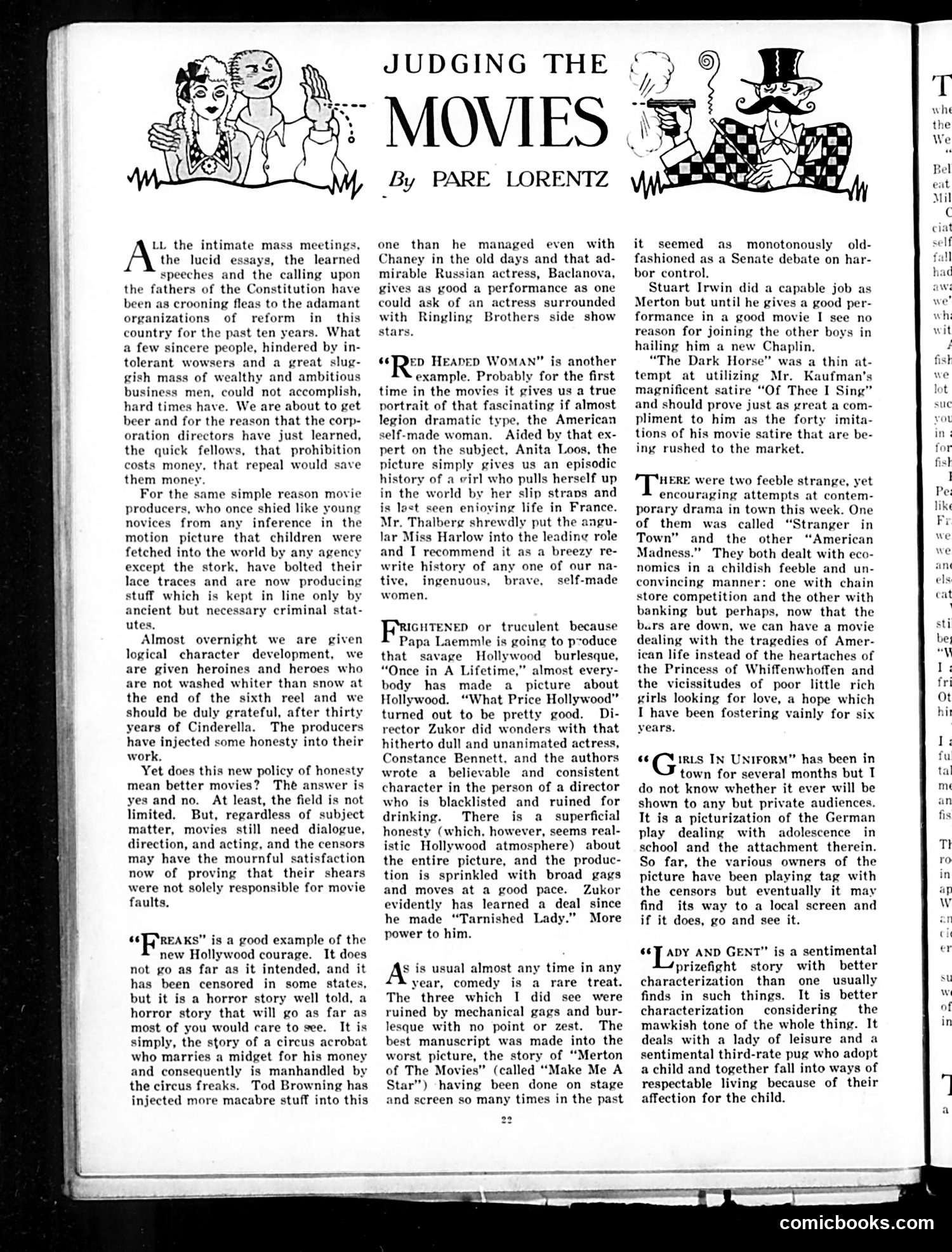
A restored page from Judge, 1932-08. Page through the whole issue in the reader above.
📄 Transcribed text from this page (OCR, searchable)
Machine-transcribed from the original scan — historical spelling and the odd misread are preserved.
LL the intimate mass meetings, Atte lucid essays, the learned speeches and the calling upon the fathers of the Constitution have been as crooning fle; organizations of reform in_ this country for the past ten years. What a few sincere people, hindered by in- tolerant wowsers and a great slug- gish mass of wealthy and ambitious business men, could not accomplish, hard times have. We are about to get beer and for the reason that the corp- oration directors have just learned, the quick fellows, that prohibition costs money, that repeal would save them mone For the same simple reason movie producers, who once shied like young novices from any inference in the motion picture that children were fetched into the world by any agency except the stork, have bolted their lace traces and are now producing stuff which is kept in line only by ancient but necessary criminal stat- utes, Almost overnight we are given logical character development, we are given heroines and heroes who are not washed whiter than snow at the end of the sixth reel and we should be duly grateful, after thirty years of Cinderella. The producers have injected some honesty into their work, Yet does this new policy of honesty mean better mo! 2? The answer is yes and no. At least, the field is not limited. But, regardless of subject matter, movies still need dialogue, direction, and acting, and the censors may have the mournful satisfaction now of proving that their shears were not solely responsible for movie faults. «6 QQ’REAKS” is a good example of the new Hollywood courage. It does not go as far as it intended, and it has been censored in some states, but it is a horror story well told, a horror story that will go as far as most of you would care to see. It is simply, the story of a circus acrobat who marries a midget for his money and consequently is manhandled by the circus freaks. Tod Browning has injected more macabre stuff into this one than he managed even with Chaney in the old days and that ad- mirable Russian actress, Baclanova, gives as good a performance as one could ask of an actress surrounded with Ringling Brothers side show stars, “ D HeEApED WOMAN” is another example. Probably for the first time in the movies it gives us a true portrait of that fascinating if almost legion dramatic type, the American self-made woman. Aided by that ex- pert on the subject, Anita Loos, the picture simply gives us an episodic history of a virl who pulls herself up in the world by her slip straps and is lect seen enioving life in France. Mr. Thalberg shrewdly put the angu- lar Miss Harlow into the leading role and I recommend it as a breezy re- write history of any one of our na- tive, ingenuous, brave, self-made women. IGHTENED or truculent because Papa Laemmle is going to produce that savage Hollywood burlesque, “Once in A Lifetime,” almost every- body has made a picture about Hollywood. “What Price Hollywood” turned out to be pretty good. Di- rector Zukor did wonders with that hitherto dull and unanimated actress, Constance Bennett, and the authors wrote a believable and consistent character in the person of a director who is blacklisted and ruined for drinking. There is a superficial honesty (which, however, seems real- istic Hollywood atmosphere) about the entire picture, and the produc- tion is sprinkled with broad gags and moves at a good pace. Zukor evidently has learned a deal since he made “Tarnished Lady.” More power to him. AS $ usual almost any time in any year, comedy is a rare treat. The three which I did see were ruined by mechanical gags and bur- lesque with no point or zest. The best manuscript was made into the worst picture, the story of “Merton of The Movies” (called “Make Me A Star”) having been done on stage and screen so many times in the past it seemed as monotonously old- fashioned as a Senate debate on har- bor control. Stuart Irwin did a capable job as Merton but until he gives a good per- formance in a good movie I see no reason for joining the other boys in hailing him a new Chaplin. “The Dark Horse” was a thin at- tempt at utilizing Mr. Kaufman's magnificent satire “Of Thee I Sing” and should prove just as great a com- pliment to him as the forty imita tions of his movie satire that are be- ing rushed to the market. HERE were two feeble strange, yet encouraging attempts at contem- porary drama in town this week. One of them was called “Stranger in Town” and the other “American Madness.” They both dealt with eco- nomics in a childish feeble and un- convincing manner: one with chain store competition and the other with banking but perhaps, now that the bars are down, we can have a movie dealing with the tragedies of Amer- ican life instead of the heartaches of the Princess of Whiffenwhoffen and the vicissitudes of poor little rich girls looking for love, a hope which I have been fostering vainly for six years. “ IRLS IN UNIFORM” has been in town for several months but I do not know whether it ever will be shown to any but private audiences. It is a picturization of the Germa play dealing with adolescence in school and the attachment therein. So far, the various owners of the picture have been playing tag with the censors but eventually it may find its way to a local screen and if it does, go and see it. a Ek AND GENT” is a sentimental prizefight story with better characterization than one usually finds in such things. It is better characterization considering the mawkish tone of the whole thing. It deals with a lady of leisure and a sentimental third-rate pug who adopt a child and together fall into ways of respectable living because of their affection for the child. comicbooks.com