
Judge, 1932-08 · page 26 of 36
Judge — August 1932 — page 26: what you’re looking at
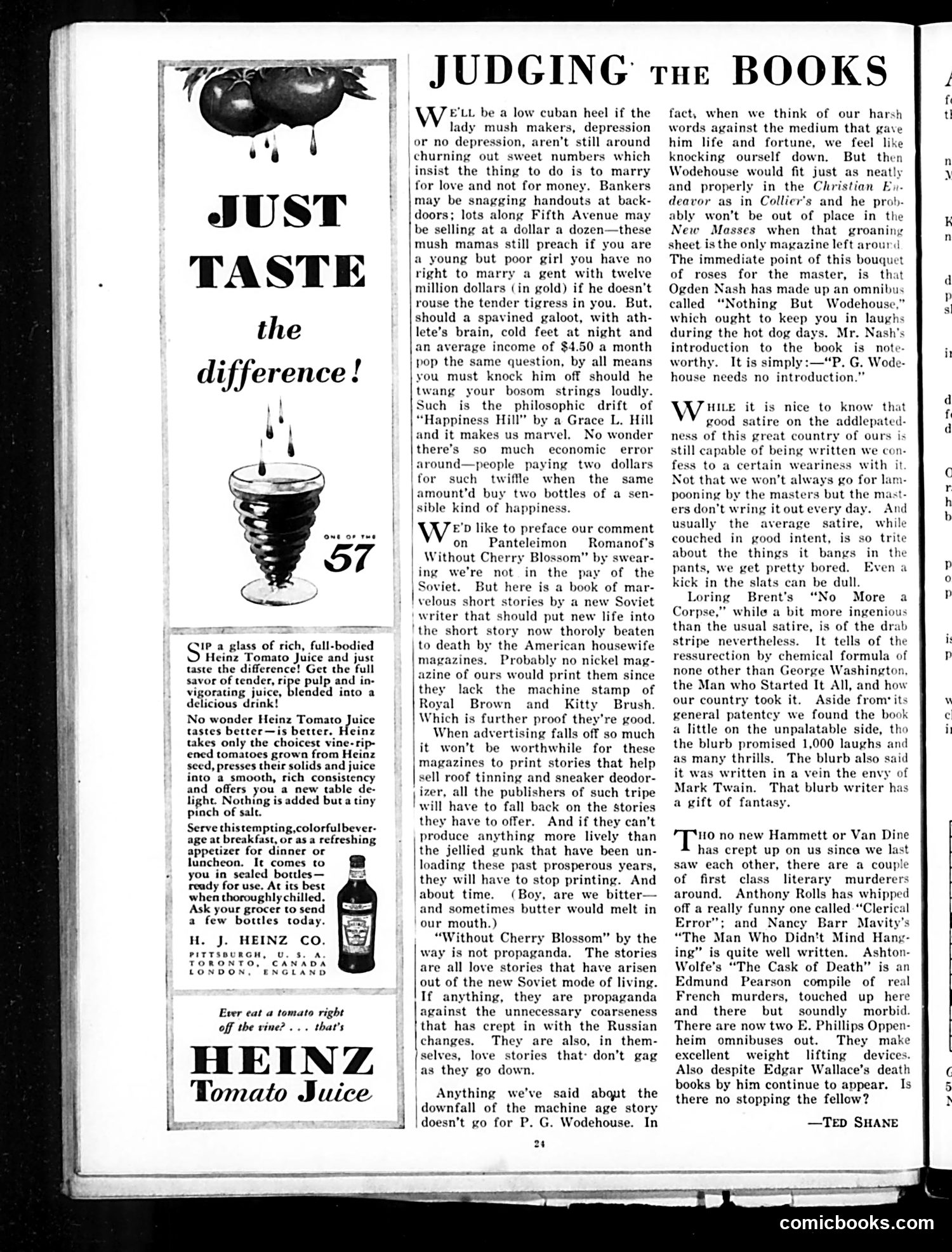
A restored page from Judge, 1932-08. Page through the whole issue in the reader above.
📄 Transcribed text from this page (OCR, searchable)
Machine-transcribed from the original scan — historical spelling and the odd misread are preserved.
JUST TASTE the difference! Si a glass of rich, full-bodied Heinz Tomato Juice and just taste the difference! Get the full savor of tender, ripe pulp and in- vigorating juice, blended into a delicious drink! No wonder Heinz Tomato Juice tastes better—is better. Heinz takes only the choicest vine-rip- ened tomatoes grown from Heinz seed, presses their solids and juice into a smooth, rich consistency and offers you a new table de- light. Nothing is added but a tiny pinch of sale. Serve thistempting,colorfulbever- age at breakfast, or as a refreshing appetizer for dinner or luncheon. It comes to you in sealed bottles— ready for use. At its best when thoroughly chilled. Ask your grocer to send a few bottles today. H. J. HEINZ CO. PITTSBURGH, TORONTO, NA LONDON, ENGLA Ever eat a tomato right off the vine? ... that's HEINZ Tomato Juice 4 JUDGING true BOOKS | Soviet. | it won't V ELL be a low cuban heel if the lady mush make: depression or no depression, aren't still around hurning out sweet numbers which sist the thing to do is to marry for love and not for money. Bankers may be snagging handouts at back- doors; lots along Fifth Avenue may be selling at a dollar a dozen—these mush mamas still preach if you are a young but poor girl you have no right to ma a gent with twelve million dollars (in gold) if he doesn’t rouse the tender tigress in you. But, should a spavined galoot, with ath- lete’s brain, cold feet at night and an average income of $4.50 a month | pop the same question, by all means you must knock him off should he twang your bosom strings loudly. Such is the philosophic drift of “Happiness Hill” by a Grace L. Hill and it es us marvel. No wonder there’s so much economic error around—people paying two dollars for such twiffle when the same amount’d buy two bottles of a sen- sible kind of happiness. Wer like to preface our comment on Panteleimon Romanof’s Without Cherry Blossom” by swear- ing we're not in the pay of the But here is a book of mar- velous short stories by a new Soviet {writer that should put new life into ‘the short story now thoroly beaten to death by the American housewife vazines. Probably no nickel mag- azine of ours would print them since they lack the machine stamp of al Brown and _ Kitty Brush. h is further proof they’re good. When advertising falls off so much be worthwhile for these magazines to print stories that help sell roof tinning and sneaker deodor- izer, all the publishers of such tripe will have to fall back on the stories they have to offer. And if they can’t ; produce anything more lively than the jellied gunk that have been un- |loading these past prosperous years, they will have to stop printing. And about time. (Boy, are we bitter— and sometimes butter would melt in our mouth.) “Without Cherry Blossom” by the way is not propaganda. The stories are all love stories that have arisen out of the new Soviet mode of living. If anything, they are propaganda against the unnecessary coarseness that has crept in with the Russian changes. They are also, in them- selves, love stories that- don’t gag as they go down. Anything we've said abqut the |downfall of the machine age story doesn’t go for P. G. Wodehouse. In fact, when we think of our harsh Is against the medium that gave him life and fortune, we feel like knocking ourself down, But then Wodehouse would fit just as neatly and prope! in the Christian Ev. deavor as in Collier's and he prob- ably won't be out of place in the New Masses when that groaning sheet is the only magazine left arourd The immediate point of this bouquet of roses for the master, is that Ogden Nash has made up an omnibus called “Nothing But Wodehouse,” which ought to keep you in laughs during the hot dog days. Mr. Nash's introduction to the book is note- worthy. It is simply:—“P. G. Wode- house needs no introduction.” W ite it nice to know that good satire on the addlepated- ness of this great country of ours is still capable of being written we con- fess to a certain weariness with it Not that we won't always go for lam- pooning by the masters but the mast- ers don’t wring itout every day. And usually the average satire, whi couched in good intent, is so trite about the things it bangs in the pants, we get pretty bored. Even a kick in the slats can be dull. Loring Brent's “No More a Corpse,” while a bit more ingenious than the usual satire, is of the drab stripe neverthel It tells of the ressurection by chemical formula none other than George Washington, the Man who Started It All, and how our country took it. Aside fromr its general patentcy we found the book a little on the unpalatable side, tho the blurb promised 1,000 laughs and as many thrills. The blurb also said it was written in a vein the envy of Mark Twain. That blurb writer has a gift of fantasy. HO no new Hammett or Van Dine has crept up on us since we last saw each other, there are a couple of first class literary murderers around. Anthony Rolls has whipped off a really funny one called-“Clerical Error’; and Nancy Barr Mav “The Man Who Didn't Mind Hang- ing” is quite well written. Ashton- Wolfe’s “The Cask of Death” is an Edmund Pearson compile of real French murders, touched up here and there but soundly morbid. There are now two E. Phillips Oppen- heim omnibuses out. They make excellent wv ht lifting devices. Also despite Edgar Wallace’s death books by him continue to appear. Is there no stopping the fellow? —TED SHANE comicbooks.com won