
Judge, 1932-08 · page 8 of 36
Judge — August 1932 — page 8: what you’re looking at
What you’re looking at
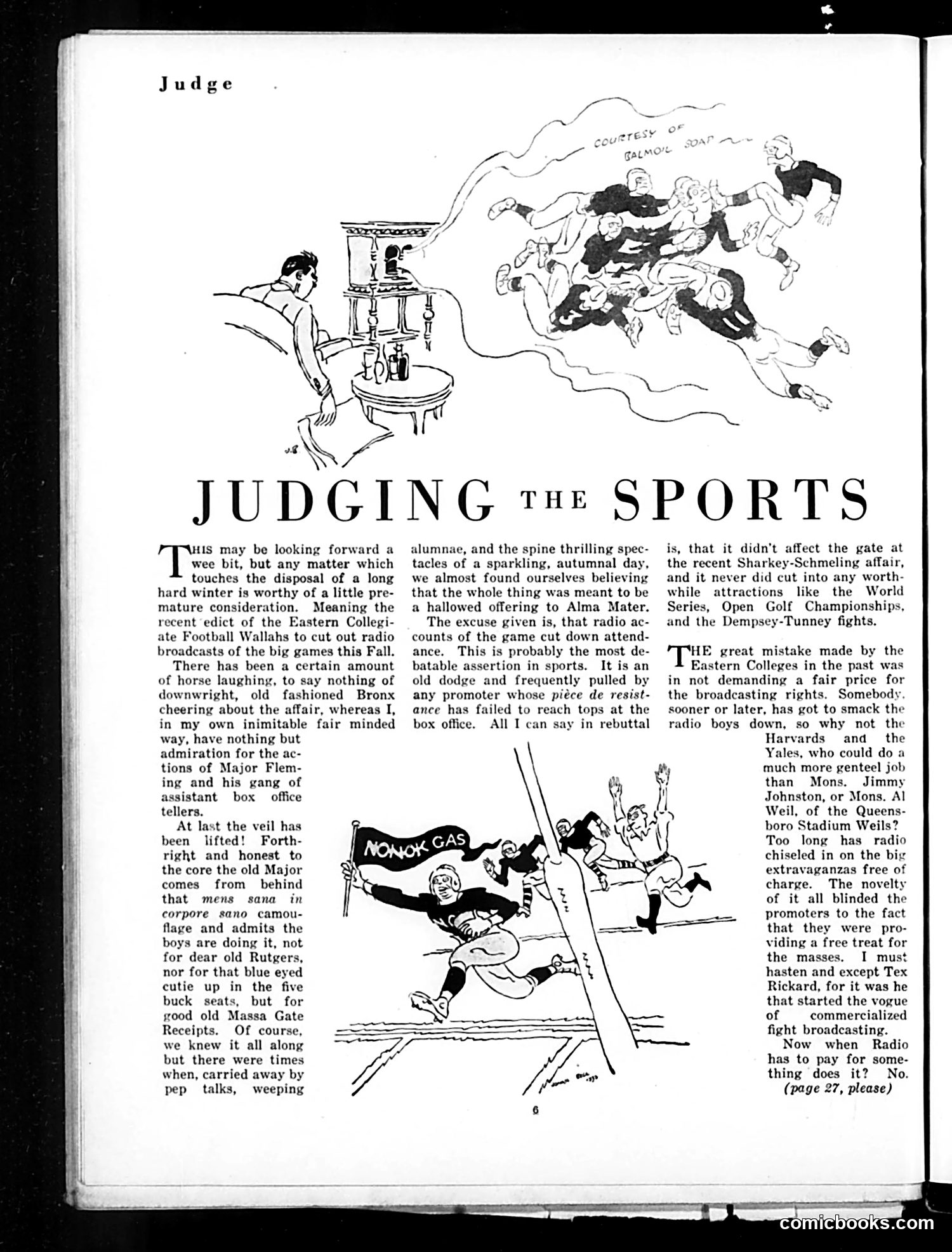
# "Judging the Sports" This article critiques Eastern Colleges' radio broadcasts of football games. The author argues that colleges failed to demand fair payment from radio stations, allowing free transmission that hurt gate receipts. He contrasts this with Harvard and Yale—which "could do much more rented job than Mons"—and praises Tex Rickard for pioneering paid sports broadcasting. The piece mocks the naïveté of colleges that provided "free treat for the masses" without recognizing radio's commercial value. A cartoon labeled "HONOR GAS" depicts a figure being knocked down, likely satirizing the explosive consequences of this broadcasting mistake. The article addresses early 1920s debates over radio's relationship to live sports attendance—a novel problem in the emerging broadcast era.
📄 Transcribed text from this page (OCR, searchable)
Machine-transcribed from the original scan — historical spelling and the odd misread are preserved.
Aa JUDGING 2 SPORTS 41S may be looking forward a | wee bit, but any matter which touches the disposal of a long hard winter is worthy of a little pre- mature consideration. Meaning the recent edict of the Eastern Collegi- ate Football Wallahs to cut out radio broadcasts of the big games this Fall. There has been a certain amount of horse laughing, to say nothing of downwright, old fashioned Bronx cheering about the affair, whereas I, in my own inimitable fair minded way, have nothing but admiration for the ac- tions of Major Flem- ing and his gang of assistant box office tellers. At last the veil has been lifted! Forth- right and honest to the core the old Major comes from behind that mens sana in corpore sano camou- flage and admits the boys are doing it, not for dear old Rutgers, nor for that blue eyed cutie up in the five buck seats, but for good old Massa Gate alumnae, and the spine thrilling spec- tacles of a sparkling, autumnal day, we almost found ourselves believing that the whole thing was meant to be a hallowed offering to Alma Mater. The excuse given is, that radio ac- counts of the game cut down attend- ance. This is probably the most de- batable assertion in sports. It is an old dodge and frequently pulled by any promoter whose piéce de resist- ance has failed to reach tops at the box office. All I can say in rebuttal Receipts. Of course, we knew it all along but there were times when, carried away by pep talks, weeping is, that it didn’t affect the gate at the recent Sharkey-Schmeling affair, and it never did cut into any worth- while attractions like the World Series, Open Golf Championships, and the Dempsey-Tunney fights. HE great mistake made by the Eastern Colleges in the past was in not demanding a fair price for the broadcasting rights. Somebody. sooner or later, has got to smack the radio boys down, so why not the Harvards and the Yales, who could do a much more genteel job than Mons. Jimmy Johnston, or Mons. Al Weil, of the Queens- boro Stadium Weils? Too long has radio chiseled in on the big extravaganzas free of charge. The novelty of it all blinded the promoters to the fact that they were pro- viding a free treat for the masses. I must hasten and except Tex Rickard, for it was he that started the vogue of commercialized fight broadcasting. Now when Radio has to pay for some- thing does it? No. (page 27, please)