A complete issue · 36 pages · 1932
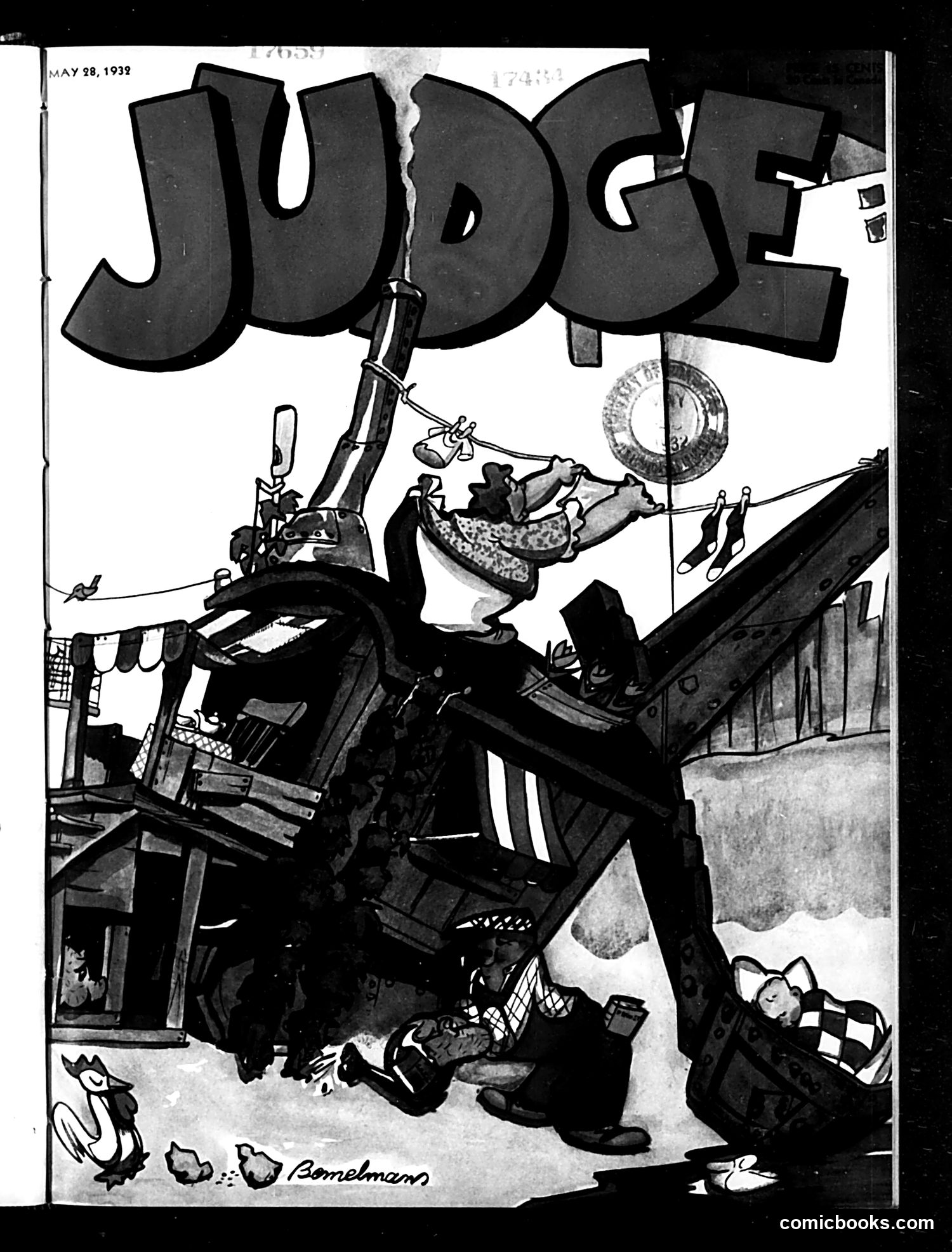
Judge — May 28, 1932
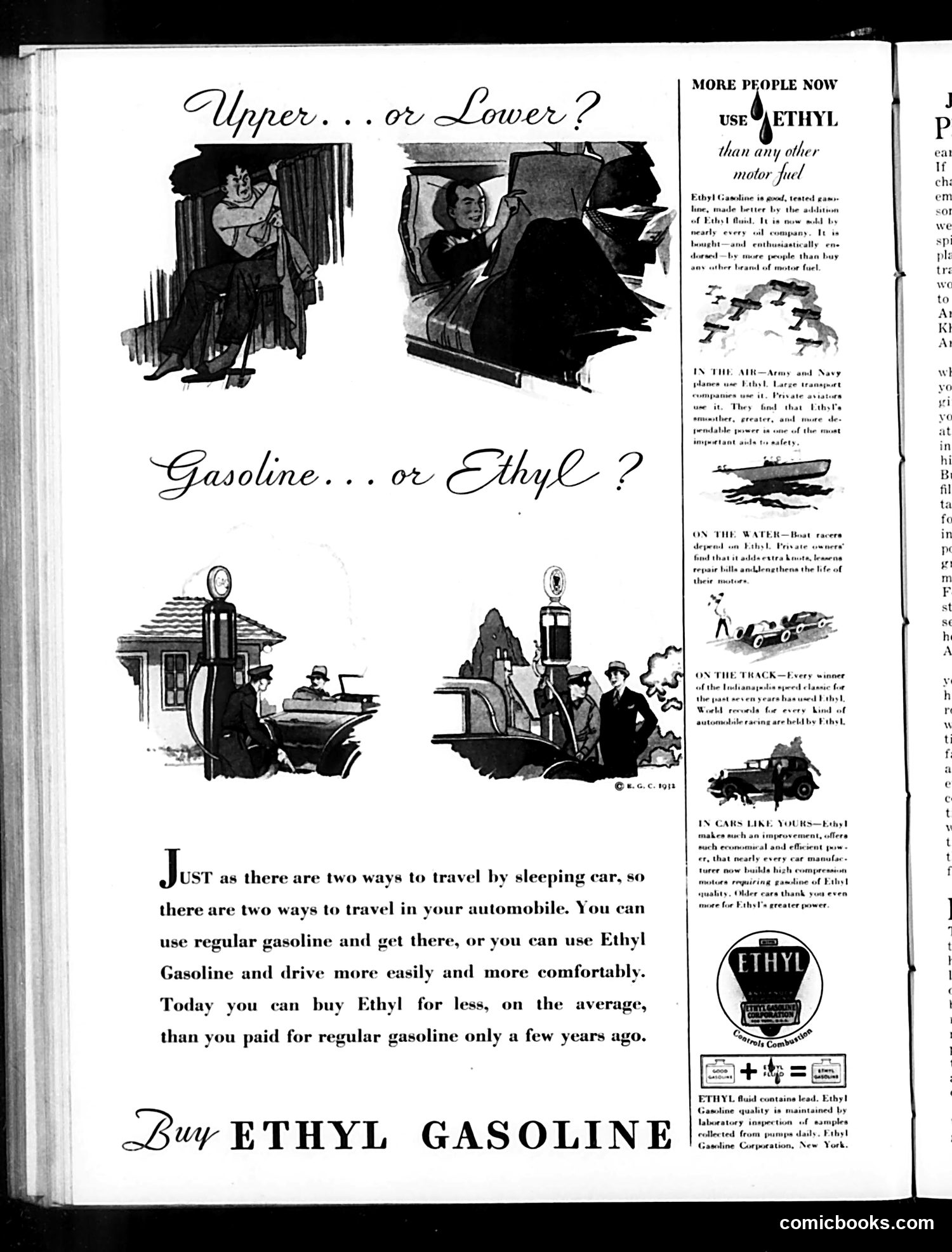
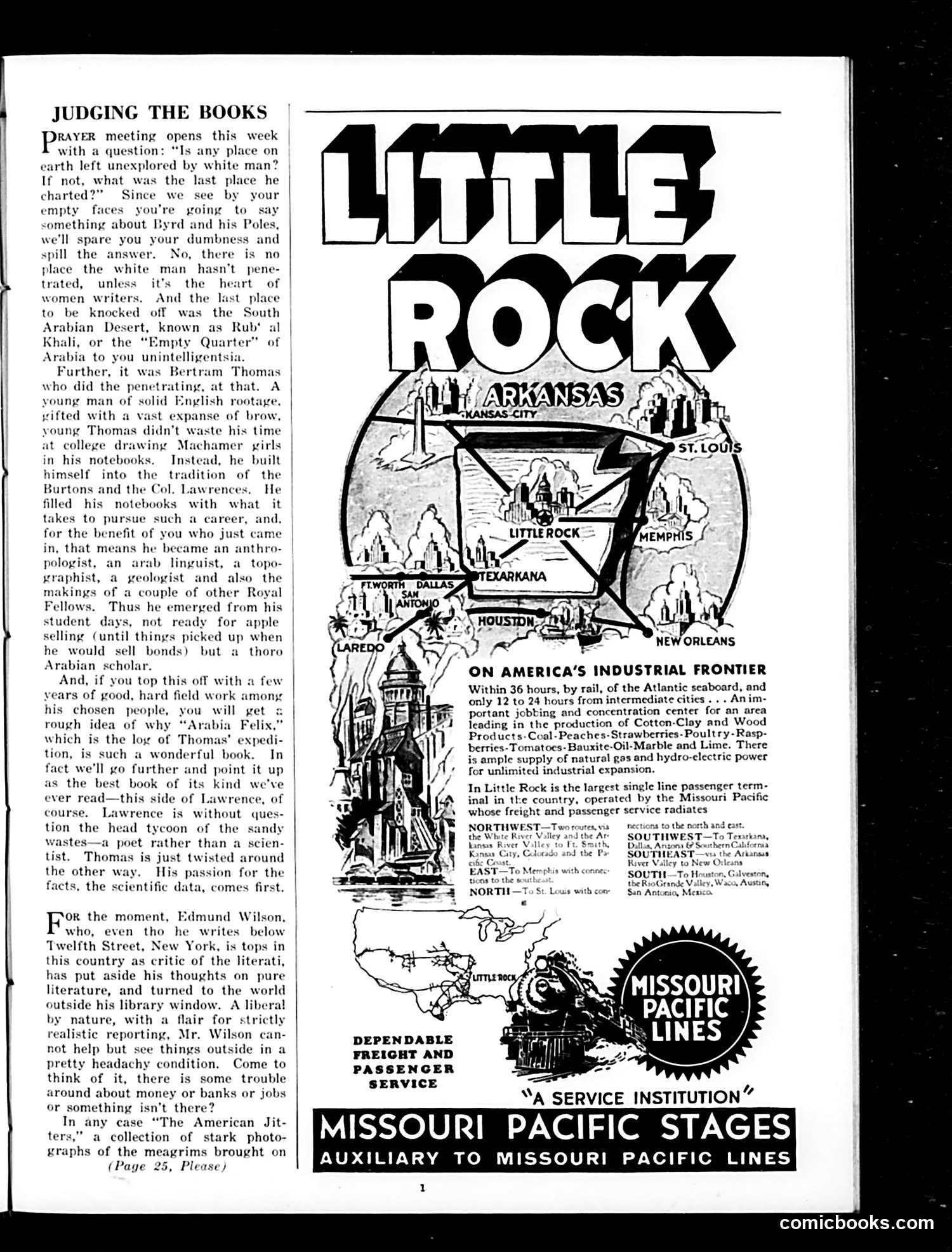
# Analysis This page is primarily **advertising for Ethyl Gasoline**, not political satire. The main cartoon contrasts two scenarios: "Upper...or Lower?" and "Gasoline...or Ethyl?" The imagery suggests social class differences—upper-class comfort versus lower-class struggle—as a metaphor for choosing between regular gasoline and Ethyl brand. The accompanying illustrations show Ethyl being used in various contexts: military aircraft and ships, boats, trains, and private automobiles. The advertisement's central argument is that Ethyl Gasoline provides smoother, easier driving than regular gasoline, despite costing less than regular gas did years prior. This appears to be a vintage ad promoting an early premium fuel product, likely from the 1920s-1930s era based on the styling and references to "lead" content in the small text.
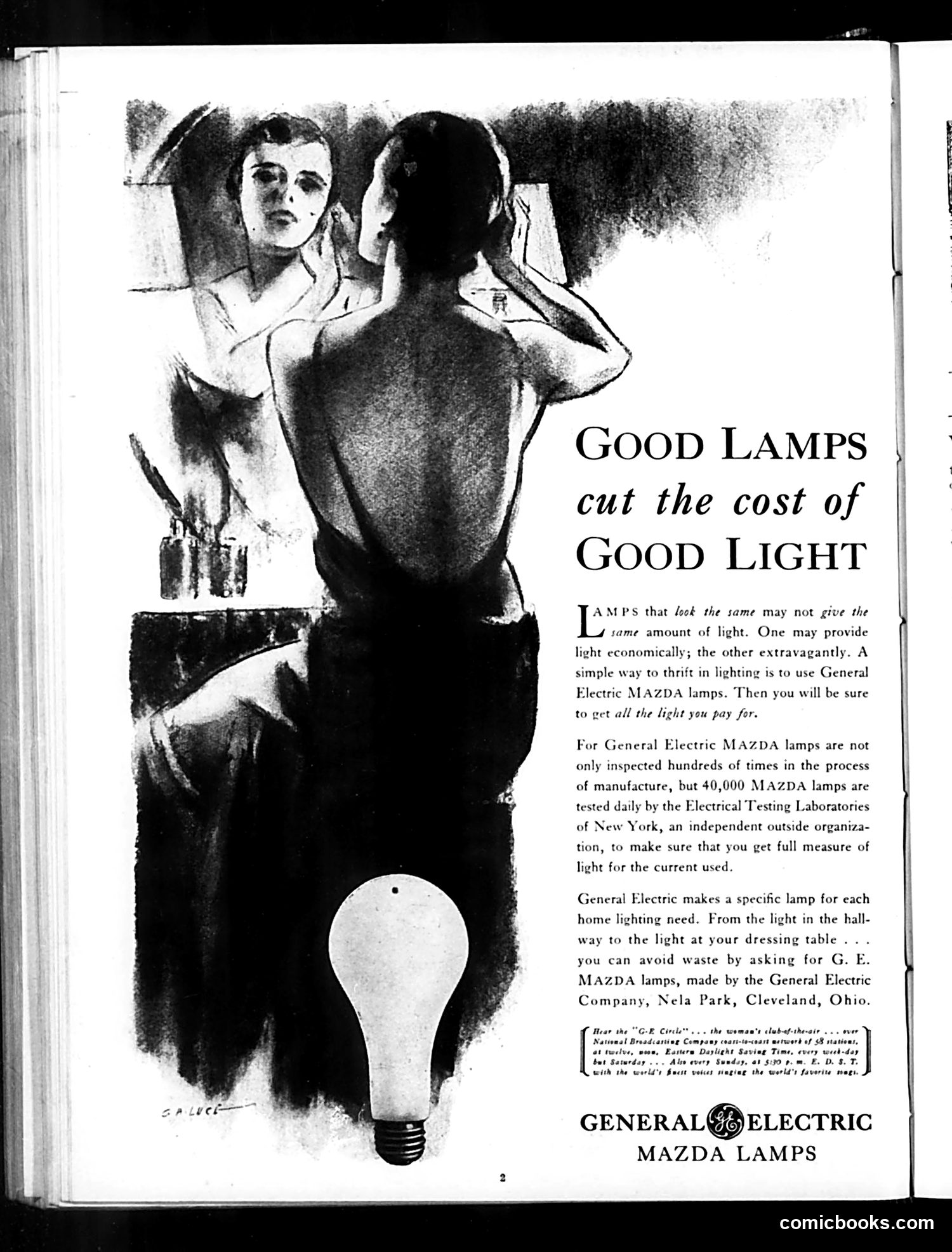
# Analysis This page is **primarily an advertisement**, not satire or political commentary. It's a General Electric MAZDA lamp advertisement from what appears to be an early-to-mid 20th century issue of Judge magazine. The ad uses an artistic illustration of a shirtless man admiring his reflection in a mirror, alongside a woman's face in the mirror. This imagery appeals to vanity and self-improvement—common advertising tropes of the era. The tagline "Good Lamps cut the cost of Good Light" makes an economic argument: efficient MAZDA lamps provide better lighting value than competitors. The text emphasizes quality testing and reliability. There is **no political satire** on this page. Judge, while known for humor and satire, carried paid advertisements like other magazines. This is purely commercial messaging dressed in aesthetically appealing artwork.
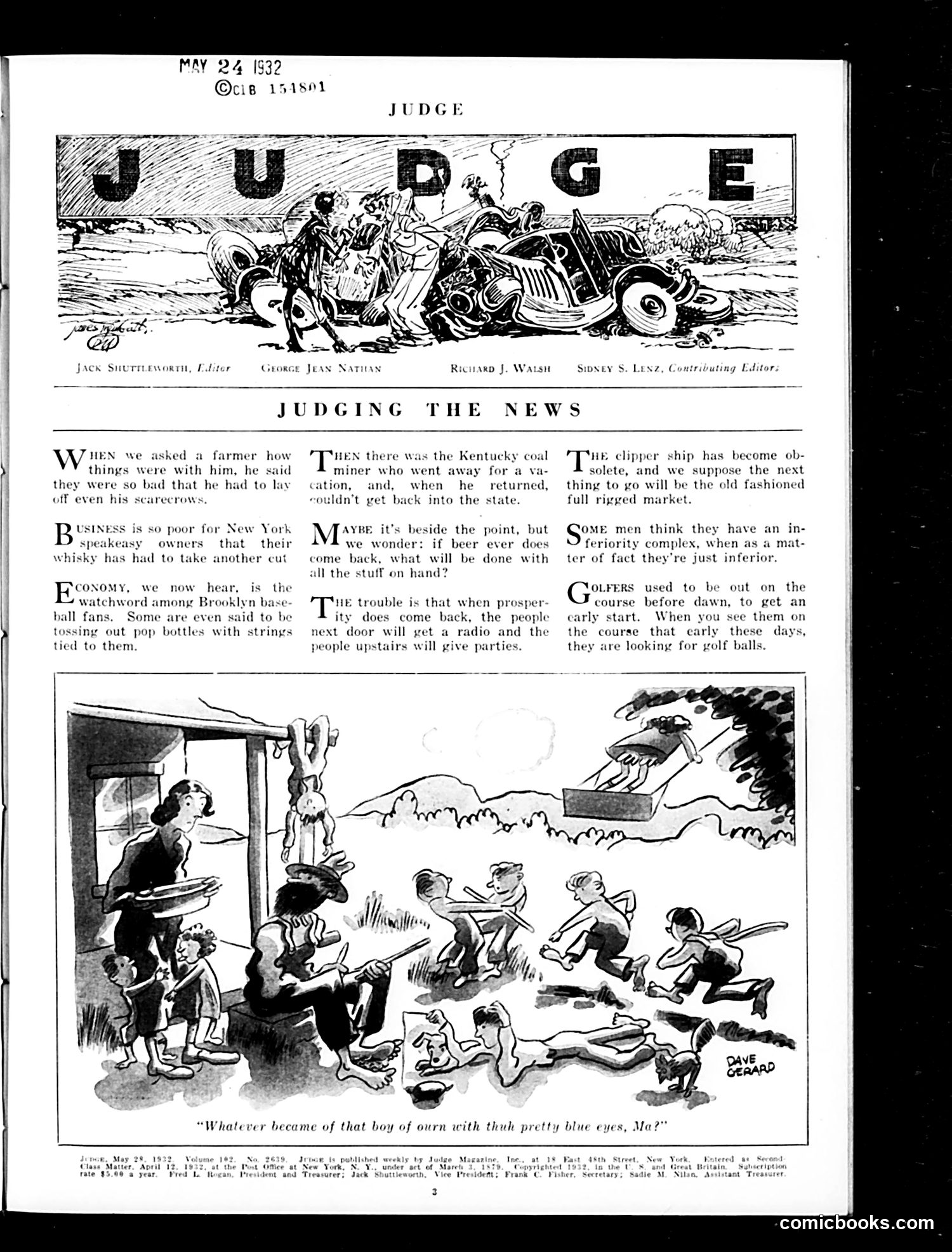
# Explanation for Modern Readers This 1932 *Judge* magazine page satirizes Depression-era economic anxieties through brief editorial commentary paired with a cartoon. The text snippets mock various social impacts: farmers losing livelihoods, New York speakeasies (illegal bars during Prohibition) forced to dilute whiskey, and Brooklyn baseball fans economizing by reusing bottles with strings. The main cartoon depicts children playing outside a house while a mother tends to them, with the caption: "Whatever became of that boy of ours with those pretty blue eyes, Ma?" This likely comments on **child welfare during the Depression**—suggesting families were struggling so severely that children's health and well-being (the "pretty blue eyes") were deteriorating from poverty and malnutrition. The satire critiques both economic hardship and parents' helplessness during this crisis.
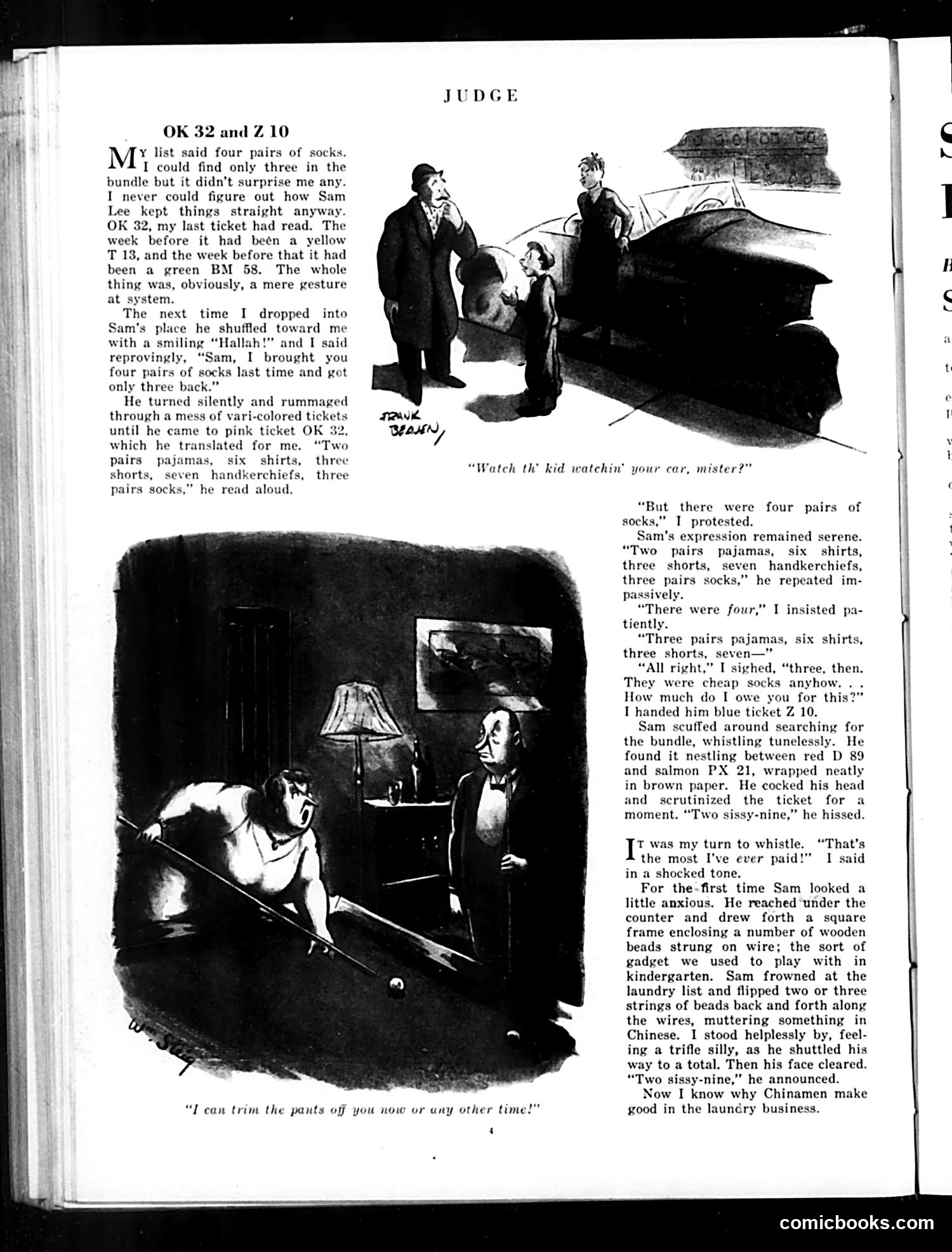
# Analysis of Judge Page "OK 32 and Z 10" This page satirizes a Chinese laundry business's accounting system. The narrator complains about missing socks from a laundry delivery, presenting numbered tickets as evidence. When confronting the laundry owner "Sam," the narrator discovers an elaborate bead-counting device—apparently a traditional Chinese abacus or similar tool used to track inventory. The humor relies on a stereotype common in early 20th-century American satire: portraying Chinese immigrants as inscrutable and operating by mysterious, incomprehensible methods. The narrator's frustration at being unable to "follow" Sam's accounting suggests cultural incomprehension treated as comedy. The final caption reveals the narrator's grudging respect for the system's efficiency, though still framed through ethnic stereotyping.
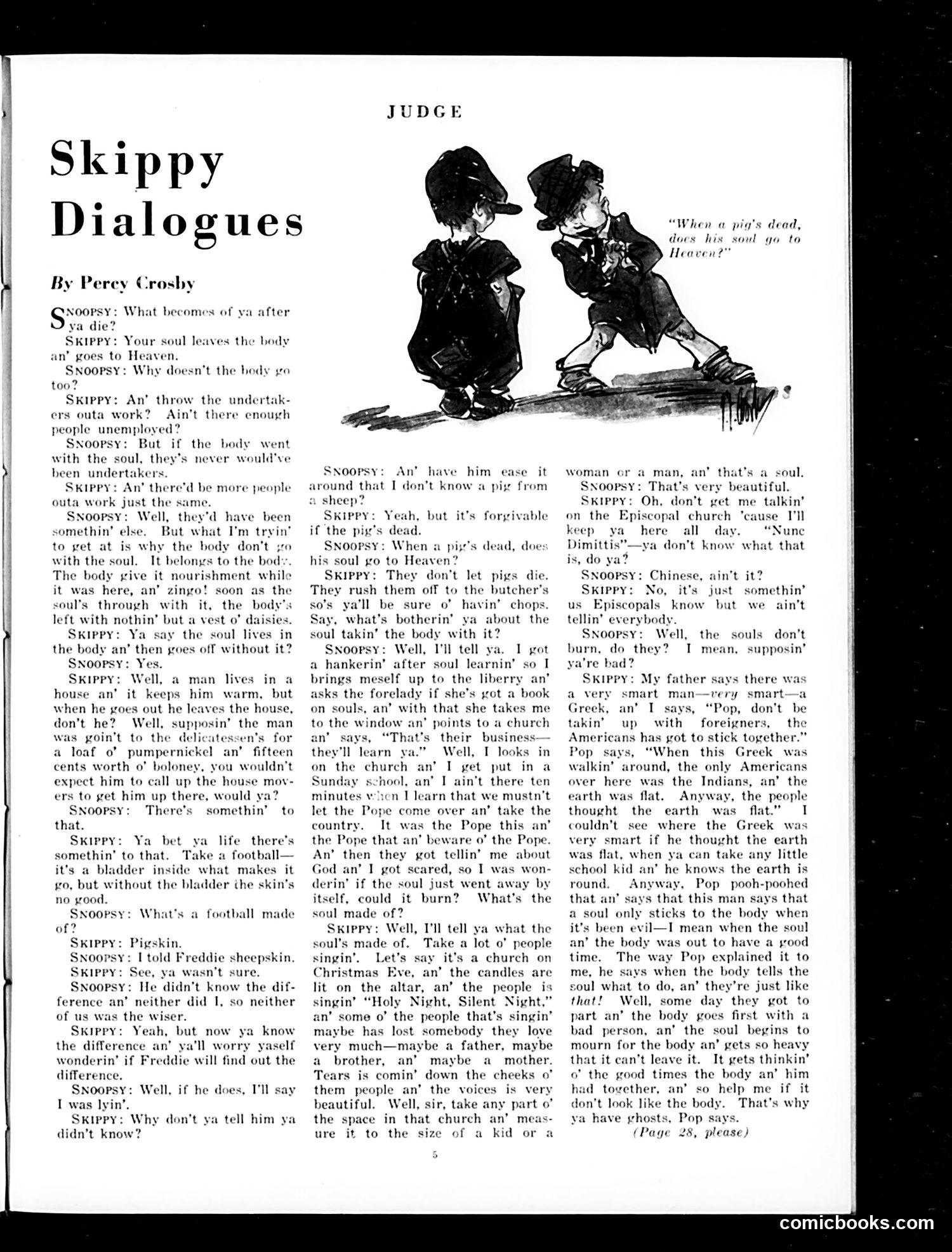
# Skippy Dialogues by Percy Crosby This page features "Skippy Dialogues," a comic dialogue series by Percy Crosby that appeared in *Judge* magazine. The dialogue is between two characters—Snoopsy and Skippy—who discuss philosophical and theological questions in a humorous, mock-serious manner. The illustration shows two child characters in conversation. The dialogue explores absurdist humor typical of early 20th-century children's comics, debating questions about death, the afterlife, church practices, and cultural differences (notably including period-appropriate ethnic stereotypes regarding Greek and Native American peoples). The satire targets pretentious philosophical discourse by having children deliver it naively, exposing the absurdity of adult reasoning through innocent questioning.
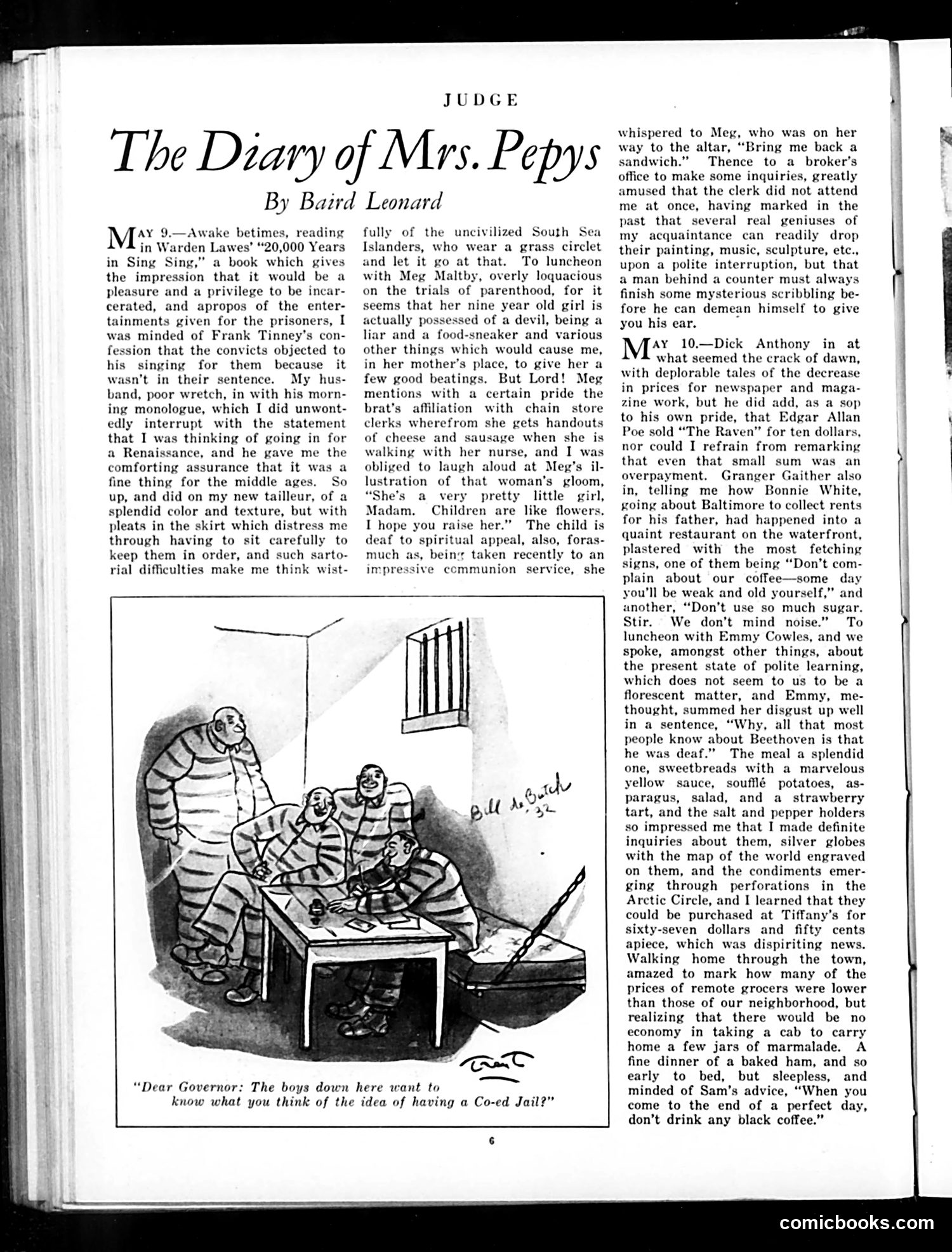
# "The Diary of Mrs. Pepys" - Judge Magazine This is a humorous diary entry by Baird Leonard, not a political cartoon. The accompanying illustration depicts prisoners in striped uniforms in what appears to be a jail cell, with the caption: "Dear Governor: The boys down here want to know what you think of the idea of having a Co-Ed Jail?" The satire references a contemporary debate about co-educational prison facilities. The joke plays on the absurdity of prisoners petitioning authorities about jail conditions while imprisoned, and the questionable logic of mixing male and female inmates. The striped prison uniforms and barred window establish the setting. The diary entries themselves discuss mundane social observations about reading, children, and urban life, offering broader social commentary typical of Judge's satirical approach.
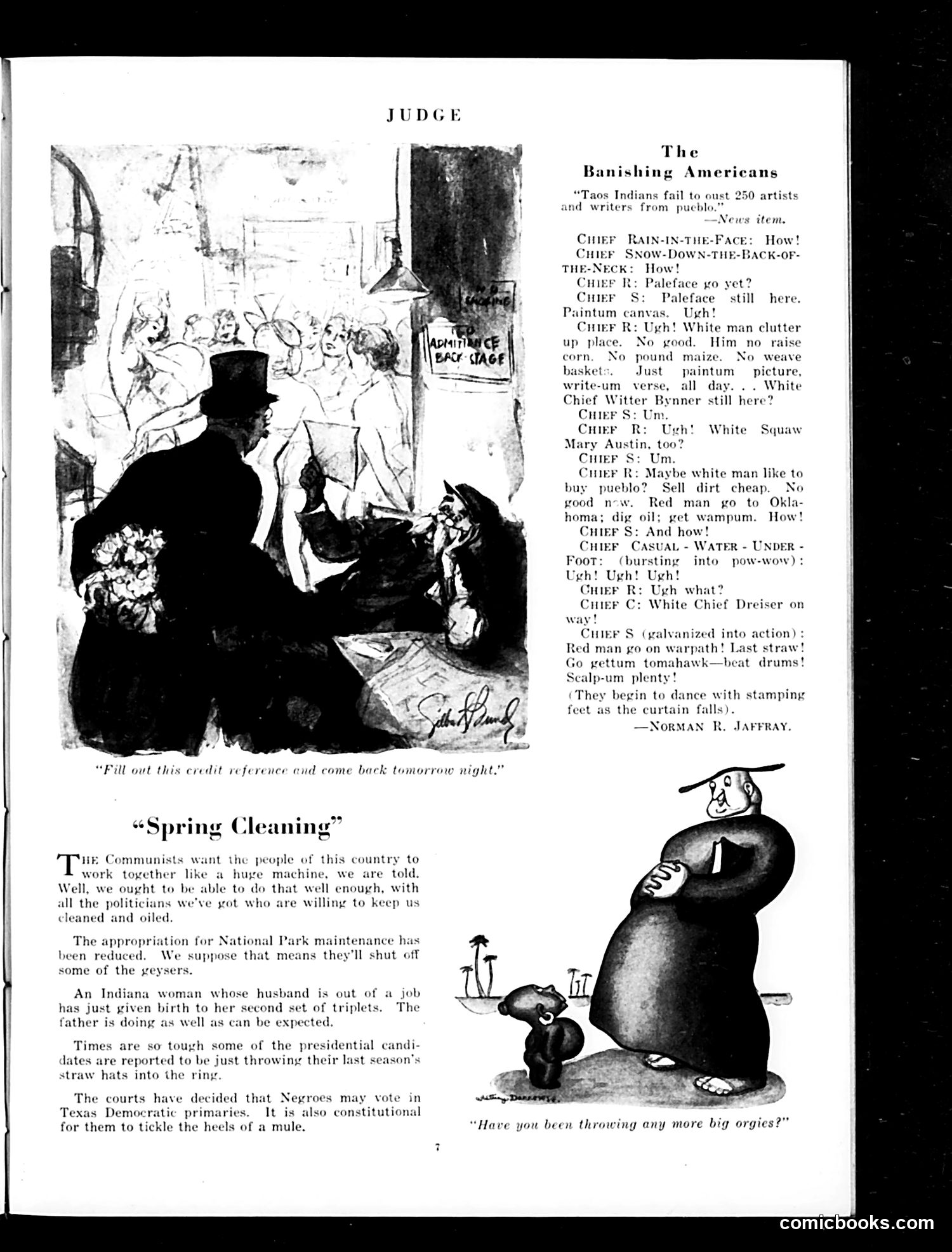
# Explanation for Modern Readers **"The Banishing Americans"** satirizes a real 1924 news story: Taos Pueblo Indians attempting to expel 250 artists and writers living in their community. The sketch mocks both the Indians' complaint and the bohemian residents. Taos was an artist colony attracting literary figures like Witter Bynner and D.H. Lawrence. The cartoon presents Native American chiefs in exaggerated dialect complaining that white artists produce nothing useful—no corn, maize, or baskets, only paintings and verse. When told famous writer Theodore Dreiser is arriving, they declare war. The satire cuts both ways: it ridicules the stereotyped "primitive" resistance while also gently mocking the self-absorbed artists as parasitic outsiders. The humor relies on portraying the Pueblo's actual economic grievances as petty cultural snobbery. The accompanying "Spring Cleaning" section contains separate political commentary on Communism, the Depression, and racial discrimination in Texas voting.
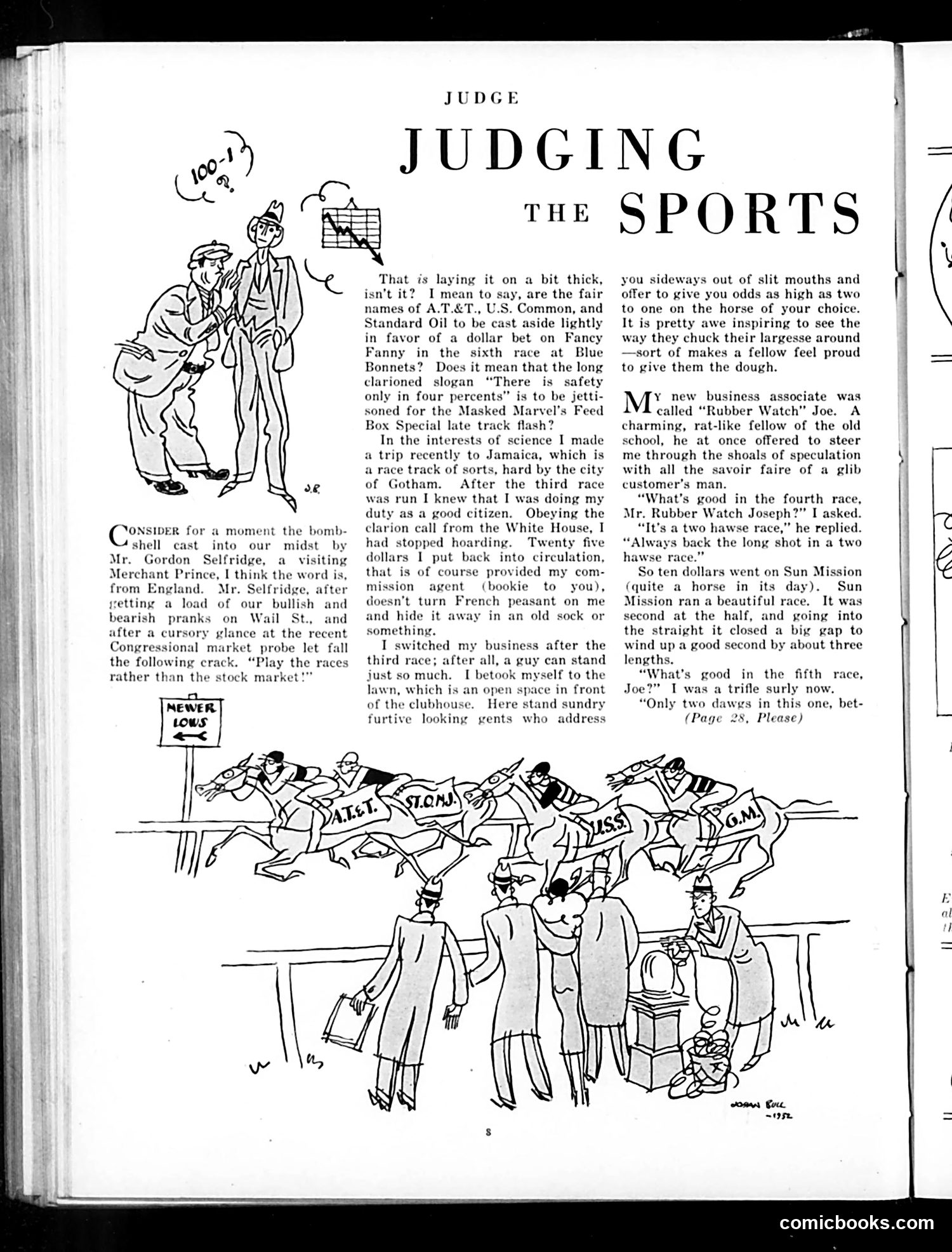
# "Judging the Sports" This satirical piece mocks wealthy spectators at horse racing who make ostentatious bets and display their riches. The main narrative follows a narrator who encounters "Rubber Watch" Joe, a smooth-talking tout (racing advisor) who steers him toward betting tips at Jamaica race track. The satire targets: - **Wealthy British visitors** like Gordon Selfridge, who flaunt money and make showy bets - **Post-WWI hoarding concerns**: references to people hiding money in socks rather than circulating it - **Class pretension**: Joe's slick "savoir faire" contrasts with his rat-like appearance - **Gullibility**: The narrator repeatedly bets on Joe's recommendations with middling results The joke is that despite Joe's confident advice ("Always back the long shot"), the bets underperform—suggesting that flashy confidence and insider tips are unreliable. The cartoon satirizes both wealthy show-offs and the con-artist types who prey on them at racetracks.
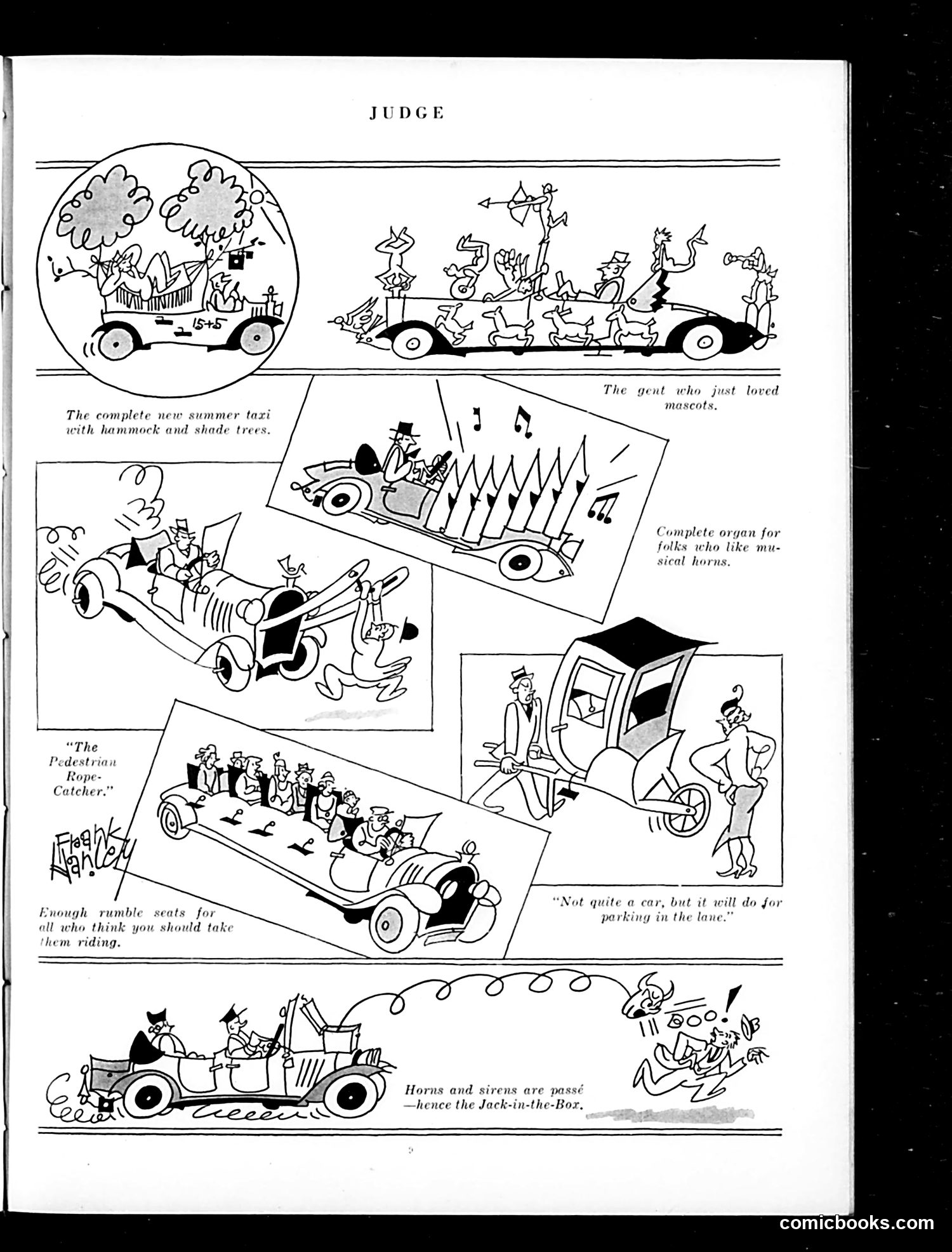
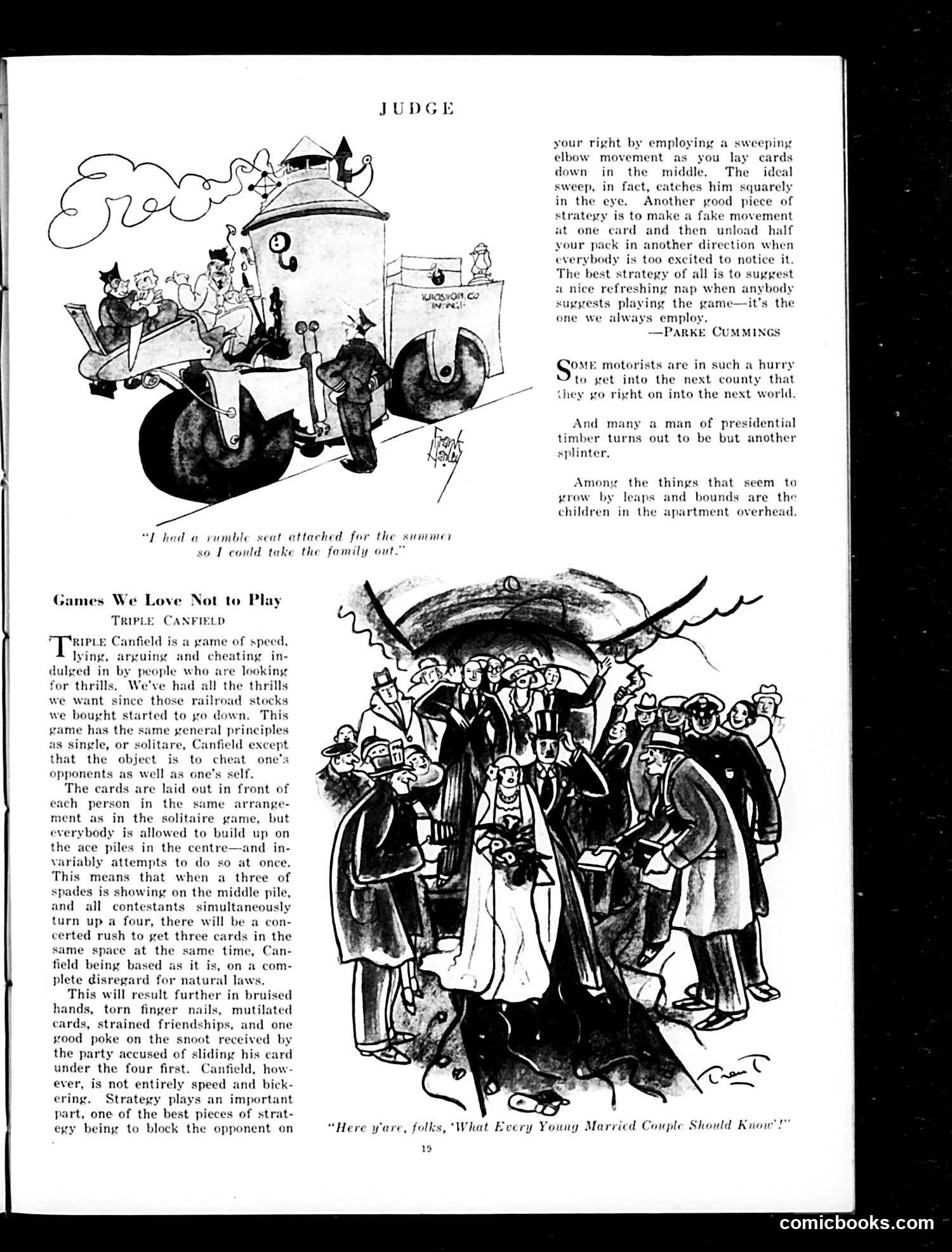
# Judge Magazine Satire Page: Automobile Parodies This page satirizes 1920s automobile culture through exaggerated vehicle designs. Each cartoon mocks contemporary car trends and social behaviors: - **Top panel**: A ridiculously overcrowded taxi with mascots and entertainment features, parodying luxury vehicle excess - **"Pedestrian Rope-Catcher"**: A vehicle with a rope attachment, satirizing pedestrian dangers from speeding cars - **Musical organ car**: Mocking drivers who honk excessively - **"Jack-in-the-Box"**: Replaces traditional horns/sirens with a pop-up clown, suggesting horn-blowing had become absurdly commonplace - **Rumble seat vehicle**: Critiques the trend of cramming multiple passengers into tiny side seats for joyrides The satire targets 1920s automotive excess, reckless driving culture, noise pollution from horns, and dangerous traffic conditions—particularly the contradiction between cars' promised luxury and their actual chaotic, noisy impact on urban life.
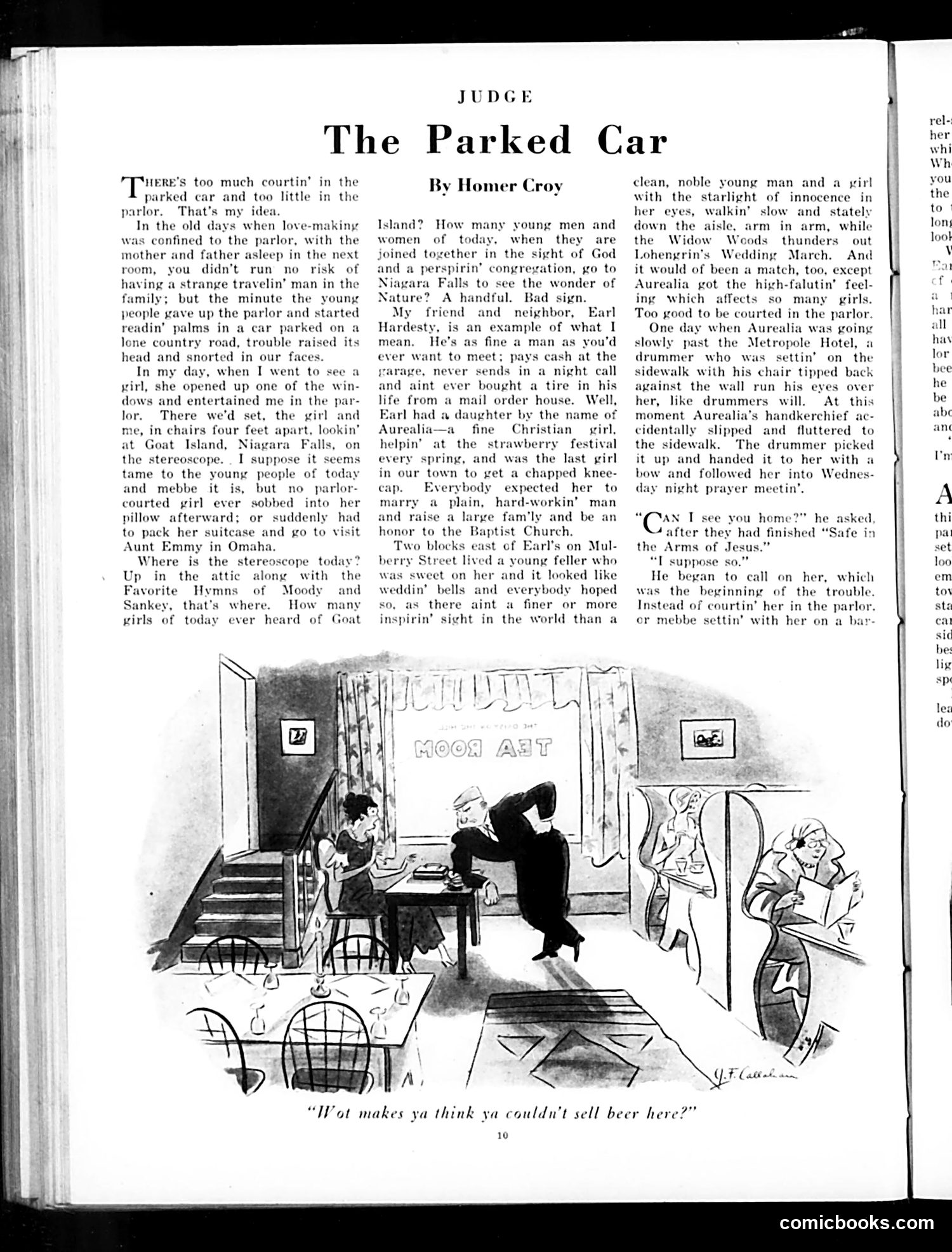
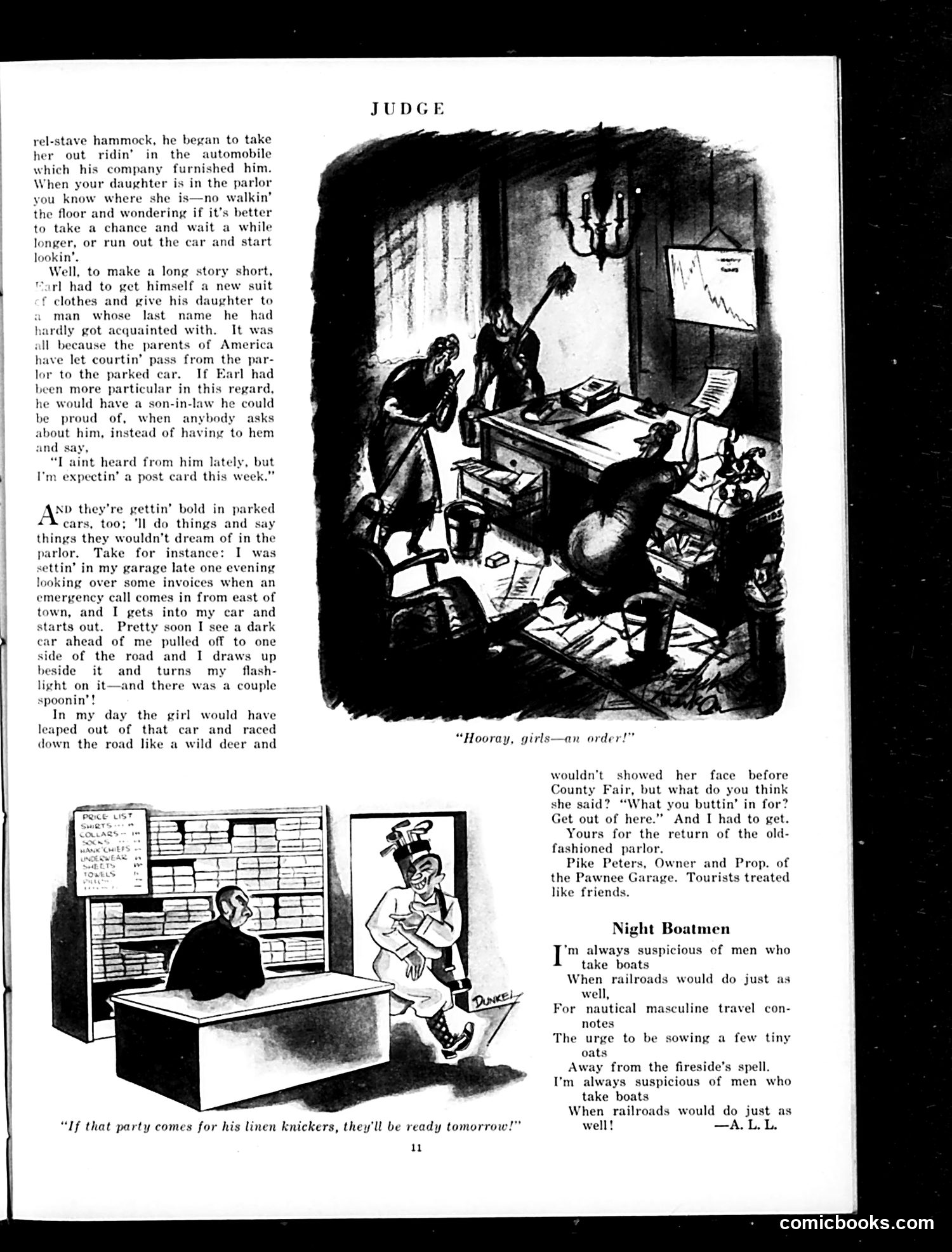
# "The Parked Car" - Judge Magazine Satire This story-cartoon by Homer Croy satirizes changing courtship customs of the early 20th century. The narrator nostalgically contrasts old-fashioned "parlor courting" (chaperoned, supervised, in the home) with modern youth who court in parked cars—viewed as morally dangerous. The plot: Earl Hardesty's daughter Aurealia was a virtuous girl expected to marry a respectable local boy. But when a traveling drummer compliments her, she abandons proper parlor courtship. The implication is that unsupervised car-courting leads to moral compromise and broken engagements. The accompanying cartoon shows a young couple in a parked car beside what appears to be a speakeasy or movie theater, illustrating the "immoral" modern dating practice the text condemns. The satire mocks generational hand-wringing about youth morality—a recurring social anxiety. The joke cuts both ways: the old guard's anxiety about cars and unchaperoned dating seems excessive, yet the story validates their concerns by showing actual (implied) consequences.