
Judge, 1932-05-28 · page 6 of 36
Judge — May 28, 1932 — page 6: what you’re looking at
What you’re looking at
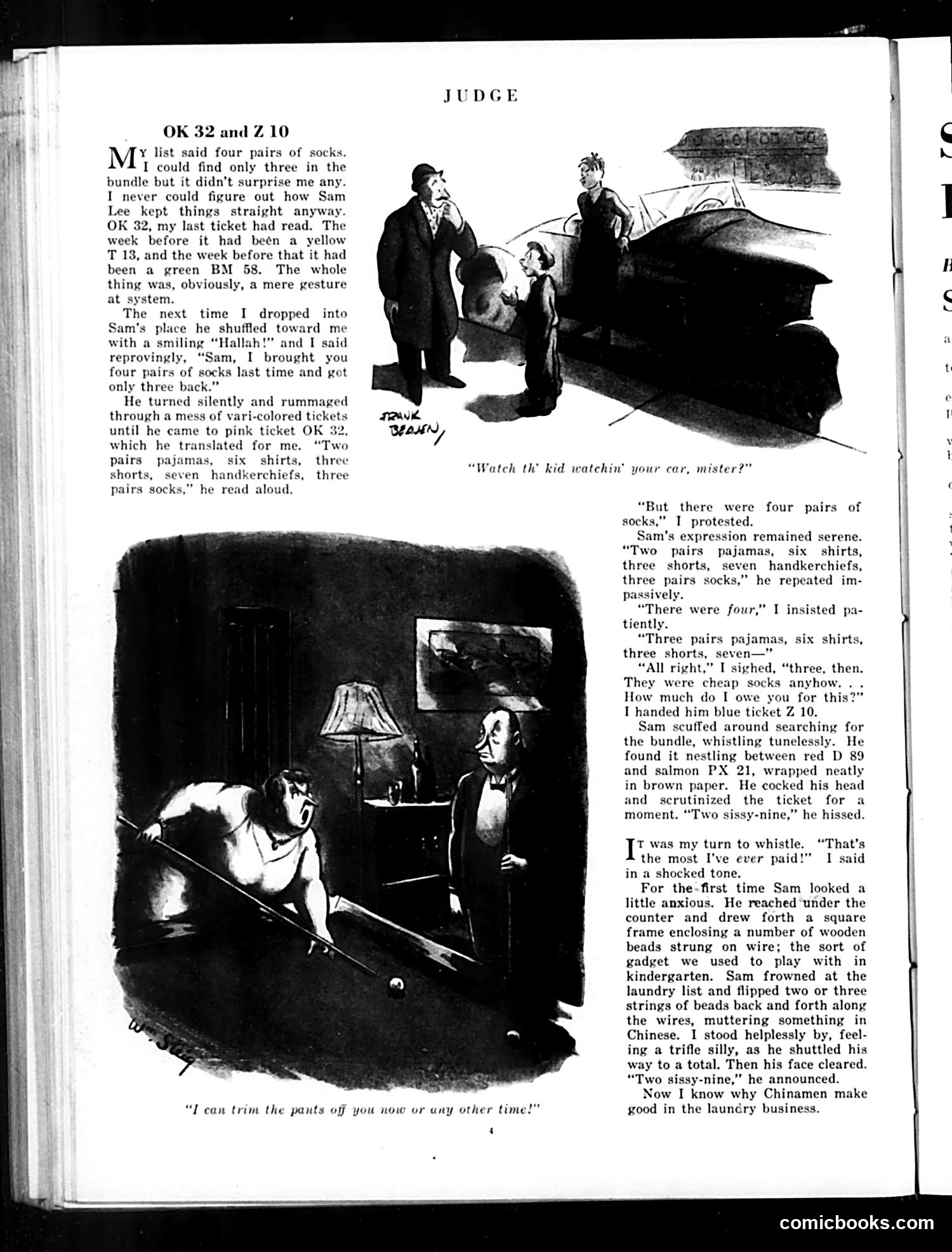
# Analysis of Judge Page "OK 32 and Z 10" This page satirizes a Chinese laundry business's accounting system. The narrator complains about missing socks from a laundry delivery, presenting numbered tickets as evidence. When confronting the laundry owner "Sam," the narrator discovers an elaborate bead-counting device—apparently a traditional Chinese abacus or similar tool used to track inventory. The humor relies on a stereotype common in early 20th-century American satire: portraying Chinese immigrants as inscrutable and operating by mysterious, incomprehensible methods. The narrator's frustration at being unable to "follow" Sam's accounting suggests cultural incomprehension treated as comedy. The final caption reveals the narrator's grudging respect for the system's efficiency, though still framed through ethnic stereotyping.
📄 Transcribed text from this page (OCR, searchable)
Machine-transcribed from the original scan — historical spelling and the odd misread are preserved.
pie a i} OK 32 and Z 10 } Y list said four pairs of socks. I could find only three in the bundle but it didn’t surprise me any. I never could figure out how Sam Lee kept things straight anyway. OK 32, my last ticket had read. The week before it had beén a yellow T 13, and the week before that it had been a green BM 58. The whole thing was, obviously, a mere gesture at system. The next time I dropped into Sam's place he shuffled toward me with a smiling “Hallah!” and I said reprovingly, “Sam, I brought you four pairs of socks last time and got only three back.” He turned silently and rummaged through a mess of olored tic $ until he came to pink ticket OK 32, which he translated for me. “Two , six shirts, three shorts, sev handkerchiefs, three pairs socks,” he read aloud. “I can trim the pants off you now or uny other time!” JUDGE “Watch th’ kid watchin’ your car, mister?” “But there were four pairs of socks,” I protested. Sam’s expression remained serene. “Two pairs amas, six shirts, three shorts, seven handkerchiefs, three pairs socks,” he repeated im- irs pajamas, six shirts, seven—"” .” I sighed, “three, then. They were cheap socks anyhow. . . How much do I owe you for this?” I handed him blue ticket Z 10. Sam scuffed around searching for the bundle, whistling tunelessly. He found it nestling between red D 89 and salmon PX 21, wrapped neatly in brown paper. He cocked his head and scrutinized the ticket for a moment. “Two sissy-nine,” he hissed. T was my turn to whistle. “That's the most I’ve ever paid!” I said in a shocked tone. For the-first time Sam looked a little anxious. He reached ‘under the counter and drew forth a square frame enclosing a number of wooden beads strung on wire; the sort of gadget we used to play with in kindergarten. Sam frowned at the laundry list and flipped two or three strings of beads back and forth along the wires, muttering something in Chinese. I stood helplessly by, feel- ing a trifle silly, as he shuttled his way to a total. Then his face cleared. “Two sissy-nine,” he announced. Now I know why Chinamen make good in the laundry business. comicbooks.com TH —