
Judge, 1932-05-28 · page 24 of 36
Judge — May 28, 1932 — page 24: what you’re looking at
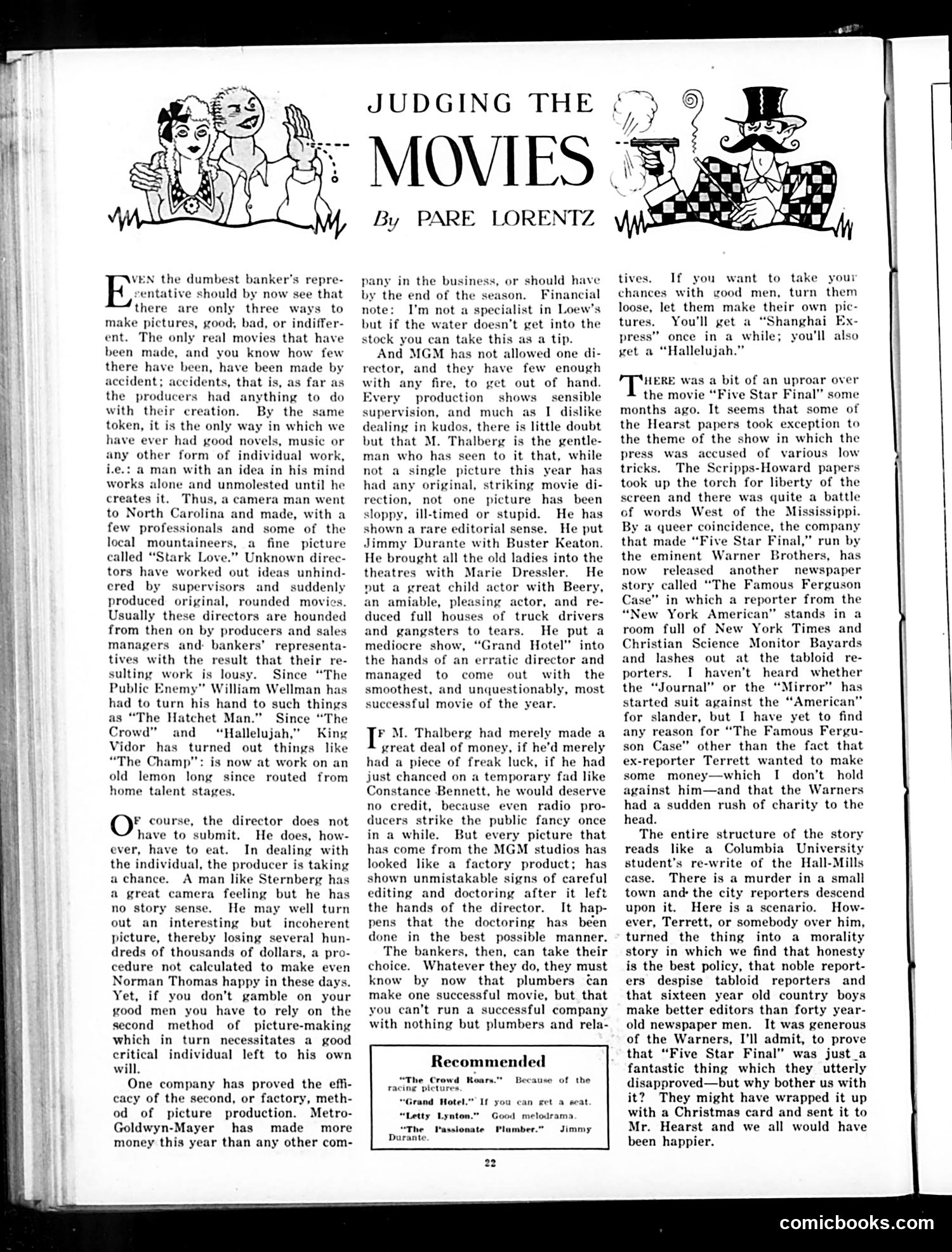
A restored page from Judge, 1932-05-28. Page through the whole issue in the reader above.
📄 Transcribed text from this page (OCR, searchable)
Machine-transcribed from the original scan — historical spelling and the odd misread are preserved.
VEN the dumbest banker's repre- E: entative should by now see that there are only three ys to make pictures, good, bad, or indiffer- ent. The only real movies that have been made, and you know how few there have been, have been made by accident; accidents, that i the producers had anything to do with their creation. By the token, it is the only way in whic have ever had good novels, music or ny other form of individual work, a man with an idea in his mind works alone and unmolested until he creates it. Thus, a camera man went to North Carolina and made, with a few professionals and some of the local mountaineers, a fine picture called “Stark Love.” Unknown direc- tors have worked out ideas unhind- ered by super $s and suddenly produced original, rounded movies. Usually these directors are hounded from then on by producers and sales managers and: bankers’ represent. tives with the result that their re- sulting work is lousy. Since “The Public Enemy” William Wellman has had to turn his hand to such things as “The Hatchet Man.” Since “The Crowd” and “Hallelujah,” King Vidor has turned out things like “The Champ”: is now at work on an old lemon long since routed from home talent stages. F course, the director does not have to submit. He does, how- ever, have to eat. In dealing with the individual, the producer is taking achance. A man like Sternberg has a great camera feeling but he has no story sense. He may well turn out an interesting but incoherent picture, thereby losing several hun- dreds of thousands of dollars, a pro- cedure not calculated to make even Norman Thomas happy in these days. Yet, if you don’t gamble on your good men you have to rely on the second method of picture-making which in turn necessitates a good critical individual left to his own will. One company has proved the effi- cacy of the second, or factory, meth- od of picture production. Metro- Goldwyn-Mayer has made more money this year than any other com- JUDGING THE MOVIES * By PARE LORENTZ pany in the business, or should have by the end of the s on. Financial note: I'm not a specialist in Loew’s but if the water doesn’t get into the stock you can e this as a tip. And MGM has not allowed one di- rector, and they have few enough y fire, to get out of hand. production shows sensible supervision, and much I dislike dealing in kudos, there is little doubt but that M. Thalberg is the gentle- man who has seen to it that, while not a single picture this year has had any original, striking movie di- rection, not one picture has been sloppy, ill-timed or stupid. He has shown a rare editorial sense. He put Jimmy Durante with Buster Keaton. He brought all the old ladies into the theatres with Marie Dressler. He put a great child actor with Beery, amiable, pleasing actor, and re- duced full hou of truck drivers and gangsters to tears. He put a mediocre show, “Grand Hotel” into the hands of an erratic director and managed to come out with the smoothest, and unquestionably, most successful movie of the year. F M. Thalberg had merely made a srreat deal of money, if he’d merely had a piece of freak luck, if he had just chanced on a temporary fad like Constance Bennett, he would deserve no credit, because even radio pro- ducers strike the public fancy once in a while. But every picture that s come from the MGM studios has looked like a factory product; has shown unmistakable signs of careful editing and doctoring after it left the hands of the director. It hap- pens that the doctoring has been done in the best possible manner. The bankers, then, can take their choice. Whatever they do, they must know by now that plumbers ¢an make one successful movie, but that you can’t run a successful company with nothing but plumbers and rela- Recommended e Crowd Roars.” Because of the pictures Grand Hotel.” If you can get a seat “Letty Lynton." Good melodrama. “The Passionate Plumber.” Jimmy Durante. tives. chances with good men, turn them loose, let them make their own pic- If you want to take your You'll get once in “Hallelujah.” HERE W: bit of an uproar over the movie “Five Star Final” some months ago. It seems that some of the Hearst papers took exception to the theme of the show in which the press was accused of various low tricks. The Scripps-Howard papers took up the torch for liberty of the screen and there was quite a battle of words West of the Mi ippi. By a queer coincidence, the company that made “Five Star Final,” run by the eminent Warner Brothers, has now released another newspaper story called “The Famous Ferguson Case” in which a reporter from the “New York American” stands in a room full of New York Times and Christian Science Monitor Bayards and lashes out at the tabloid re- porters. I haven't heard whether the “Journal” or the “Mirro: started suit against the “Ame for slander, but I have yet to find any reason for “The Famous Fergu- son Case” other than the fact that ex-reporter Terrett wanted to make some money—which I don’t hold against him—and that the Warners had a sudden rush of charity to the head. The entire structure of the story reads like a Columbia University student's re-write of the Hall-Mills case. There is a murder in a small town and: the city reporters descend upon it. Here is a scenario. How- ever, Terrett, or somebody over him, turned the thing into a morality story in which we find that honesty is the best policy, that noble report- ers despise tabloid reporters and that sixteen year old country boys make better editors than forty year- old newspaper men. It was generous of the Warners, I'll admit, to prove that “Five Star Final” was just_a fantastic thing which they utterly disapproved—but why bother us with it?) They might have wrapped it up with a Christmas card and sent it to Mr. Hearst and we all would have been happier. comicbooks.com