
Judge, 1932-05-28 · page 18 of 36
Judge — May 28, 1932 — page 18: what you’re looking at
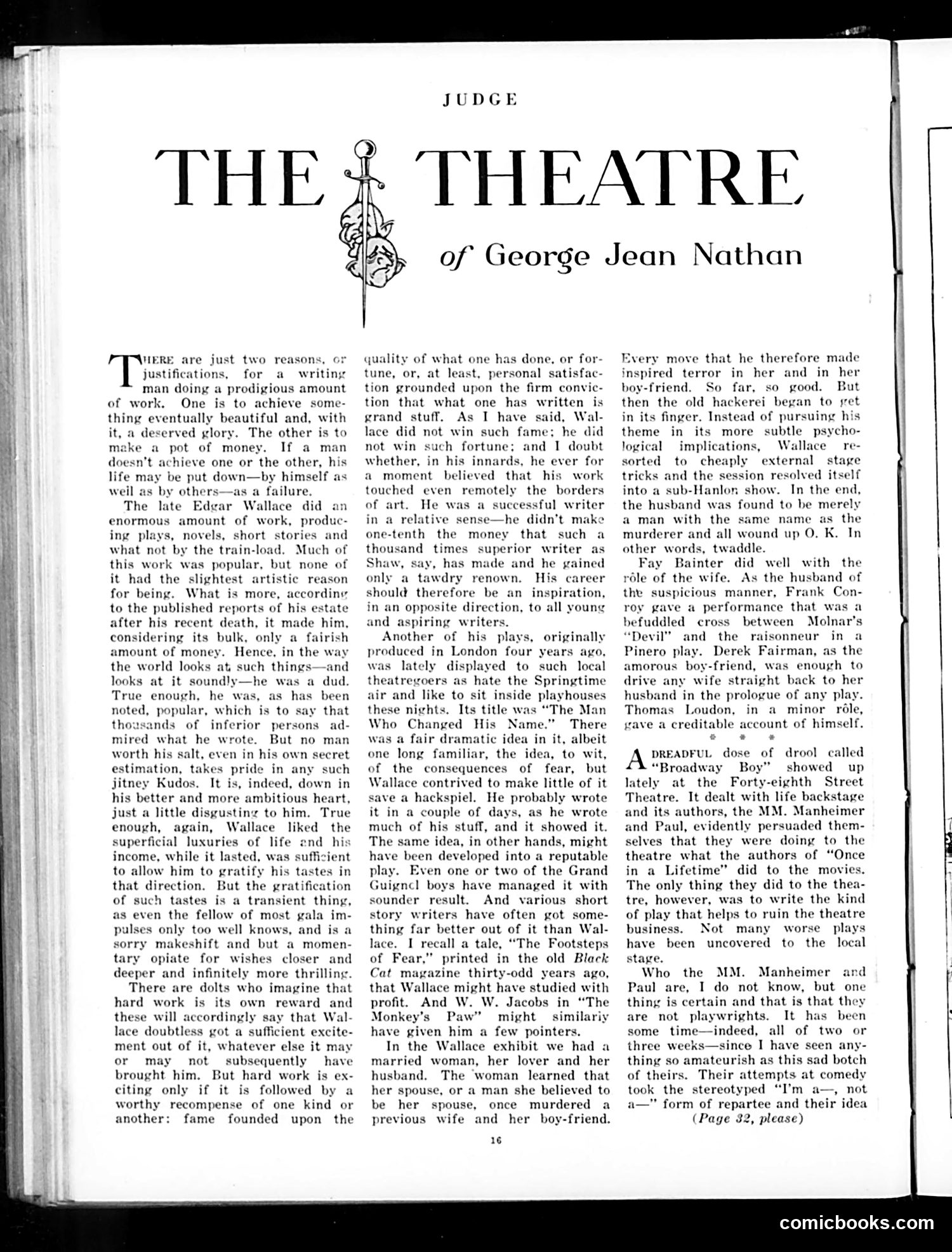
A restored page from Judge, 1932-05-28. Page through the whole issue in the reader above.
📄 Transcribed text from this page (OCR, searchable)
Machine-transcribed from the original scan — historical spelling and the odd misread are preserved.
THE Tissti re just two reasons, or justifications, for a writing. man doing a prodigious amount of work. One is to achieve some- thing eventually beautiful and, with it, a deserved glory. The other is to meke a pot of money. If a man doesn’t achieve one or the other, his life may be put down—by himself as weil as by others—a lure. The late Edgar W e did an enormous amount of work, produc- ing play novels, short stories and what not by the train-load. Much of this work was popul. but none of it had the slightes stic reason for being. What is more, accordiny to the published reports of his estate after his recent death, it made him, considering its bulk, only a fairish amount of money. Hence, in the way the world looks at such things—and dud. s been looks at it soundly—he was a sh to True enough, he was, noted, popular, which is ay that thousands of inferior persons ad- mired what he wrote. But no man worth his salt, even in his own secret estimation, takes pride in any such jitney Kudos. It is, indeed, down in his better and more ambitious heart, just a little disgusting to him. True enough, ain, Wall liked the superficial luxuries of life end his income, while it lasted, was suff to allow him to gratify his taste: that direction. But the gratification of such tastes is a transient thing, as even the fellow of most gala im- pulses only too well knows, and is a sorry makeshift and but momen- tary opiate for wishes closer and deeper and infinitely more thrilling. There are dolts who imagine that hard work is its own reward and these will accordingly say that Wal- lace doubtless got a sufficient excite- ment out of it, whatever else it may or may not subsequently brought him. But hard work is citing only if it is followed by a worthy recompense of one kind or another: fame founded upon the JUDGE quality of what one has done, or for- tune, or, at least, personal satisfac- tion grounded upon the firm convic- tion that what one has written i grand stuff. As I have said, V lace did not win such fame; he did not win such fortune; and I doubt whether, in his innards, he ever for a moment believed that his work touched even remotely the borders of art. He was a successful writer in a relative sense—he didn’t make one-tenth the money that such thousand times superior writer as Shaw, has made and he gained only a tawdry renown. H hould therefore be an i in an opposite direction, to z and aspiring writers. Another of his plays, originally produced in London four years ago, was lately displayed to such local ate the Springtime air and like to sit inside playhouses these nights. Its title was “The Man Who Changed His Name.” was a fair dramatic idea in it, albeit one long familiar, the idea, to wit, of the consequences of fear, but Wallace contrived to make little of it save a hackspiel. He probably wrote it in a couple of : he wrote much of his stuff, and it showed it. The same idea, in other hands, might have been developed into a reputable play. Even one or two of the Grand Guigncl boys have managed it with sounder result. And various short story writers have often got some- thing far better out of it than Wal- le I recall a tale, “The Footsteps of Fear,” printed in the old Black Cat magazine thirty-odd years ago, that Wallace might have studied with profit. And W. W. Jacobs in “The Monkey’s Paw” might — similariy have given him a few pointers. In the Wallace exhibit we had a married woman, her lover and h husband, The woman learned th: her spouse, or a man she believed to be her spouse, once murdered a previous wife and her boy-friend. 16 THEATRE of George Jean Nathan y move that he therefore made inspired terror in her and in her boy-friend. So far, so good. But then the old hackerei began to sret in its finger. Instead of pursuing his theme in its more subtle psycho- logical implication: Wallace re- sorted to cheaply external stage tricks and the session resolved itself into a sub-Hanlon show. In the end, the husband was found to be merely a man with the same name as the murderer and all wound up O. K. In other words, twaddle. Fay Bainter did well with the réle of the wife. As the husband of the suspicious manner, Frank Con- roy gave a performance that w a befuddled cross between Molnar’s “Devil” and the raisonneur in a Pinero play. Derek Fairman, as the amorous boy-friend, was enough to drive any wife straight back to her husband in the prologue of any play. Thomas Loudon, in a minor réle, yave a creditable account of himself. * * DREADFUL dose of drool called “Broadway Boy” showed up lately at the Forty-eighth Street Theatre. It dealt with life age and its authors, the MM. Manheimer and Paul, evidently persuaded them- selves that they were doing to the theatre what the authors of “Once in a Lifetime” did to the movie The only thing they did to the thes tre, however, was to write the kind helps to ruin the theatre Not many wo ys uncovered to the local have been stage. Who the MM. Manheimer ard Paul are, I do not know, but one thing is certain and that is that they are not playwrights It has been some time—indeed, all of two or three weeks nce I have seen any- thing so amateurish as this sad botch of theirs. Their attempts at comedy took the stereotyped “I’m a—, not a—" form of repartee and their idea (Page 32, please) comicbooks.com