
Judge, 1932-05-28 · page 8 of 36
Judge — May 28, 1932 — page 8: what you’re looking at
What you’re looking at
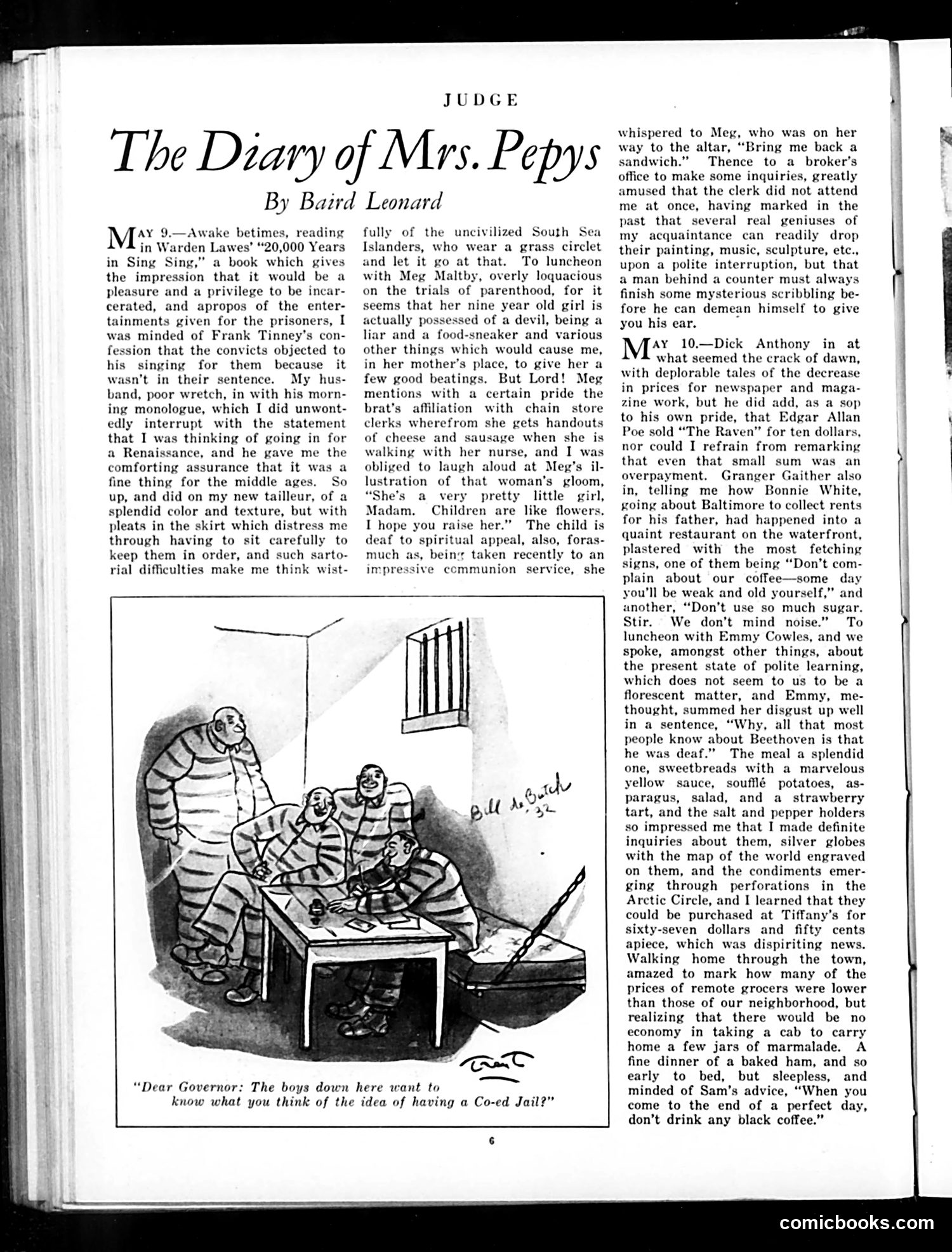
# "The Diary of Mrs. Pepys" - Judge Magazine This is a humorous diary entry by Baird Leonard, not a political cartoon. The accompanying illustration depicts prisoners in striped uniforms in what appears to be a jail cell, with the caption: "Dear Governor: The boys down here want to know what you think of the idea of having a Co-Ed Jail?" The satire references a contemporary debate about co-educational prison facilities. The joke plays on the absurdity of prisoners petitioning authorities about jail conditions while imprisoned, and the questionable logic of mixing male and female inmates. The striped prison uniforms and barred window establish the setting. The diary entries themselves discuss mundane social observations about reading, children, and urban life, offering broader social commentary typical of Judge's satirical approach.
📄 Transcribed text from this page (OCR, searchable)
Machine-transcribed from the original scan — historical spelling and the odd misread are preserved.
ft JUDGE The Diary of Mrs. Pepys By Baird Leonard ay 9.—Awake betimes, reading in Warden Lawes’ “20,000 Years in Sing Sing,” a book which gives the impression that it would be pleasure and a privilege to be incar- cerated, and apropos of the enter- tainments given for the prisoners, I minded of Frank Tinney’s con- on that the convicts objected to nging for them because it n't in their sentence. My hus- band, poor wretch, in with his morn- ing monologue, which I did unwont- edly interrupt with the statement that I was thinking of going in for a Renaissance, and he gave me the comforting assurance that it was a fine thing for the middle ages. So up, and did on my new tailleur, of a splendid color and texture, but with pleats in the skirt which distress me through having to sit carefully to keep them in order, and such sarto- rial difficulties make me think w st- fully of the uncivilized South Sea Islanders, who wear a grass circlet and let it go at that. To luncheon with Meg Maltby, overly loquacious on the trials of parenthood, for it seems that her nine year old girl is actually possessed of a devil, being a liar and a food-sneaker and various other things which would cause me, in her mother’s place, to give her a few good beatings. But Lord! Meg mentions with a certain pride the ’s affiliation with chain store s wherefrom she gets handouts of cheese and sausage when she is walking with her nurse, and I was obliged to laugh aloud at Meg's il- lustration of that woman's gloom, “She’s a very pretty little girl, Madam. Children are like flowers. I hope you raise her.” The child is deaf to spiritual appeal, also, foras- taken recently to an she as, bein ve communion much impre service, — “Dear Governor: The boys down here want to know what you think of the idea of having a Co-ed Jail?” — whispered to Meg, who was on her way to the altar, “Bring me back a sandwich.” Thence to a_ broker's office to make some inquiries, greatly amused that the clerk did not attend me at once, having marked in the past that several real geniuses of my acquaintance can readily drop their painting, music, Ipture, etc., upon a polite interruption, but that a man behind a counter must always finish some mysterious scribbling be- fore he can demean himself to give you his ear. AY 10.—Dick Anthony in at what seemed the crack of dawn, with deplorable tales of the decrease in prices for newspaper and maga- zine work, but he did add, as a sop to his own pride, that Edgar Allan that even that small sum was an ayment. Granger Gaither a elling me how Bonnie White, going about Baltimore to collect rents for his father, had happened into a quaint restaurant on the waterfront, plastered with the most fetching signs, one of them being “Don’t com- plain about our coffee—some day you'll be weak and old yourself,” and another, “Don’t use so much sugar. Stir. We don’t mind noise.” To luncheon with Emmy Cowles, and we spoke, amongst other things, about the present state of polite learning, which does not seem to us to be a florescent matter, and Emmy, me- thought, summed her disgust up well in a sentence, “Why, all that most people know about Beethoven is that he was deaf.” The meal a splendid one, sweetbreads with a marvelous yellow sauce, soufflé potatoes, as- paragus, salad, and a_ strawberry tart, and the salt and pepper holders so impressed me that I made definite inquiries about them, silver globes with the map of the world engraved on them, and the condiments emer- ging through perforations in the Arctic Circle, and I learned that they could be purchased at Tiffany’s for sixty-seven dollars and fifty cents apiece, which was dispiriting news. Walking home through the town, amazed to mark how many of the prices of remote grocers were lower than those of our neighborhood, but realizing that there would be no economy in taking a cab to carry home a few jars of marmalade. A fine dinner of a baked ham, and so early to bed, but sleepless, and minded of Sam's advice, “When you come to the end of a perfect day, don’t drink any black coffee.” comicbooks.com