
Judge, 1932-05-28 · page 14 of 36
Judge — May 28, 1932 — page 14: what you’re looking at
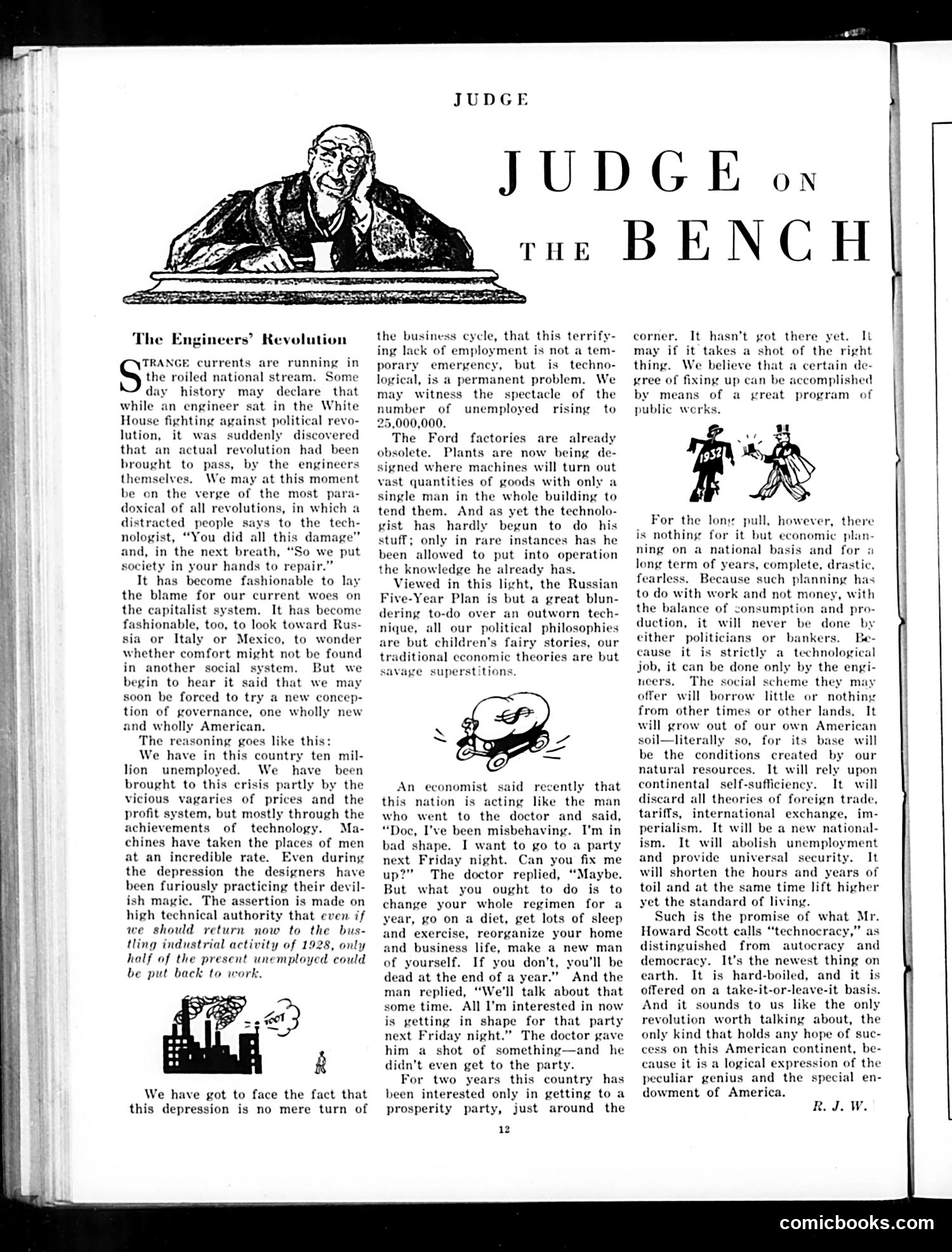
A restored page from Judge, 1932-05-28. Page through the whole issue in the reader above.
📄 Transcribed text from this page (OCR, searchable)
Machine-transcribed from the original scan — historical spelling and the odd misread are preserved.
The Engineers’ Kevolu TRANGE currents are running in S the roiled national stream. Some day history m declare that while an engineer sat in the White House fighting against political revo- lution, it was suddenly discovered that an actual revolution had been brought to by the engin themselves. We may at this moment be on the verge of the most para- doxical of all revolutions, in which distracted people says to the tech- nologist, “You did all this damage” and, in the next breath, “So we put society in your hands to repair.” It has become fashionable to lay the blame for our current woes on the capitalist system. It has become fashionable, too, to look toward Rus- sia or Italy or Mexico, to wonder whether comfort might not be found in another social system. But we begin to hear it said that we may soon be forced to try a new concep- tion of governance, one wholly new and wholly American. The reasoning goes like this: We have in this country ten mil- lion unemployed. We have been brought to this crisis partly by the vicious vagaries of prices and the profit system, but mostly through the achievements of technology. Ma- chines have taken the places of men at an incredible rate. Even during the depression the designers have been furiously practicing their devil- ish magic. The assertion is made on high technical authority that even if we should return now to the bus- tling industrial activity of 1928, only half of the present unemployed could be put back to work. We have got to face the fact that this depression is no mere turn of JUDGE the business cycle, that this terrify- ing lack of employment is not a tem- porary emergency, but is techno- logical, 4 permanent problem. We may witness the spectacle of the number of unemployed rising to 25,000,000. The Ford factories are already obsolete. Plants are now being de- signed where machines will turn out vast quantities of goods with only a single man in the whole building to tend them. And as yet the technolo- gist has hardly begun to do his stuff; only in rare instances has he been allowed to put into operation the knowledge he already has. Viewed in this light, the Russian Five-Year Plan is but a great blun- dering to-do over an outworn tech- nique, all our political philosophies are but children’s fairy stories, our traditional economic theories are but savage superstitions. An economist said recently that this nation is acting like the man who went to the doctor and said, “Doc, I've been misbehaving. I’m in bad shape. I want to go to a party next Friday night. Can you fix me up?” The doctor replied, “Maybe. But what you ought to do is to change your whole regimen for a year, go on a diet, get lots of sleep and exere: reorganize your home and business life, make a new man of yourself. If you don’t, you'll be dead at the end of a year.” And the man replied, “We'll talk about that some time. All I'm interested in now is yetting in shape for that party next Friday night.” The doctor gave him a shot of something—and he didn’t even get to the party. For two years this country has been interested only in getting to a prosperity party, just around the 12 JUDGE ox roe BENCH corner. It hasn't yot there yet. It may if it ta a shot of the right thing. We believe that a certain de- gree of fixing up can be pmplished by means of a great program of public werks. For the lony pull, however, there is nothing for it but economic pla ning on a national basis and for a long term of. s, complete, drasti fearle Because such planning ha to do with work and not money, with the balance of consumption and pro- duction, it will never be done by either politicians or bankers. Be- cause it is strictly a technologic job, it can be done only by the engi- neers. The social scheme they may offer will borrow little or nothing from other times or other lands. It will grow out of our own Amer soil—literally so, for its base will be the conditions created by our natural resour It will rely upon continental self-sufficiency. It will discard all theor of foreign trade, tariffs, international exchange, im- perialism. It will be a new national- ism. It will abolish unemployment and provide universal securit: It will shorten the hours and years of toil and at the same time lift higher yet the standard of living. Such is the promise of what Mr. Howard Scott calls “technocracy,” as distinguished from autocracy and democracy. It’s the newest thing on earth. It is hard-boiled, and it is offered on a take-it-or-leave-it basis. And it sounds to like the only revolution worth talking about, the only kind that holds any hope of suc- cess on this American continent, be- e it is a logical expression of the peculiar genius and the special en- dowment of America. R.J.W. comicbooks.com