A complete issue · 36 pages · 1931
Judge — December 5, 1931
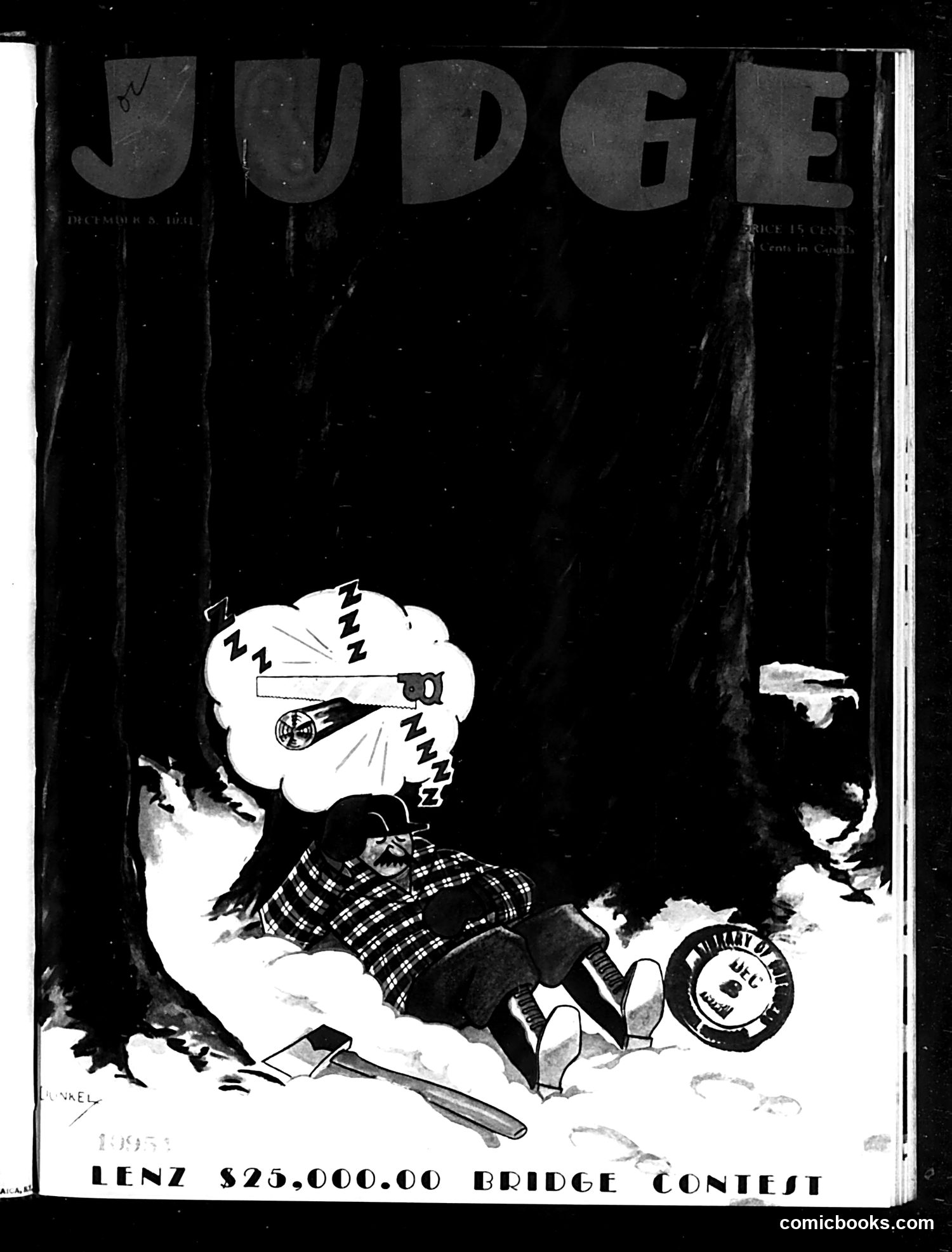
# Political Cartoon Analysis This Judge magazine cover satirizes the "Lenz $25,000.00 Bridge Contest," likely referencing a real competition or proposal from the early 20th century. The cartoon depicts a sleeping figure in a plaid shirt lying in snow, dreaming of a telescope or surveying instrument (shown in a thought bubble with "Z"s indicating sleep). The figure appears to be a bridge engineer or contestant, humorously suggesting that designing or winning this bridge contest requires both technical skill and perhaps some luck or wishful thinking. The snowy setting and sleeping pose may mock the impracticality or difficulty of the contest itself. The circular seal on the lower right is partially visible but unclear. The satire likely criticizes the contest's terms, feasibility, or the dreamlike optimism of participants.
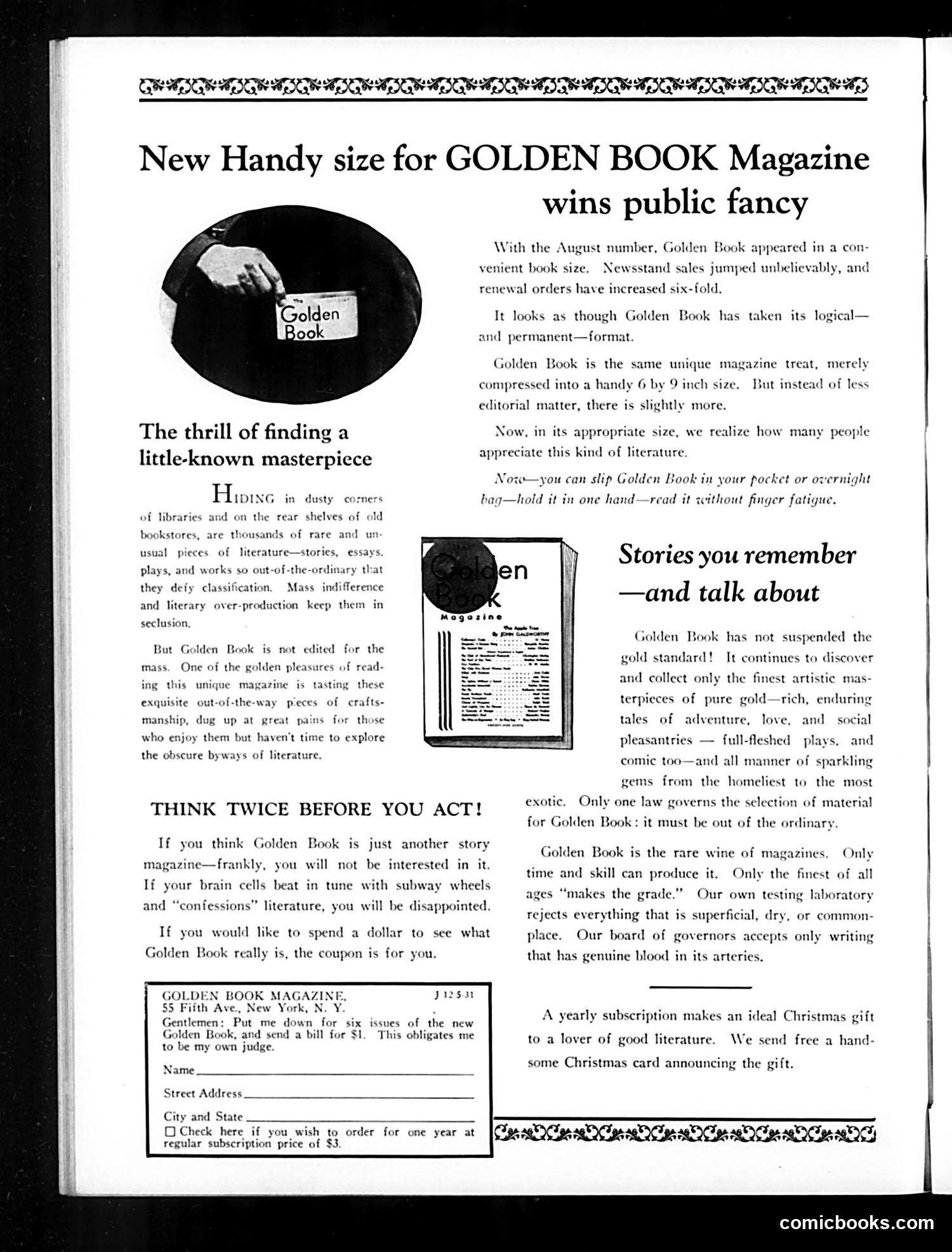
# Analysis This page is primarily **advertising copy**, not political satire. It promotes Golden Book Magazine's new handy 6-by-9-inch format, launched in their August issue. The advertisement uses marketing language typical of early 20th-century literary magazines, emphasizing exclusivity and sophistication. It positions Golden Book as curating rare, high-quality literature for educated readers who appreciate obscure works unavailable in mass-market publications. The only visual element is a photograph showing the magazine's new compact size in a hand, plus an image of the magazine's cover. The text's somewhat condescending tone toward "mass indifference" and emphasis on "blood in its arteries" reflects period attitudes about literary elitism—the magazine appeals to those who consider themselves above ordinary readers. This is primarily a subscription solicitation, not editorial commentary.
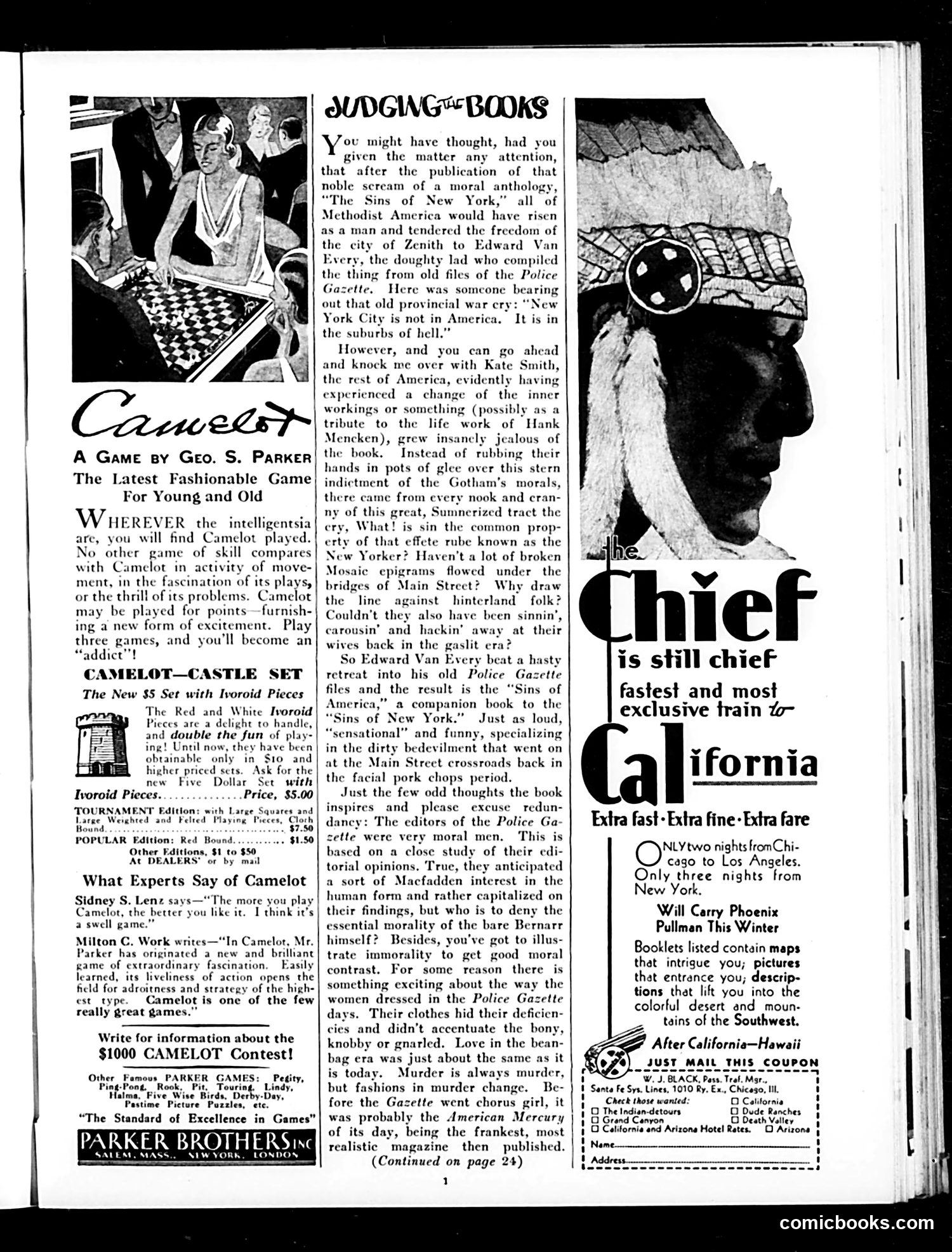
# Analysis of Judge Magazine Page This page is primarily **advertising and book reviews** rather than political satire. The main content includes: 1. **"Camelot" Game Advertisement** - A board game by Geo. S. Parker advertised as fashionable entertainment for "young and old" 2. **"The Sins of New York" Book Review** - The text discusses a moral anthology that apparently criticized New York City's perceived depravity. The review notes that despite the book's stern moral judgments, New York continues unchanged—suggesting satirical commentary on the ineffectiveness of moral crusades against urban vice. 3. **"California" Train Advertisement** - Promoting the fastest train service between Chicago, New York, and Los Angeles The page reflects early 20th-century concerns about urban morality and the emerging consumer culture of games and travel advertising.
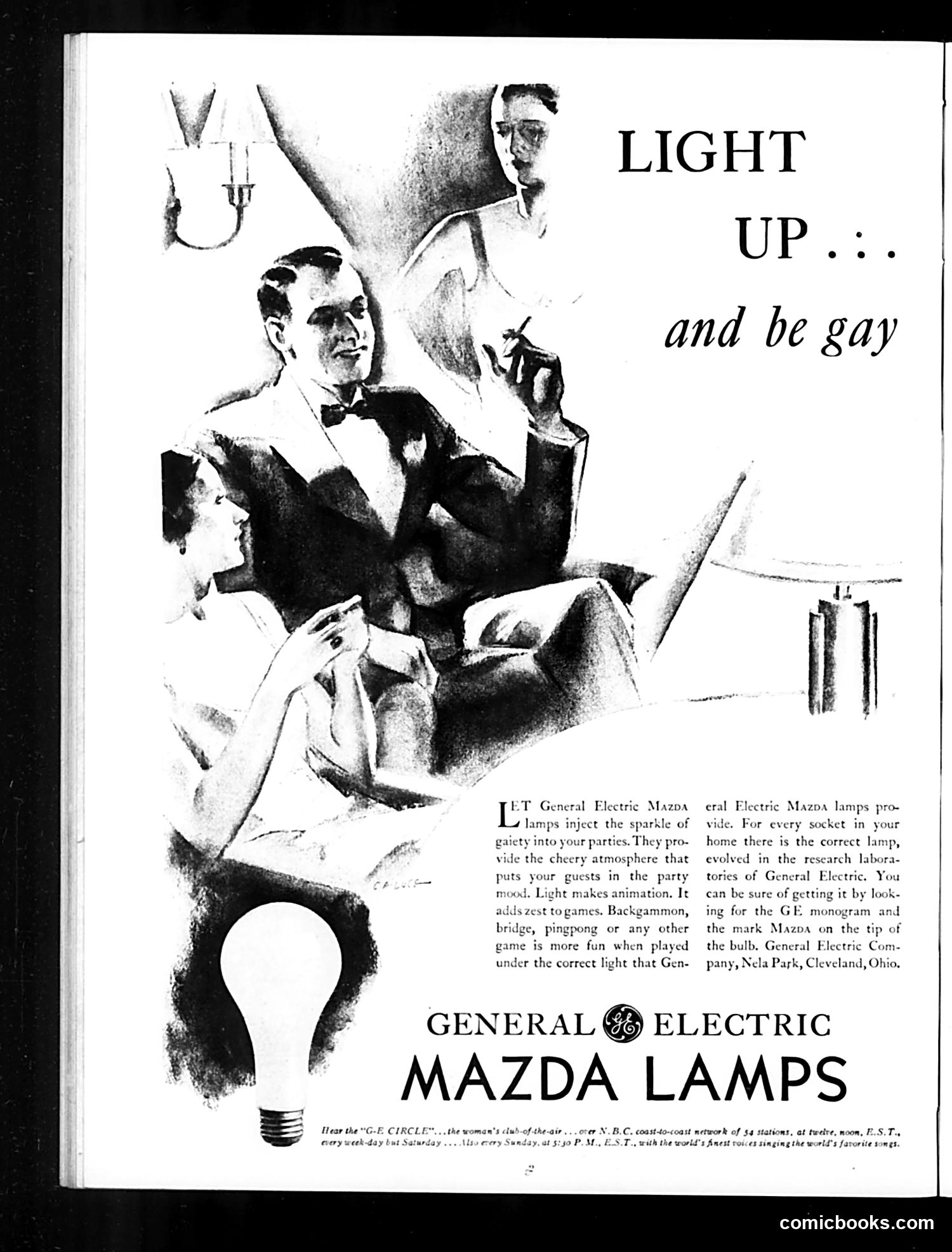
# Analysis This is primarily a **General Electric Mazda Lamps advertisement**, not political satire. The page shows stylized illustrations of well-dressed people at a social gathering, with the tagline "LIGHT UP... and be gay." The ad argues that proper lighting—specifically GE Mazda brand bulbs—enhances home entertainment and party atmospheres. It claims correct lighting makes games like backgammon and bridge "more fun" and creates the right "cherry atmosphere" for socializing. The word "gay" here uses its mid-20th century meaning: cheerful or lighthearted. The advertisement is selling the idea that quality electric lighting improves one's social life and entertaining abilities. This reflects the era's marketing of modern electric home conveniences as essential to successful, pleasant living.
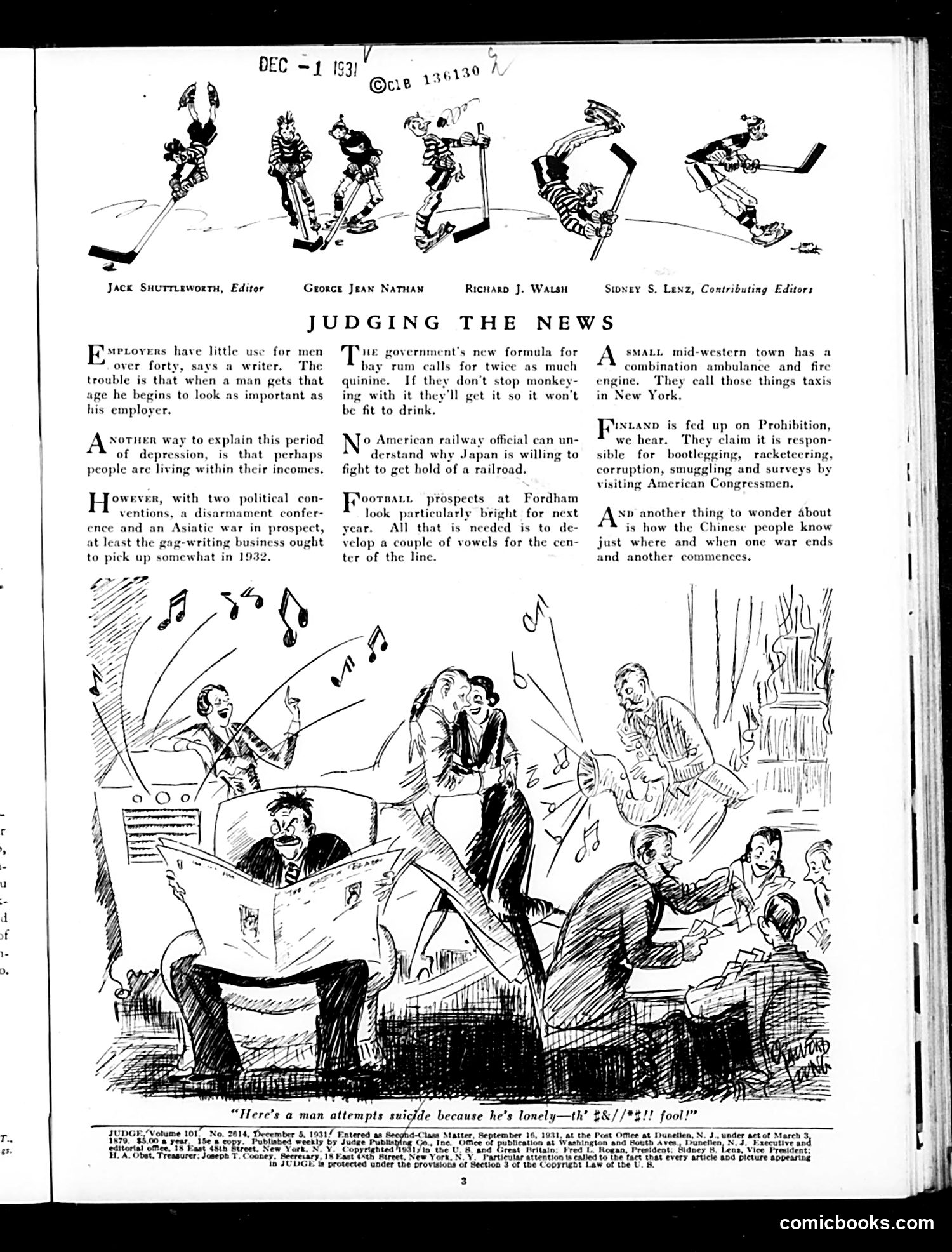
# "Judging the News" - December 1, 1931 This page contains editorial commentary and a main cartoon titled "Here's a man attempts suicide because he's lonely—th' ***'ll fool!!!!" The cartoon satirizes callousness during the Great Depression. A man in a bed (apparently attempting suicide) is surrounded by indifferent or mocking figures—some playing music, others gesturing dismissively. The joke's bitter irony: instead of sympathy for someone driven to despair by loneliness and economic hardship, he receives ridicule. The accompanying text snippets criticize various topics: aging workers facing unemployment, Japanese railway expansion, Prohibition enforcement failures, and Chinese conflict. The satire captures early-1930s cynicism about social problems and public indifference to human suffering during economic crisis.
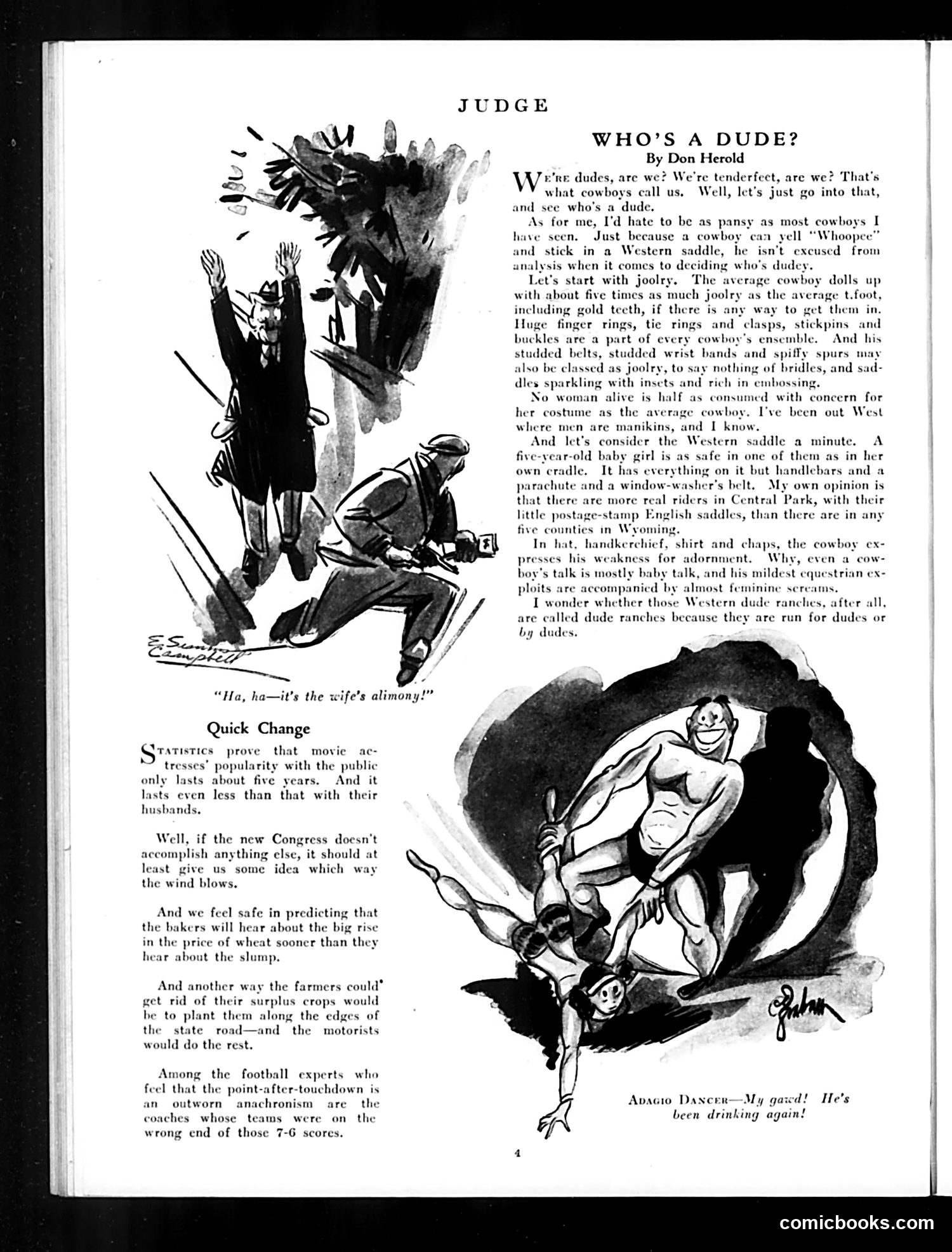
# Analysis of Judge Magazine Page This page contains two distinct pieces: **"Who's a Dude?"** by Don Herold examines cowboy fashion and masculinity. Herold argues that despite their tough image, cowboys are actually quite concerned with appearance—jewelry, studded belts, decorative saddles—and thus qualify as "dudes." The satire mocks the contradiction between cowboys' claimed ruggedness and their actual vanity. The cartoon illustration supports this by depicting an exaggerated, fashionably-dressed cowboy figure. **"Quick Change"** offers brief political commentary on Congress and farming issues, mentioning movie actresses' popularity and predictions about bread prices and surplus crops. The cartoonist's signature appears to read "Yadkin." Overall, the page uses humor to critique masculine pretension and comment on contemporary agricultural and political concerns.
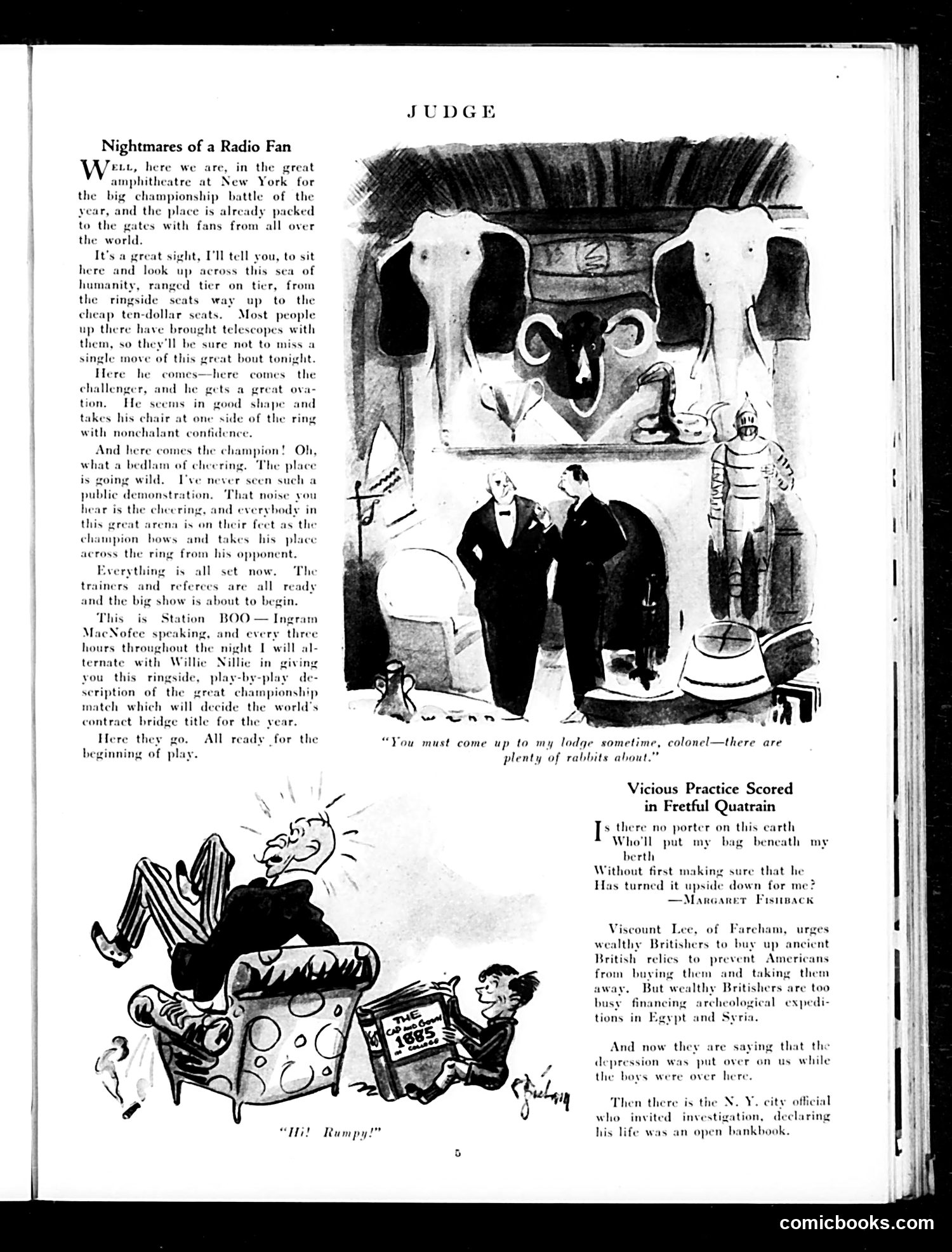
# Analysis of Judge Magazine Page The page contains two distinct pieces: **"Nightmares of a Radio Fan"** depicts the excitement of listening to a championship boxing match broadcast on radio. The main cartoon shows a radio audience experiencing the event vicariously through broadcast commentary. The humor satirizes radio listeners' intense emotional investment in events they cannot physically see—they're dependent entirely on the announcer's description and their imagination to follow the action. **"Vicious Practice Scared in Fretful Quatrain"** includes a Margaret Fishback poem criticizing hotel porters. The accompanying cartoon shows a disheveled figure labeled "1865," likely representing outdated practices or old-fashioned service standards. The lower cartoon ("Hi! Rumpy!") appears to be unrelated comic filler, though its specific reference is unclear without additional context. The satire generally mocks radio culture's novelty and its emotional pull on the public.
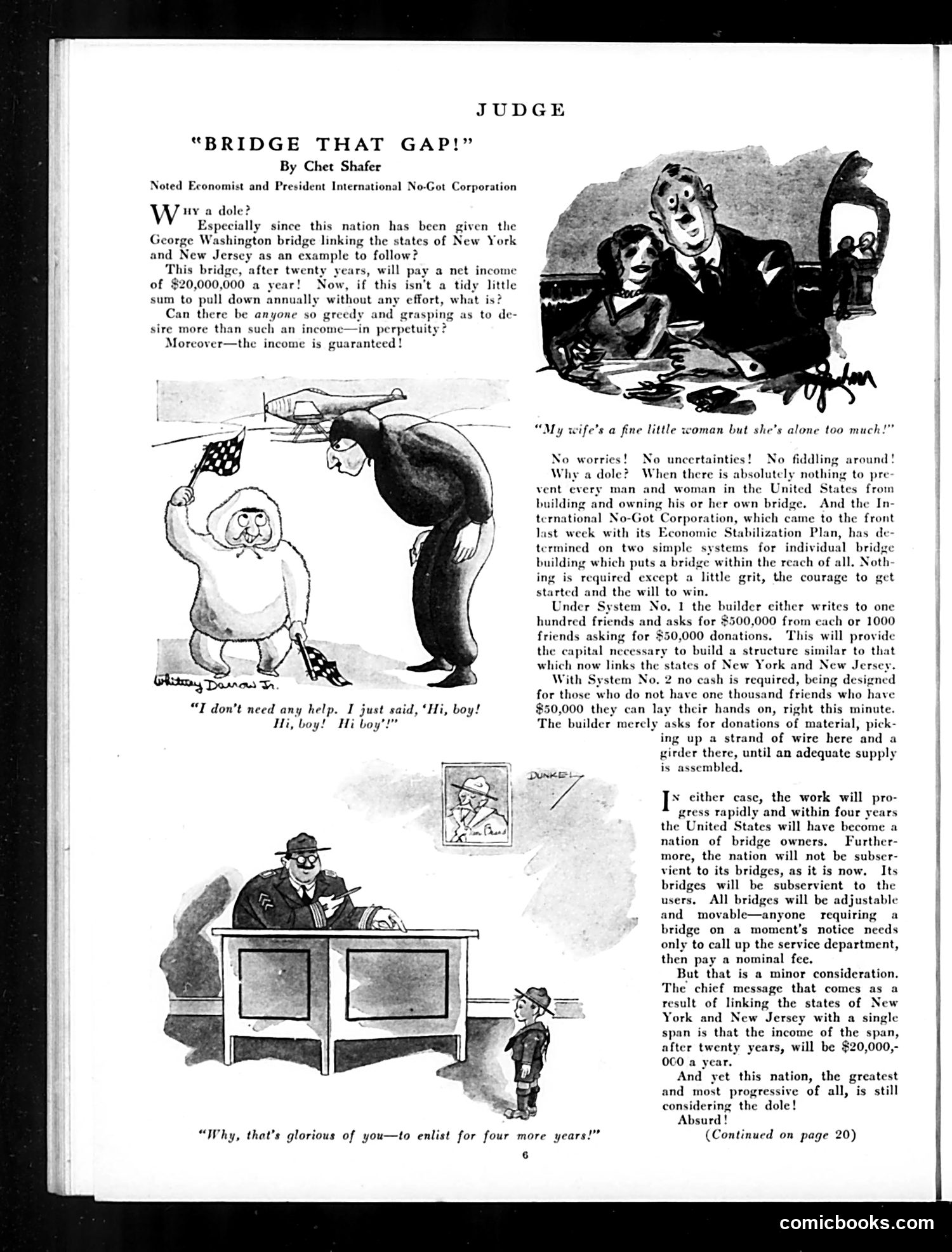
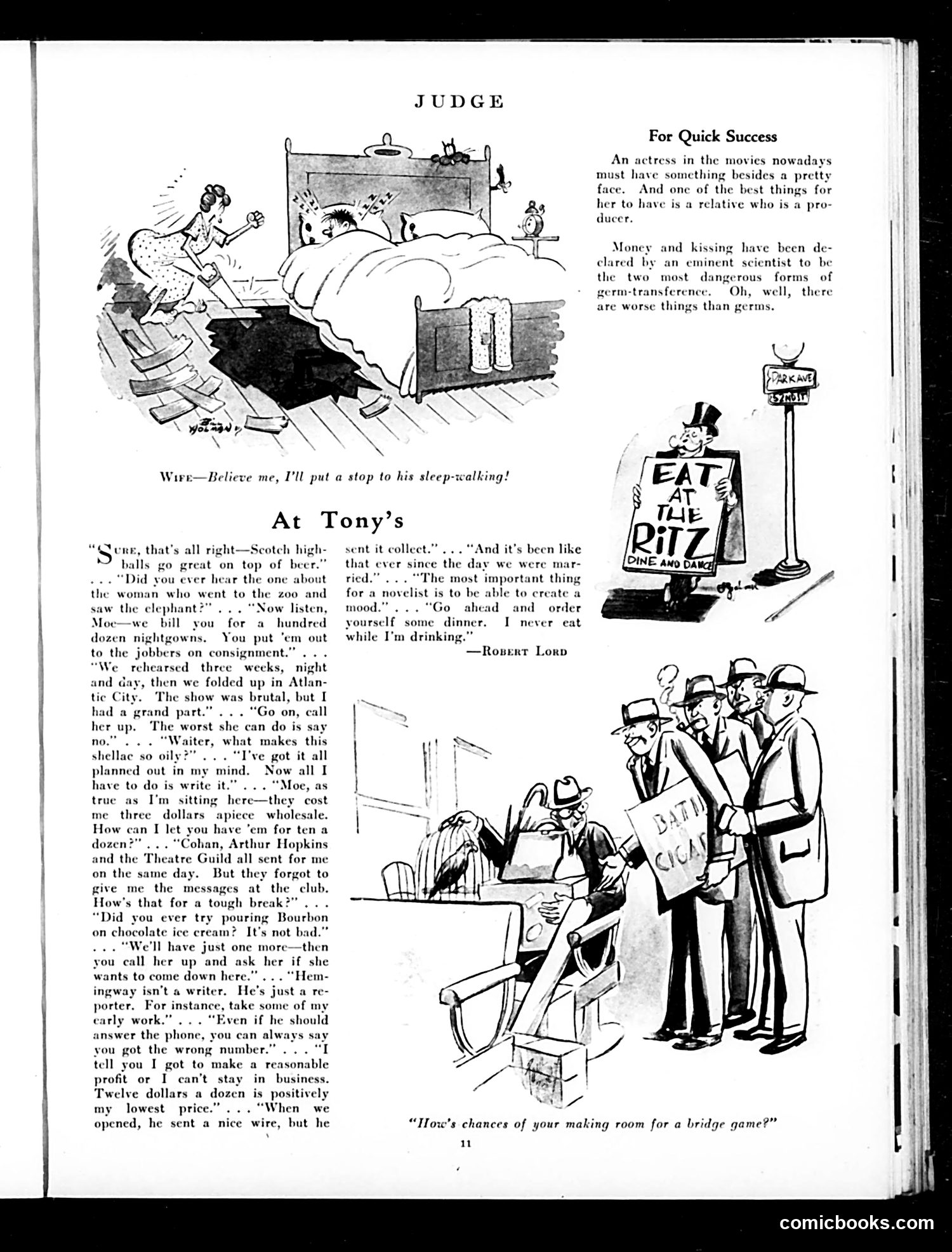
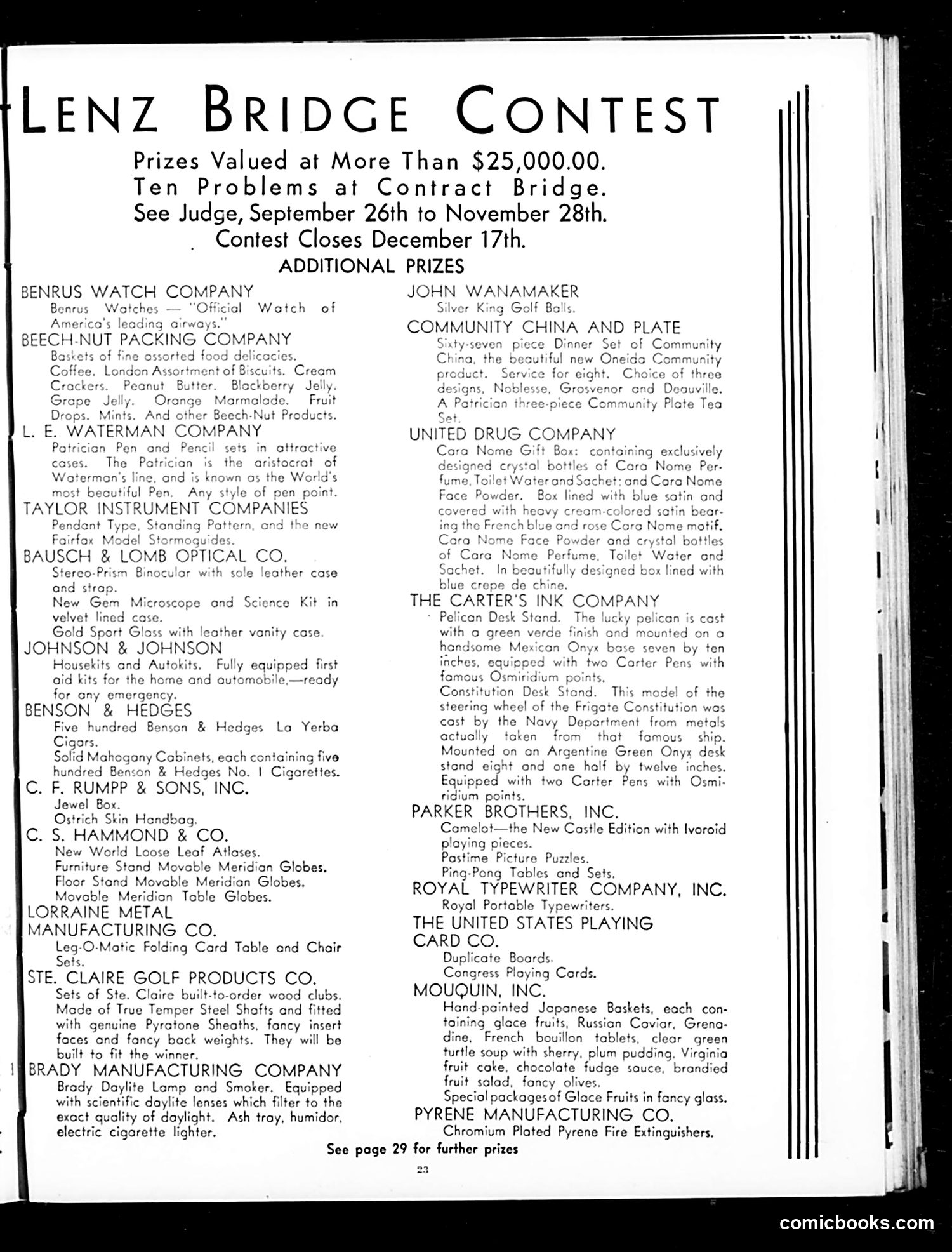
# "Bridge That Gap!" - Judge Magazine Satire This satirical article by Chet Shafer mocks a proposal to make individual bridge-building accessible to ordinary Americans. The cartoon argues that the George Washington Bridge (linking New York and New Jersey) demonstrates bridge-building's profitability—generating $20 million annually. The satire presents two absurd "systems" for democratizing bridge ownership: System No. 1 asks wealthy individuals for donations ($500,000 each), while System No. 2 requires no cash, just voluntary material donations. The accompanying cartoons ridicule this notion—showing an enthusiastic but delusional character claiming he needs no help, and a bureaucratic official questioning someone's enlistment. The piece satirizes both blind optimism about economic opportunity and the impracticality of crowdfunding infrastructure projects.
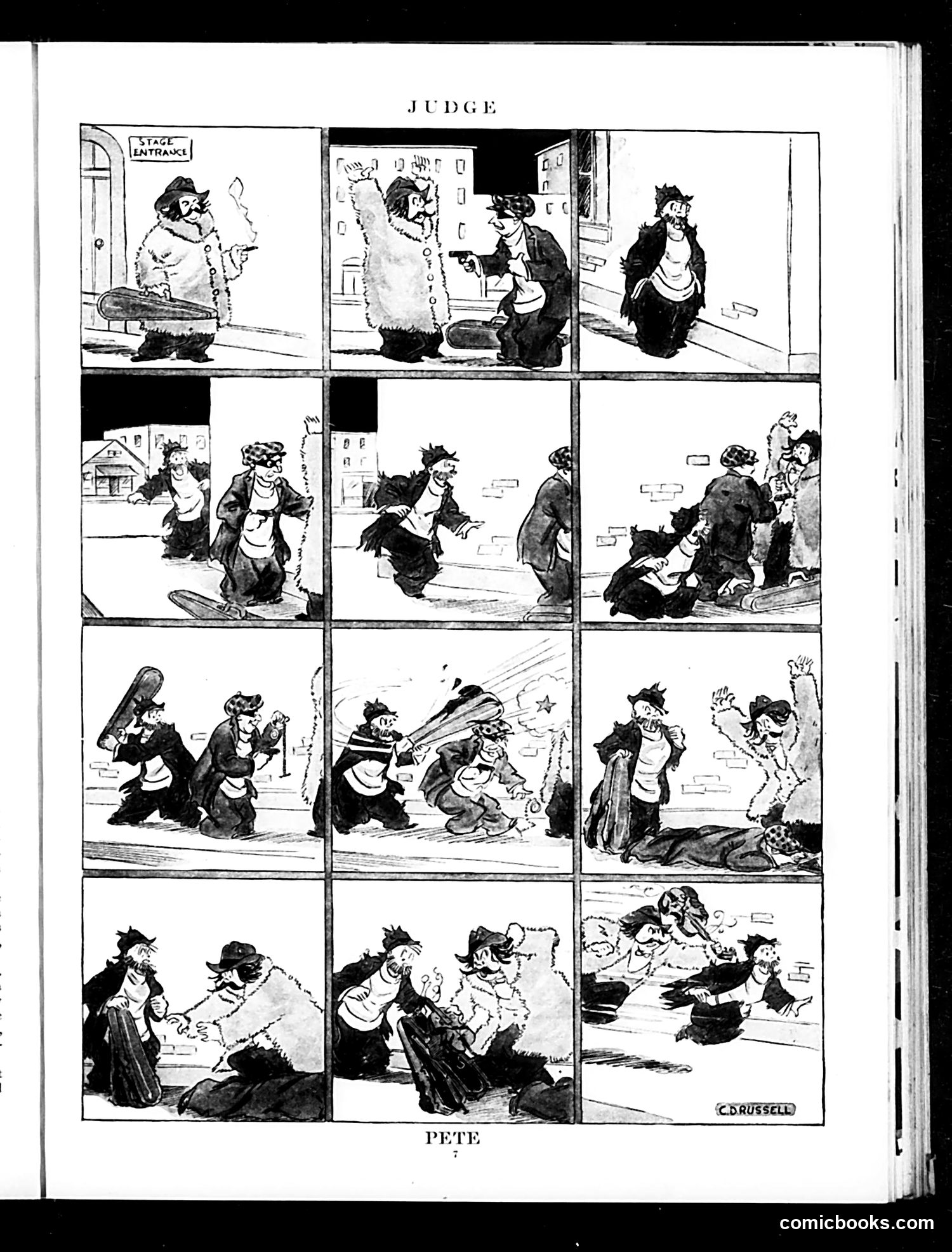
# "Judge Pete" Cartoon Analysis This is a sequential comic strip titled "Judge Pete" by C.D. Russell, appearing in *Judge* magazine. The narrative follows what appears to be a magistrate or judge character through various scenes involving confrontations and chaos on city streets and indoors. The strip satirizes urban police court proceedings and street-level justice, showing the judge character repeatedly engaged in physical altercations and comedic mishaps. The exaggerated, slapstick style typical of early 20th-century American comics suggests the humor derives from the dignified "Judge" figure's undignified involvement in street brawls and disorder. Without clearer OCR text or additional context, the specific political or social commentary remains unclear, though it likely comments on urban law enforcement or judicial authority of its era.
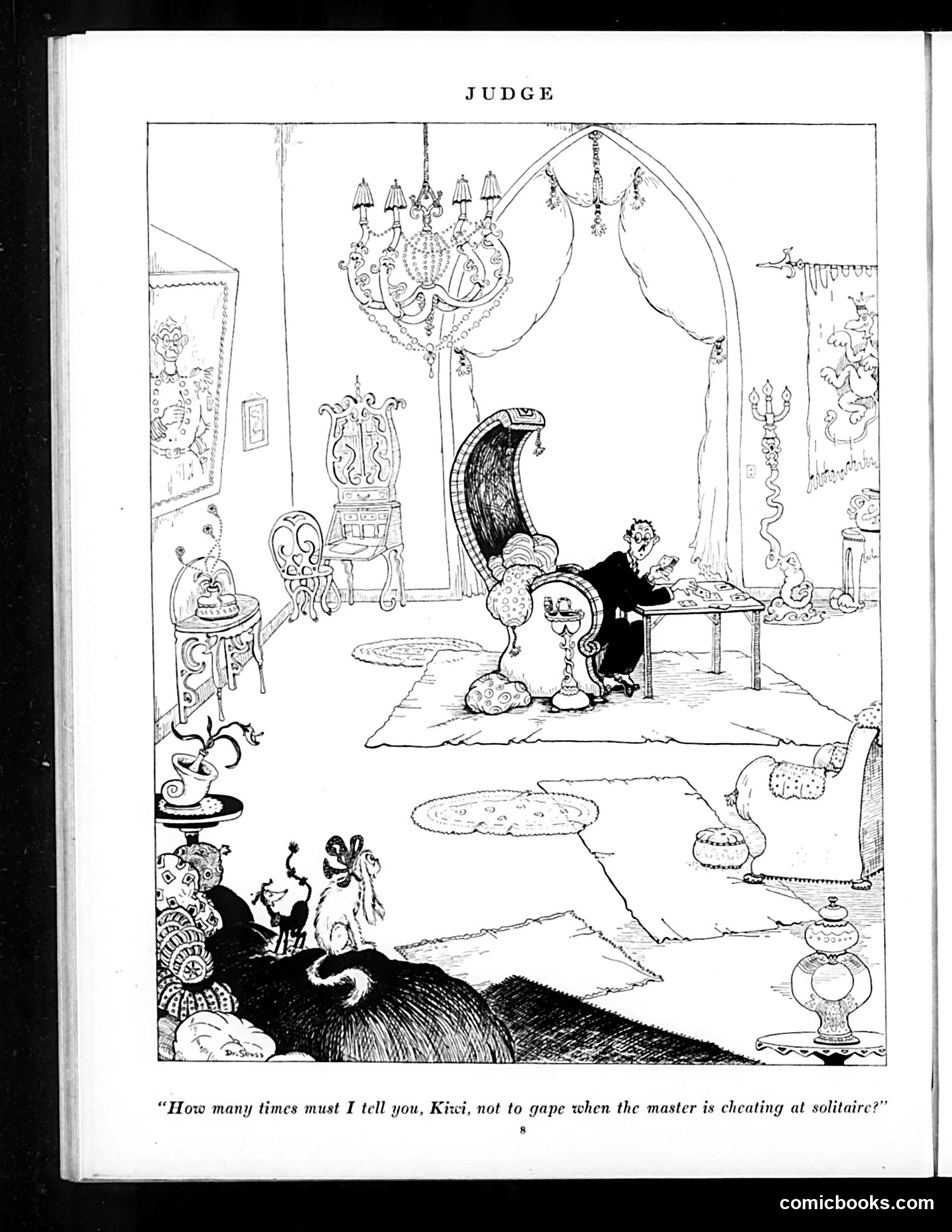
# Analysis This single-panel cartoon satirizes hypocrisy and social pretense among the wealthy. A well-dressed man sits at a table playing solitaire while apparently cheating—manipulating the cards. His pet monkey, "Kiwi," watches openly, prompting the man's indignant rebuke about gaping. The humor works on multiple levels: the master criticizes the animal for witnessing his dishonesty while engaged in that very dishonesty; he's concerned with *appearances* of propriety rather than actual honesty. The ornate, luxurious interior setting (chandelier, decorative furnishings) emphasizes that this is someone of means and social standing, making the petty cheating at a solitary card game even more ridiculous. The cartoon mocks the pretentiousness of the upper class—their obsession with maintaining a facade of respectability regardless of their actual behavior.
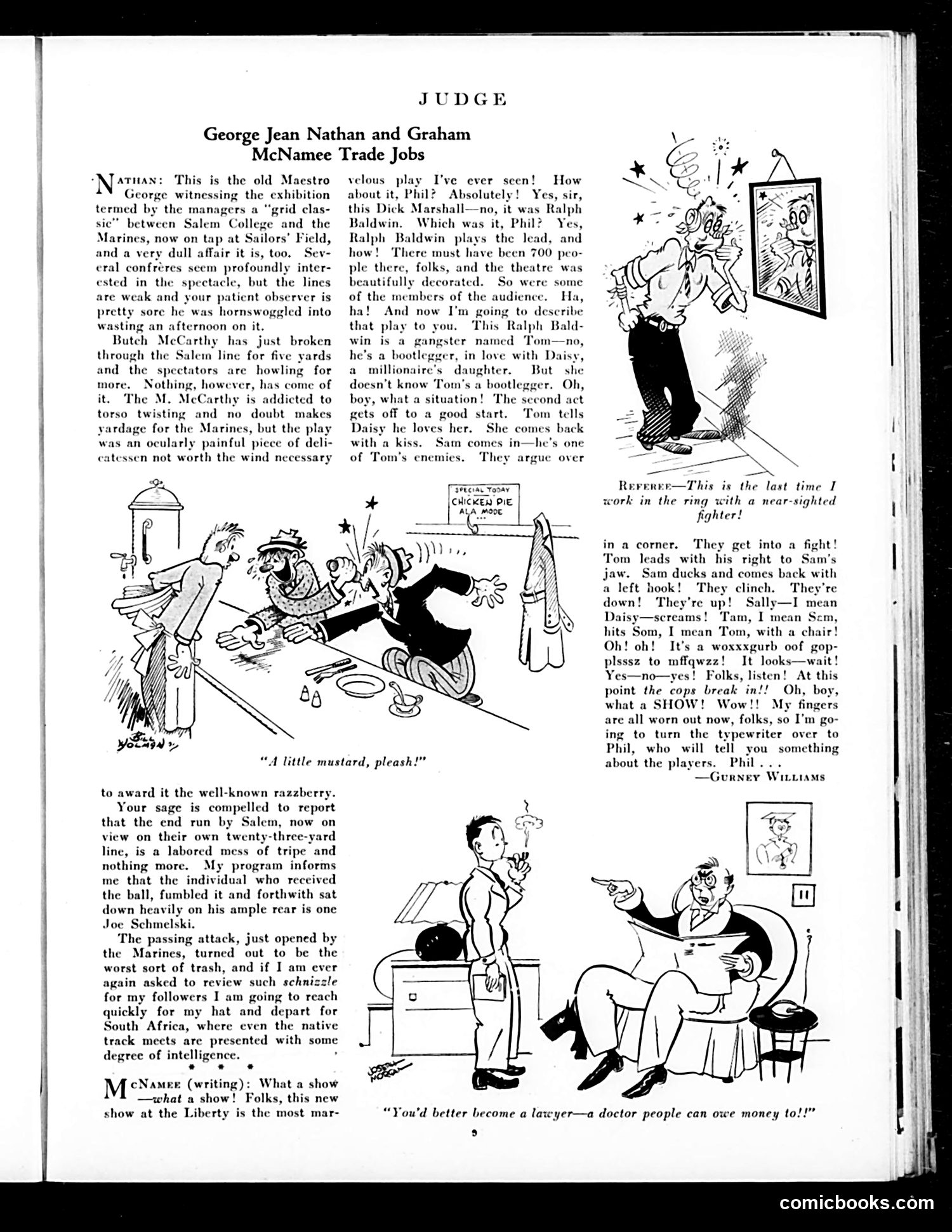
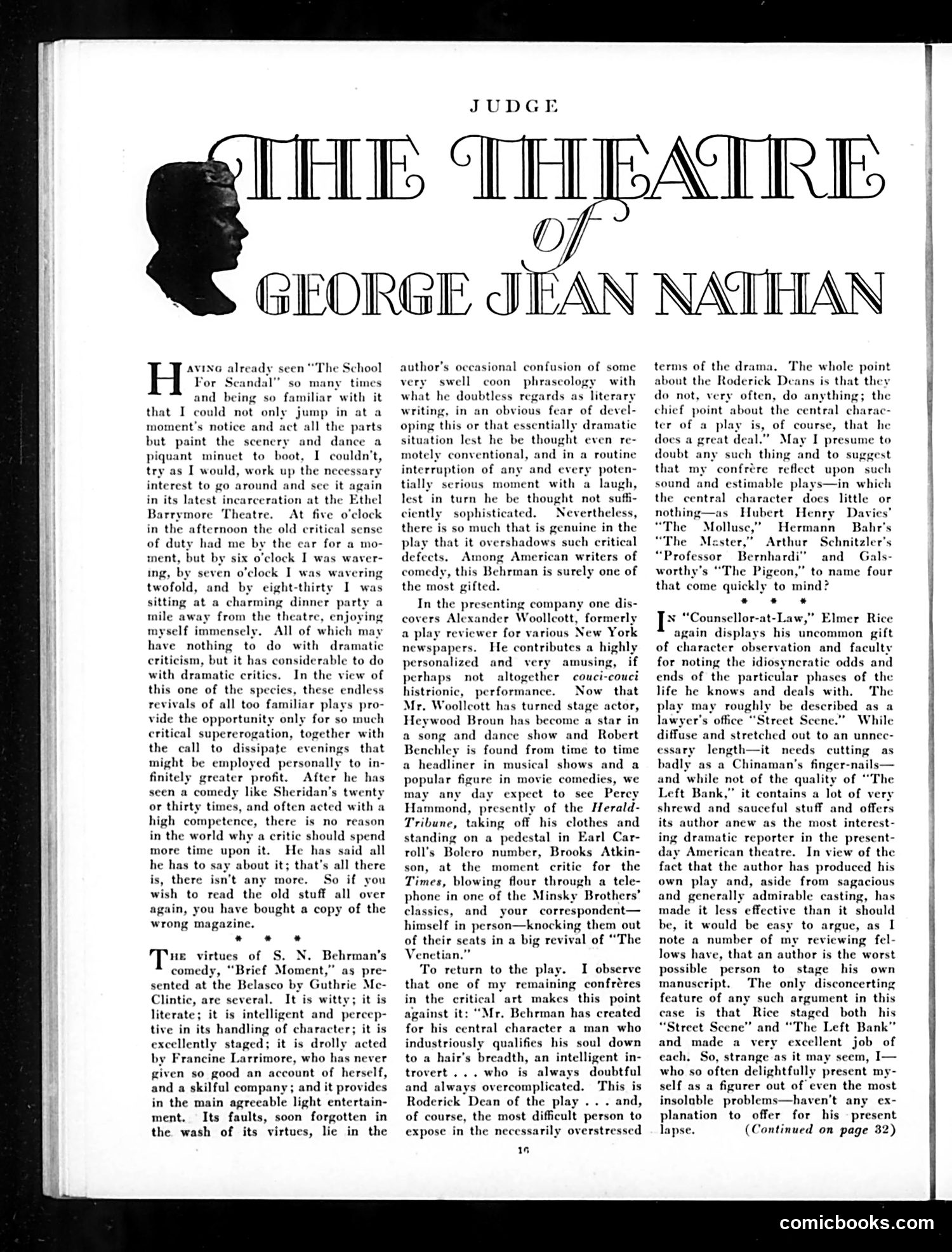
# Analysis of Judge Magazine Page This page satirizes two prominent figures **trading jobs**: George Jean Nathan (theater critic) and Graham McNamee (famous radio sports broadcaster). The top section mocks Nathan covering a boring college football game at Sailors' Field, dismissing the Marines-Salem match as tedious "tripe." The bottom section ridicules McNamee attempting theater criticism, breathlessly describing a melodramatic play with a gangster-bootlegger plot in his characteristic excited radio style—repeating character names incorrectly, losing track of the story, and delivering overwrought play-by-play commentary ("It's a woxxxgurb oof gop-pssz"). The joke: each man is hilariously incompetent outside his specialty. Nathan finds football boring and writes dismissively; McNamee's breathless sports-announcer delivery is absurdly inappropriate for theater, reducing drama to incomprehensible excitement. The cartoons illustrate the chaos of their mismatched assignments—Nathan bored at a game, McNamee overwhelmed and confused at a theatrical event.
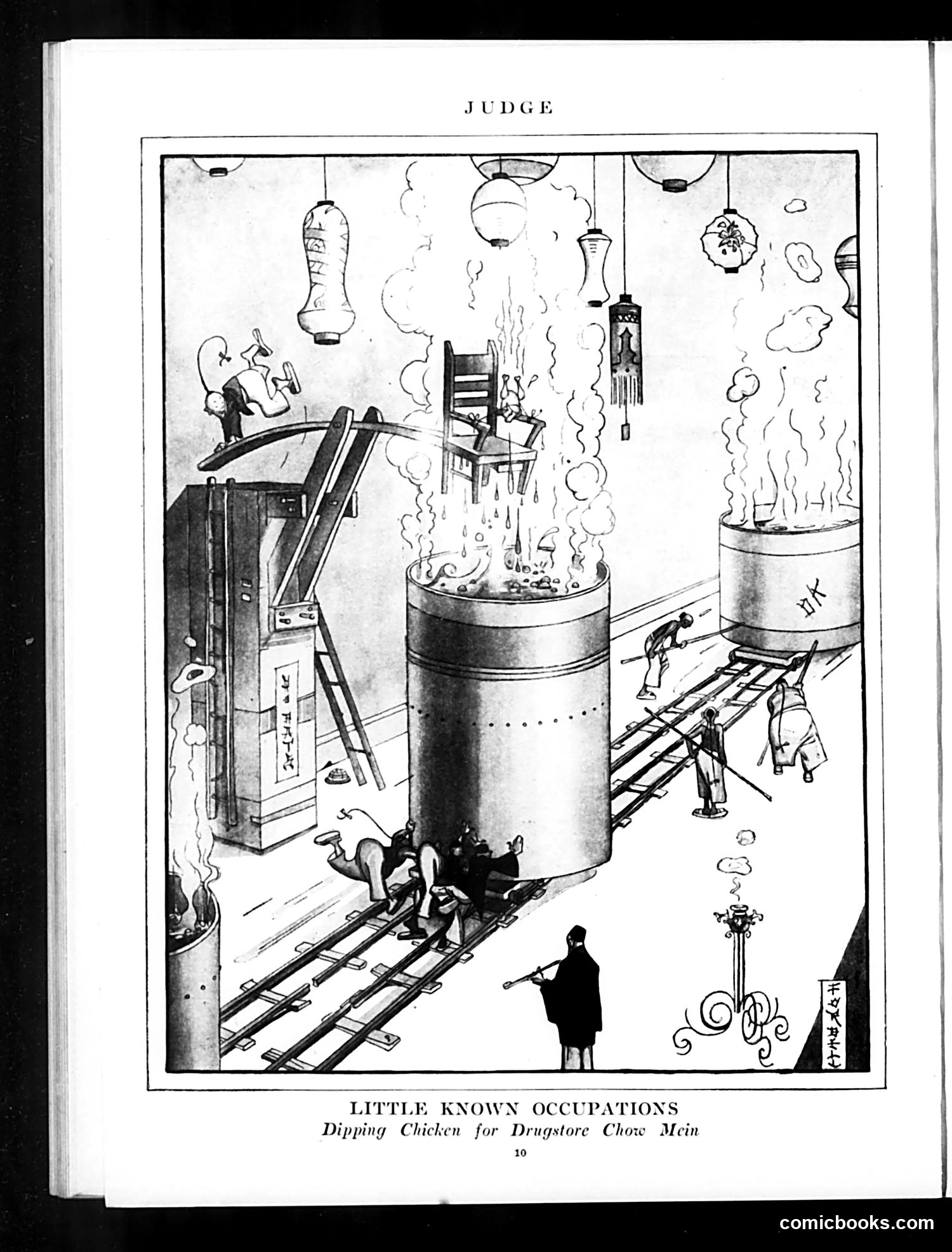
# "Judge" Magazine Cartoon Analysis This is a satirical cartoon mocking Chinese-American restaurant food, specifically chow mein served in drugstores—a common casual dining option in early-to-mid 20th century America. The cartoon depicts an absurdly dangerous industrial operation where workers dip chickens into enormous vats of boiling liquid using factory equipment and rail systems. The exaggeration is the joke: presenting mundane drugstore food preparation as an elaborate, perilous manufacturing process. The title "Little Known Occupations" uses deadpan humor, treating this imaginary job as a legitimate profession worthy of documentation. The cartoon likely reflects both the novelty of Chinese food in American popular culture and contemporary stereotypes about mass-production and questionable food quality in casual eateries. The style and content suggest this dates from the early-to-mid 20th century, when such casual ethnic food mockery was standard magazine fare.