
Judge, 1931-12-05 · page 13 of 36
Judge — December 5, 1931 — page 13: what you’re looking at
What you’re looking at
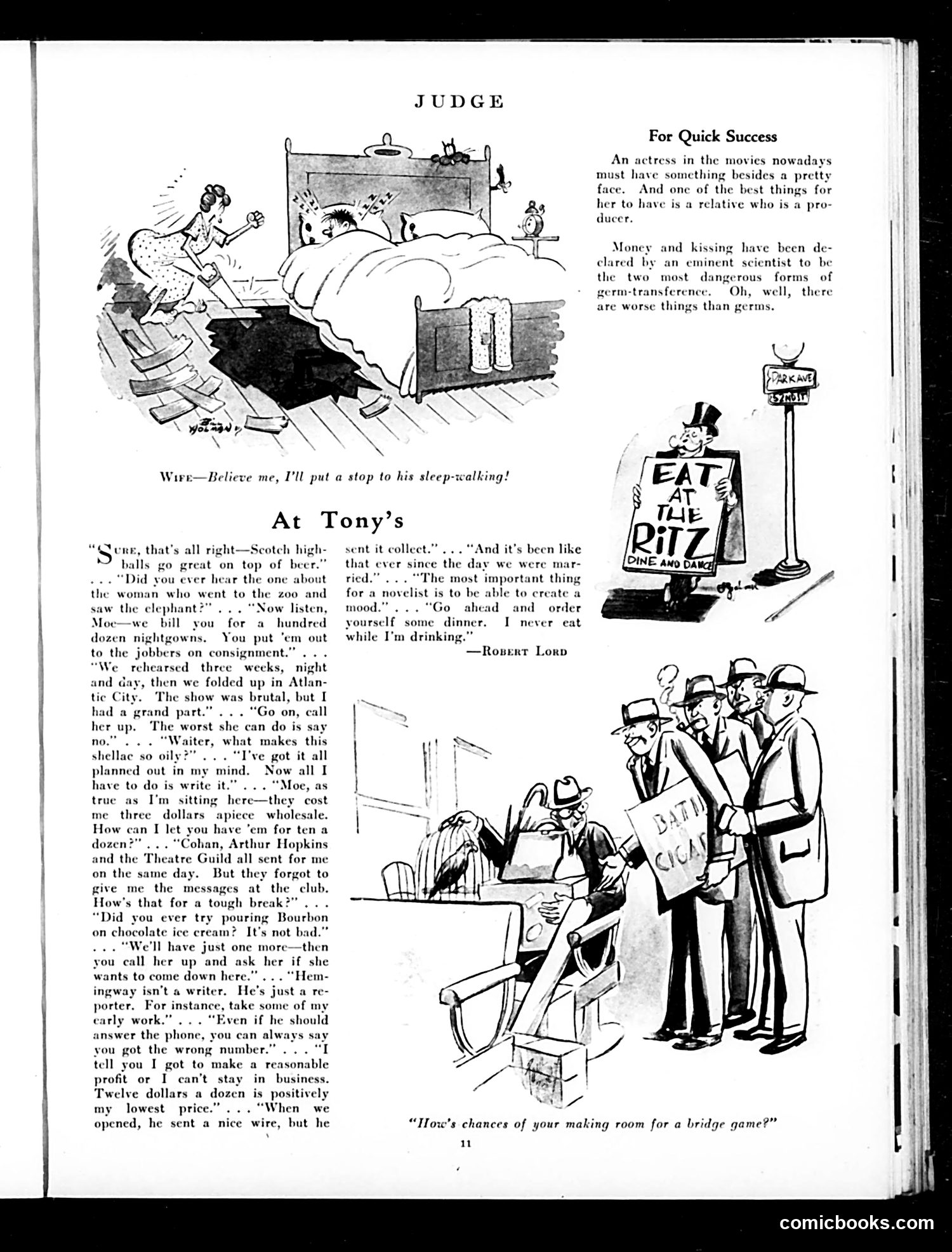
# Judge Magazine Page Analysis This page contains satirical content targeting early 20th-century entertainment and social circles. **Top cartoon**: A wife threatens to stop her husband's sleepwalking, depicted as he wanders near a bedroom. The joke plays on marital anxiety about nighttime behavior. **"At Tony's" section**: A lengthy monologue (credited to Robert Lord) reproduces overheard bar conversations—likely at a real establishment frequented by theater people and writers. The satirized figures include Broadway producers, playwrights (Cohan, Hopkins, possibly Hemingway), and business people. Topics mock: theatrical gossip, failed productions, wholesale pricing disputes, romantic complications, and artistic pretension. The humor targets how these men drink, boast, complain, and rationalize business dealings and infidelity. **Right-side advertisements/cartoons**: Include a Ritz restaurant advertisement and a cartoon about crowded apartments, poking fun at urban living constraints. **Sidebars**: Brief satirical notes about actresses needing producer relatives for success, and scientific claims about money and kissing spreading germs. The overall tone satirizes male entertainment-industry culture through exaggerated dialogue and social commentary.
📄 Transcribed text from this page (OCR, searchable)
Machine-transcribed from the original scan — historical spelling and the odd misread are preserved.
Wire—Believe me, I’ll put a stop to his sleep-walking! At Tony’s “Sere. that’s all right—Scoteh h alls go great on top of beer.” ... “Did you ever hear the one about the woman who went to the zoo and saw the elephant?” . .. “Now listen, Moe—we bill you for a hundred dozen nightgowns. You put ‘em out to the jobbers on consignment.” . . . “We rehearsed three weeks, night » then we folded up in Atlan- The show was brutal, but I had a grand part.” . . . “Go on, call her up. The worst she can do is say Vaiter, what makes this so oily?” ... “I've got it all planned out in my mind. Now all I ve to do is write it. . “Moe, as true as I'm sitting here—they cost me three dollars apiece wholesale. How can I let you have ‘em for ten a dozen?” .,. “Cohan, Arthur Hopkins and the Theatre Guild all sent for me on the same day. But they forgot to give me the messages at the club. How's that for a tough break?” ... “Did you ever try pouring Bourbon on chocolate ice cream? It’s not bad.” ... “We'll have just one more—then you call her up and ask her if she wants to come down here.” . . . “Hem- ingway isn't a writer. He’s just a re- porter. For instance, take some of my early work.” ... “Even if he should answer the phone, you can always say you got the wrong number.” . . . “I tell you I got to make a reasonable profit or I can't stay in business. Twelve dollars a dozen is positively my lowest price.” ... “When we opened, he sent a nice wire, but he sent it collect.” ... And it’s been like that ever since the day we were mar- ried.” ... “The most important thing for a novelist is to be able to create a mood.” ... “Go ahead and order yourself some dinner. I never eat while I'm drinking.” —Rosert Lorp For Quick Success An actress in the movies nowadays must have something besides a pretty face. And onc of the best things for her to have is a relative who is a pro- ducer. Money and kissing have been de- clared by an eminent scientist to be the two most dangerous forms of germ-transference. Oh, well, there are worse things than germs. “How's chances of your making room for a bridge game?” i comicbooks.com