
Judge, 1931-12-05 · page 15 of 36
Judge — December 5, 1931 — page 15: what you’re looking at
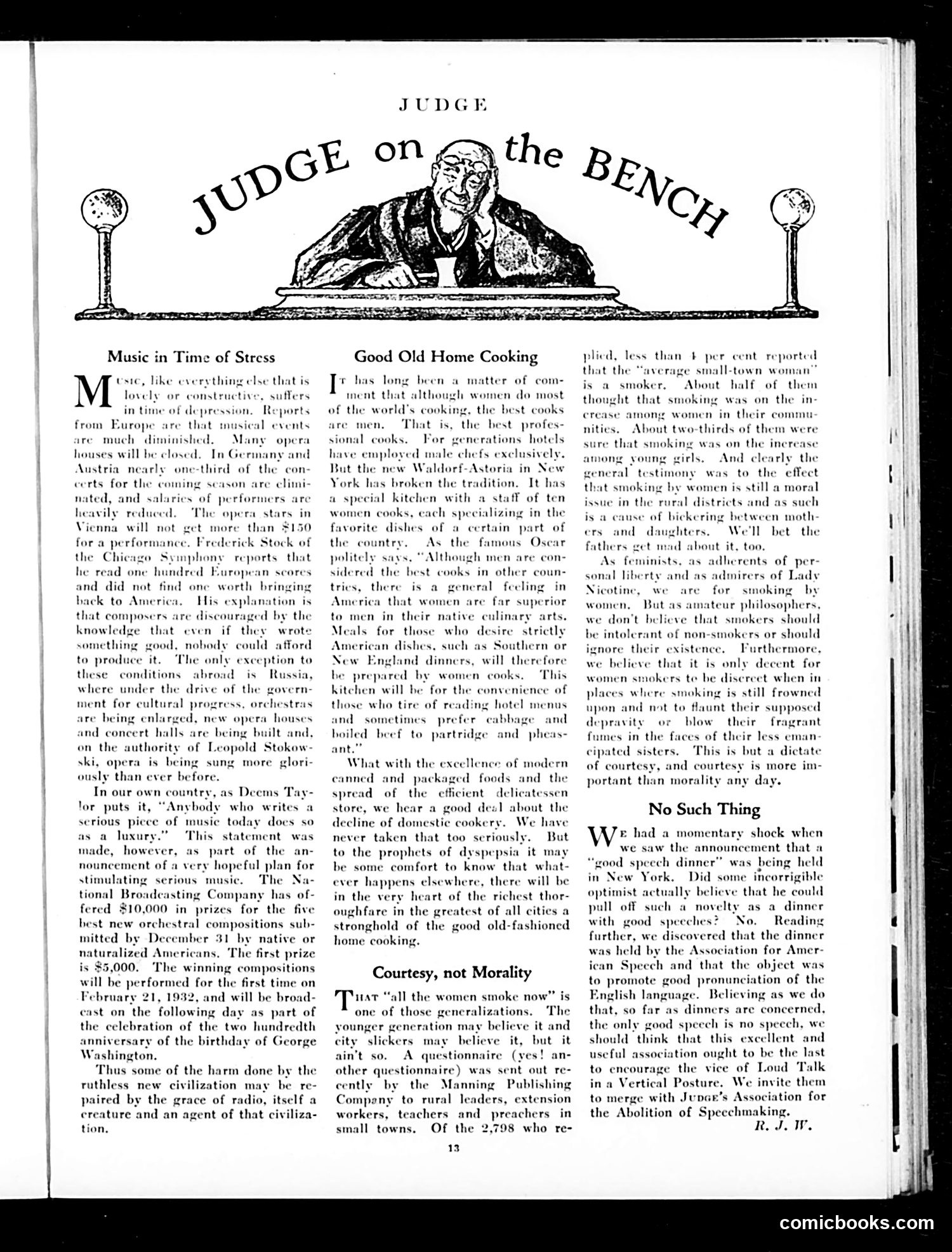
A restored page from Judge, 1931-12-05. Page through the whole issue in the reader above.
📄 Transcribed text from this page (OCR, searchable)
Machine-transcribed from the original scan — historical spelling and the odd misread are preserved.
JUDG Music in Time of Stress uste, like everything else that is lovely or constructive, suffers in time of depression. Reports from Europe are that musical events ire much diminished. Many opera In Germany and third of the con- season sre climi- houses will be close Austria nearly one certs for the comir nated, and salaries of performers are heavily reduced. ‘The opera stars in Vienna will not get more tl 3150 for a performance. Frederick Stock of the Chicago Symphony reports that he read one hundred European scores and did not find one worth bringing hack to America, His explanation is that composers are discouraged by the knowledge that even if they wrote something good, nobody could afford to produce it. The only exception to these conditions abroad is Russia, where under the drive of the govern- ment for cultural progress, orchestras are | ing enlarged, new ind concert halls are being built 1, on the authority of Leopold Stokow- ski, ope ypera houses is being sung more glori- ously than ever befor In our own country, as Deems lor puts it, “Anybody who writes a serious piece of music today does so as a luxury This statement was made, however, as part of the an- nouncement of a very hopeful plan for stimulating serious music. The > tional Broadcasting Company has of- fered $10,000 in prizes for the five best new orchestral compositions sub- mitted by December 31 naturalized Americans, y native or he first p: 5,000. The winning compositions will be performed for the first time on February 21, 1 nd will be broad- cast on the following day as part of the celebration of the two hundredth nniversary of the birthday of George ashington, ‘Thus some of the harm done by the ruthless new civilization may be re- aired by the grace of radio, itself a ture and an agent of that civiliza- tion. Good Old Home Cooking I" has long been a matter of com- trent that although women do most of the world's cooking, the best cooks men, That is, the best: profes- sional cooks. For nerations hotels have employed male chefs exclusively. But the new Waldorf-Astoria in New York has broken the tradition. It has a special kitchen with a staff of ten women cooks, cach specializing in the favorite dishes of : tain part of amous Oscar the country, As politely says." ho men are con sidered the best cooks in other coun- tries, there is a general feeling in America that women are far superior to men in their native culinary arts. Meals for those who desire strictly American dishes, such as Southern or New England dinners, will therefore be prepared by women cooks. ‘This kitchen will be for the nvenience of those who tire of reading hotel menus and sometimes prefer cabbage and boiled beef to partridg ant.” What with the excellence of modern canned and packaged foods and the spread of the efficient delicatessen store, we hear a good desl about the decline of domestic cookery. We have never taken that too seriously, But to the prophets of dyspepsia’ it may be some comfort to know that what- ever happens elsewhere, there will be in the very heart of the richest thor- oughfare in the greatest of all cities a stronghold of the good old-fashioned home cooking. Courtesy, not Morality wat “all the women smoke now” is one of those generalizations. The younger generation may believe it and city slickers may believe it, but it ain't so. A questionnaire (yes! an- other questionnaire) was s nt out re- cently by the Manning Publishing Company to rural leaders, extension workers, teachers and preachers small towns. Of the 2,798 who re- 13 plied, le that the is a sme than # per cent reported “average small-town woman” er. About half of them thought that smoking was on the in erease umnong women in their commu nities. About two-thirds of them were that smoking was on the increase rls, And clearly the general testimony was to the effect that smoking by women is still a me among your issue in the rural districts and as such is a cause of bickering between moth ers and daughters. We'll bet’ the fathers get mad about it, too. As feminists. as adherents of per- sonal liberty and as adinirers of Lady Nicotine, we are for smoking by women, But as amateur philosophers, we don't believe that smokers should be intolerant of non-smokers or should ignore their existence, Furthermore, we believe that it is only decent for women smokers te be discreet when in places where smoking is still frowned upon and not to flaunt their supposed depravity blow their fragrant fumes in the faces of their less eman cipated sisters. ‘This is but a dictate of courtesy, and courtesy is more im- portant than morality any day. No Such Thing WE had a momentary shock when we saw the announcement that a rood speech dinner” was being held in New York. Did some incorrigible optimist actually believe that he could pull off such a novelty as a dinner with good speeches? No. Readi further, we discovered that the dinner was held by the Association for Amer- ican Speech and that the object was to promote good pronunciation of the Believing as we do that, so far as dinners are concerned, the only good speech is no speech, we should think that this excellent and useful association ought to be the last to encourage the vice of Loud Talk in a Vertical Posture. We invite them to merge with Jupar’s Association for the Abolition of Specchmaking. RJ. comicbooks.com