
Judge, 1931-12-05 · page 8 of 36
Judge — December 5, 1931 — page 8: what you’re looking at
What you’re looking at
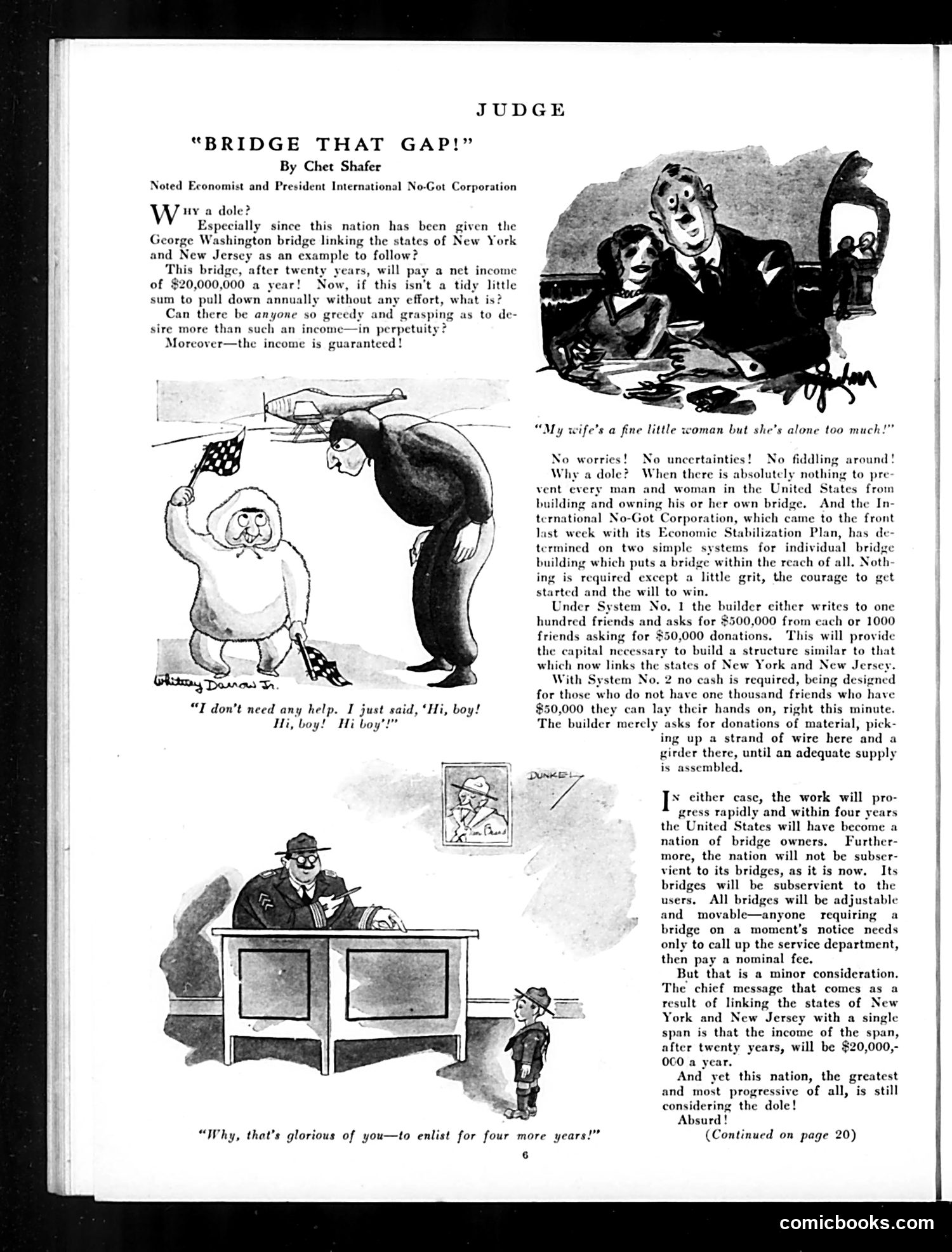
# "Bridge That Gap!" - Judge Magazine Satire This satirical article by Chet Shafer mocks a proposal to make individual bridge-building accessible to ordinary Americans. The cartoon argues that the George Washington Bridge (linking New York and New Jersey) demonstrates bridge-building's profitability—generating $20 million annually. The satire presents two absurd "systems" for democratizing bridge ownership: System No. 1 asks wealthy individuals for donations ($500,000 each), while System No. 2 requires no cash, just voluntary material donations. The accompanying cartoons ridicule this notion—showing an enthusiastic but delusional character claiming he needs no help, and a bureaucratic official questioning someone's enlistment. The piece satirizes both blind optimism about economic opportunity and the impracticality of crowdfunding infrastructure projects.
📄 Transcribed text from this page (OCR, searchable)
Machine-transcribed from the original scan — historical spelling and the odd misread are preserved.
JUDGE “BRIDGE THAT GAP!” By Chet Shafer Noted Economist and President International No-Got Corporation ny a dole? Especially since this nation has been given the George Washington bridge linking the states of New York and New Jersey as an example to follow? This bridge, after twenty years, will y a net income of $20,000,000 a year! Now, if this isn’t a tidy little sum to pull down annually without any effort, what is? Can there be anyone so greedy and grasping as to de- sire more than such an income—in perpetuity? Morcover—the income is guaranteed ! “My wife’s a fine little woman but she’s alone too much!” No worries! No uncertainties! No fiddling around! Why a dole? When there is absolutely nothing to pre vent every man and woman in the United States from building and owning his or her own bridge. And the In- ternational No-Got Corporation, which came to the front last week with its Economic Stabilization Plan, has de- termined on two simple systems for individual bri building which puts a bridge within the reach of all. Noth ing is required except a little grit, the courage to get started and the will to win. Under System No. 1 the builder cither writes to one hundred friends and asks for $500,000 from each or 1000 friends asking for $50,000 donations. This will provide the capital necessary to build a structure similar to that i which now links the states of New York and New Jersey. With System No. 2 no cash is required, being designed for those who do not have one thousand friends who have “T don't need any help. I just said, ‘Hi, boy! $50,000 they can lay their hands on, right this minut Hi, boy! Hi boy’!” The builder merely asks for donations of material, pic ing up a strand of wire here and a j girder there, until an adequate supply is assembled. ] Is either casc, the work will pro- gress rapidly and within four years the United States will have becom nation of bridge owners. Further- more, the nation will not be subser- vient to its bridges, as it is now. Its bridges will be subservient to the | users. All bridges will be adjustable ] and movable—anyone requiring : bridge on a moment's notice needs only to call up the service department, then pay a nominal fee, But that is a minor consideration. The chief message that comes as a result of linking the states of New York and New Jersey with a single span is that the income of the span, after twenty years, will be $20,000,- 0CO a year. And yet this nation, the greatest and most progressive of all, is still considering the dole! Absurd! “Why, that’s glorious of you—to enlist for four more years!” (Continued on page 20) 6 comicbooks.com