
Judge, 1931-12-05 · page 18 of 36
Judge — December 5, 1931 — page 18: what you’re looking at
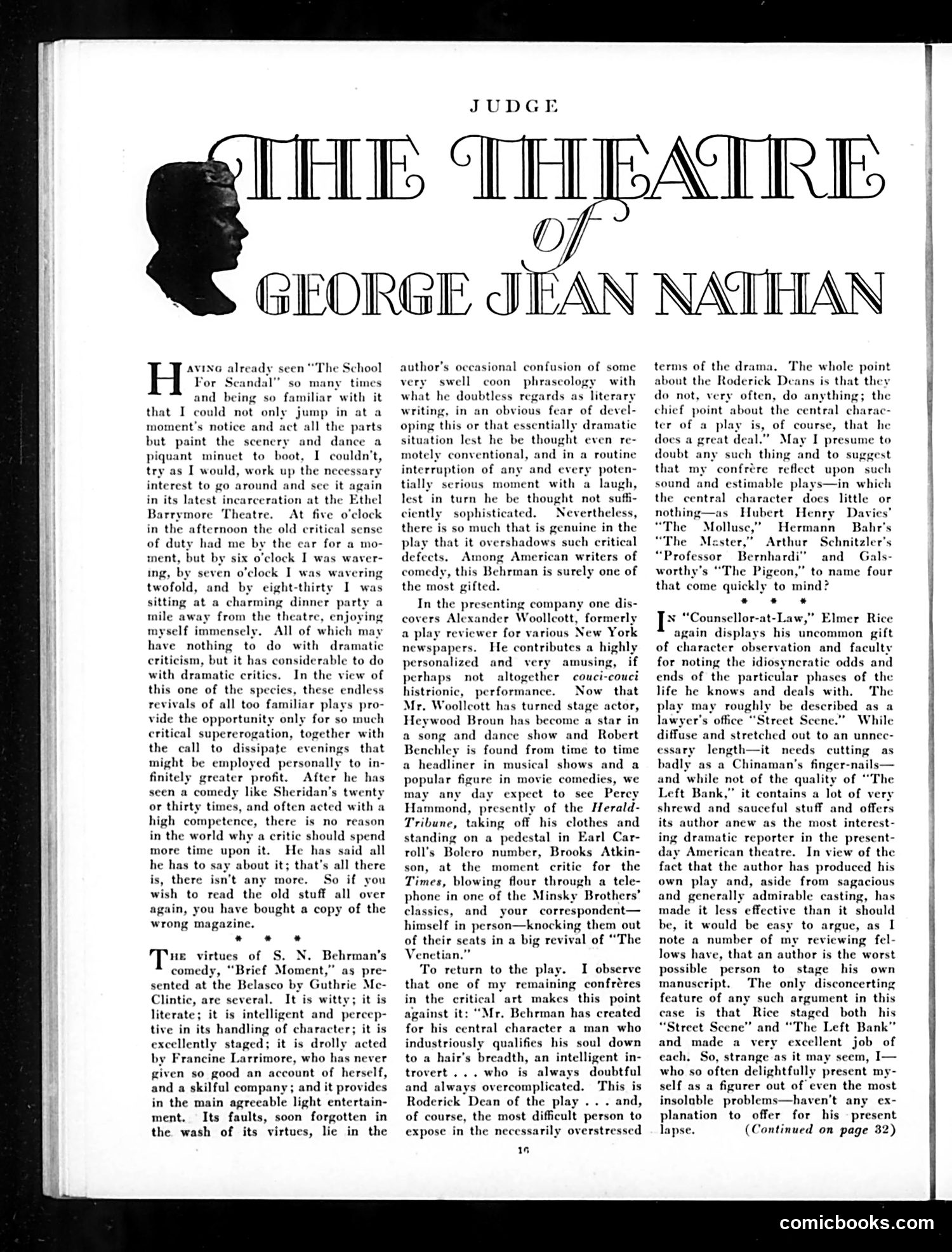
A restored page from Judge, 1931-12-05. Page through the whole issue in the reader above.
📄 Transcribed text from this page (OCR, searchable)
Machine-transcribed from the original scan — historical spelling and the odd misread are preserved.
AVING already seen “The School and being so familiar with it that I could not only jump in at a moment's notice and act all the parts but paint the scenery and dance a piquant minuct to boot, I couldn't, try as I would, work up the necessary interest to go around and see it in its latest incarceration at the Ethel Barrymore Theatre. At five o'clock in the afternoon the old critical sense of duty had me by the ear for a mo- ment, but by six o'clock I waver- ing, by seven o'clock I was wavering twofold, and by eight-thirty I was sitting at a charming dinner party a mile away from the theatre, enjoy myself immensely. All of which may have nothing to do with dramatic cism, but it has considerable to do with dramatic critics. In the view of this one of the spec these endless revivals of all too ar plays pro- vide the opportunity only for so much critical supererogation, together with the call to dissipate evenings that might be employed personally to in- finitely greater profit. After he has seen a comedy like Sheridan's twenty or thirty times, and often acted with a high competence, there is no reason in the world why a critic should spend more time upon it. He has said all he has to say about it; that’s all there is, there isn’t any more. So if you wish to read the old stuff all over again, you have bought a copy of the wrong magazine. * * « ne virtues of S, N. Behrman’s comedy, “Brief Moment,” as pre- sented at the Belasco by Guthr Clintic, are several. It is witty literate; it is intelligent and percep- tive in its handling of character; it is excellently staged; it is drolly acted by Francine Larrimore, who has never given so good an account of herself, and a skilful company; and it provides in the main agreeable light entertain- ment. Its faults, soon forgotten in the wash of its virtues, lie in the JUDGE I GEORGE J 0 author’s occasional confusion of some very swell coon phraseology with what he doubtless regards as literary writing, in an obvious fear of devel- oping this or that essentially dramatic situation lest he be thought even motely conventional, and in a routine interruption of any and every poten- tially serious moment with a laugh, lest in turn he be thought not suffi- ciently sophisticated. | Nevertheless, there is so much that is genuine in the play that it overshadows such critical defects. Among American writers of comedy, this Behrman is surely one of the most gifted. In the presenting company one dis- covers Ale der Woollcott, formerly a play reviewer for various New York newspapers. He contributes a highly personalized and very amusing, if perhaps not altogether couci-couci histrionic, performance. Now that Mr. Woollcott has turned st: actor, Heywood Broun h star in a song and dance show and Robert Benchley is found from time to time a headliner in musica popular figure in movie comedies, we may any day expect to see Percy Hammond, presently of the Herald- Tribune, taking off his clothes and standing on a pedestal in Earl Car- roll's Bolero number, Brooks Atkin- son, at the moment critic for the Times, blowing flour through a tel phone in one of the Minsky Brothers classics, and your correspondent— himself in person—knocking them out of their seats in a big revival of “The Venetian.” To return to the play. I observe that one of my rem: ig confréres in the critical art makes this point against it: “Mr. Behrman has created for his central character a man who industriously qualifies his soul down to a hair's breadth, an intelligent in- trovert... who is always doubtful and always overcomplicated. This is Roderick Dean of the play .. . and, of course, the most difficult person to expose in the necessarily overstressed become ty ACRES NATHAN terms of the drama. The whole point about the Roderick Deans is that they do not, very often, do anything; the chief point about the central charac- ter of a play is, of course, that he does a great deal.” May I presume to doubt any such thing and to suggest that my confrére reflect upon such sound and estimable plays—in which the central character does little or nothing—as Hubert Henry Davies’ Mollusc,” Hermann Mester,” Arth Schni “Professor Bernhard and Gals- worthy’s on,” to name four that come quickly to mind? *“ * * Ik “Counsellor-at-Law,” Elmer Rice again displays his uncommon gift of character observation and faculty for noting the idiosyncratic odds and ends of the particular phases of the life he knows and deals with. The y roughly be described as a 3 office “Street Scene.” While diffuse and stretched out to an unnec- essary length—it needs cutting F Chinaman's finger-nails— and while not of the quality of “The Left Bank,” it contains a lot of very shrewd and sauceful stuff and offers author anew as the most interest- ing dramatic reporter in the present- day American theatre. In view of the fact that the author has produced his own play and, aside from sagacious and generally admirable casting, has made it less effective than it should be, it would be easy to argue, as I note a number of my reviewing fel- lows have, that an author is the worst possible person to stage his own manuscript. The only disconcerting feature of any such argument in this case is that Rice staged both his “Street Scene” and “The Left Bank” and made a very excellent job of cach. So, strange as it may secm, I— who so often delightfully present my- self as a figurer out of even the most insoluble problems—haven’t any ex- planation to offer for his present lapse. (Continued on page 32) —— ‘ comicbooks.com