
Judge, 1931-12-05 · page 34 of 36
Judge — December 5, 1931 — page 34: what you’re looking at
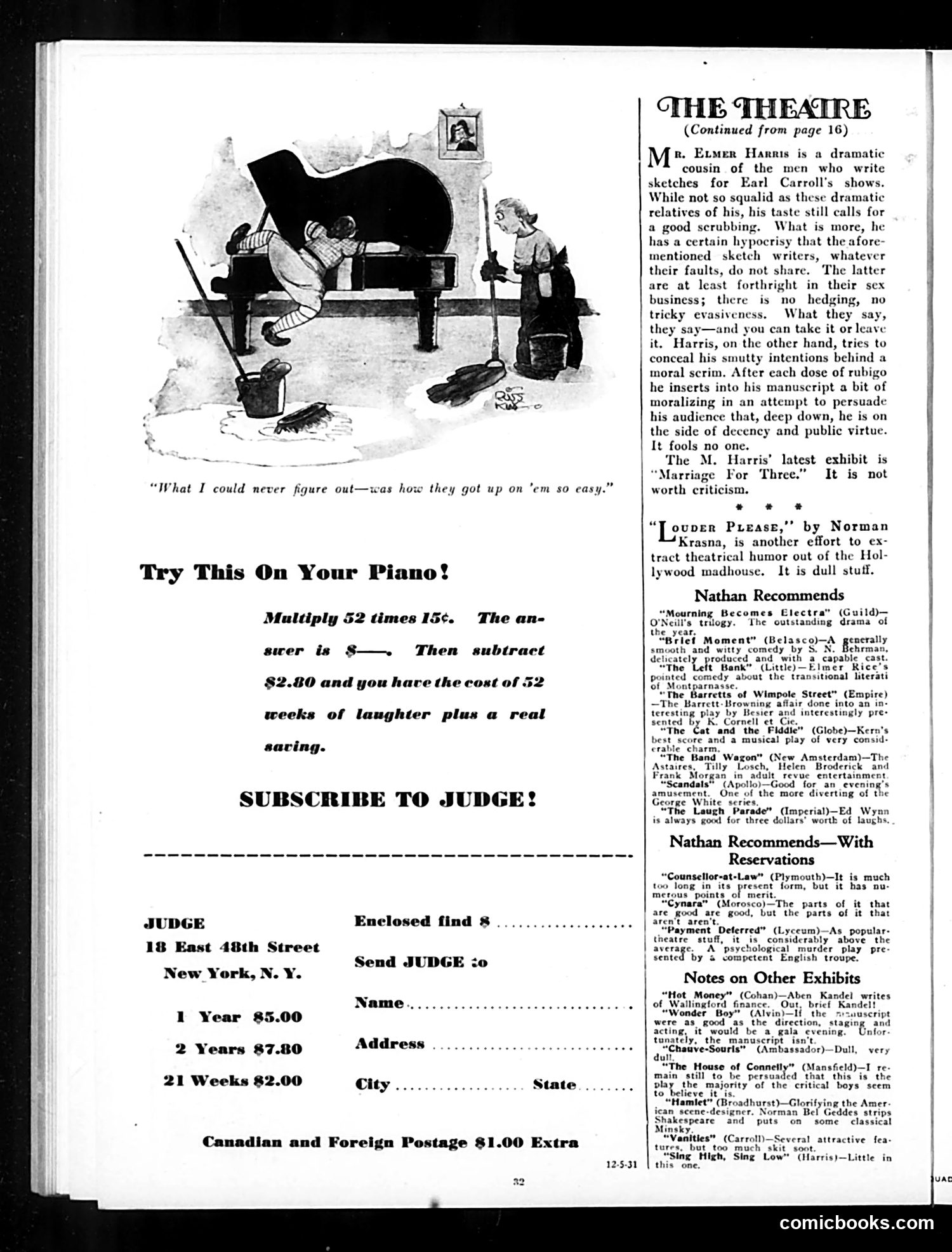
A restored page from Judge, 1931-12-05. Page through the whole issue in the reader above.
📄 Transcribed text from this page (OCR, searchable)
Machine-transcribed from the original scan — historical spelling and the odd misread are preserved.
| Try This On Your Piano! Maltiply 52 times 15¢. The an- swer is S—— Then subtract $2.80 and you hace the cost of 52 weeks of laughter plus a real saving. SUBSCRIBE TO JUDGE 18 East 48th Street JDGE ¢ New York, N. Y. Send: JUDGE to “What I could never figure out—was how they got up on ’em so easy.” JUDGE Enclosed find 8 ......... Name............ oo ; 1 Year 85.00 t 2 Years 87.80 Address ...................... f 21 Weeks $2.00 City ...... vevesecss.. State \ i Canadian and Foreign Postage $1.00 Extra 12-5-31 CTHE THEATRE (Continued from page 16) Evmer Harris a dramatic cousin of the men who write sketches for Earl Carroll's shows. While not so squalid as these dramatic relatives of his, his taste still calls for a good scrubbing. What is more, he has a certain hypocrisy that the afore- mentioned sketch writers, whatever their faults, do not share. The latter are at least forthright in their sex business; there is no hedging, no tricky evasiveness. What they say, they say—and you can take it or leave it. Harris, on the other hand, tries to conceal his smutty intentions behind a moral scrim. After each dose of rubigo he inserts into his manuscript a bit of moralizing in an attempt to persuade his audience that, deep down, he is on the side of decency and public virtue. It fools no one. The M. Harris’ latest exhibit is farriage For Three.” It is not worth criticism. * * # “Lovper Prease,’’ by Norman Xrasna, is another effort to ex- tract theatrical humor out of the Hol- lywood madhouse. It is dull stuff. Nathan Recommends “Mourning Becomes Electra” (Guild)— O'Neill's trilogy. The outstanding drama of the year. “Brief Moment” (Belasco)—A generally smooth and witty comedy by S. N. Behrman, delicately produced and ‘with a capable cast. “The Lelt Bank” (Litte)—Elmer Rice's pointed comedy about the transitional literati of Montparnasse. “The Barretts of Wimpole Street” (Empire) ~The Barrett-Browning affair done into an in- teresting play by ester and interestingly pre- sented by K. Cornell et Ci “The Cat and the Fiddle” (Globe)—Kern's best score and a musical play of very consid- erable charm, “The Band Wagon” (New Amsterdam)—The Astaires, Tilly Losch, Helen Broderick and Frank Morgan in adult. revue entertainment “Scand: (Apollo) —Good for an evening's amusement. One of the more diverting of the George White series. “The Laugh Parade” (Imperial)—Ed Wynn is always good for three dollars’ worth of laughs, Nathan Recommends—With Reservations “Counsellor-at-Law” (Plymouth)—It is much too long in its present form, but it has nu: metous points of merit ra” (Morosco)—The parts of it that re good, but the parts of it that a SPayment ‘Deterred” (Lyceum)—As_ popular- theatre stuff, it is considerably above the average. A ‘psychological murder play pre | sented by & competent English troupe. Notes on Other Exhibits “Hot Money” (Cohan)—Aben Kandel writes of Wallingford finance. brief del! * i the ction, staging and acting, it would be a gala gvening. Untor tunately, the manuscript isn't auignatve-Souris” (Ambassador)—Dull, very ull “The House of Conneily” (Mansfield)—I re- main still to be persuaded that this is the play the majority of the critical boys seem to believe it is. jamlet” (Broadhurst)—Glorifying the Amer- ican scene-designer. Norman Bel Geddes strips SI skespeare and puts on some classical waitles” (Carroll) —Several attractive fea- but too much skit soot. “Sing High, Sing Low” (Harris)— this one. ee comicbooks.com