A complete issue · 40 pages · 1931
Judge — September 26, 1931
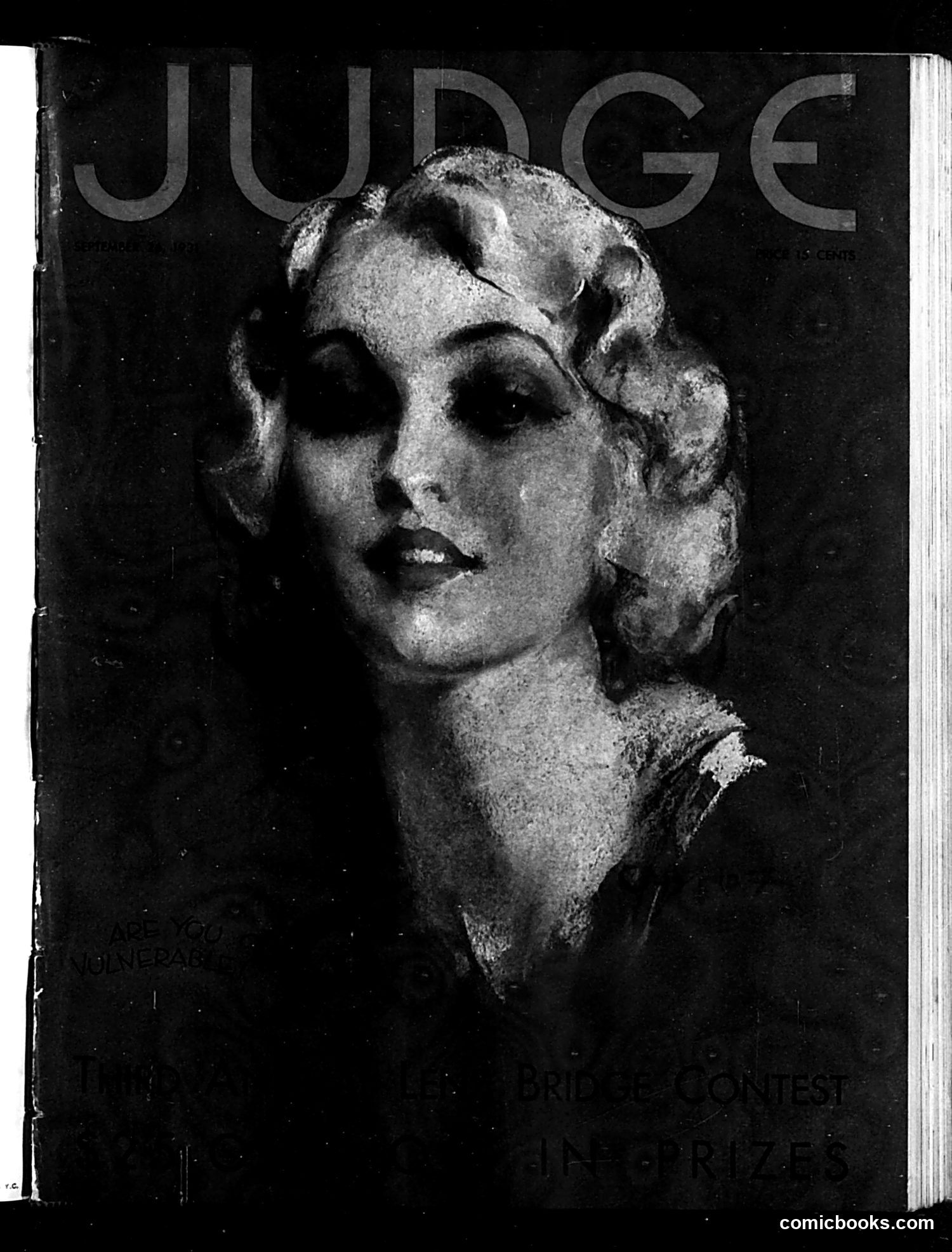
I can see this is a *Judge* magazine cover featuring a black and white portrait photograph of a woman with wavy blonde hair styled in what appears to be 1920s-30s fashion. The word "JUDGE" appears at the top, and there's partial text visible mentioning "CONTEST" and what appears to be "PRIZE" at the bottom. However, I cannot confidently identify the specific woman pictured or definitively explain the satirical point without clearer text. The OCR'd text provided is too fragmentary to establish context—I can see references to "contest" and "prizes" but cannot determine what event or social commentary this page addresses. To accurately explain this cartoon's meaning to a modern reader, I would need either a clearer image of the accompanying text or additional context about the specific *Judge* issue.
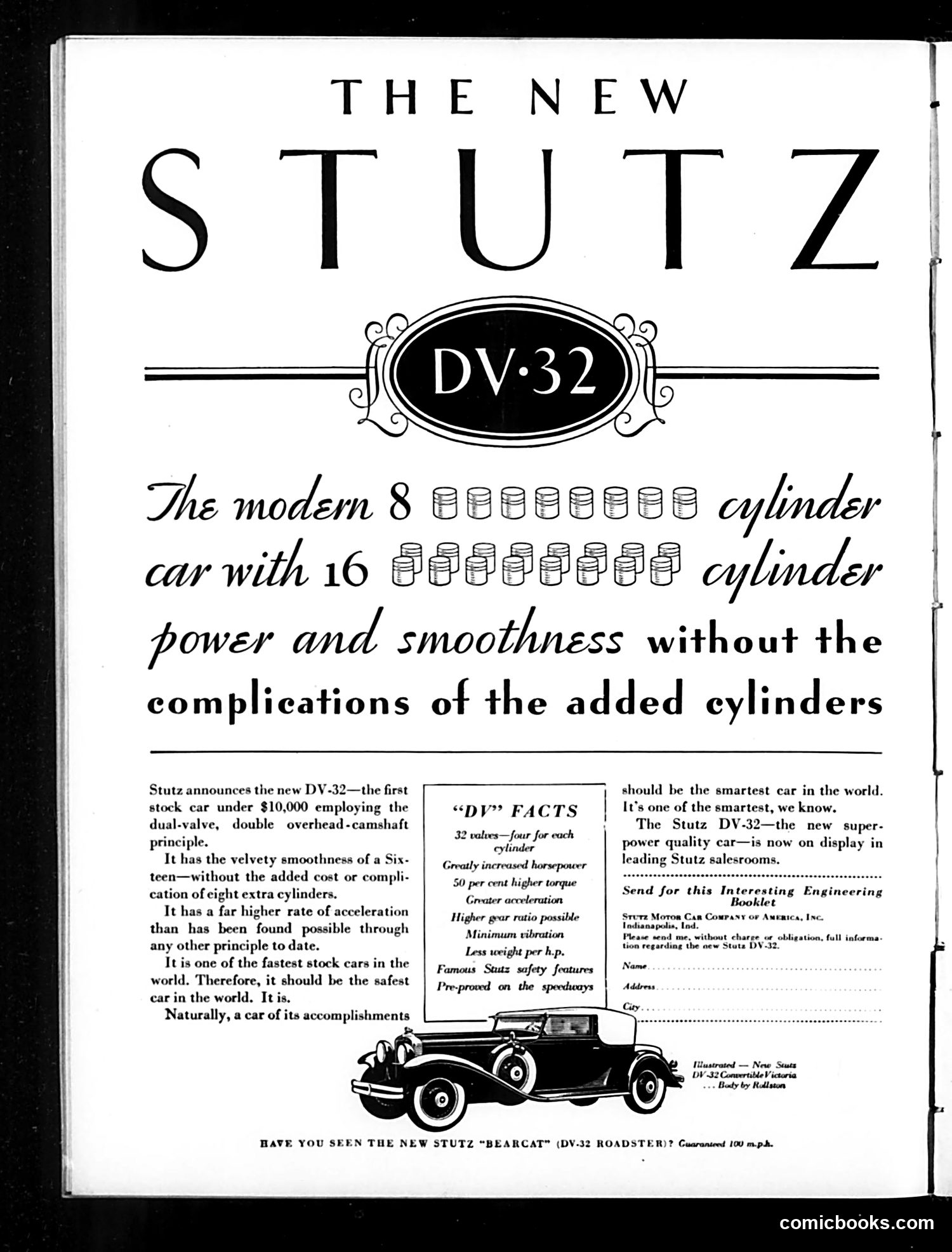
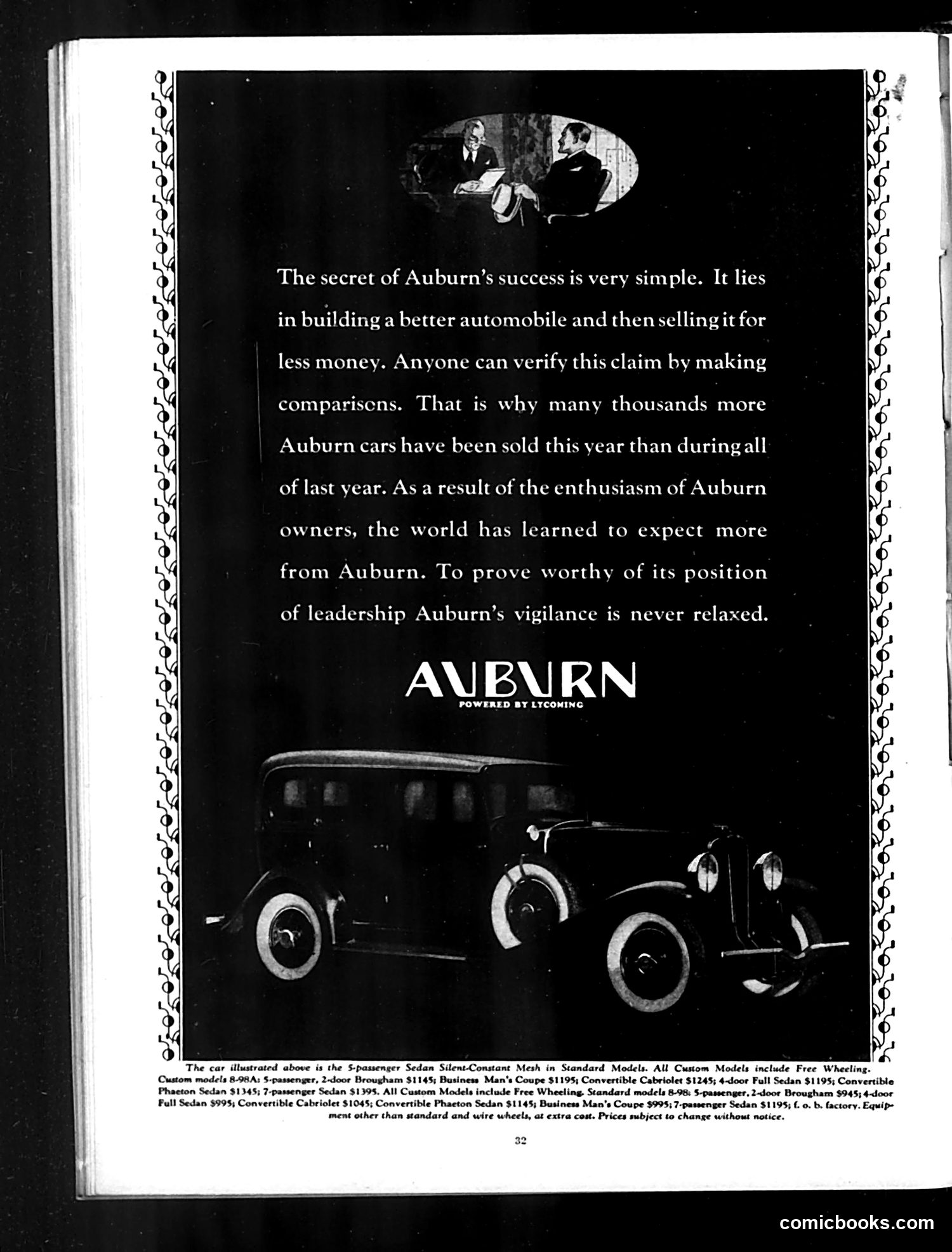
# Content Analysis This page is **primarily an advertisement**, not satirical content. It promotes the new Stutz DV-32 automobile, emphasizing its innovative 8-cylinder engine with 16-valve technology. The ad claims the car delivers "16-cylinder power and smoothness without the complications of the added cylinders"—a marketing pitch highlighting engineering efficiency. Key selling points listed include increased horsepower, higher torque, greater acceleration, and minimal vibration. A small illustration shows a 1920s-30s era automobile. The page includes a tear-out coupon inviting readers to request an "Interesting Engineering Booklet" about the vehicle. **No political satire or caricature is present.** This represents Judge magazine's commercial advertising content rather than its satirical editorial function.
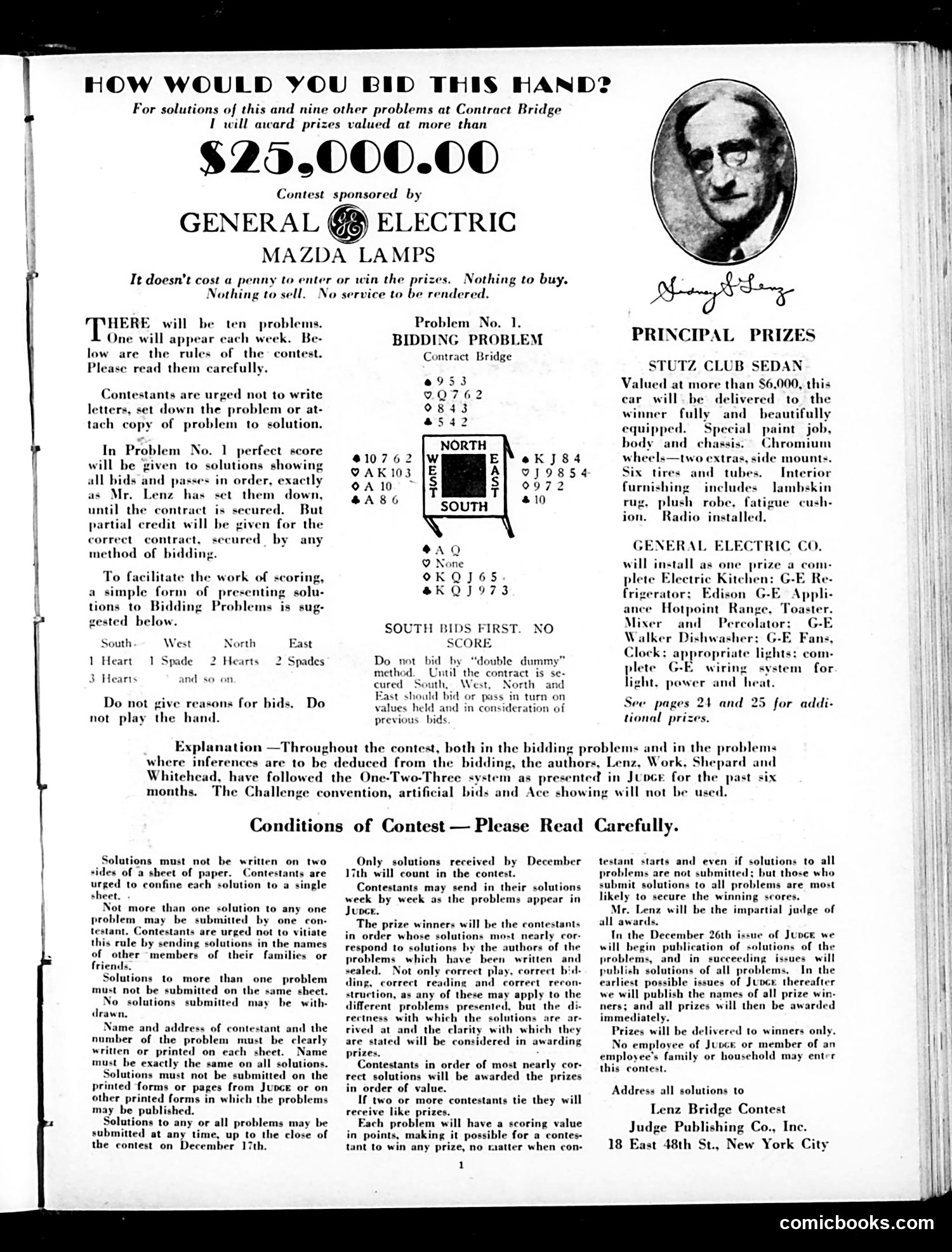
# Page Content Analysis This page is primarily **advertising and contest material**, not political satire. It announces a bridge-bidding puzzle contest sponsored by General Electric (Mazda Lamps), offering $25,000 in prizes including a Stutz Club Sedan automobile. The content includes: - A bidding problem for Contract Bridge (a card game) - Contest rules and submission instructions - A photograph of a man (identity unclear from image alone) whose signature appears present - Lists of prizes from General Electric appliances The page reflects **1920s-30s commercial culture**: major corporations sponsoring public contests to build brand engagement. Bridge was a popular leisure activity among middle and upper-class Americans during this era. There is no discernible political satire or social commentary on this particular page.
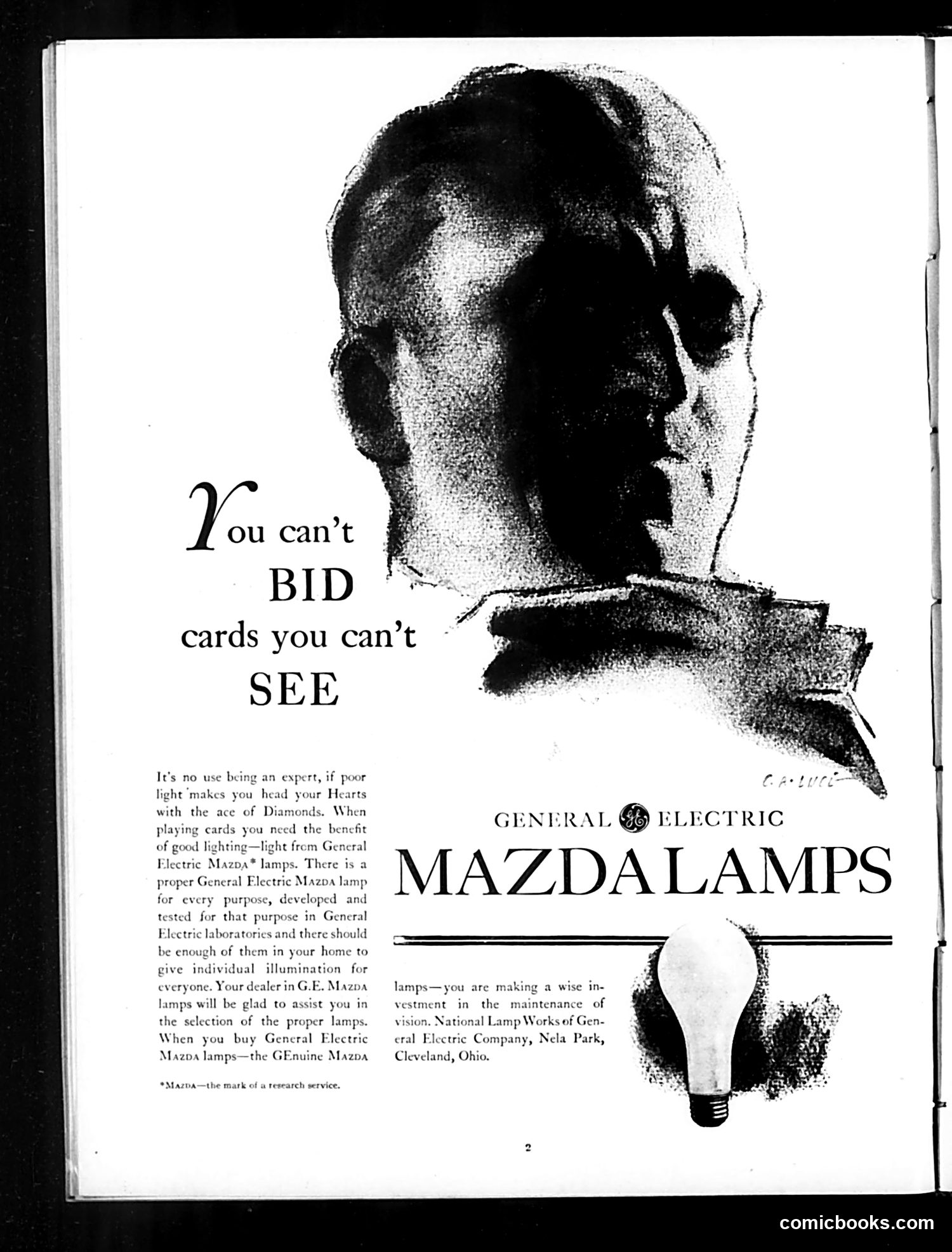
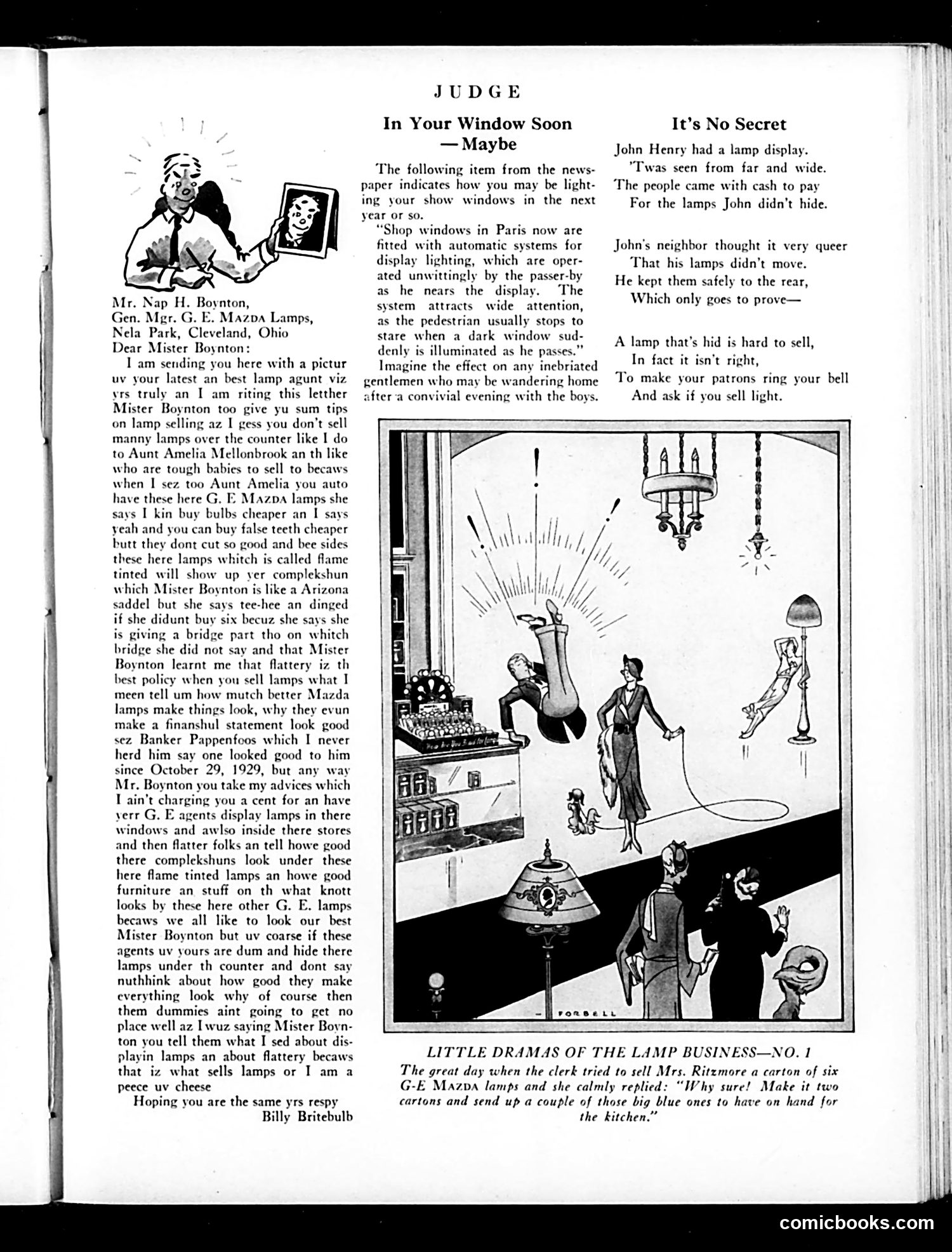
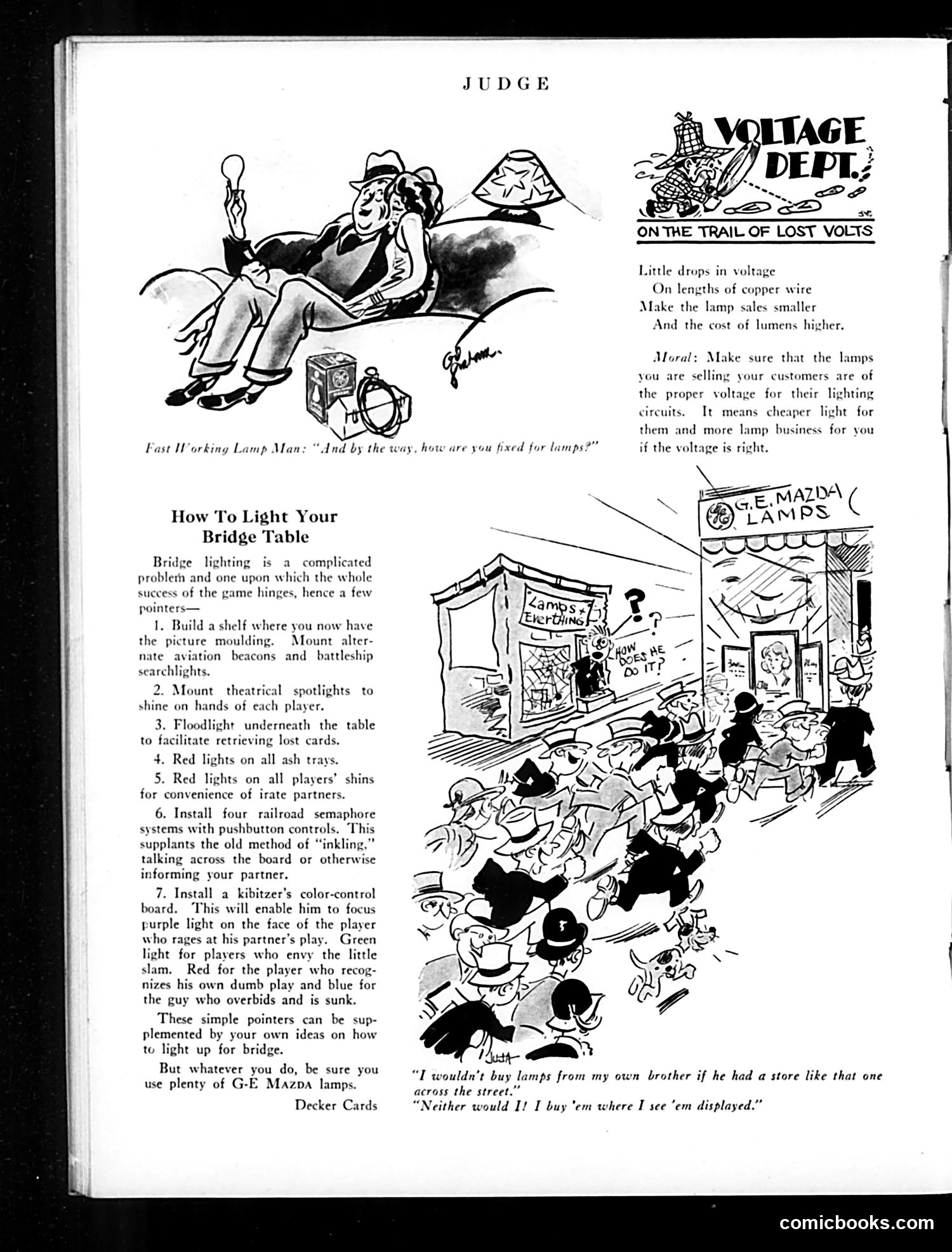
# Analysis This page is primarily a **General Electric advertisement for Mazda Lamps**, not political satire. The headline "You can't BID cards you can't SEE" uses a card-playing reference to promote proper lighting for home use. The image shows a man's face in profile, partially shadowed, illustrating the advertisement's point: poor lighting creates shadows that obscure details—just as inadequate light makes playing cards difficult to read. The ad argues that General Electric's Mazda lamps provide "good lighting" necessary for various household activities. While published in *Judge* magazine (known for satire), this particular page functions as commercial advertising rather than political or social commentary. The "satire" is purely commercial—a clever visual pun about visibility and product utility.
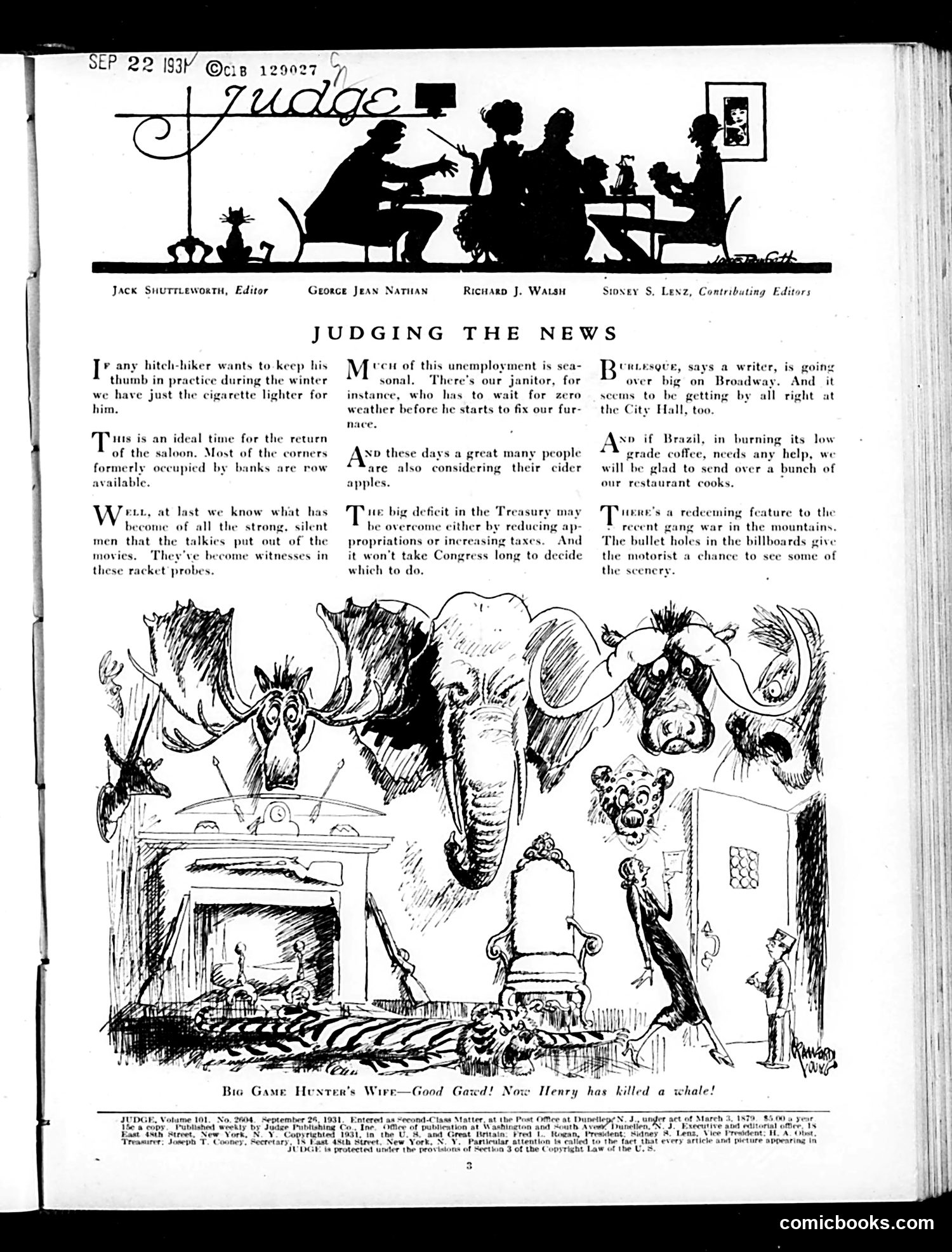
# "Judging the News" - September 22, 1931 This page satirizes contemporary 1931 issues through brief commentary and a large cartoon. The text discusses unemployment, the saloon's return (likely referencing Prohibition's repeal), Treasury deficits, and Broadway's resilience. The main cartoon, titled "Big Game Hunter's Wife—Good Gawd! Now Henry has killed a whale!", depicts a hunting-room trophy wall featuring fantastical creatures alongside what appears to be an elephant or large game animal. The joke likely mocks either an overly ambitious hunter's exaggerated claims or, more probably, satirizes wealthy individuals' excess during the Depression—the irony of conspicuous consumption (trophy hunting) amid economic hardship. The wife's shocked exclamation underscores the absurdity or wastefulness of the pursuit.
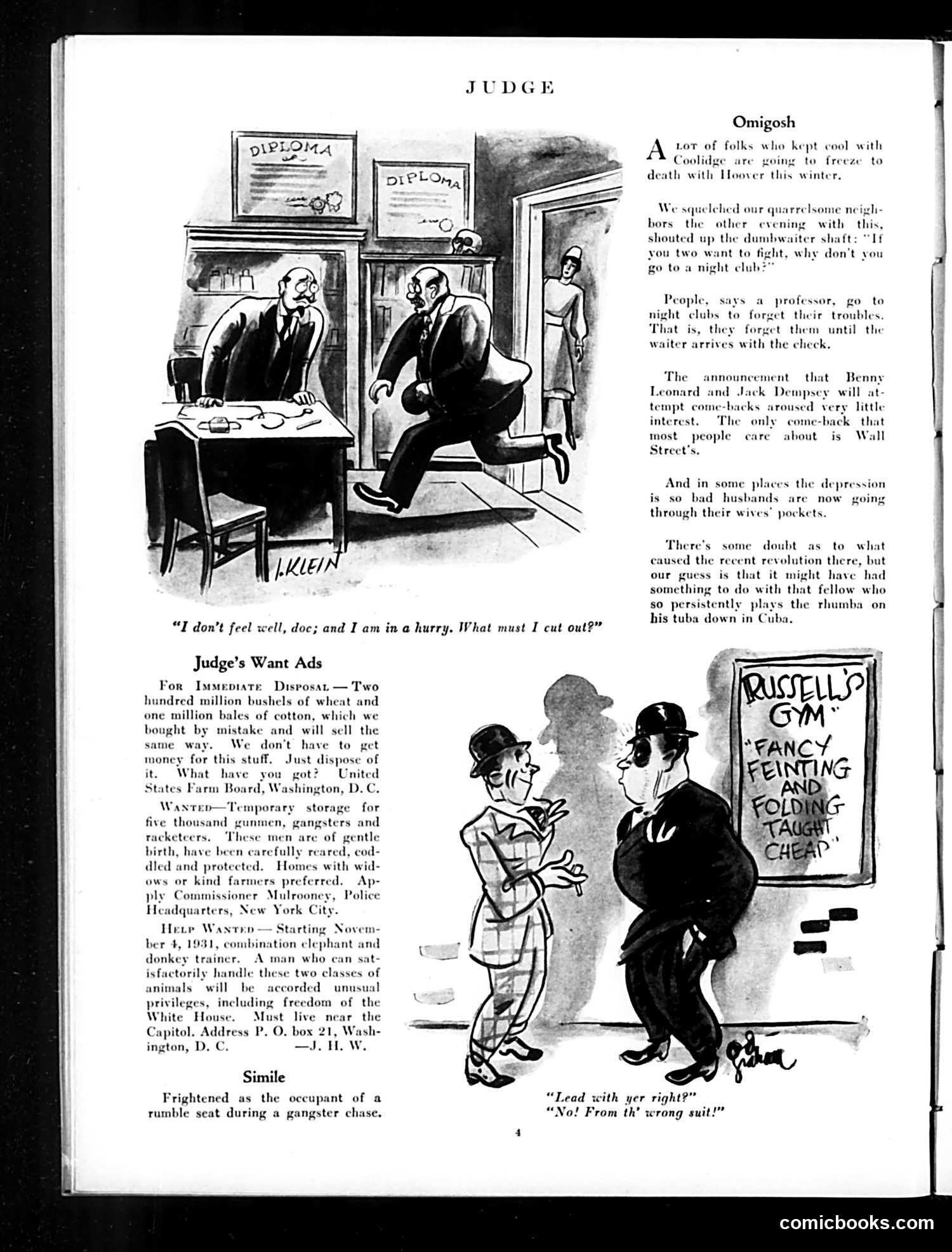
# Analysis of Judge Magazine Page **Top Cartoon**: Two men in an office with diplomas on the wall debate cutting expenses. One says "I don't feel well, doe; and I am in a hurry. What must I cut out?" The joke satirizes how during economic hardship (likely the Depression era), even educated professionals look for ways to economize—the implication being he should cut something unnecessary, perhaps his own salary or position. **Bottom Cartoon**: Two men argue outside "Russell's Gym" advertising "Fancy Feinting and Footwork Taught Cheap." The dialogue "Lead with yer right!" / "No! From th' wrong suit!" appears to mock either boxing instruction or the gym's dubious teaching methods. Both cartoons use working-class vernacular and economic anxiety as their comedic framework.
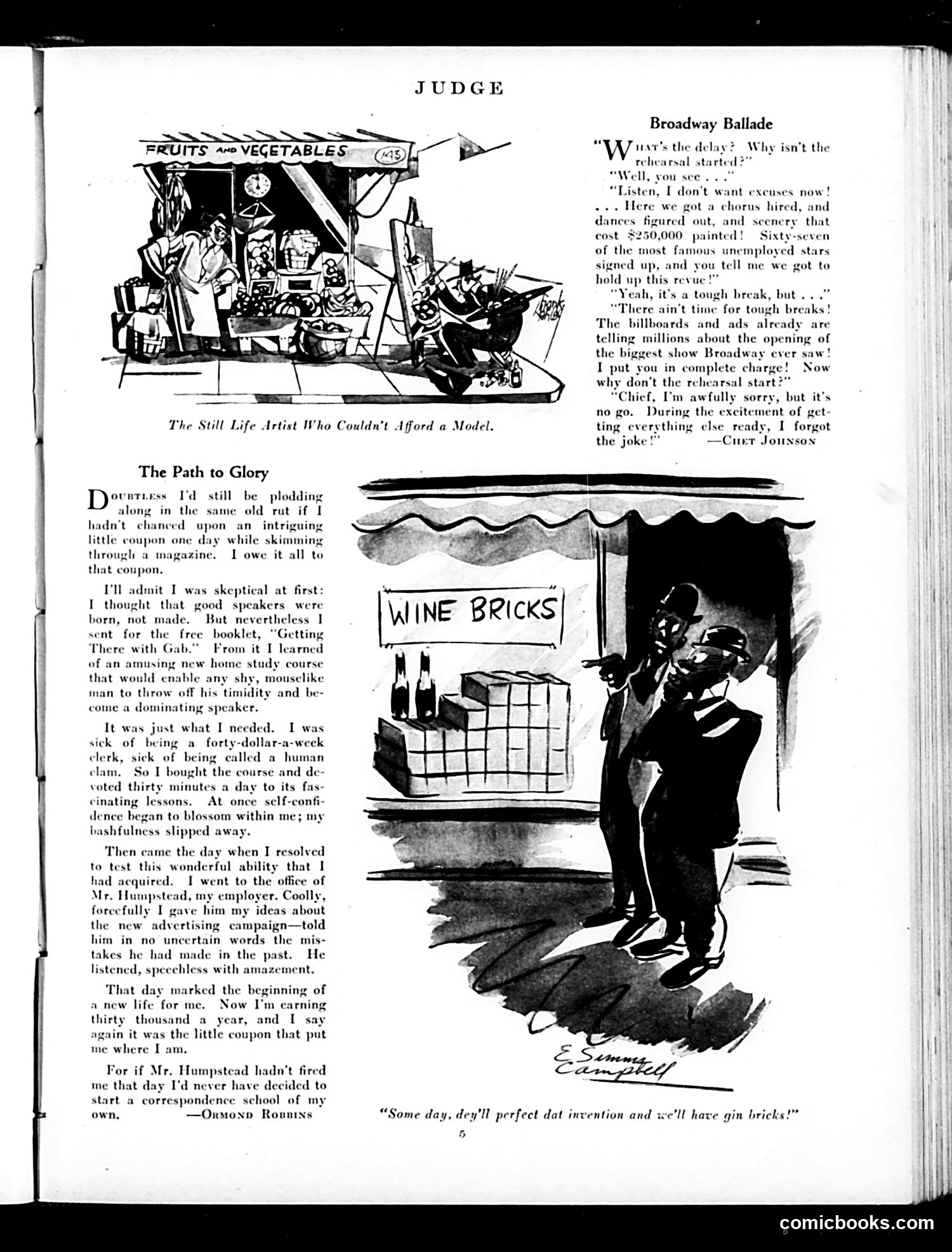
# Analysis of Judge Magazine Page **Top Cartoon ("The Still Life Artist Who Couldn't Afford a Model"):** Satirizes struggling artists during economically difficult times (likely the Great Depression era). The chaotic fruit and vegetable stand scene mocks an artist forced to use cheap produce as still-life subjects instead of hiring human models—a commentary on poverty within the arts community. **"The Path to Glory" Article:** A personal essay about self-improvement through a mail-order public-speaking course, tracing the author's transformation from timid clerk to confident speaker after taking "Getting There with Gab." **"Wine Bricks" Cartoon:** References Prohibition-era prohibition enforcement. The illustration appears to mock a commercial product marketed to circumvent alcohol laws, showing two men examining wine bricks—a real product sold during Prohibition purportedly for "educational purposes."
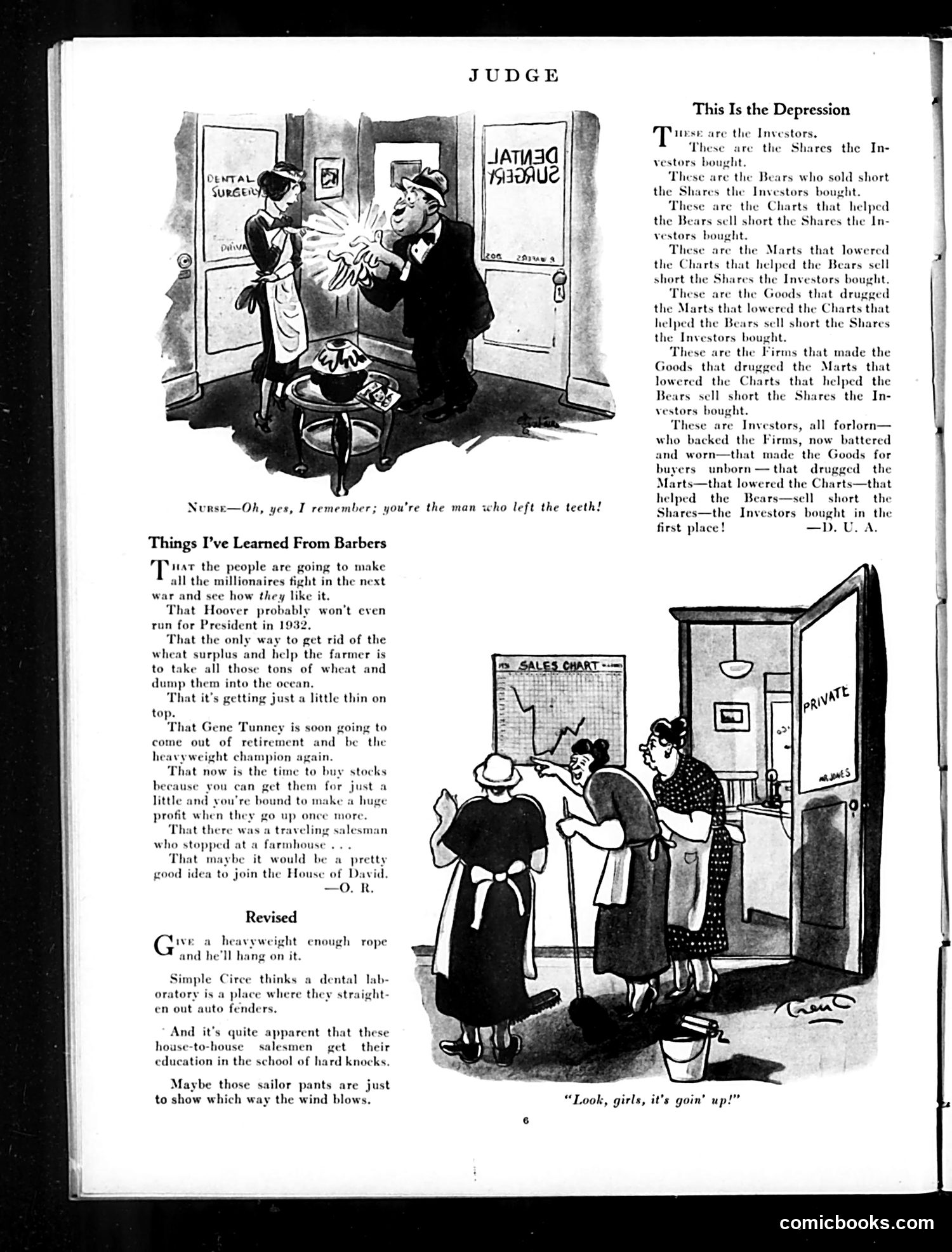
# Analysis of Judge Magazine Page This page contains two satirical cartoons about the Great Depression era. **Top cartoon**: A dental surgeon operates on a patient while a nurse says "Oh, yes, I remember; you're the man who left the teeth!" This jokes about financial ruin—someone so impoverished they literally cannot afford dental work. **Bottom cartoon**: Two women peer into a "Private" office, saying "Look, girls, it's goin' up!" while viewing a sales chart. This satirizes stock market speculation and false optimism during economic crisis. **Text section "This Is the Depression"**: Uses repetitive, tongue-in-cheek language to blame various financial actors—investors, bears, firms, and chart manipulators—for the economic collapse, suggesting systemic failures rather than individual responsibility. The overall message critiques both personal economic devastation and the financial establishment's role in causing the Depression.
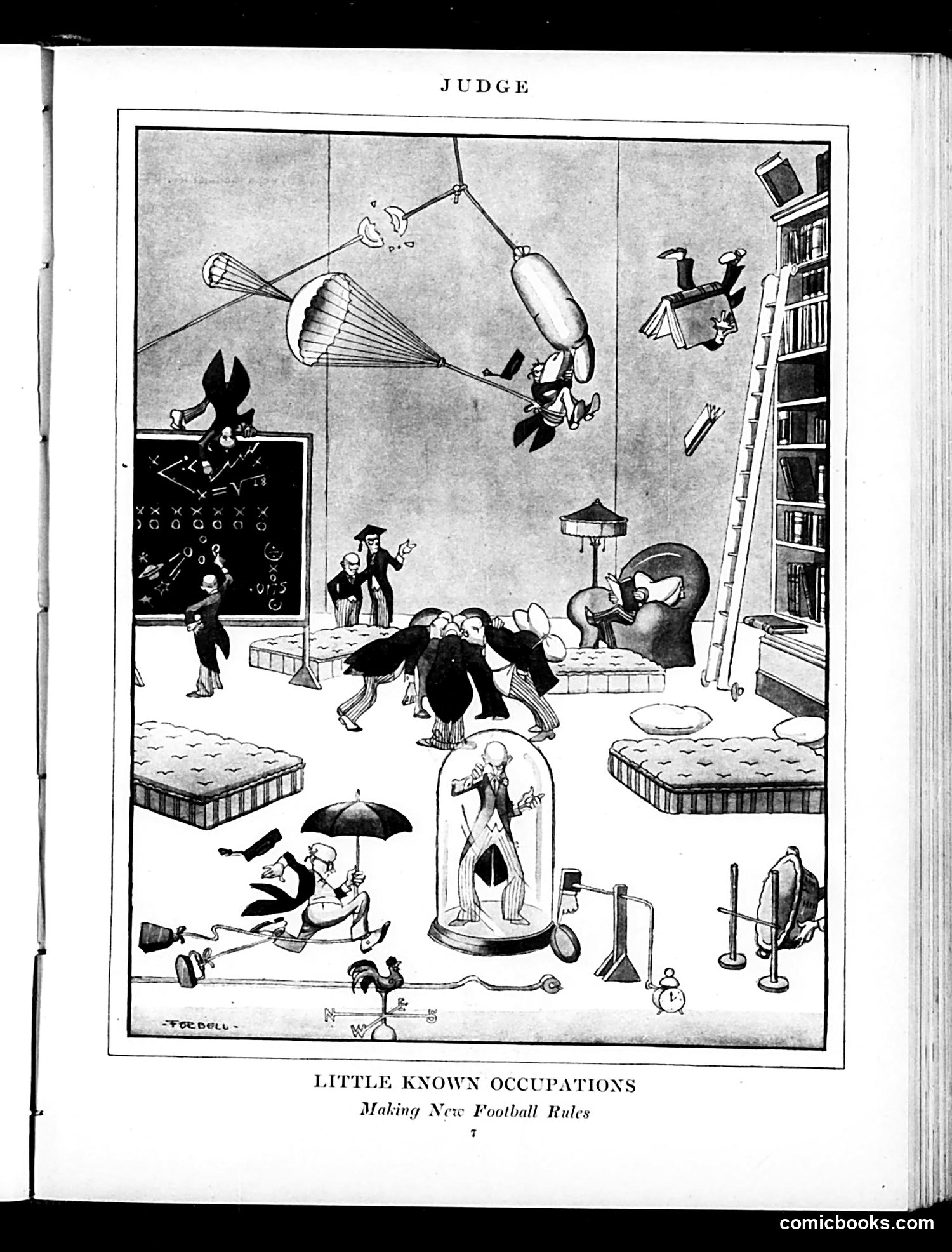
# "Little Known Occupations: Making New Football Rules" This satirical cartoon mocks the absurdity of football rule-making by depicting it as chaotic pandemonium rather than serious governance. The scene shows various figures in a surreal laboratory-like space engaged in absurd activities: men suspended from impossible contraptions, others consulting a blackboard of equations, figures in jars, people tugging at each other, and scattered sporting equipment. The joke appears to be that football rule committees operate with no logic or order—more like a madhouse than a rational deliberative body. The elaborate, nonsensical machines and confused figures suggest that creating football rules is less about legitimate decision-making and more about arbitrary, incomprehensible bureaucratic chaos. This likely reflects early 20th-century frustrations with the complexity and frequent changes in American football regulations during its formative years.
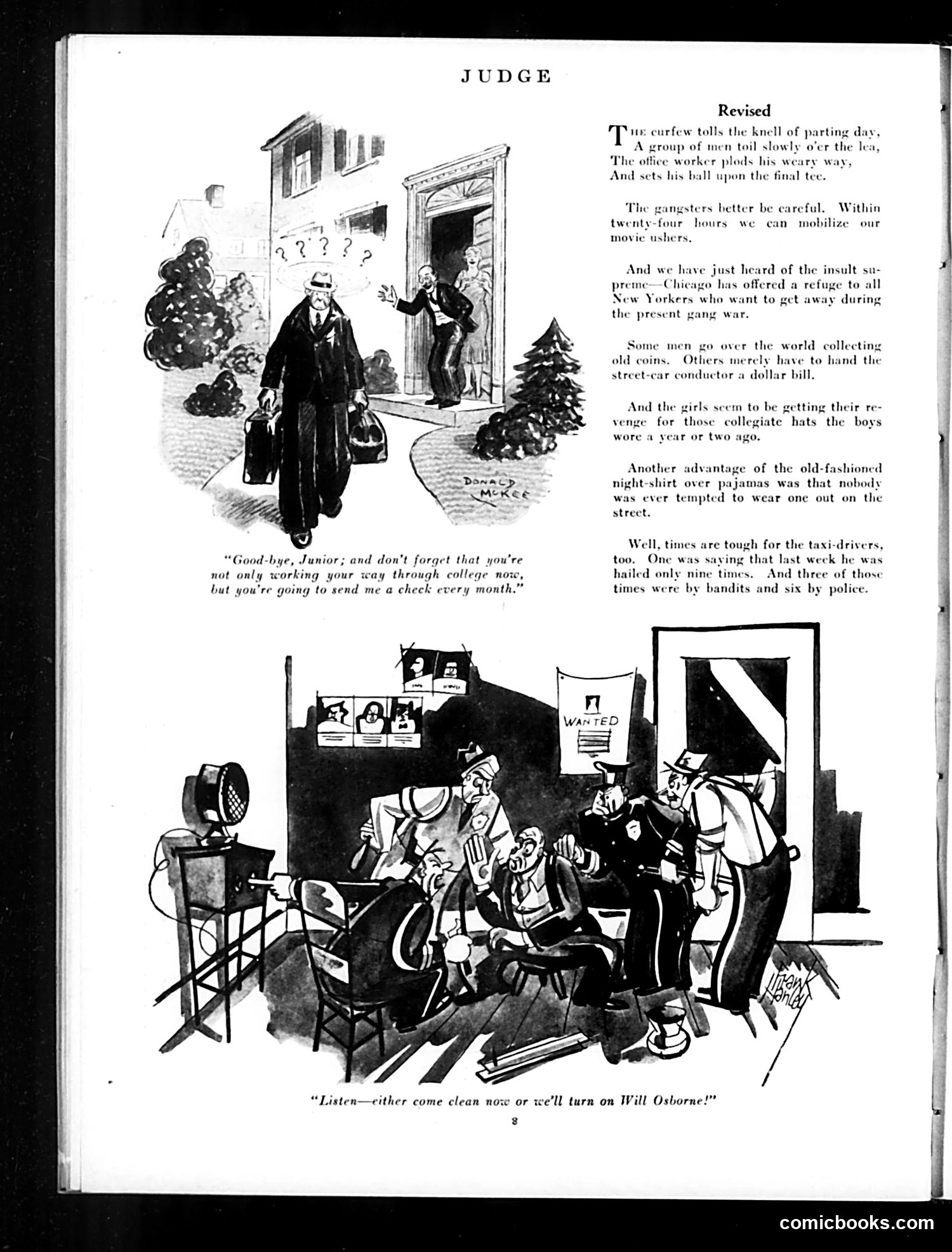
# Judge Magazine Satire Analysis This page contains two cartoons satirizing 1920s American social conditions during Prohibition and the era of organized crime. **Top cartoon:** A father sends his son off to college, emphasizing that despite working his way through, the son must still send home monthly checks—satirizing economic hardship and parental expectations during what appears to be the post-WWI recession. **Bottom cartoon:** Gangsters threaten someone, invoking "Will Osborne" as a threat. The "WANTED" posters and police presence suggest this mocks the era's gang violence. The caption references Chicago offering refuge to New Yorkers fleeing gang wars, while other text jokes about taxi drivers being robbed by both bandits and police—satirizing the chaos and lawlessness of Prohibition-era organized crime and police corruption. The poem above provides commentary on modern life's anxieties: golf, gang violence, poverty, and changing fashion—all contemporary concerns of the 1920s reader.
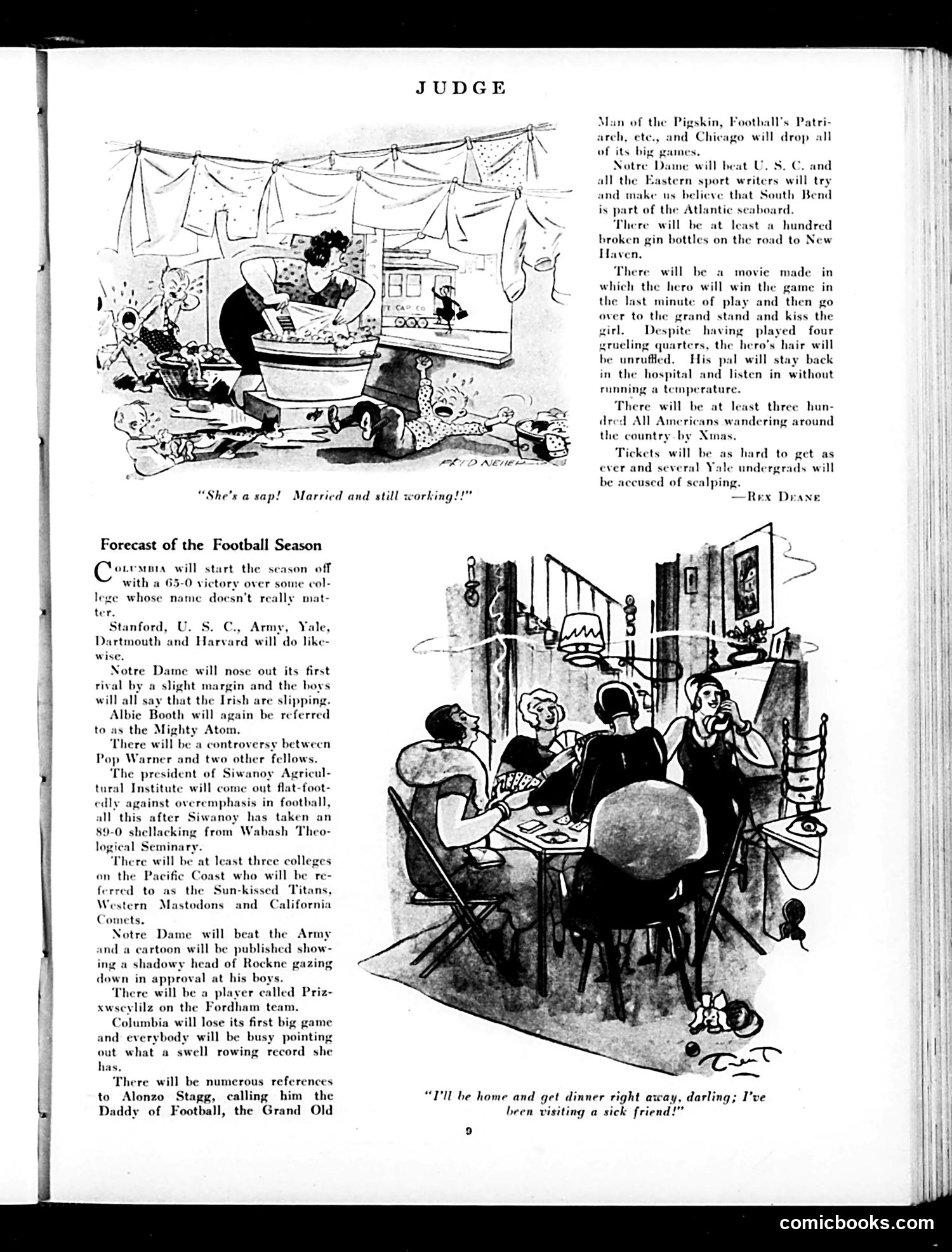
# Judge Magazine Football Satire Analysis This page contains two satirical pieces about American college football culture circa the 1920s-30s. **Top cartoon**: A woman in domestic attire manages household chores while holding a football, captioned "She's a sap! Married and still working!!" This mocks the era's gender expectations—the joke being that a married woman should have quit her job, yet she's still active/involved (here represented by football interest). **"Forecast of the Football Season"**: Rex Deane's column satirizes predictable football season tropes: dominant teams winning by enormous scores, Notre Dame's consistent strength, coach Rockne's prestige, Columbia's unrelated rowing success, references to "Daddy" Alonzo Stagg, Hollywood's inevitable football hero film, scalped Yale tickets, and the mass production of "All American" players. The satire skewers sports media clichés, institutional hypocrisy (colleges condemning "overemphasis" after lopsided wins), and cinema's formulaic sports narratives—all presenting football season as a predictable, manufactured spectacle rather than genuine competition.
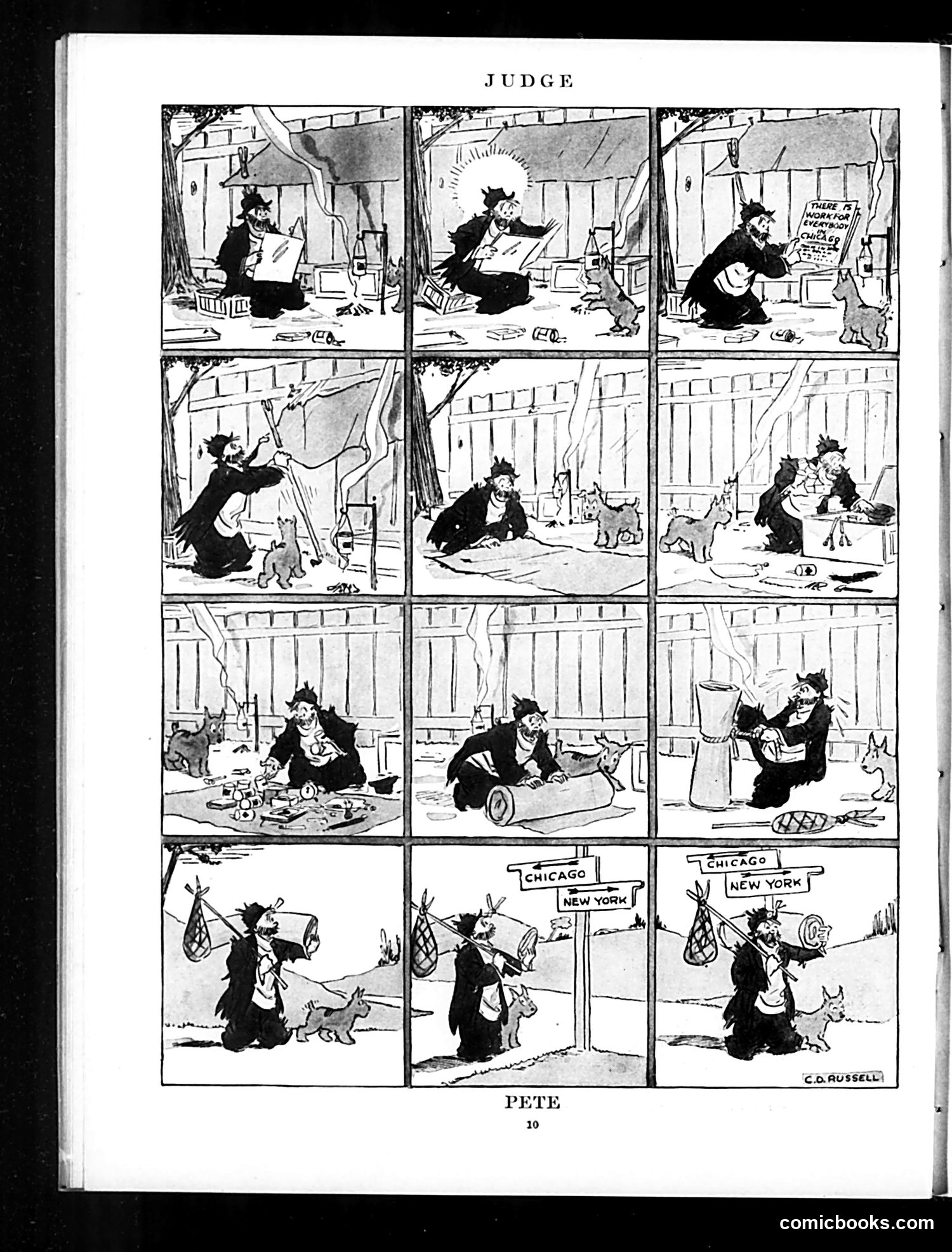
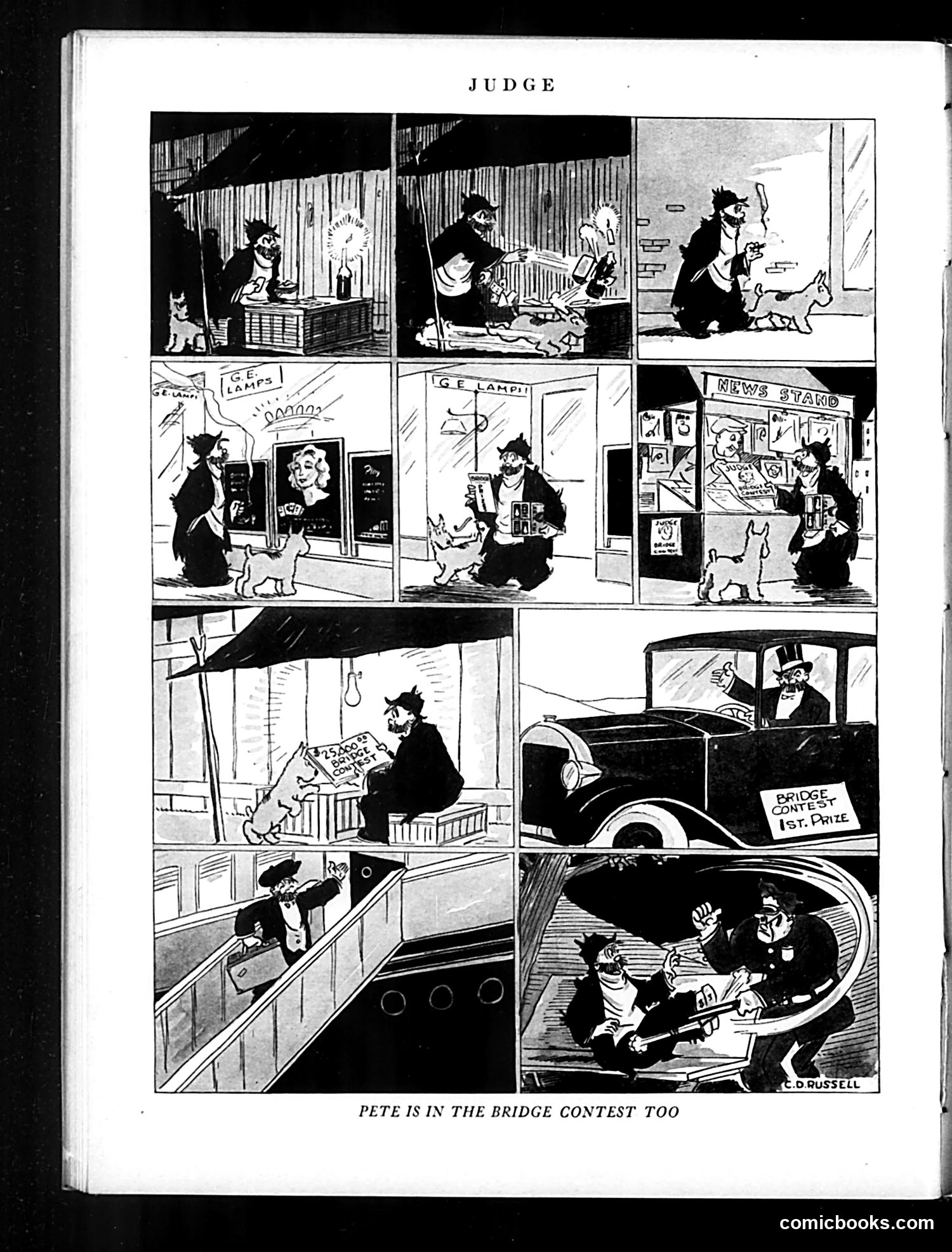
# Judge Comic: "Pete" by C.D. Russell This is a sequential comic strip titled "Pete" showing a judge character working in his chambers with a small dog. The narrative follows the judge's deteriorating focus as he attempts legal work: he begins studying documents seriously, grows increasingly distracted by the dog's antics, and eventually abandons his judicial duties entirely to play with the pet. The final panels reveal the joke's punchline—the judge has apparently decided to relocate, packing up his belongings and traveling from Chicago to New York with the dog, suggesting he's abandoned his judicial position altogether. The satire likely critiques judicial negligence or corruption of the era, using the comedic device of a judge's complete dereliction of duty, reduced to an absurd extreme. The specific Judge character referenced remains unclear from the page alone.