
Judge, 1931-09-26 · page 24 of 40
Judge — September 26, 1931 — page 24: what you’re looking at
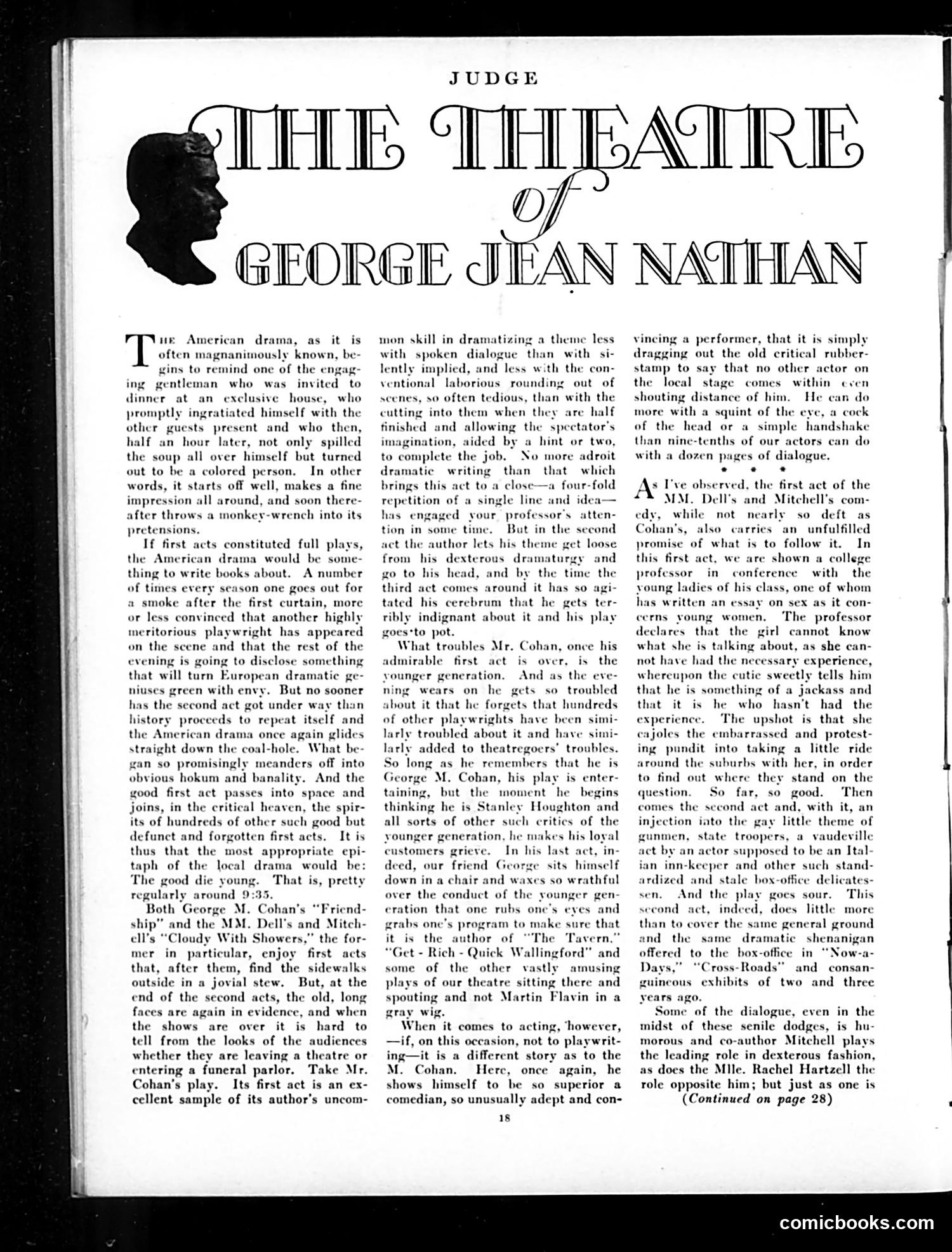
A restored page from Judge, 1931-09-26. Page through the whole issue in the reader above.
📄 Transcribed text from this page (OCR, searchable)
Machine-transcribed from the original scan — historical spelling and the odd misread are preserved.
or RRR ue American drama, as it is often magnanimously known, be- gins to remind one of the engag- ing gentleman who was invited to dinner at an exclusive house, who promptly ingratiated himself with the other guests present and who then, half an hour later, not only spilled the soup all over himself but turned out to be a colored person. In other words, it starts off well, makes a fine impression all around, and soon there- after throws a monkey-wrench into its pretensions. If first acts constituted full plays, the American drama would be som thing to write books about. A number of times every season one goes out for a smoke after the first curtain, more or less convinced that another highly meritorious playwright has appeared on the scene and that the rest of the evening is going to disclose something turn European dramatic ge- niuses green with envy. But no sooner has the second act got under way than history proceeds to repeat itself and the American drama once again glides straight down the coal-hole. What be- gan so promisingly meanders off into obvious hokum and banality. And the good first act passes into space and joins, in the critical heaven, the spir- its of hundreds of other such good but defunct and forgotten first acts. It is thus that the most appropriate epi- taph of the local drama would be: The good die young. That is, pretty regularly around § Both George M. Cohan’s ‘*Friend- and the MM. Dell's and Mitch- ell’s “Cloudy With Showers,” the for- mer in particular, enjoy first acts that, after them, find the sidewalks outside in a jovial stew. But, at the end of the second acts, the old, long faces are again in evidence, and when the shows are over it hard to tell from the looks of the audiences whether they are leaving a theatre or entering a funeral parlor. Take Mr. Cohan’s play. Its first act is an ex- cellent sample of its author's uncom- JUDGE lc GEORGE J O mon skill in dramatizing a theme less with spoken dialogue than with si- lently implied, and less with the con- tional laborious rounding out of es, so often tedious, than with the cutting into them when they are half finished and allowing the spectator’s imagination, aided by a hint or two, to complete the job. No more adroit dramatic writing than that which brings this 1 four-fold repetition of and i has engaged your professor's atten- tion in some tine. But in the second act the author lets his theme get loose from his dexterous dramaturgy and go to his head, and by the time the third act comes around it has so agi- tated his cerebrum that he gets ter- ribly indignant about it and his play goes*to pot. What troubles Mr. Cohan, once his admirable first act is over, is the younger generation. And as the eve- ning wears on he gets so troubled yut it that he forgets that hundreds of other playwrights have been simi- larly troubled about it and have simi- larly added to theatregoers’ troubles. So long as he remembers that he is George M. Cohan, his play is enter- aining, but the moment he beg thinking he is Stanley Houghton all sorts of other such critics of the younger generation, he makes his lo: customers grieve. In his last act, deed, our friend G © sits himself down in a chair and waxes so wrathful over the conduct of the younger gen- ct to a close single line eration that one rubs one’s eyes and grabs one’s program to make sure that it is the author of 2 T “Get - Rich - Quick Walling fore some of the other vastly amusing of our theatre spouting and not Martin Flavin in a gray wig. When it comes to acting, ‘however, —if, on this occasion, not to playwrit- ing a different story as to the M. Cohan. Herc, once again, he shows himself to be so superior a comedian, so unusually adept and con- 18 AIRES NACHIHIAN vincing a performer, that it is simply dri ng out the old critical rubber- stamp to say that no other actor on the local st. comes within’ even shouting distance of him. He can do more with a squint of the eye, a cock of the head or a simple handshake than nine-tenths of our actors can do with a dozen pages of dialogue. 7 « @ s I've observed, the first act of the MM. Dell's and Mitchell's com- edy, while not nearly so deft as Cobh rrics an unfulfilled promise of what is to follow it. In this first act, we are shown a college professor in’ conference with the young ladies of his class, one of whom has written an essay on sea n’s, also ca as it con- cerns young women. The professor declares that the girl cannot’ know what she is talking about, as she can- not have had the necessary experience, whereupon the cutie sweetly tells him that he is something of a jackass and that it is he who hasn't had the The upshot is that she embarrassed and_protest- ing pundit into taking a little ride around the suburbs with her, in order to find out where they stand on the question. So far, so good. Then comes the second act and, with it, an injection into the gay little theme of gunmen, state troopers, a vaudeville act by an actor supposed to be an Ital ian inn-keeper and other such stand- ardized and stale box-office delicates- sen, And the play goes sour. This second act, indeed, does little more tl n to cover the same general ground nd the same dramatic shenanigan offered to the box-office in Days,” “Cross-Roads” and consan- guincous exhibits of two and three y rs ago. Some of the dialogue, even in the midst of these senile dodges, is hu- morous and co-author Mitchell plays the leading role in dexterous fashion, as does the Mlle. Rachel Hartzell the role opposite him; but just as one is (Continued on page 28) comicbooks.com