
Judge, 1931-09-26 · page 28 of 40
Judge — September 26, 1931 — page 28: what you’re looking at
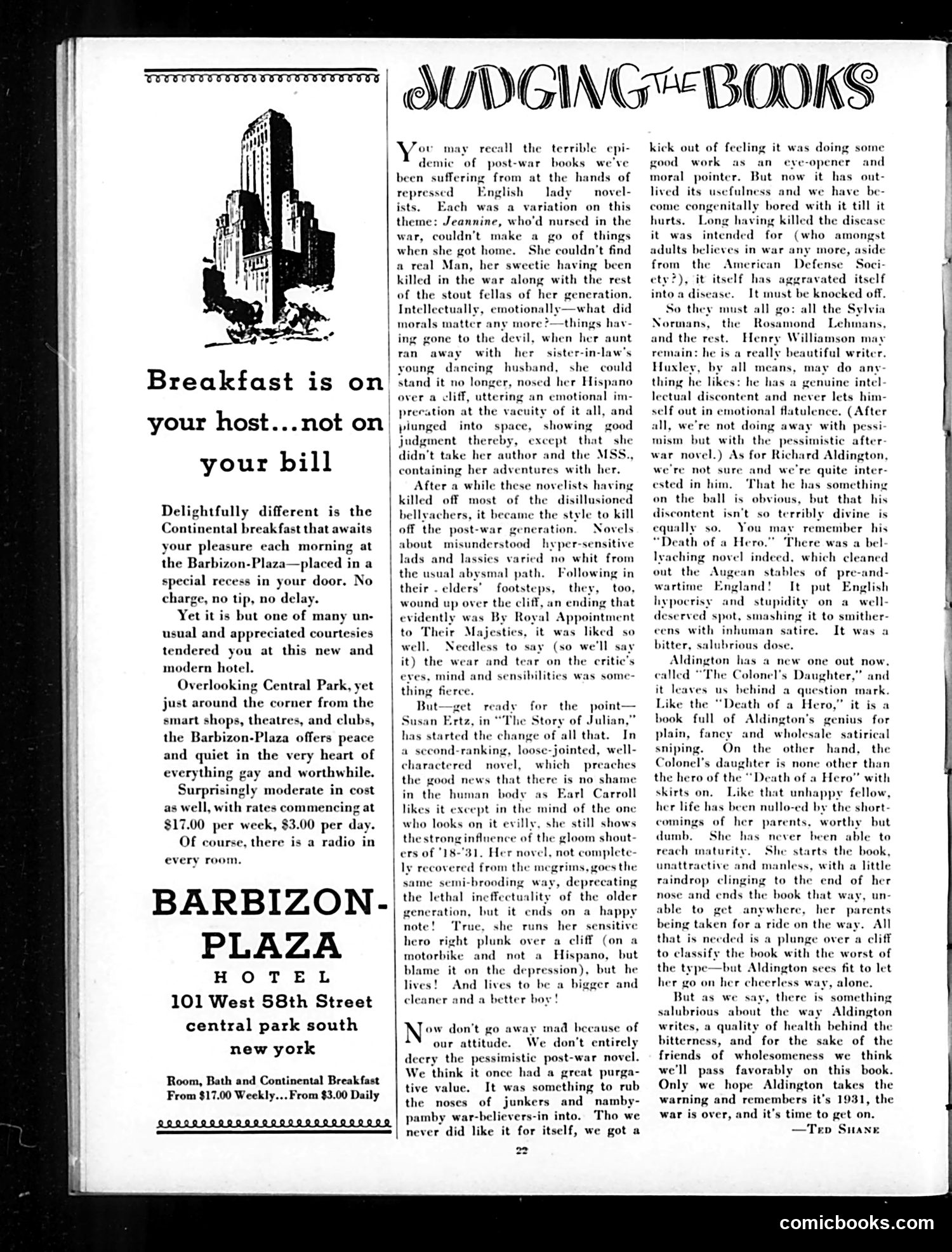
A restored page from Judge, 1931-09-26. Page through the whole issue in the reader above.
📄 Transcribed text from this page (OCR, searchable)
Machine-transcribed from the original scan — historical spelling and the odd misread are preserved.
Breakfast is on your host...not on your bill Delightfully different is the Continental breakfast that awaits your pleasure each morning at the Barbizon-Plaza—placed in a | special recess in your door. No charge, no tip, no delay. Yet it is but one of many un- usual and appreciated courtesies tendered you at this new and modern hotel. ] Overlooking Central Park, yet just around the corner from the smart shops, theatres, and clubs, the Barbizon-Plaza offers peace and quiet in the very heart of everything gay and worthwhile. Surprisingly moderate in cost as well, with rates commencing at $17.00 per week, $3.00 per day. Of course, there is a radio in every room. BARBIZON- PLAZA HOTEL 101 West S8th Street central park south new york Room, Bath and Continental Breakfast From $17.00 Weekly... From $3.00 Daily RLLQLQLAALALLAMALRLALLLALCLA ALL LL AUDGING™ BODKS may recall the terrible epi- of post-war books w been suffering from at the hands of repressed nglish lady —_ novel- i ach was a variation on this Jeannine, who'd nursed in the war, couldn’t make a go of things when she got home. She couldn't find a real Man, her sweetie having been killed in the war along with the rest of the stout fellas of her generation. Intellectually, emotionally—what did morals matter any more?—things hav- gone to the devil, when her ran away with her sister-in-law’s young dancing husband, she could Stand it no longer, nosed her Hispano iff, uttering an emotional im- ation at the vacuity of it all, and plunged into space, showing good judgment thereby, except that she didn’t take her author and the M aining her adventures with her. c After a while these novelists having killed off most of the disillusioned bellyachers, it became the style to kill off the post-war generation. Novels about misunderstood hyper-sensitive lads and lassies varied no whit from the usual abysmal path. Following in their . elders’ footsteps, they, too, wound up over the cliff, an ending that evidently was By Royal Appointment to Their Majesties, it was liked so well. Needless to s: (so we'll s: it) the wear and tes n the eri eyes, mind and sensibilities was some- thing fierce. But—get ready for the point— Susan Ertz, in “The Story of Julian,” has started the change of all that. In ond-ranking, loose-jointed, well- charactered novel, which — pre the good news that there is no shame in the human body as Earl Carroll likes it except in the mind of the one who looks on it evilly, she still shows the strong influence of the gloom shout- ers of '18-'31, Her novel, not complete- ly recovered from the megrims, goes the same semi-brooding way, deprecating the lethal ineffectuality of the older gencration, but it ends on a happy note! True, she runs her sensitive hero right plunk over a cliff (on a motorbike and not a Hispano, but blame it on the depression), but he lives! And lives to be cleaner and a better boy Now don't ad because of our attitude. don’t entirely ry the pessimistic post-war novel. k it once had a great purga- tive value. It was something to rub the noses of junkers and namby- pamby war-believers-in into. Tho we never did like it for itself, we got a a se ches er and 22 kick out of feeling it was doing some good work as an eye-opener and moral pointer. But now it has out- lived its usefulness and we have be- come congenitally bored with it till it hurts. Long having killed the disease it was intended for (who amongst adults believes in war any more, aside from the American De i ety?), it itself has aggrava into a disea It must be knocked off. So they must all Normans, the Rosamond and the rest. Henry Williamson ma remain: he is a really beautiful writer. Huxley, by all means, may do any- thing he likes: he h enuine intel lectual discontent and never lets him- self out in emotional flatulence. (After Hl, we're not de mism but with the pessimistic war novel.) As for Richard Aldin we're not su ested in him. on the ball is obvious, but t discontent isn’t so terribly divine is ly so. You h of a Hero.” There was a bel ching novel indeed, which el ut the an stables of pre wartime England! It put’ English hypocrisy and stupidity on a deserved spot, smashing it to smither- cens with inhuman satire. It was a bitter, salubrious dose. th pessi fter Aldington has a new one out now, called “The Colonel's Daughter,” and it leaves us behind a question mark. Like the “Death of a Hero,” it is a book full of Aldington’s genius for plain, fancy and wh le satirical sniping. On the other hand, the Colonel's daughter is none other than the hero of the “Death of a Hero” with skirts on. Like that unhappy fellow, her life has been nullo-ed by the short- comings of her ents, worthy but dumb. She has never been able to reach maturity. She starts the book, unattractive and manless, with a little raindrop clinging to the end of her nose and ends the book that way, un- able to get anywhere, her parents being taken for a ride on the wa All that is necded is a plunge over a cliff to classify the book with the worst of the type—but Aldington se her go on her cheerless w: But as we say, there is something salubrious about the Aldington writes, a quality of health behind the bitterness, and for the sake of the friends of wholesomeness we think we'll pass favorably on this book. Only we hope Aldington takes the warning and remembers it’s 1931, the war is over, and it's time to get on. —Tev Suanr comicbooks.com — J.