
Judge, 1931-09-26 · page 15 of 40
Judge — September 26, 1931 — page 15: what you’re looking at
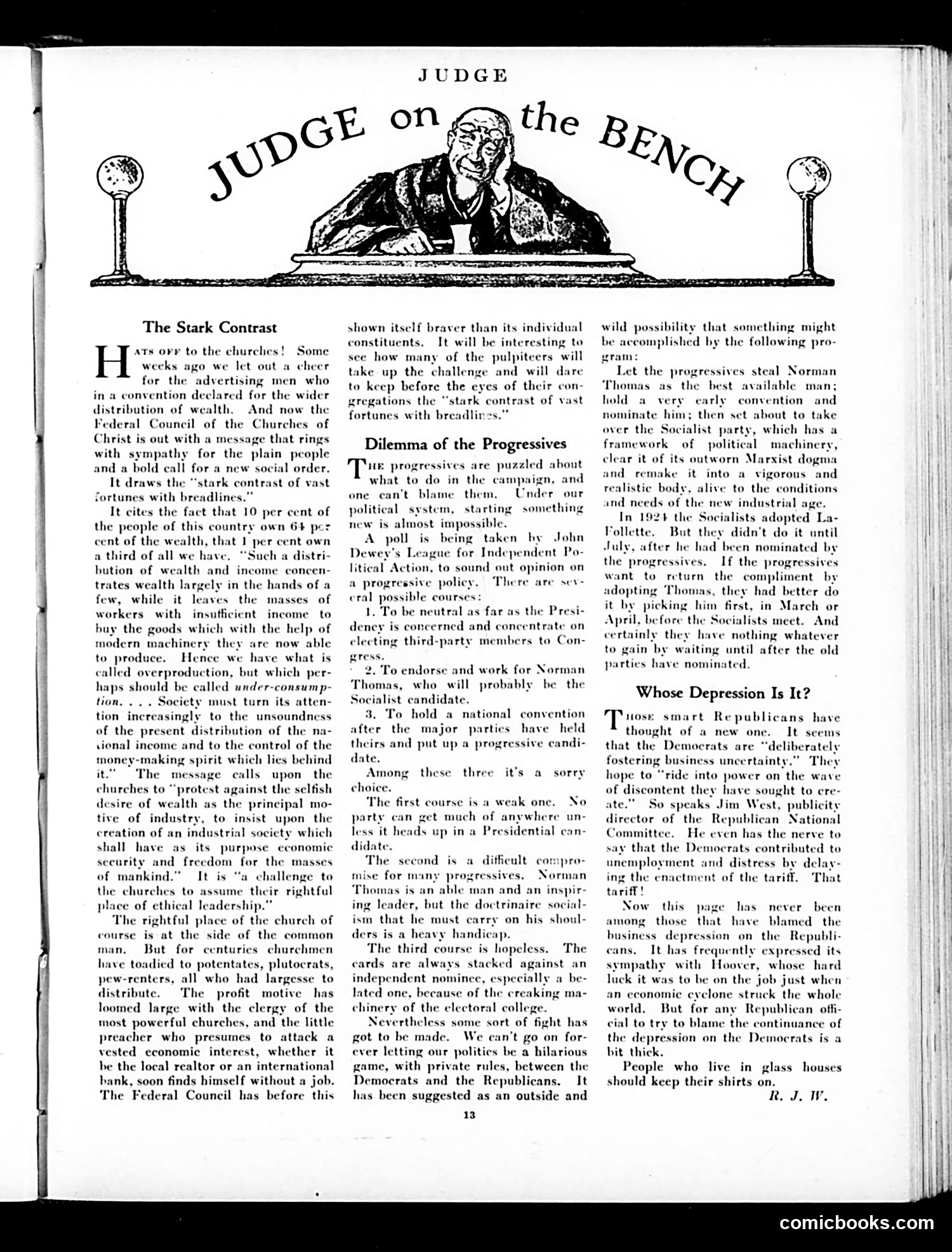
A restored page from Judge, 1931-09-26. Page through the whole issue in the reader above.
📄 Transcribed text from this page (OCR, searchable)
Machine-transcribed from the original scan — historical spelling and the odd misread are preserved.
The Stark Contrast ats or¥ to the churches! Some for the advertising men who in a convention declared for the wider distribution of wealth. And now the Council of the Churches of Christ is out with a message that rings with sympathy for the plain people and a bold call for a new social order. It draws the “stark contrast of vast fortunes with breadlines. It cites the fact that 10 per cent of the people of this country own 64 per cent of the wealth, that I per cent own a third of all we have. “Such a distri- bution of wealth and income concen- trates wealth largely in the hands of a few, while it leaves the masses of workers with insufficient income to buy the goods which with the help of modern machinery they are now to produce. Hence we have w illed overproduction, but which per- »s should be called under-consump- tion, . .. Society must turn its atten- tion increasingly to the unsoundness of the present distribution of the na- sional income and to the control of the money-making spirit which lies behind it.” The message calls upon the churches to “protest against the selfish desire of wealth as the principal mo- tive of industry, to insist upon the creation of an industrial society which shall have as its purpose economic security and freedom for the masses of mankind.” It is “a challenge to the churches to assume their rightful place of ethical leadership.” The rightful of the church of course is at the side of the common man, But for centuries churchmen have toadied to potentates, plutocrats, pew-renters, all who had largesse to distribute. The profit motive has loomed large with the clergy of the most powerful churches, and the little preacher who presumes to attack a vested economic interest, whether it he the local realtor or an international ank, soon finds himself without a job. The Federal Council has before this shown itself braver than its individual constituents. It will be interesting to see how many of the pulpiteers will take up the challenge and will dare to keep before the eyes of their con- gregations the “stark contrast of vast fortunes with br Dilemma of the Progressives ue progressives are puzzled about what to do in the campaign, and can't blame them, Under our system, starting something new is almost impossible. A poll is being taken by John Dewey's League for Independent Po- litical Action, to sound out opinion on a progressive policy. Ther cral possible courses 1, To be neutral as far as the Presi- deney is concerned and concentrate on electing third-party members to Con- gress. 2. To endorse and work for Norman Thomas, who will probably be the list candidate. To hold a national convention major parties have held 1 put up a progressive candi- re seve Among these three it’s a sorry choice. The first course is a weak one. party can get much of anywhere un- less it heads up in a Presidential didate. The second is a difficult compro- No an- Norman Thomas is an able man and an inspir- ing leader, but the doctrin ism that he must carry on his shoul- ders is a heavy handicap. The third course is hopeless. The cards are always stacked against an independent nominee, especially a be- lated one, because of the creaking ma- chinery of the electoral college. Nevertheless some sort of fight has got to be made. We can't go on for- ever letting our polities be a hilarious game, with private rules, between the Democrats and the Republicans. It has been suggested as an outside and 13 mise for many progressive: r social- wild possibility that something might be accomplished by the following pro- gram: Let the progressives steal Norman Thomas as the best available man; hold a very early convention and nominate him; then set about to take over the Socialist party, which has a framework of political machine clear it of its outworn Marxist dogm and remake it into a vigorous and realistic body, alive to the conditions ind needs of the new industrial age. In 1924 the Socialists adopted La Follette. But they didn’t do it unt July, after he had been nominated by the progressives. If the progressives want to return the compliment by adopting Thomas, they had better do it by picking him first, in March or April, before the Socialists meet. And . they have nothing whatever by waiting until after the old parties have nominated. Whose Depression Is It? Nios: smart Republicans have thought of a new one. It seems that the Democrats are “deliberately fostering business uncertainty hey hope to “ride into power on the wave of discontent they have sought to cre- ate.” So speaks Jim West, publicity director of the Republican National Committee. He even the nerve to say that the Democrats contributed to unemployment and distress delay- ing the enactment of the tariff. That tariff! Now this page has never been among those that have blamed the business depression on the Republi- cans. It has frequently expressed its sympathy with Hoover, whose hard luck it was to be on the job just when an economic cyclone struck th world. But for any Republi cial to try to blame the continus the depression on the Democ hit thick. People who live in glass houses should keep their shirts on. RIL W. > whole comicbooks.com