
Judge, 1931-09-26 · page 23 of 40
Judge — September 26, 1931 — page 23: what you’re looking at
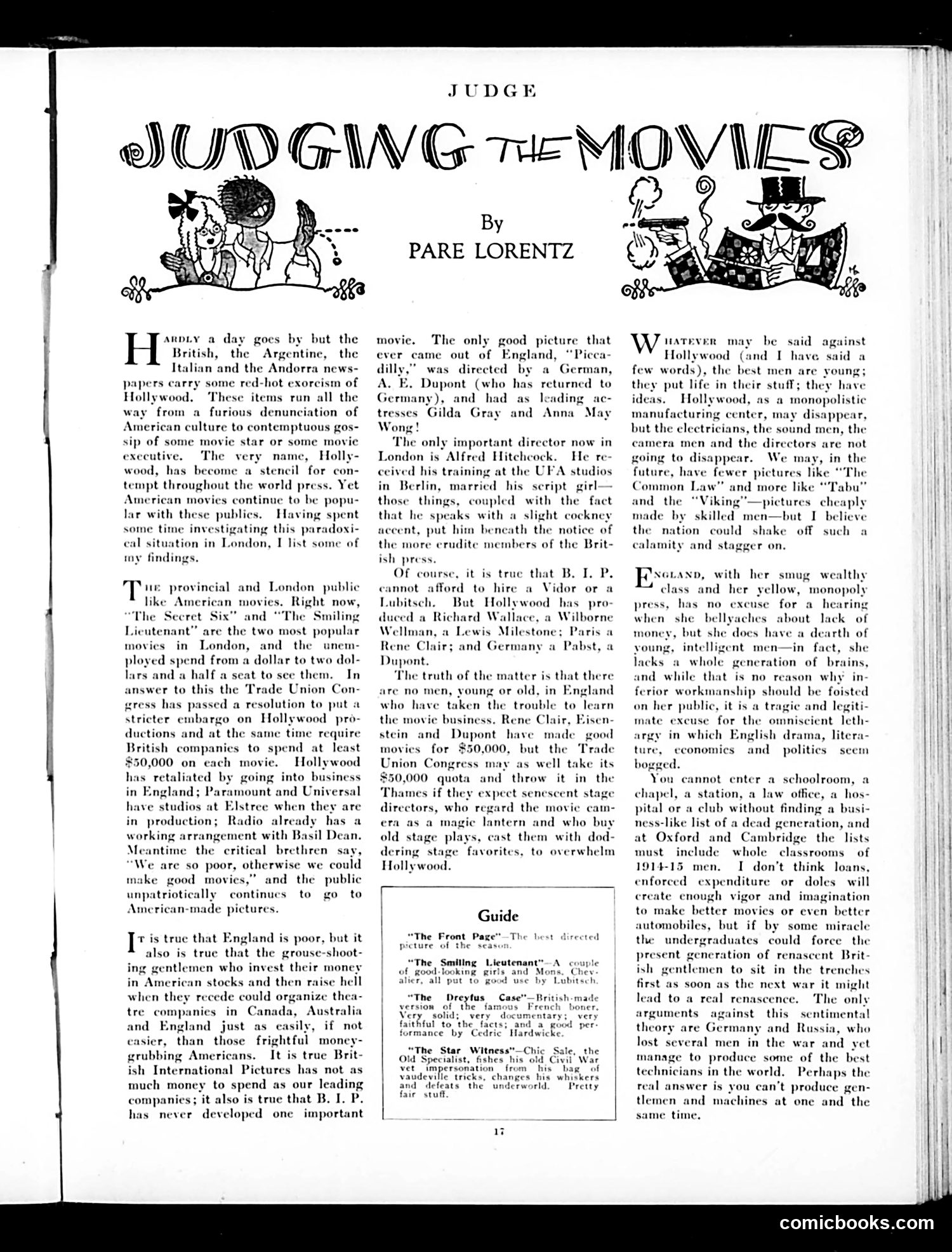
A restored page from Judge, 1931-09-26. Page through the whole issue in the reader above.
📄 Transcribed text from this page (OCR, searchable)
Machine-transcribed from the original scan — historical spelling and the odd misread are preserved.
— anpLy a day goes by but the H British, the Argentine, the Itali: nd the Andorra new papers carry some red-hot exorcism of lywood. These items run all the from a furious denunciation of American culture to contemptuous gos- sip of some movie star or some movie executive. The very name, Holly- wood, has become a stencil for con- tempt throughout the world press. Yet American movies continue to be popu- lar with these publics. Having spent some time investigating this } Hoxi- cal situation in London, I list some of iny findings. Te provinei like Ameri and London public 1 movies. Right now, “The Secret Six” and “The Smiling Lieutenant” are the two most popular movies in London, and the unem- ployed spend from a dollar to two dol- lars and a half a seat to sce them. In answer to this the Trade Union Con- gress has passed a resolution to put a stricter embargo on Hollywood pro- ductions and at the same time require British companies to spend at least $50,000 on each movie. Hollywood has retaliated by going into business in England; Paramount and Universal have studios at Elstree when they are in production; Radio already has a working arrangement with Basil Dean. ntime the ¢ al brethren s. are so poor, otherwise we could make good movies,” and the public unpatriotically continues to go to American-made pictures. I" is true that England is poor, but it Iso is true that the grouse-shoot- ing gentlemen who invest their money in American stocks and then when they recede could o tre companies in Canada, and England just as easil easier, than those frightful money- grubbing Americans. It is true Brit- ish International Pictures has not as much money to spend as our leading com also is true that B. I. P. has never developed one important JUDGE JUDGWG r#<MOVI By PARE LORENTZ movie. The only good picture that ever came out of England, “Picca dilly,” was directed by a German, A. E. Dupont (who has returned to Germany), and had as leading tresses Gilda Gray and Anna Wong! The only important director now in London is Alfred Hitchcock. He re- ceived his training at the UFA studios in Berlin, mar his script. girl those things, coupled with the fact that he speaks with a slight cockney accent, put him beneath the notice of the more erudite members of the Brit- ish press. Of course, it is true that B. I. P. cannot afford to hire a Vidor or a Lubitseh. But Hollywood has pro duced a Richard Wallace, a Wilborne Wellm a Lewis Milestone; Paris a Rene Clair; and Germany a Pabst, a Dupont. The truth of the matter is that there are no men, young or old, in England who have taken the trouble to le the movie business, Rene C stein and Dupont have made good movies for $50,000, but the Trade Union Congress may as well take its 50,000 quota and throw it in’ the Thames if they expect senescent stage directors, who regard the movie camn- gic lantern and who buy old stage plays, cast them with dod- dering stage favorites, to overwhelm Hollywood. era as ait - | Guide “The Front Page The picture of the seas “The Smiling Lieutenant™—A cox of good-looking girls and Mons. Ch er, all fuse by Lubit to gd | “The Dreyfus Case*—British version of the famous French very. si very d. n faithful to the facts formance by Cedric he Star Witness"—Ch ale, the | Old Specialist, fishes his vet impersonation — fr: | vaudeville tri and defeats the fair stuff ag of changes his whiskers world. — Pretty W isteven may be said s Hollywood (and [hs few words), the best men they put life in their stuff; they have ideas. Hollywood, as a monopolistic manufacturing center, may disappe but the electricia nd men, the ner: going to disappear. future, have fe Common Law and the "pictures cheaply made by skilled men—but I believe the nation could shake off such a calamity and stagger on. Feet, with her smug wealthy class and her yellow, monopoly press, has no excuse for a hearing when she bellyaches about lack of money, but she does have a dearth of intelligent men—in fact, she lacks a whole generation of brains, and while that is no reason why in ferior workmanship should be foisted on her public, it is a tragic and legiti- mate excuse for the omniscient leth- argy in which English drama, litera- ture, economics and politics seem bogged. You cannot enter a schoolroom, a chapel, a station, a law office, a hos- pital or a club without finding a busi- ness-like list of a dead at Oxford and Cambridge the lists must include whole classrooms of 1914-15 men. I don’t think loans, enforced expenditure or doles will create enough vigor and imagination to ma better movies or even better automobiles, but if by some miracle the unde duates could force the present generation of renascent Brit- ish gentlemen to sit in the trenches first as soon as the next w lead to a real renascence. The only arguments against this sentimental theory are Germany and Russia, who lost several men in the war and yet manage to produce some of the best technicians in the world. Perhaps the nswer is you can’t produce gen- tlemen and machines at one and the same time. you r it might comicbooks.com