A complete issue · 36 pages · 1931
Judge — August 1, 1931
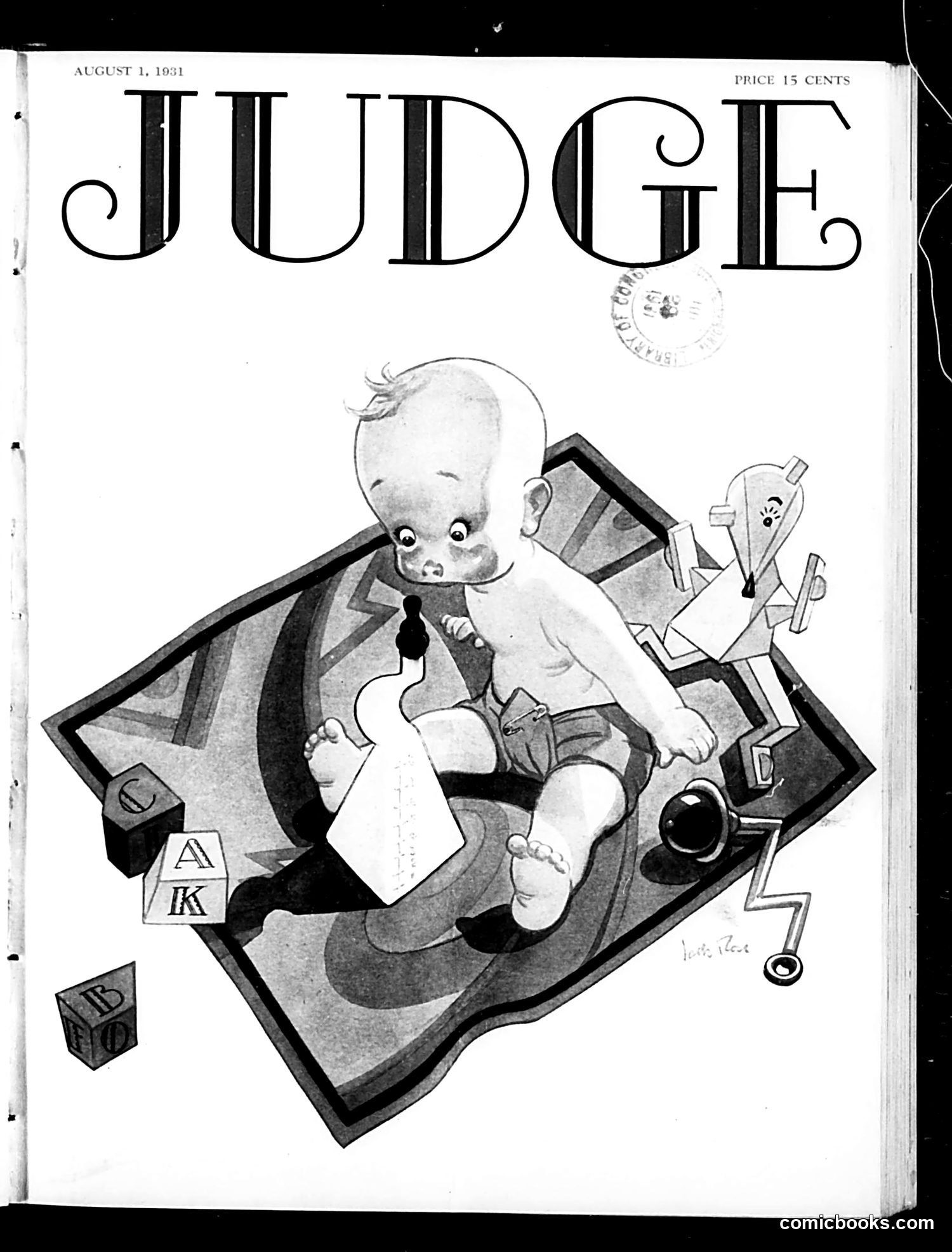
# Judge Magazine Cover, August 1, 1931 This cover depicts a stylized baby surrounded by toys and blocks labeled with letters (A, K, B). The infant appears dressed like a businessman or adult—wearing a tie and suit jacket—while holding what looks like a handkerchief or document. The satire likely comments on **infantilized leadership or political figures** during the **Great Depression era** (1931). The juxtaposition of a baby in adult clothing suggests commentary on the immaturity or incompetence of politicians or businessmen supposedly managing the economic crisis. The toys and blocks reinforce the theme of childish, toy-like governance during serious economic turmoil. However, without identifying specific OCR text content, the exact political target remains unclear.
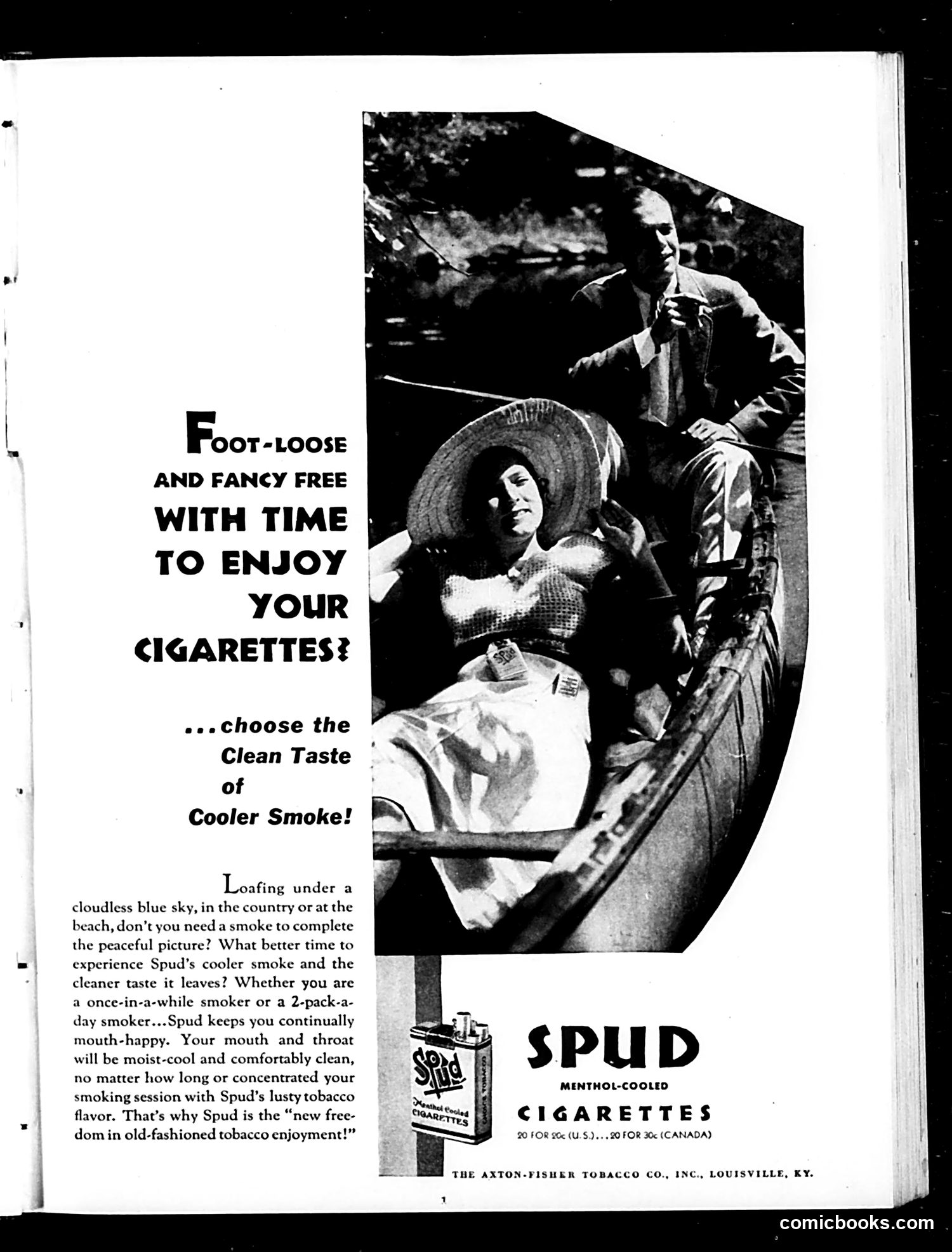
# Analysis This is a **cigarette advertisement, not satire or political commentary**. It's a vintage Spud menthol cigarettes ad from the Axton-Fisher Tobacco Company (Louisville, Kentucky), pricing at 20 for 10¢ US / 20 for 3¢ Canada. The ad depicts a couple relaxing outdoors—a woman in a wide-brimmed hat and man in casual clothing—promoting smoking as a leisure activity. The marketing pitch emphasizes "clean taste" and "cooler smoke," claiming the product keeps one's "mouth and throat...comfortably clean" regardless of smoking frequency. This reflects **mid-20th century tobacco marketing** that normalized smoking and made unsubstantiated health claims. Modern readers would recognize this as historically significant evidence of aggressive cigarette promotion before health regulations and warnings were implemented.
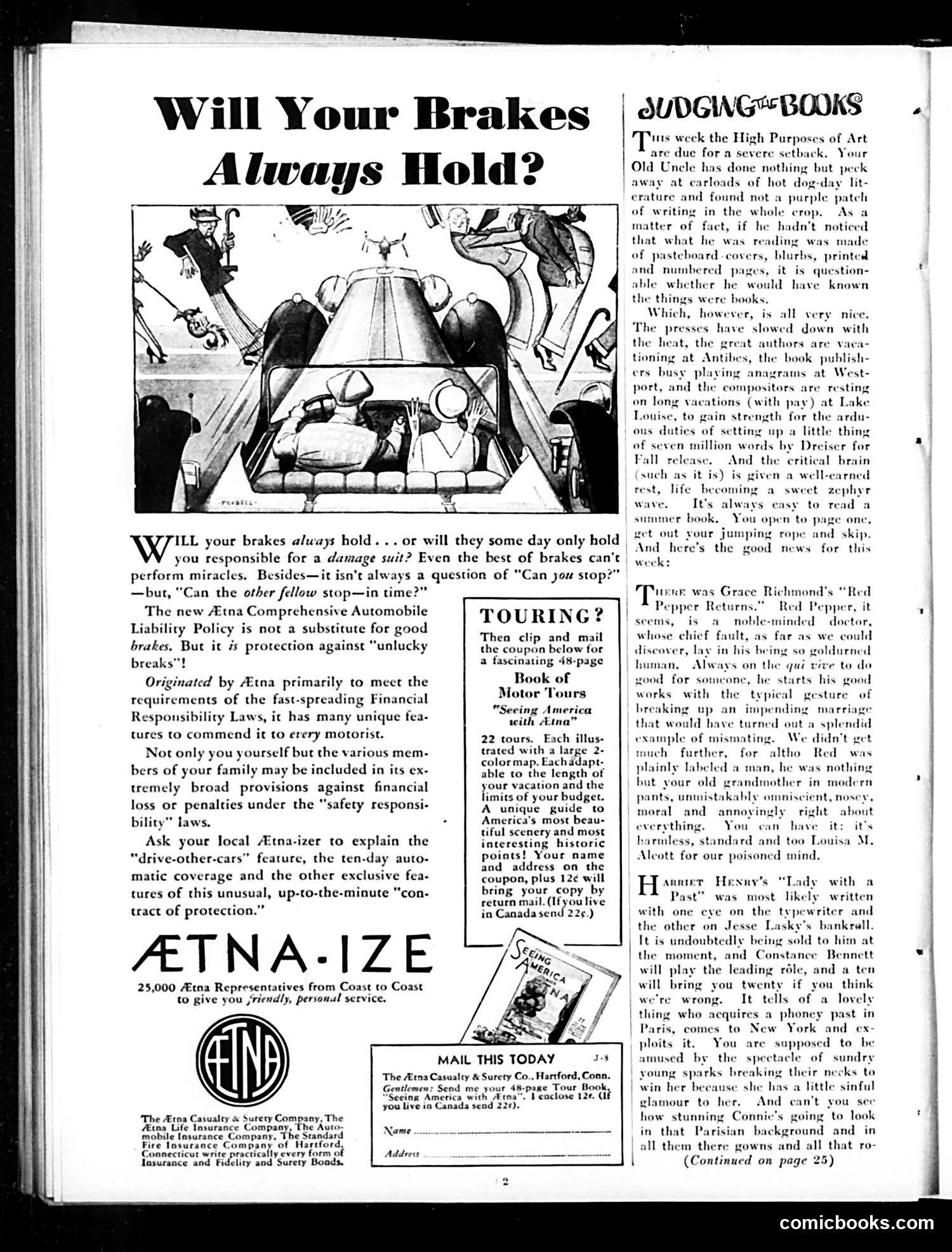
# Analysis of Judge Magazine Page This page is primarily **advertising-driven**, featuring an Aetna Insurance advertisement for automobile liability coverage. The large cartoon depicts a dramatic car accident with passengers being thrown from a vehicle, illustrating the advertisement's message about brake failure and financial liability risks. The satire is implicit rather than explicit: the ad uses fear-based messaging about whether brakes will "always hold," positioning Aetna's "Comprehensive Automobile Liability Policy" as protection against unexpected accidents and lawsuits. The right column contains book reviews under "Judging the Books," offering literary commentary unrelated to the insurance messaging. **Context for modern readers:** This reflects early-20th-century concerns about automobile safety and the emerging need for liability insurance as cars became widespread.
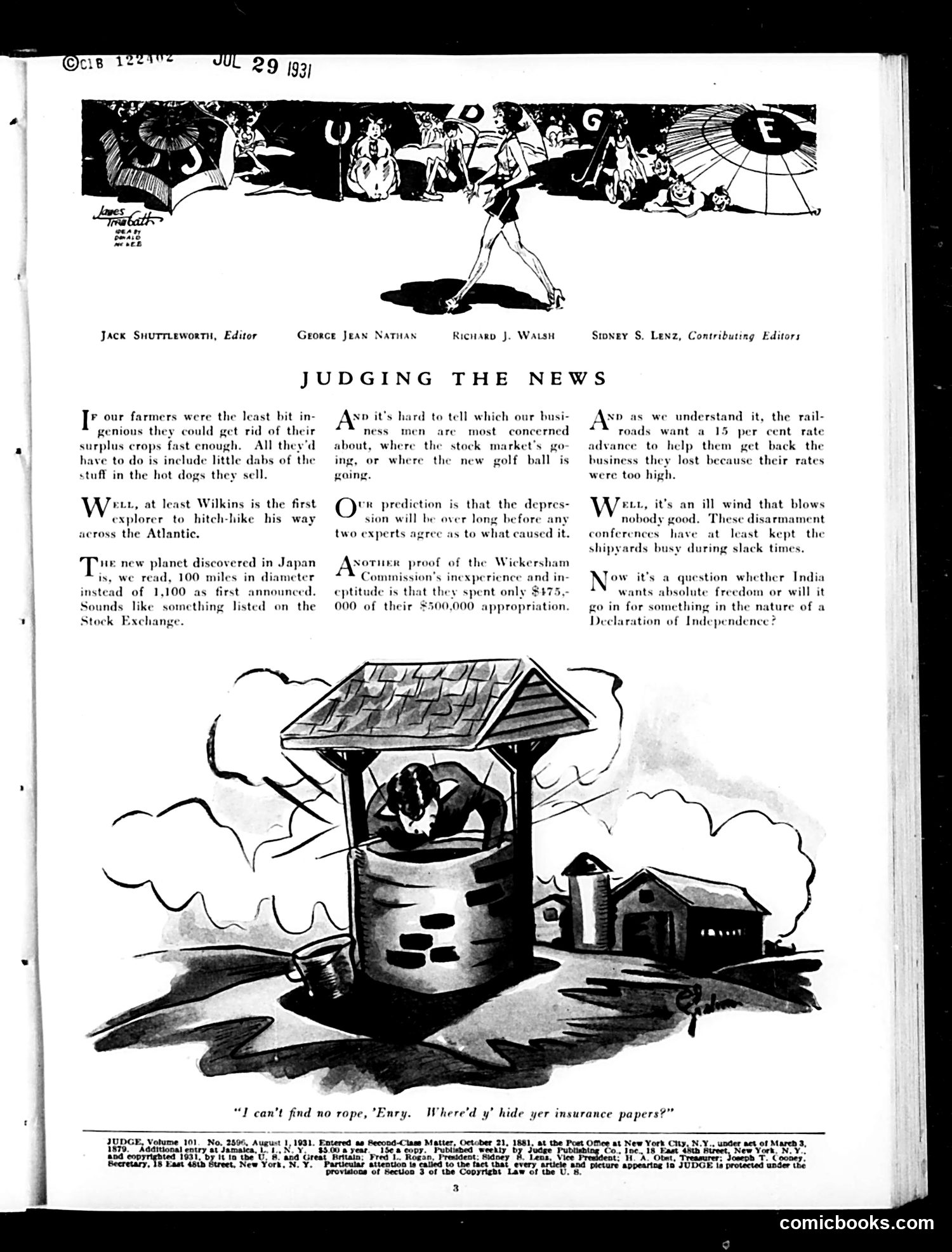
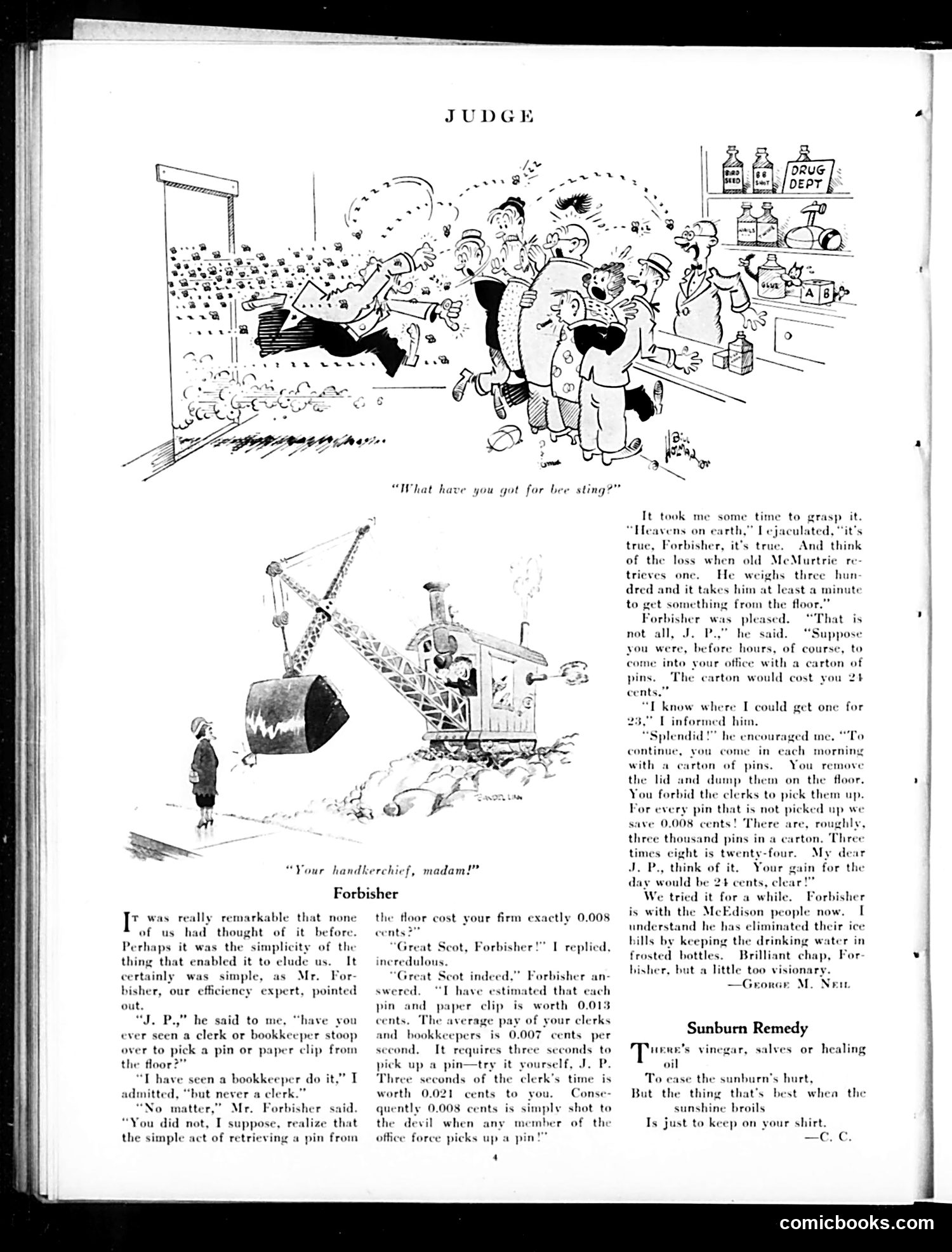
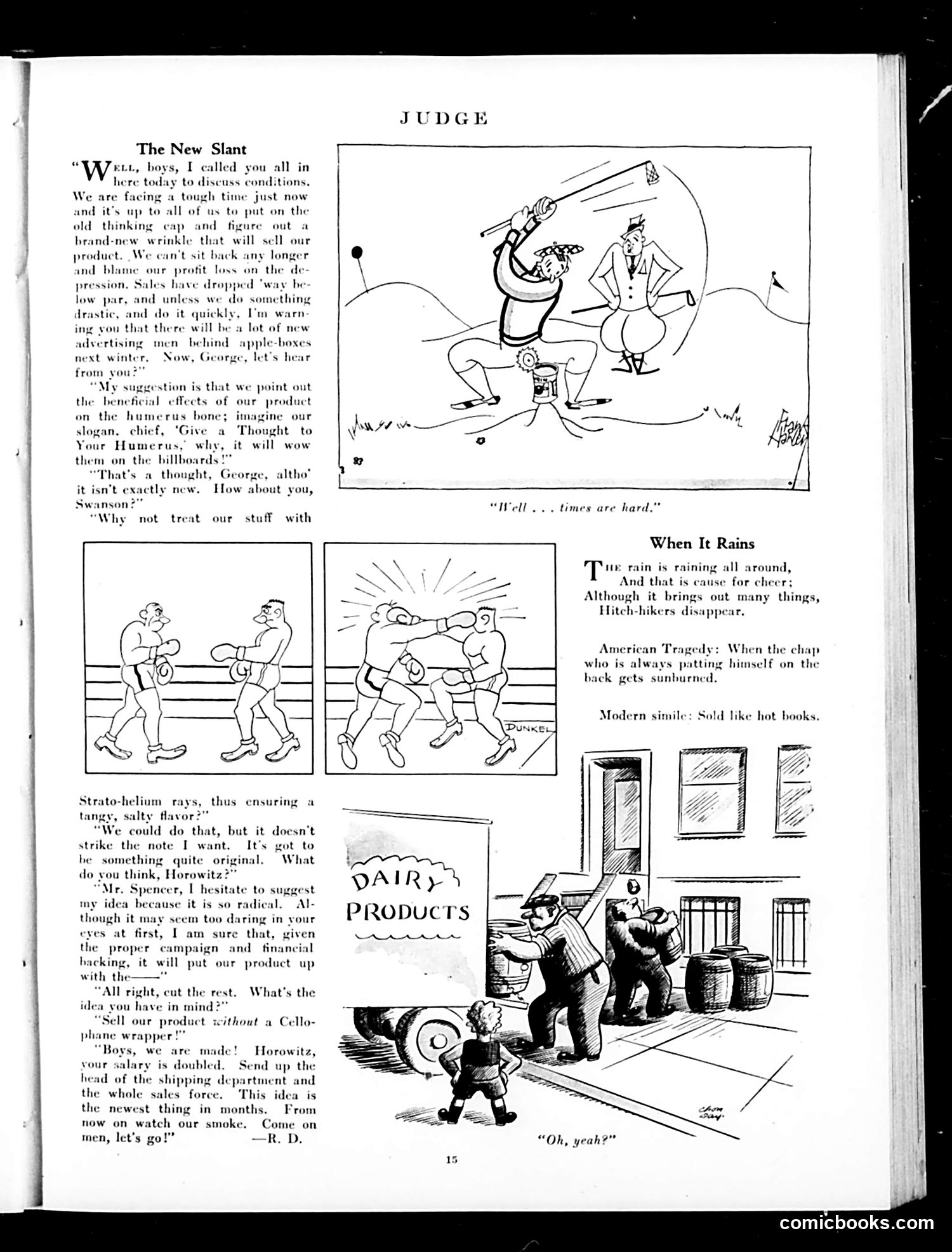
# Explanation for Modern Readers The top cartoon satirizes workplace efficiency obsession. A judge observes someone being violently expelled from a drug store, captioned "What have you got for lice sting?" The accompanying story "Forbisher" mocks a boss's obsessive cost-cutting: calculating that retrieving dropped pins saves money (0.008 cents per pin). The satire targets early 20th-century industrial "scientific management" crazes, where employers nitpicked trivial savings while creating absurd workplace policies. The lower cartoon shows someone holding a large handkerchief, captioned "Your handkerchief, madam!" The bottom feature, "Sunburn Remedy," offers folk advice about treating sunburn with vinegar and staying indoors—light humor about summer complaints. The page satirizes American business culture's extreme cost-consciousness and managerial fads of the era.
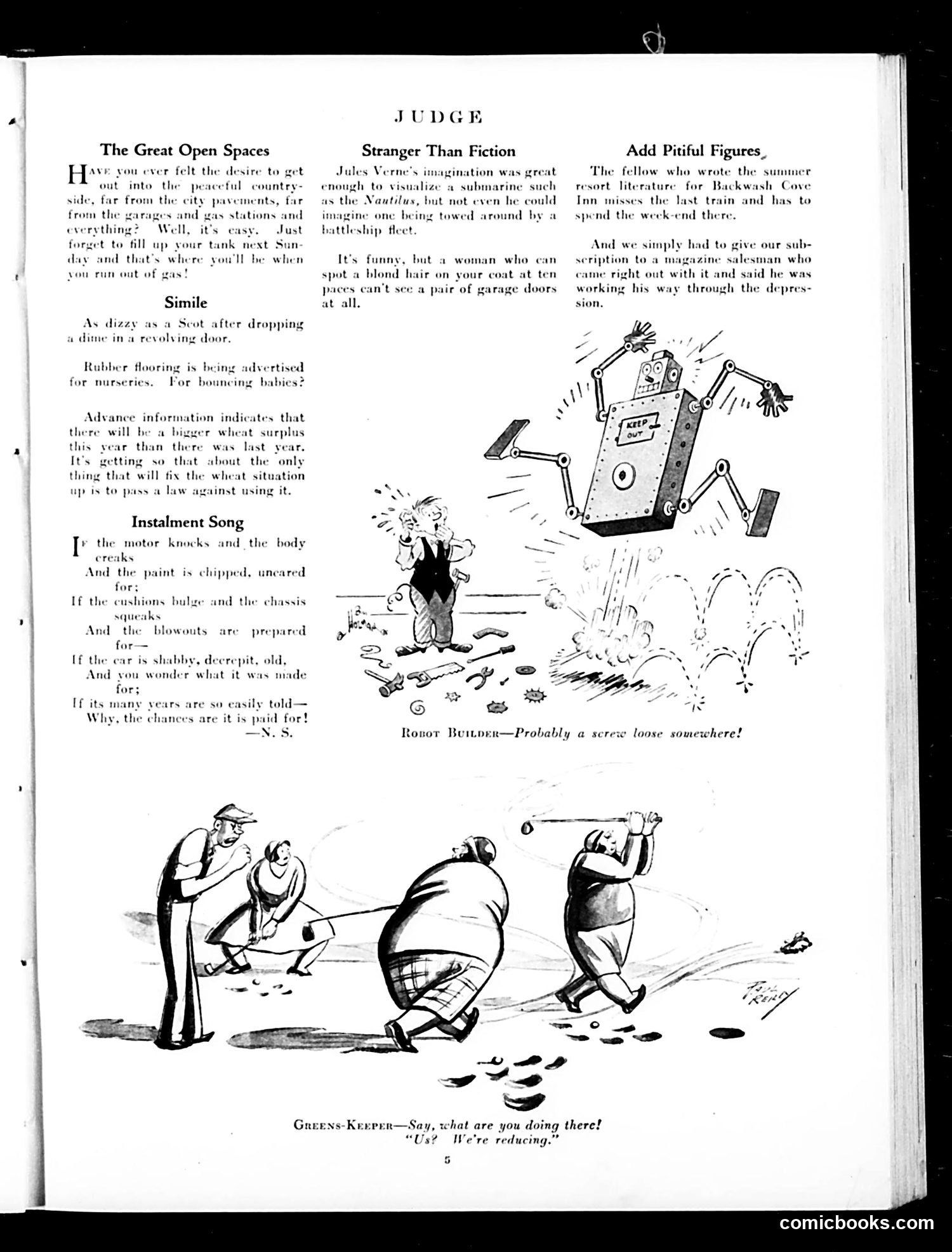
# Judge Magazine Page Analysis This page contains three separate humor pieces: 1. **"The Great Open Spaces"** - A brief joke about running out of gas on a Sunday drive in the countryside. 2. **"Instalment Song"** - A poem by N.S. mocking the poor condition of cars purchased on installment plans, with worn motors, cracked bodies, and unreliable chassis. This satirizes both automobile quality and the economic practice of installment buying, likely reflecting Depression-era concerns about consumer debt. 3. **Two cartoons**: The "Robot Builder" shows mechanical chaos; the "Greens-Keeper" depicts golfers apparently reducing the course's grass to bare ground—likely satirizing either over-maintenance or careless play. The content reflects early-to-mid 20th-century concerns: automobile reliability, installment purchasing, and leisure activities.
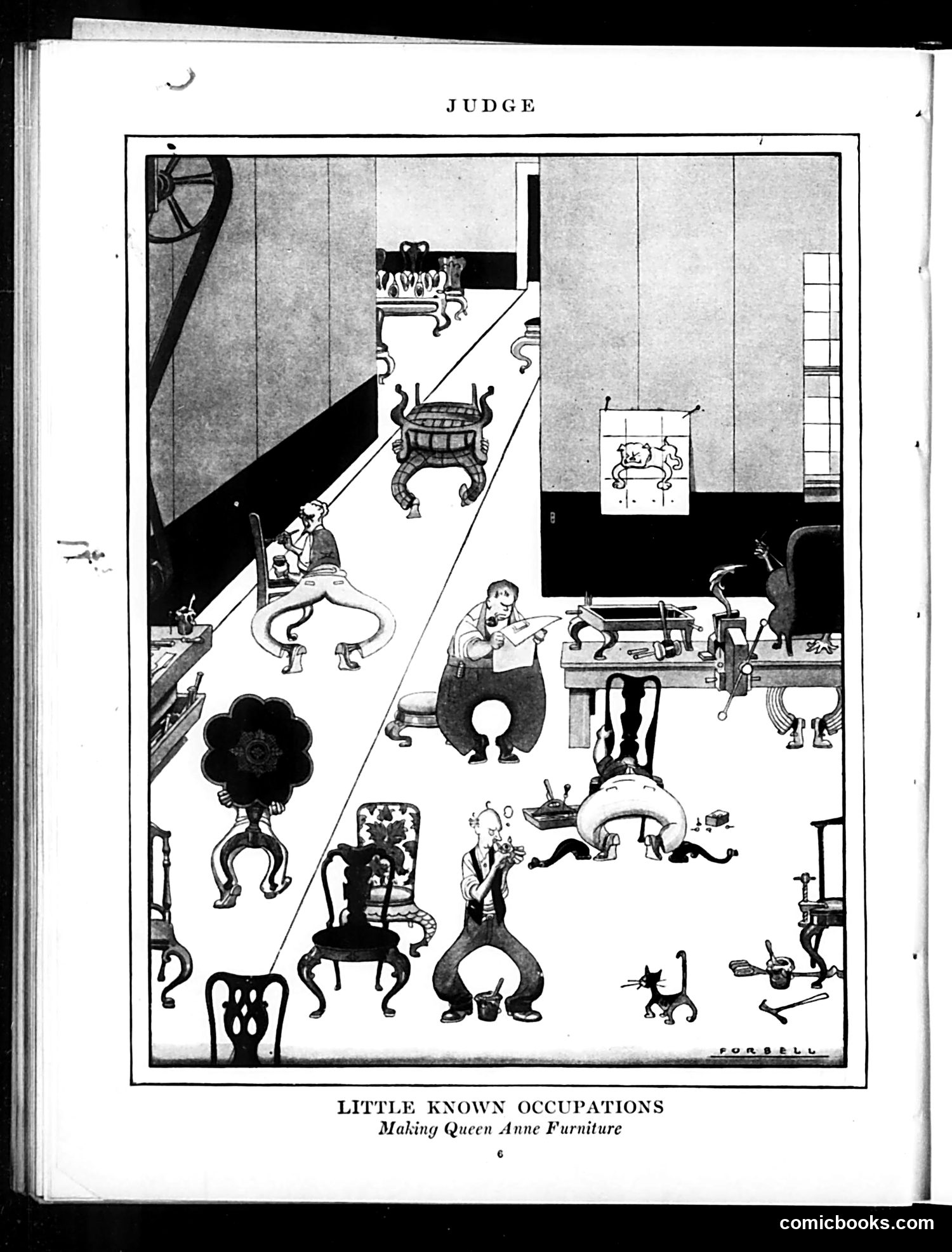
# Explanation for Modern Readers This cartoon satirizes the furniture-making industry through the title "Making Queen Anne Furniture." The scene depicts a chaotic workshop where various grotesque, contorted human figures are themselves being used as furniture—serving as chairs, tables, and other pieces. The satire appears to critique exploitative labor practices in furniture manufacturing, suggesting workers are treated as mere objects or raw materials rather than people. The exaggerated, impossible body positions humorously illustrate the physical toll and dehumanization of factory work during the early 20th century. The "Queen Anne" style reference (an elegant furniture aesthetic) contrasts sharply with the grotesque scene, amplifying the joke: fine furniture supposedly comes from treating workers like disposable components. The signature indicates this was created by Forbell, a Judge magazine artist.
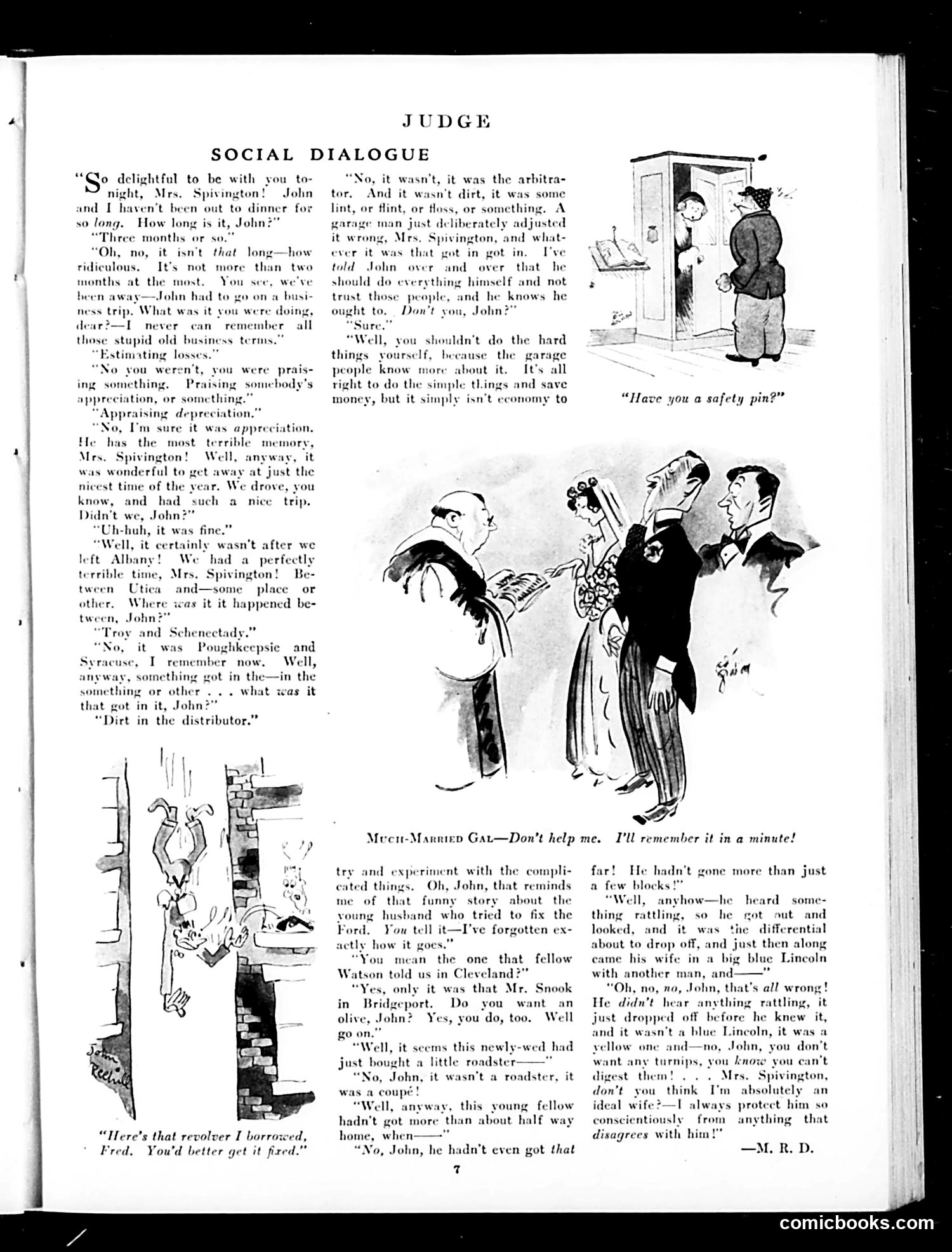
# Judge Magazine Social Dialogue Cartoon This is a humorous domestic scene satirizing married couples' dinner conversations. Two couples (the Spivingtons and another pair) attempt to share anecdotes, but repeatedly interrupt and "correct" each other on trivial details—locations, car types, mechanical terms—while fundamentally agreeing on nothing. The satire targets: 1. **Marital dynamics**: The wife constantly corrects her husband's memory and details, claiming she's "protecting" him while actually dominating the conversation. 2. **Social pretension**: The characters discuss "appreciating depreciation" and other business jargon they barely understand. 3. **1920s automobile culture**: The failed attempt to tell a story about a young husband fixing a Ford—a vehicle associated with ordinary people—becomes bogged down in contradictions about whether it was a roadster or coupe. The final caption reveals the joke: Mrs. Spivington's "corrections" aren't helpful—they're controlling behavior dressed as wifely devotion. The satire mocks both the mundane nature of such conversations and the power dynamics within marriage.
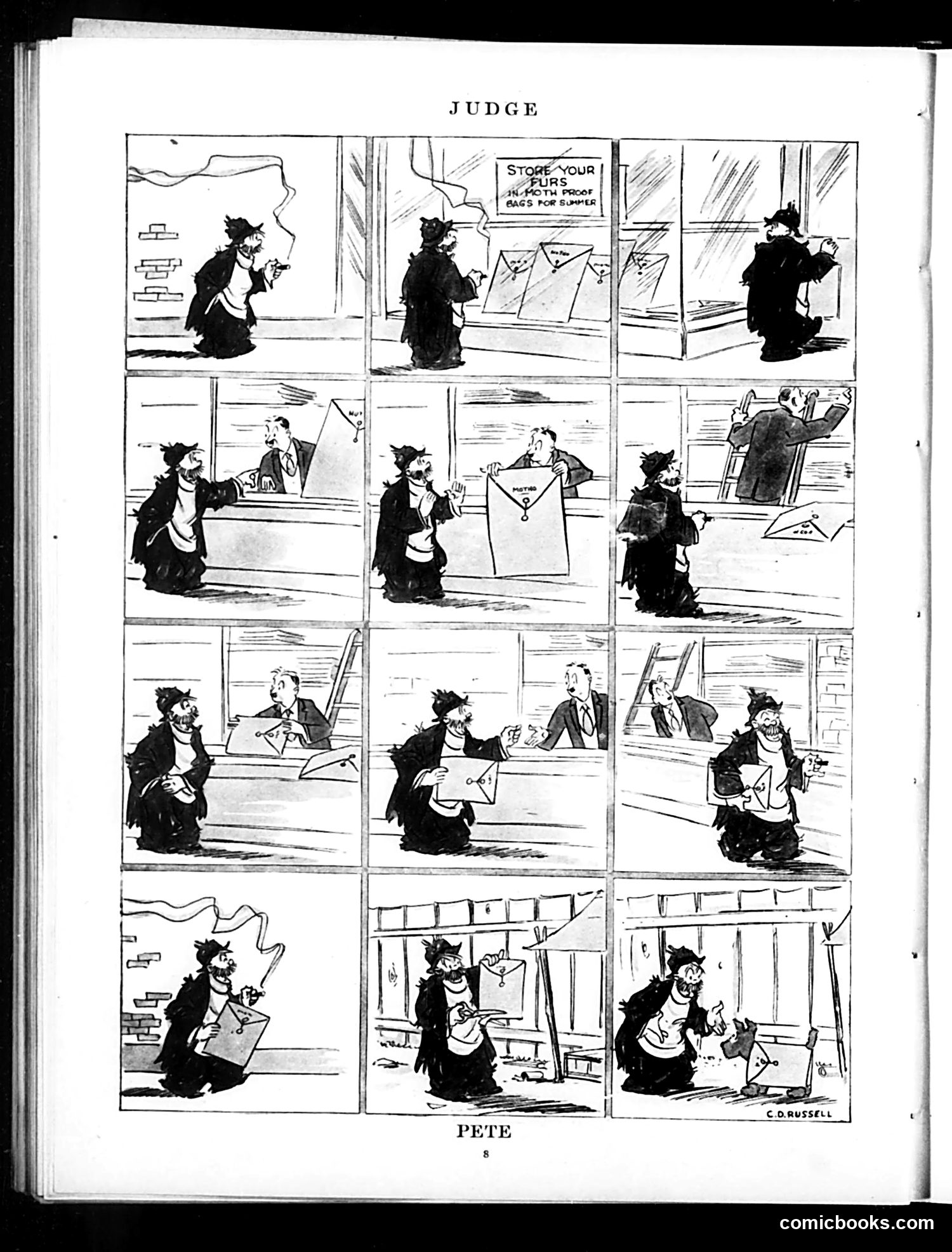
# Analysis This is a comic strip titled "Judge" and "Pete" (credited to C.D. Russell) depicting a character repeatedly attempting to store furs and winter clothing for summer. The strip shows Pete visiting what appears to be a storage facility or business, presenting garments to be stored, and then retrieving them—with the joke escalating through repeated panels showing increasingly frantic or comedic interactions. The satire targets the seasonal storage industry and likely the expense or inconvenience of such services. The sign in the top panel reading "STORE YOUR FURS AND WINTER RAGS FOR SUMMER" suggests this mocks commercial practices of convincing consumers to pay for storage solutions. The humor derives from Pete's persistent efforts and the business's responses across multiple visits.
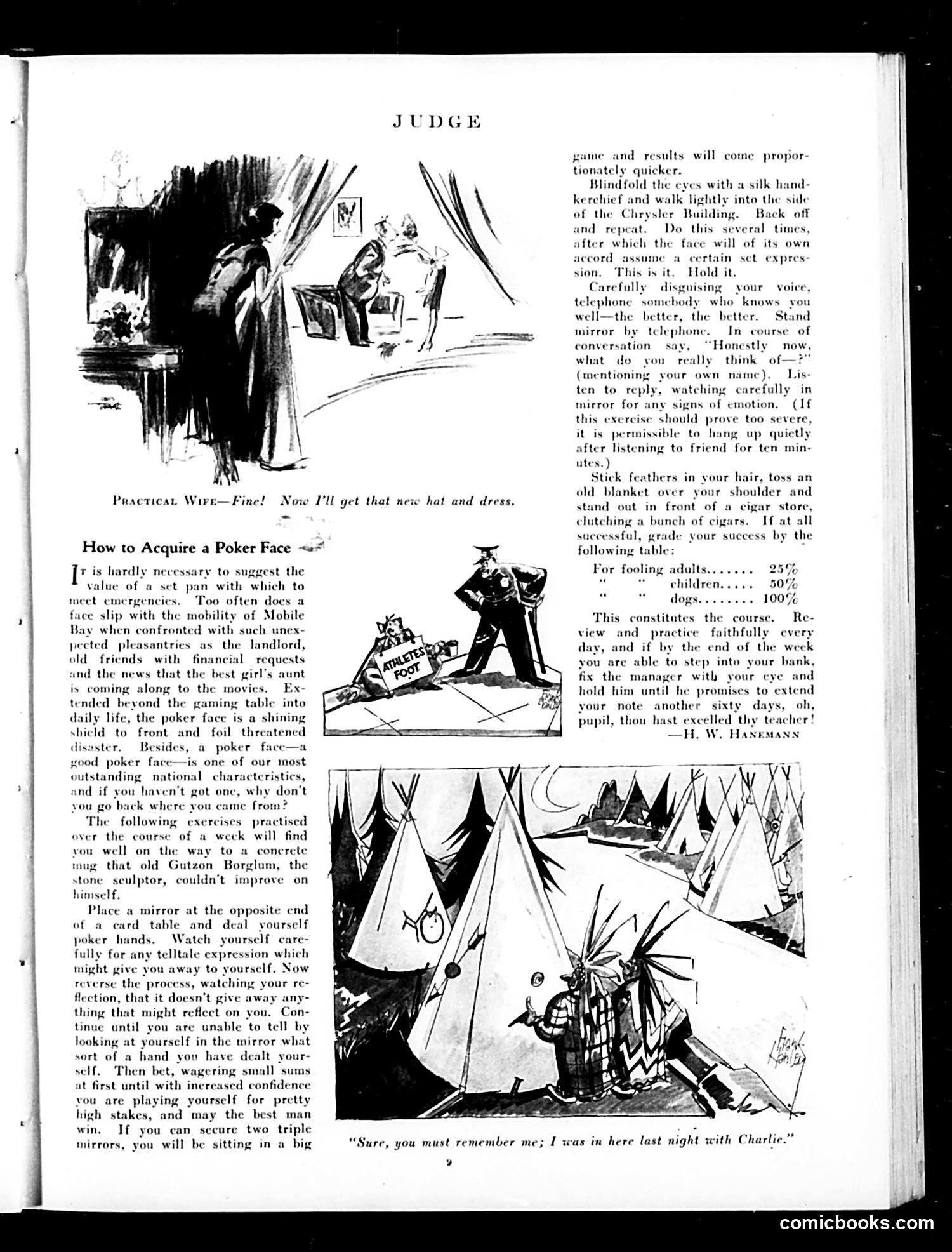
# Judge Magazine Satire Analysis This page satirizes American masculine stoicism and emotional repression through absurdist humor. The main article, "How to Acquire a Poker Face," mocks the cultural ideal of the impassive, unreadable man—presented as a quintessential "outstanding national characteristic." The satire works by taking this social expectation to ridiculous extremes: practicing poker expressions in mirrors, walking blindfolded into buildings, disguising your voice to friends, and dressing as a Native American in front of cigar stores. The humor lies in treating emotional suppression as a learnable skill requiring systematic training, like developing a poker hand. The opening cartoon shows a "practical wife" announcing she'll acquire "that new hat and dress"—a domestic scene suggesting women's consumer desires contrasted with masculine restraint. The bottom cartoon depicts a camping scene with the caption about remembering "Charlie"—likely implying infidelity or compromising situations that a proper "poker face" would conceal. The underlying satire critiques American masculinity's demand for emotional opacity in both business (the banker scene) and personal life.
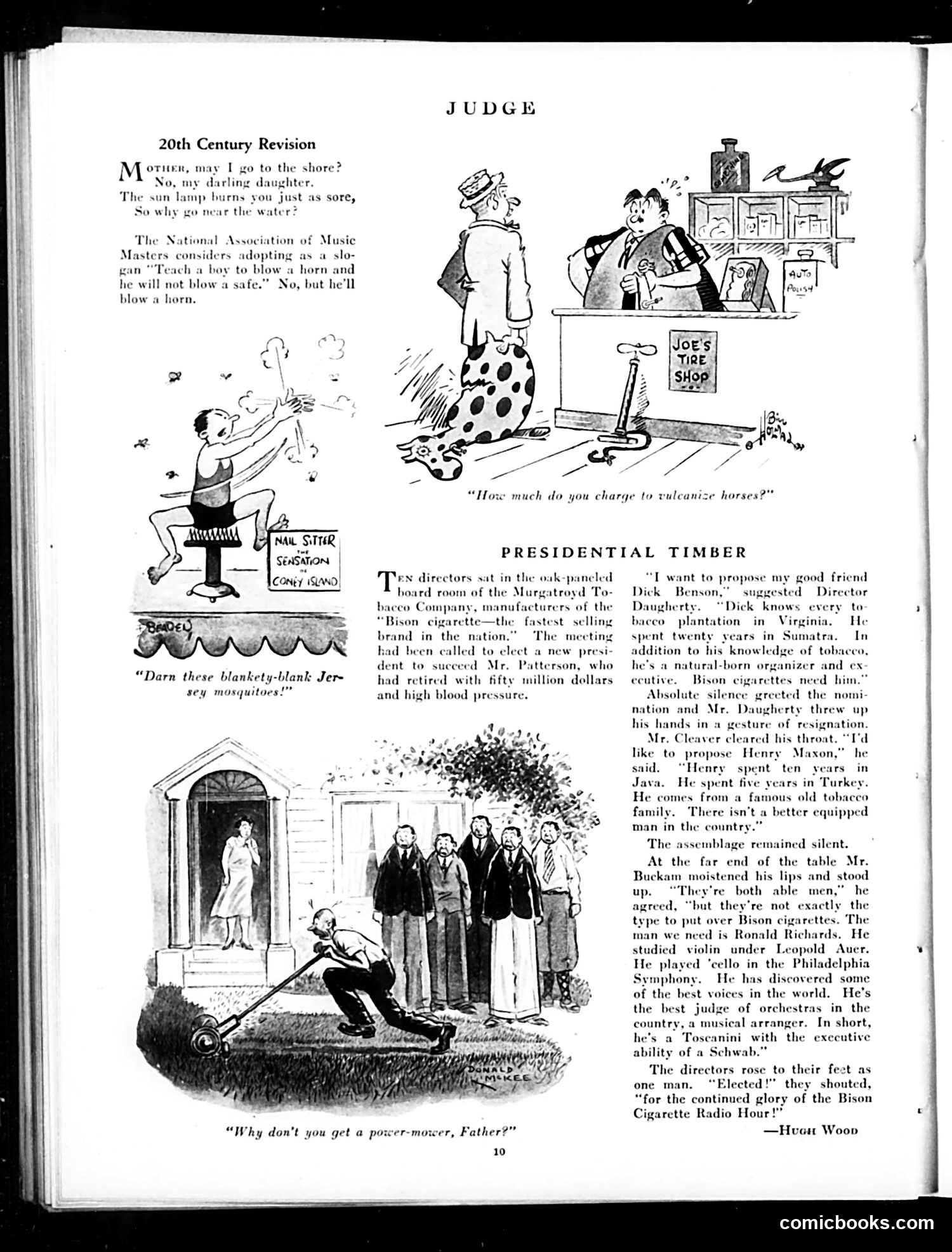
# Explanation for Modern Readers This page contains three satirical pieces from *Judge* magazine: **Top cartoons**: Light social humor about sunlamps (newly fashionable), horn safety, and horse vulcanization—absurdist jokes with no deep political meaning. **"Presidential Timber"**: The main satire mocks corporate cigarette marketing. Tobacco executives at Murgatroyd Company debate selecting a new president. They reject experienced tobacco men (Benson, Maxon) in favor of Ronald Richards—chosen solely because he's a classical musician and conductor with no tobacco expertise. **The joke**: This ridicules how corporations make foolish hiring decisions based on superficial qualities rather than actual qualifications. It also satirizes cigarette advertising's manipulation—suggesting a famous musician lends cultural prestige to an inherently dubious product. The irony is that a Toscanini-like figure somehow qualifies to lead a tobacco company, exposing the absurdity of modern advertising and executive recruitment.