
Judge, 1931-08-01 · page 24 of 36
Judge — August 1, 1931 — page 24: what you’re looking at
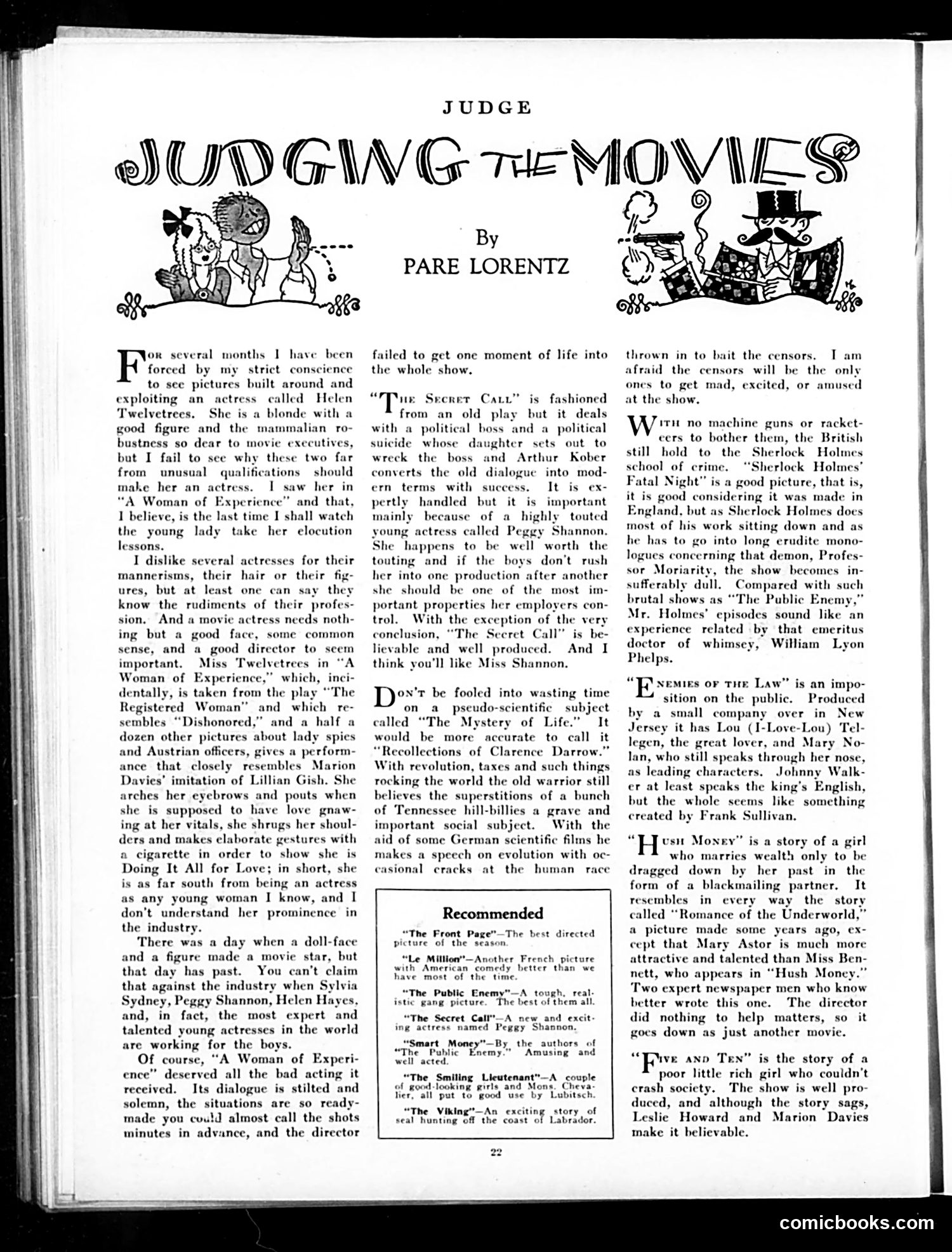
A restored page from Judge, 1931-08-01. Page through the whole issue in the reader above.
📄 Transcribed text from this page (OCR, searchable)
Machine-transcribed from the original scan — historical spelling and the odd misread are preserved.
JUVGIWG TEM or several months I have been Freee by my. strict conscienc to see pictures built around and exploiting an actress called Helen Twelvetrees. She is a blonde with a good figure and the mammalian ro- bustness so dear to movie executive: but I fail to see why these two far from unu: 2 ions should make her w her in “A Woman of Experience” and that, 1 believe, is the last time I shall watch the young lady take her elocution lessons. I dislike several actresses for their mannerisms, their hair or their fi ures, but at least one can say they know the rudiments of their profe sion. And a movie actress needs noth- ing but a good face, some common sense, and a good director to seem important. Miss Twelvetrees in “A Woman of Experience,” which, inci- dentally, is taken from the play “The Registered Woman" and which re- sembles “Dishonored,” and a half a dozen other pictures about lady spies and Austrian officers, gives a perform- ance that closely rese I es’ imitation of L arches her eyebrows and pouts wh she is supposed to have love gnaw- ing at her vitals, she shrugs her shoul- ders and makes elaborate gestures with a cigarette in order to show she is Doing It All for Love; in short, she is as far south from being an actress as any young woman I know, and | don’t understand her prominence in the industry. There was a day when a doll-face and a figure made a movie star, but that day has past. You can’t claim that against the industry when Sylvia Sydney, Peggy Shannon, Helen Hayes, and, in fact, the most expert and talented young actresses in the world are working for the boys. Of course, “A Woman of Experi- ence” deserved all the bad acting it received. Its dialogue is stilted and solemn, the situations are so ready- made you cuuld almost call the shots minutes in advance, and the director JUDGE By PARE LORENTZ failed to get one moment of life into the whole show. “Tu Secret Cari” is fashioned from an old play but it deals with a political boss and a_ political suicide whose daughter sets out to wreck the boss and Arthur Kober converts the old dialogue into mod- ern terms with success. It is ex- pertly handled but it is important mainly because of a highly touted young actress called Peggy Shannon. She happens to be well’ worth the touting and if the boys don't rush her into one production after another she should be one of the most im- portant properties her employers con- trol. With the exception of the very conclusion, “The Secret Call” is be- lievable and well produced. And I think you'll like Miss Shannon. D°" be fooled into wasting time on a pseudo-scientifie subject called “The Mystery of Life.” It would be more accurate to call i “Recollections of Clarence Darrow. With revolution, taxes and such things rocking the world the old warrior still believes the superstitions of a bunch of Tennessee hill-billies a grave a important social subject. With the aid of some German scientific films he makes a speech on evolution with oc- casional cracks at the human race Recommended “The Front Page”—The best directed picture of the season. “Le Million"—Another French picture with American comedy better than we have most of the time. “The Public Enemy"—A tough, real- istic gang picture. The best of them all. “The Secret Call"—A new and excit ing actress named Peggy Shannon. “Smart Money"—By the authors of “The Public Enemy.” Amusing and well acted. “The Smiling Licutenant"—A couple of good-looking girls and Mons. Cheva- lier, all put to good use by Lubitsch “The Viking"—An exciting story of seal hunting off the coast of Labrador. OV I Si thrown in to bait the censors. Ta afraid the censors will be th ones to get mad, excited, or 4 at the show, ITH no machine guns or racket- cers to bother them, the British still hold to the Sherlock Holmes school of crime. “Sherlock Holmes’ al Night” is a good picture, that is, it is good considering it was made in England, but as Sherlock Holmes does most of his work sitting down and as he has to go into long erudite mono- logues concerning that demon, Profes- sor Moriarity, the show becomes in- sufferably dull. Compared with such brutal shows a he Public Enemy,” Mr. Holmes’ episodes sound like an experience related by that emeritus doctor of whimsey, William Lyon Phelps. “Fe sears ov sae Law” is an impo- sition on the public. Produced by a small company over in New Jersey it has Lou (I-Love-Lou) Tel- legen, the great lover, and Mary No- lan, who still speaks through her nose, as leading characters. Johnny Walk- er at least speaks the king’s English, but the whole seems like something created by Frank Sullivan. “He Money” is a story of a girl who marries wealth only to be dragged down by her past in the form of a blackmailing partner, It resembles in every way the story called “Romance of the Underworld a picture made some years ago, ex- cept that Mary Astor is much more attractive and talented than Miss Ben- nett, who appears in “Hush Money. Two expert newspaper men who know better wrote this one. The director did nothing to help matters, so it gocs down as just another movie. “Tver ann T is the story of a poor little rich girl who couldn't crash society. The show is well pro- duced, and although the story sags, Leslie Howard and Marion Davies make it believable. comicbooks.com